
Standard oem material options are the least documented part of our published range, and the reason is structural rather than careless. Every specification row we carry names a behaviour or a number — a cell capacity, a runtime, a charge time, a charging interface, a camera resolution class, a case capacity — and not one of them identifies what a part is made of: no frame composition, no temple polymer, no lens substrate, no hinge material and no surface finish. That is not a gap that a pleasant supplier conversation closes; it is the outer edge of what a product catalogue can carry. A buyer who arrives with a material request therefore arrives with a question our published rows cannot answer, and the useful work is deciding what that request should have been asking for.
This page is written for the person who carries the consequence of the decision: a product manager, a sourcing lead or a channel buyer who has a material requirement in a spreadsheet and needs to turn it into something a supplier can quote against and a factory can build to. It does three things. It sets out what the published record actually contains for the physical parts of this range. It works through the places where a material request collides with a published row, because most of the disappointment in this category comes from that collision rather than from a refusal. And it gives the structure of a written material specification that can survive the first production batch.
What you will not find here is a list of material choices. Our catalogue does not carry one, and the temptation to supply one from general knowledge about eyewear is exactly the error this page is built to prevent.
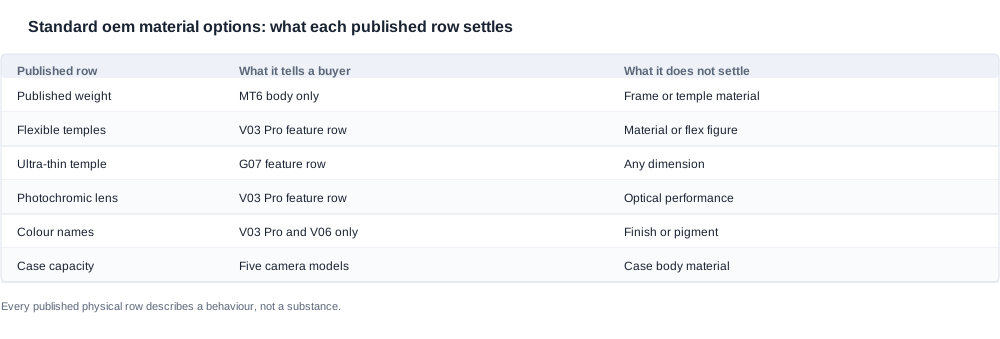
The table is the argument of this page in one frame. Every row we publish about a physical part describes something the part does, not something it is made of. A buyer reading down the third column will find, repeatedly, that the answer to "what is it made of" is not the answer to any question we have published.
Material choices and where the published specification ends
Our catalogue carries twenty-eight entries arranged in seven groups: eleven camera models, eight audio models, three sport models, three children's models in the A05, A06 and A07 line, and three entries published without a model code — the AR glasses entry, the electrochromic entry and the bone-conduction entry. Between them, these pages publish a lot. They publish cell configurations from 40 mAh on the A05 and the A06 through to 290 mAh on four camera models, among them the L2 Utral and the CY03, and the CY05 and the L1 Pro. They publish runtimes from about six hours on the G07 and the YK12 up to about twenty hours on the three children's models. They publish a charge time of two hours or less on twenty-six of the twenty-eight entries and about one hour on the D17 and the ZH12. They publish a magnetic charging method on seventeen entries, a Type-C interface on seven, and for four camera models nothing at all is printed about the method.
They also publish a handful of physical rows, and these are the ones that matter for a material conversation. The V03 Pro carries a feature row for flexible temples and a separate row for a photochromic lens. The G07 carries a row combining an ultra-thin temple with a detachable one. The V06 and the S7 carry a row for a removable inner frame, an ergonomic design row, and an ingress marking of IP54. The MT6 carries a row for portability, a row for a weight of 158 g, and a row for a folding charging case. The V03 Pro publishes three colour names; the V06 publishes four. The D17 and the ZH12 carry a remote shutter row. The A05 and the A06 publish a fogging unit together with posture-and-distance prompt rows and lens clarity and lens fogging rows. The AR entry publishes an indicator light and a button control. The bone-conduction entry carries an amplification gain of 35 dB.
Read that list again with a materials question in mind. A flexible temple is a behaviour. An ultra-thin temple is a dimension. A photochromic lens is a category of function. A removable inner frame is a fact about how the product separates. A weight of 158 g is a measurement. A colour name is a name. Not one of them is a material.
That is where the published specification ends, and the boundary is worth stating precisely because a buyer can waste a fortnight looking for a row that does not exist. There is no frame composition row anywhere in the range. There is no temple material row. There is no lens substrate row, no lens coating row, no hinge material row, no surface finish row, no ingress material row. One weight is published, and it belongs to the MT6 alone: 158 g for the glasses body, the cell and the camera counted and the folding case left out, whose own weight is not printed.
The consequence for a sourcing team is specific. A material requirement is, in catalogue terms, an unpublished item, and an unpublished item is not a refusal and not a permission. It is a question that has to be asked, in writing, against a named configuration, and answered in writing before it can be costed, scheduled or judged.

The conflict between a material request and a catalogue row
Most of the friction in a materials conversation does not come from a supplier declining a request. It comes from a buyer discovering that a published row they were relying on settles a different question from the one they asked. There are six such collisions in this range, and they are worth taking one at a time, because each of them has a different correct response.
The first collision is the weight. A buyer asking for the lightest possible unit has exactly one published anchor in the whole range, and it is the MT6 at 158 g for the body. That figure is real and it is specific, and it excludes the folding charging case whose capacity is given as 1200 mAh while the case's own weight is not printed at all. So the "lightweight" request cannot be answered by comparing models, because twenty-seven of the twenty-eight entries have no weight row, and it cannot even be answered fully for the one model that does, because the number describes the glasses and not the package a shopper lifts. A buyer who writes "158 g" into a specification as the weight of the product is writing something our catalogue does not say.
The second collision is flexibility. The V03 Pro publishes flexible temples as a feature row. A buyer who reads that as a material statement has already made an assumption the catalogue does not support: no polymer is named, no flex figure is given, no test method is stated, and no other entry in the range publishes a flexibility row at all. The correct question is not "what is the temple made of" but "flexible by what measure, against what load, for how many cycles" — and the answer to that is a written specification from the supplier, not a catalogue lookup.
The third collision is the ultra-thin temple on the G07. Ultra-thin is a dimension, and the range publishes no dimension for any entry: no frame size, no lens width, no bridge measurement, no temple length. What the G07 does publish is the thin temple row together with a detachable temple, alongside a 55 mAh × 2 cell configuration, a runtime of about six hours and a magnetic charging method. If a buyer needs the temple to be thin for a reason — a form factor, a fit target, a packaging envelope — that reason has to be stated as a measurable dimension and then checked against a physical unit, because nothing in the published record will settle it.
The fourth collision is the lens. Two locations in the catalogue carry a photochromic reference: the V03 Pro, whose product name does not include the word and whose feature rows do include a photochromic lens row, and the separate electrochromic entry published without a model code. Neither location states a substrate, a transmission figure, a response speed, a wavelength range or a tint depth. The electrochromic entry publishes a 100 mAh cell, a runtime of about seven hours, a charge time of two hours or less, a magnetic charging method and Bluetooth 5.4 — and nothing at all about the optical performance. A buyer who requests "photochromic lenses" is therefore specifying a behaviour with no published criterion attached to it, and the internal record for that category carries no optical performance parameter to draw on either. The only honest reading is that the request needs a measurement attached before it can be judged.
The fifth collision is colour. Two entries publish colour names and twenty-six publish none. The V03 Pro lists orange, off-white and black; the V06 lists orange, white ice blue, black and black ice blue. A colour name is not a material: it tells a buyer nothing about the pigment, the finish, the texture or the coating, and two entries publishing the same colour word are not thereby the same colour. A programme that needs a specific appearance across four or five SKUs is asking for something our published rows cannot anchor at all.
The sixth collision is the charging case, and it is the one where buyers most often assume a published figure answers a question it does not. The camera models sit in three published states and no more. Five of them carry a case capacity: the CY05, the CY03 and the L1 Pro — each at 1400 mAh, the L2 Utral at 900/1400 mAh printed in a single row without stating which of its two published variant names corresponds to which capacity, and the MT6 with a 1200 mAh folding case. Two of them, the KY06 and the MT5, publish a case with no figure against it. Four camera entries — the V03 and the V06, and the V03 Pro and the S7 — carry no case row at all. For those four, whether a case belongs to the configuration is an open question to put to the supplier, not a published fact to state in either direction. A material request about the case body has to start by establishing whether a case is in scope.
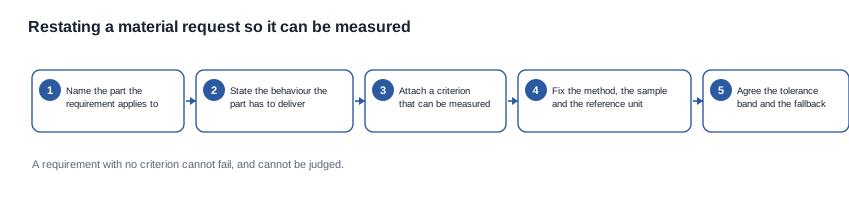
The flow above is the shortest path out of all six collisions. A material request becomes workable when it is restated as a behaviour, then given a criterion that somebody can measure, then given a method and a sample, and finally given an explicit answer to what happens if the criterion cannot be met. A request that stays at the level of a material name cannot be quoted, cannot be scheduled and cannot be judged at incoming inspection, because nothing in it can fail. The red flags are easy to name in advance: a request with no part, no behaviour and no criterion.

Which material questions a buyer can answer before sampling
Not every material question has to wait for a physical unit, and the buyer who knows which ones do is ahead of the buyer who sends everything to the factory at once. The published record resolves a specific set of questions outright.
For a shortlisted entry, the published record will tell you whether it publishes a weight at all, and for the MT6 what that weight covers. It will tell you whether colour names exist for that model, and if so how many were published. It will tell you whether the entry publishes a removable part — the V06 and the S7 publish a removable inner frame, the G07 publishes a detachable temple, and no other entry publishes either. It will tell you the camera resolution class for any of the eleven camera models, which is eight megapixels for eight of them and thirteen megapixels for three, and it will tell you the charging method where one is printed, magnetic on seventeen entries and Type-C on seven, with four camera models carrying no charging method row at all. It will tell you whether a case is in the configuration and in which of the three published states it sits. It will tell you which entries publish an ingress marking, which is only the V06 and the S7, and even there the annotation carries no third-party report number, so it cannot be restated externally without a test report behind it.
Those are real answers, and each one removes a branch from a shortlist you can build before you order.
Everything else about the physical product is a question to ask rather than a fact to look up. No entry in the range carries a certification line, and the catalogue text names none of CE, FCC or RoHS. The export page is company artwork rather than a per-model compliance record: ten patent certificates, none of which can be transferred as a model's conformity. The structure of a market-access file is normally set by two instruments, the Radio Equipment Directive (EU) 2014/53/EU and the EMC Directive (EU) 2014/32/EU, and neither of them states an outcome for any entry in this range.
So a sensible pre-sampling pass for a buyer is short, and the criteria it has to satisfy are simple. Take each shortlisted model and ask three questions in writing. What physical properties are being relied on, stated as measurable criteria rather than as material names. Which of those criteria can be checked on a sample unit, and which need a batch, a test report or a certificate that only the supplier can produce. And what the accepted tolerance is, so that the answer is a pass or a fail rather than an opinion.
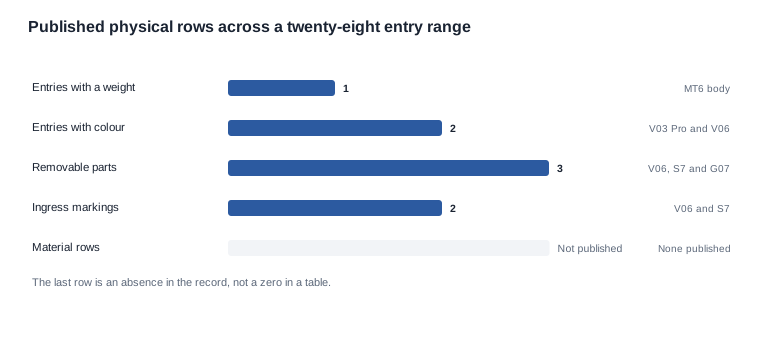
The chart counts the physical rows the range publishes. It is a short chart because the honest answer is short. One entry publishes a weight. Two publish colour names. Three publish a removable part. Two publish an ingress marking. No entry publishes a material, and that last row is published as an explicit absence rather than as a zero, because the catalogue does not record a number there — it records nothing.
The practical use of that chart is not the counting. It is the contrast. When a buyer can say "the range publishes three removable parts and one weight, and no material rows anywhere", the supplier conversation starts from a shared and accurate baseline instead of from two different documents, and the difference in what the two sides believe to be established gets closed before a price is asked for rather than after a number has been sent.
What has to go into a written material specification
A material requirement becomes quotable when it is written as a specification rather than as a wish, and there are three tests for whether it has been written well: how to evaluate it, what to ask for it, and who owns each field. The structure below is nine fields, and every one of them exists because a well-specified programme has had to answer it at some point.
The first field is the part. Not "the frame" but the front assembly, the temple, the lens, the hinge, the case body — named individually, because the parts in this category are made by different routes and a specification that refers to the product as a whole cannot be routed to the right place.
The second field is the behaviour the part has to deliver. This is where the flexible temple row and the ultra-thin temple row belong, restated as an outcome the part must produce rather than as a substance it must contain.
The third field is the criterion that proves the behaviour. A number, a range, a pass mark or a named test method — something with a unit attached. If no unit can be attached, the field stays empty and that is visible, which is more useful than a criterion that sounds precise and measures nothing.
The fourth field is the measurement method and its conditions. Who measures, with what equipment, under what conditions, and how many units are measured. A criterion without a method is an opinion with a unit attached.
The fifth field is the reference unit. The signed sample against which subsequent units are compared. This is the artefact that turns a verbal agreement into something two parties can both point at, and it is the single most commonly missing item in a materials conversation.
The sixth field is the tolerance band. How far from the reference a production unit may sit and still be accepted. A programme that has a reference but no band has an arbitration problem scheduled for the first batch.
The seventh field is the environment the criterion must survive. Handling, storage, transport and the wearing conditions the product is sold into all affect material performance, and the conditions are usually the part of the requirement nobody wrote.
The eighth field is re-order reproducibility. Whether a later order at the same specification is expected to match the first, and if so what evidence carries that expectation — a batch record, a reference sample, a material designation held in the supplier's own records. This field is what determines whether a re-order is a repeat or a re-development.
The ninth field is the fallback. What happens if the criterion cannot be met at the requested volume. A specification that ends at the criterion is a specification that ends in a dispute, because there is no answer for the case where the answer is no.
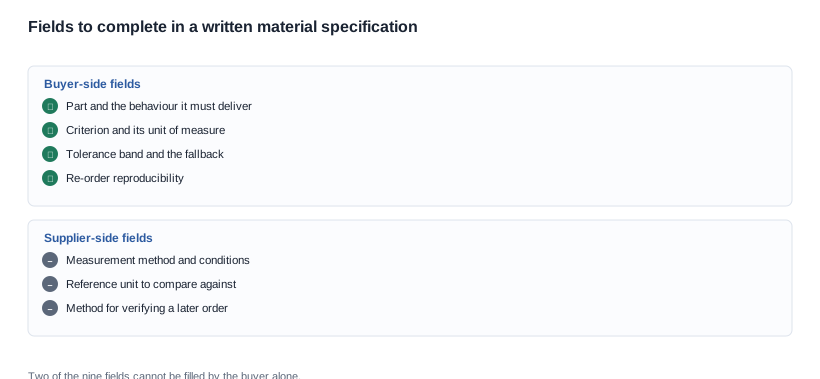
Two of those nine fields cannot be filled by the buyer alone and should not be. The measurement method and the reference unit are supplier-side decisions that a buyer can insist on receiving in writing. The rest are buyer-side and are the buyer's responsibility, which is worth saying plainly because a buyer who expects a supplier to infer a tolerance band that was never written down has misallocated the work.
Where CYNRIN stands on standard oem material selection
On material selection, our position is narrow, and we would rather state it precisely than state it broadly. We publish what our rows contain: a behaviour where we have a behaviour, a number where we have a number, and nothing where we have nothing. We do not publish frame compositions, temple polymers, lens substrates, hinge materials or finishes, because our catalogue does not carry them, and inventing a plausible list would create a worse problem than the empty field does — it would create a field a buyer believes was verified.
What we will do with a named configuration is take a material requirement and separate it into the part it applies to, the behaviour it is really asking for, and the criterion that would prove it. Where the criterion is measurable on a physical unit, we can say what we would measure and against what reference. Where the criterion needs a batch record, a test report or a certificate that carries a number, we will say that it needs a document and name the document, because a written answer that says "this requires a test report for your exact model designation" is more useful than a reassuring sentence.
Two limits apply to everything in this page. First, the photochromic and electrochromic entries publish no optical performance parameter, so no comparative optical claim can be supported from our side without external measurement. Second, the 35 dB amplification gain published for the bone-conduction entry carries no material description behind it, and nothing in this article should be read as extending it into a statement about hearing, medical use or suitability for a particular population. The figure is a catalogue row and nothing more.
What a buyer should take away is a method rather than a menu. Write the behaviour, attach the criterion, name the method and the reference, agree the band and the fallback, and then let the supplier answer the part that only the supplier can answer. Compare the answers across suppliers on those four fields rather than on the summary paragraphs, because the summary paragraphs are where the differences disappear. If a programme does that, standard oem material options stop being a guessing game and become a set of documentable positions — and if it does not, the gap surfaces at incoming inspection rather than at the sample, which is the worst place in the schedule to discover it.
Related reading
- the catalogue rows a specification can be built on
- how a sample round turns a requirement into a signed reference
- what has to be settled before a quotation can carry a price
- the physical and documentary items a carton has to move
- why a tool line and its owner belong on the same document
A material requirement becomes a specification the day it carries a behaviour, a criterion, a method and a tolerance band — and a programme that writes those four down before the quotation rarely discovers a material surprise afterwards.


