

A standard OEM programme is bought on a promise: change the visible surface, keep the engineering. The promise is accurate, and it is also incomplete in a way that only becomes visible when somebody asks what a customer will be able to say about the product six months after launch.
The omission is not dishonesty. It is that the boundary of a standard OEM programme sits exactly where the published specification is thinnest. What can be changed is well documented — the published record for the camera tier holds seven axes, and that record gives the count rather than the content, so what you can read here is how wide the surface is and what you have to ask the supplier to itemise. What cannot be changed is the layer underneath, and that layer is precisely where the catalogue has the least to say: across twenty-eight entries there is one published frame weight, no certification row at model level, no capacitive-touch row and no translation row anywhere, and ingress markings on two models only.
So the boundary is real and the risk is concentrated in it. This article sets out both sides of it, explains why it exists as a decision rather than as a deficiency, and gives a way to test whether a standard OEM programme fits the product you are actually trying to sell.
Standard OEM: what a programme cannot change
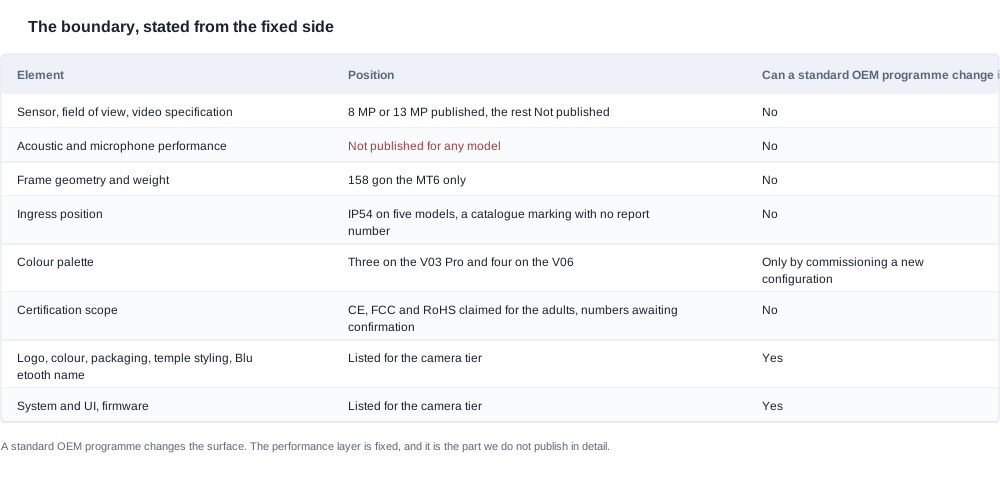
The sensor and the camera specification. The camera tier publishes 8 MP or 13 MP — 8 MP across eight models and 13 MP on the S7 and the L2 Utral, and the L1 Pro — and the sensor model, the field of view and the video specification are not published for any model. No amount of branding changes what the product sees, and a brand whose proposition is "the best camera at this price" is asking a platform whose optical performance it cannot even evidence.
The acoustic performance. No acoustic measurement and no microphone specification exists anywhere in the published range, so the sound is fixed in a way nobody can describe in advance. This is the layer that open-ear products are judged on by end users, and it is the layer a standard OEM programme cannot let you change.
The frame geometry and the weight. Exactly one model in the whole catalogue publishes a weight, the MT6 at 158 g for the glasses alone, with the 1200 mAh foldable case excluded from the figure. Everything else is fixed regardless of how the product is branded, which means a fit-related claim in a long-wear scenario cannot be evidenced from the published data for most of the range.
The runtime and the battery ceiling. All eleven camera models publish a runtime, and the published range runs from five to eight hours on cells of 220 mAh to 290 mAh, with no test condition stated. Twenty-six models publish a charge time of two hours or less, and only the D17 and ZH12 publish about one hour. A standard OEM programme inherits these ceilings rather than improving them, and the brand inherits the ceiling in its product page.
The ingress position. Only the V06 and the S7 publish an IP54 marking. Nothing else in the catalogue carries any IP marking, and a standard OEM programme inherits whatever the model already has — it does not strengthen it. A brand that needs a stronger protection claim has to buy a different product or fund different engineering.
The colour palette beyond the published one. Three options on the V03 Pro and four on the V06; the rest of the range records no colour options at all. Anything beyond the published set is a new configuration with its own minimum, its own tooling commitment and its own lead time — which is a development programme, not a branding decision.
The certification scope. The catalogue publishes nothing that splits certification by model, and the export-certification page carries a single image of ten patent certificates — eight of them designs, two of them utility models. A brand inherits the documentation position of the model it brands, which means the market-access work has to be scheduled rather than assumed.
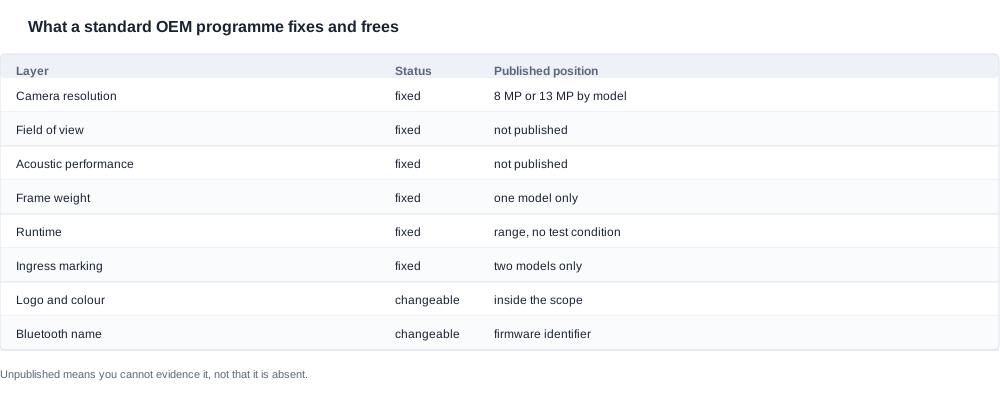
Standard OEM surfaces a brand can actually change
The published customisable scope is broader than most buyers assume, and it is worth reading as a list of what a brand can achieve without opening a development programme.
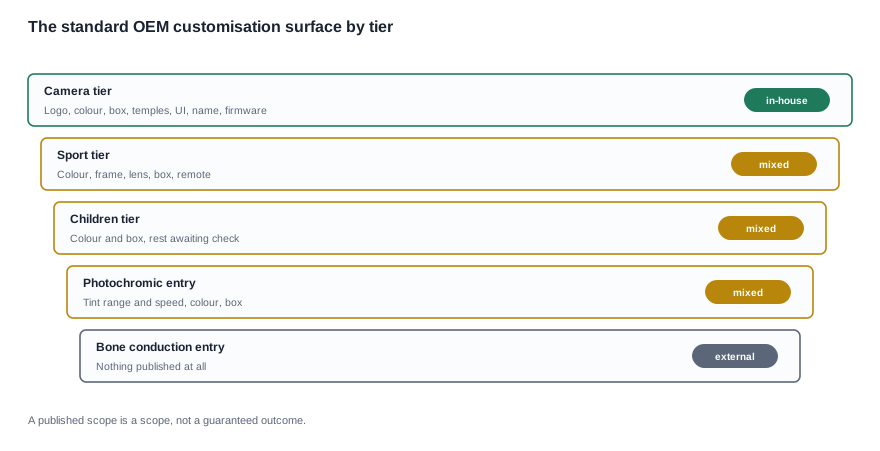
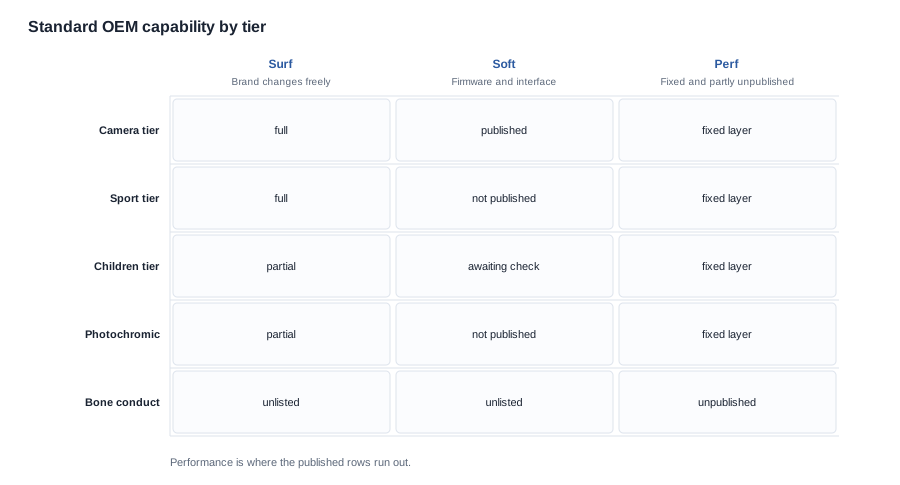
The camera tier is the widest. Its record holds seven axes, and all seven sit inside standard scope rather than inside a development programme. That is a large surface: an onboarding flow, a menu structure, a settings screen and a firmware baseline can all be made to look like your own product, and in practice this is where most of the visible differentiation in this category comes from. The branding options discussion covers how far that surface goes in practice.
The sport tier is narrower and more physical. Colour, frame styling, lens configuration, packaging and a remote. Note that lens configuration sits inside the standard scope here, which is a meaningful difference from the camera tier and is worth checking against what you actually need.
The children's tier is the narrowest of the published ones. Colour and packaging, with app and firmware customisation marked as awaiting verification. That marking is itself information: it says the capability may exist and is not currently confirmed, which is a different position from "not available" and a very different position from "available".
The photochromic entry covers lens tint range and speed, colour and packaging. The V03 Pro is the only camera model in the range fitted with photochromic lenses, and it publishes three colour options.
The bone conduction entry lists nothing at all. Its customisation capability is entirely undisclosed, and a brand considering it needs that answered in writing before it plans a range around it.
The naming and the pairing identity are within reach on every tier. The Bluetooth name is a firmware identifier rather than a marketing label, and the Bluetooth naming engineering discussion covers what that involves and why it is not the same thing as renaming a product.
It is worth separating three things that buyers routinely bundle together. The model name is what appears in your literature and on your packaging, and it is a commercial choice with a constraint — it has to be distinguishable from the platform's own naming and it has to be the string that appears on the model-specific documentation. The Bluetooth device name is what a phone shows when pairing, and it is set in firmware; it should carry the brand, because it is the only name most end users will ever see. The app name and the launcher identity is what appears on the home screen, and it is a different change again. A programme can be excellent at the third and weak at the first, and a buyer who asks only "can we change the name" will get a yes that is true and answers the wrong question.
Why the standard OEM boundary is a decision
It is worth being precise about what this boundary is, because it is frequently misread as a deficiency in the platform rather than as a commercial choice that somebody made.
A standard OEM programme fits when the differentiation is in the surface. A brand whose product is defined by its design, its packaging, its app and its storefront has bought a well-characterised platform and changed what the customer sees and uses. That is a legitimate and often excellent commercial model, and it is how a great many brands in this category actually operate.
It fits badly when the differentiation is in the performance. The performance rows are exactly the ones that are unpublished and exactly the ones that are fixed. A brand whose proposition is "the best camera at this price" is asking a platform whose field of view, video specification and stabilisation it cannot evidence, and it is doing so at the moment of the launch rather than at the moment of the sample.
The low-risk entry point exists precisely for this reason. A route that limits the surface you take on limits the claims you have to support, and for a first programme that trade is usually worth taking. The low-risk entry discussion sets out how that route differs, and the customisation depth article maps the boundary in more detail.
The financial boundary is tooling and non-recurring engineering. This is where the immovable layer becomes a number rather than a concept, and it is where the trade-off stops being abstract. The NRE and tooling discussion covers what a new configuration actually commits you to, and the standard OEM colour options shows how a stock configuration differs from a commissioned one in cash terms as well as in scope.
The reason the boundary is a decision rather than a limitation is that somebody chose it. A platform with a fixed performance layer and a wide branding surface is the direct consequence of a manufacturer amortising the engineering across many brands rather than building it once per brand. That is efficient, and it produces exactly the property that makes the route attractive: the fixed layer has already been paid for, so the buyer's incremental commitment is small. The same choice produces the cost: the fixed layer cannot be adjusted for one buyer without breaking the economics for the others.
There is a practical consequence that catches buyers out. Because the fixed layer was chosen for the platform rather than for your product, there may be a configuration in the range that suits your market better than the one you first selected, precisely because somebody optimised it for a market you are also in. The camera tier spans 8 MP and 13 MP, the sport tier carries the only two fast-charge published figures in the whole range, and the children's tier is a separate set of physical constraints entirely. A buyer who picks first and then checks has already lost the option value; a buyer who checks the range against the requirement first has not.
The other consequence is about when the boundary is cheapest to accept. A fixed layer costs least when your requirement set is stable, because the cost of the layer is the cost of changing it. In the early stages of a programme, when the product proposition is still moving, that cost is high and unpredictable, which is why the standard route and a developing product idea are a poor pairing — not because the route is bad, but because the assumption underneath it has stopped holding.

Testing a standard OEM programme against your claims
Four steps, and the order matters because the first one disqualifies candidates faster than the other three combined.
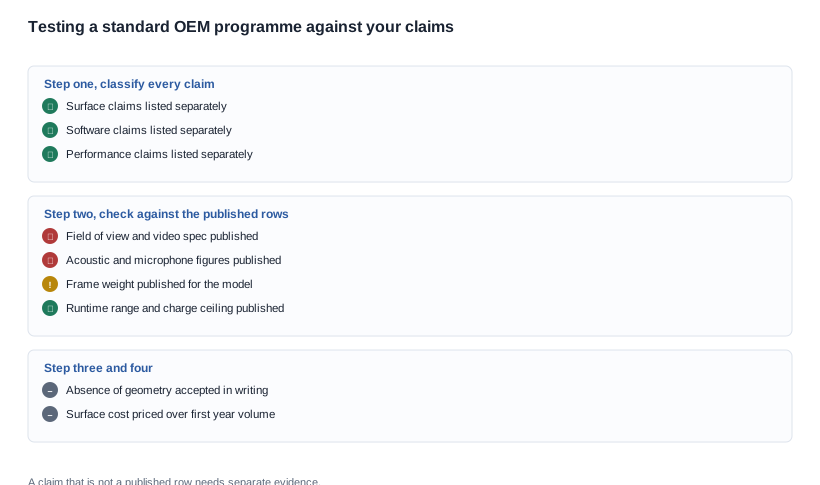
- List every claim the product will make, and mark each one as surface, software or performance. Surface claims are the ones a customer sees before the unit is switched on, and the published camera tier holds seven axes in total, so the question to put to a supplier is which of those seven your programme actually opens up. Software claims are the interface, the onboarding, the pairing identity, the firmware behaviour. Performance claims are camera, audio, runtime, weight, protection. This classification is the whole method — it turns a marketing document into a technical inventory.
- Check the performance claims against the published rows. If a claim is not a published row, it is either a claim you will have to evidence separately or a claim you should not make. In our range most performance claims fail this test: no field of view, no video specification, no acoustic measurement, no microphone specification, no published weight on any model other than the MT6, no capacitive-touch row and no translation row anywhere.
- Decide now whether the absence of published geometry, weight and acoustic figures is acceptable. It will not change later, and a decision taken at the sample stage is a decision taken with a schedule already running.
- Price the surface you are taking on, not the unit price. Add the customisation, the packaging setup, the tooling commitment and the first-article approval, and divide by your realistic first-year volume. A standard OEM programme with a low unit price and a heavy one-time cost is not a low-risk entry, and the arithmetic is what tells you which one you are buying.
The fifth step is the one that happens after the order rather than before it, and it is worth planning for anyway: confirm the fixed layer with the golden sample before the product page is written. Because the performance rows are ranges and ceilings rather than exact figures, the approved sample is the only instrument that turns the envelope into a number you can state. Ask for the sample to be built to a written brief, record the measured values against the published rows, and use the difference between the two to write the page. If the measured runtime sits at the bottom of the published range rather than the top, the page should reflect that — and it is much cheaper to learn it from a sample than from a return.

What a standard OEM product page can honestly claim
The boundary discussed above has a practical consequence that lands on the day the listing goes live: the page can only say what the platform publishes. That sounds obvious and it is regularly ignored, because the alternative — writing the page from the product's aspirations rather than from its rows — is much easier and produces a better-looking page.
The rule is simple. Every factual statement on the page maps to a published row for the model being sold, and every published row is a bounded statement rather than a flat one. Working through what that means in practice for this range:
The runtime is a range, and it is a range without a condition. All eleven camera models publish a runtime, and the figure runs from roughly five to eight hours across cells in the 220 mAh to 290 mAh band, with no test condition stated. A listing that says "up to 8 hours" is quoting a ceiling from a range, and the phrase "up to" is doing more work than most copywriters realise. The honest formulation states the range, states that the test condition is not published, and points to the specification. Buyers in this category are unusually attentive to runtime claims, and a customer who measures four hours against a page that promised eight will not read the small print.
The charge time is a ceiling too. Twenty-six models publish "2 hours or less", and only the D17 and ZH12 publish about one hour. The distinction matters commercially, because the two sport models with the faster published figure are the two where a fast-charge claim is defensible, and it is not defensible anywhere else in the range.
The protection claim applies to two models. Only the V06 and the S7 publish an IP54 marking. Nothing else in the range carries any ingress marking, so "water resistant" or "IP54" on any other product's page is a claim that does not exist. It is also a claim with consequences: a customer who believes a product is protected and then gets it wet will return it, and the return will be justified by your own page.
The weight is a single data point. Only the MT6 publishes a weight, 158 g for the glasses alone, excluding its 1200 mAh foldable case. For every other model the page cannot quote a weight, and the absence is worth stating plainly rather than leaving the shopper to assume the product is heavy or light.
The camera resolution is one of two values. Eight models publish 8 MP and three publish 13 MP, so a page can name the resolution for the model being sold and should not generalise from a sibling.
Two features have no row at all. There is no capacitive-touch row in the catalogue at all, and no translation row is published either. If a product page mentions touch controls or live translation, it is claiming a capability that the published specification does not describe, and that claim has to be supported by something outside the catalogue or removed.
The photochromic entry is a special case. The V03 Pro is the only camera model with photochromic lenses, and it publishes three colour options. A lens behaviour claim on any other model in the camera tier has no published row behind it, and the V06's four published colours are a colour range rather than a lens behaviour.
The commercial reason to be strict about this is not only the returns rate. A product page is the asset that carries every claim a channel partner repeats, and a claim that cannot be defended when the partner asks for evidence becomes a relationship problem rather than a copy problem. The colour and finish options route, the branding options surface and the fixed performance layer all have to be reflected in what the page says, which means the page has to be written from the rows rather than from the brief.
What a standard OEM programme commits you to
A standard OEM programme is a contract with a fixed layer inside it, and the commitment runs in both directions.
You commit to a performance envelope you did not choose. The envelope is bounded by what the platform does, and in this category a large part of it is unpublished, so the commitment is partly to a set of numbers you will only learn by testing. That is why the golden sample matters more here than in a bespoke programme: it is the only instrument that converts the envelope into something you can state.
You gain a fast, low-NRE route to a branded product. The tooling and setup commitment is smaller than a development programme because less of the product is being changed. For a brand with a fixed launch date and a modest budget, that is often the difference between shipping and not shipping.
You give up the ability to move the fixed layer later. Adding a performance improvement — a longer runtime, a different lens, a protection rating — is a new programme, not a change request. The trade-off is therefore about timing: the standard route is cheapest when your requirement set is stable, and most expensive when your requirement set is still moving.
A standard OEM programme is a legitimate commercial model, and its boundary is the performance layer, which is fixed and which we do not publish in detail. We will set that boundary out plainly rather than let a buyer discover it at the sample stage. We will also be direct that the customisable scope we publish is a scope and not a guarantee of a specific outcome, and that where a programme depends on something outside the published scope — an acoustic figure, a field of view, a weight, a certification extension — we will say so early rather than explore it late. What we will not do is imply that a branded product can claim performance the platform does not publish.
On the commercial side, minimum order quantities, unit prices, lead times, sample fees, warranty terms and non-recurring engineering charges are settled per enquiry rather than published, because every one of them follows today's schedule, the documentation scope, the order quantity and the configuration. That is a deliberate position rather than an omission — a published number that changed between one enquiry and the next would be worse than no number — and it means the comparison a buyer needs to make has to be built from figures supplied in writing against a configuration named on one line. Where the answer is that a figure is not published, we will say that rather than substitute a typical value, because a typical value on a spec sheet becomes a claim within a month.
Send your claim list and we will tell you which claims are surface, which are software and which are performance.
Related reading
- OEM ready platforms and branding options
- Device naming work in an ODM programme
- Low-risk entry points
- Customisation depth
- NRE and tooling
- Standard OEM colour options
Send your claim list and we will tell you which claims are surface, which are software and which are performance.


