

What happens if I exceed MOQ has an answer that sounds less satisfying than the one most buyers expect, and the reason is that this catalogue publishes no minimum order quantity for any of its twenty-eight entries. There is no floor to exceed in the published material, no unit price, no lead time, no production capacity and no warranty term — the whole commercial frame of an order is something a buyer obtains in a quotation rather than something a buyer can read. So the question cannot be answered against a published floor. It can only be answered as a structure: once a floor is known from a quotation, three things about an order above it change in a way that matters, three things do not change at all, and the difference between those two groups is where a buyer's margin is decided.
The three that change are the ones most buyers already suspect and rarely put in writing. The first is the unit-price structure: quantity breaks belong to an order and apply to the units inside it, so a larger order can reach a step that a smaller one could not, and the break only counts if it is stated in the quotation for the specific configuration and volume. The second is the way fixed setup work is spread: the tooling, the first-article approval, the packaging print setup and the compliance work are largely fixed, so they hit a small order hard and a large order lightly, and that is the part of the volume argument a unit-price comparison on its own does not show. The third is the place in the schedule, because a larger configuration generally joins a queue further forward, and a unit that starts earlier finishes earlier — which matters most when the product is seasonal.
The three that do not change are the ones that quietly get assumed to improve. The forecast does not become more accurate because the order is bigger; it becomes a bigger bet, with the deposit committed earlier and the inventory exposure larger, and a bet that was untested at one size is not tested at five times the size. The compliance position does not improve: no per-model certification row appears anywhere in the catalogue, and a larger order adds document work rather than removing it. And the specification does not move: the cell, the resolution class, the charging method, the charging-case position and the ingress marking are fixed by the model, and a programme that needs a different cell or a different case capacity needs a different configuration with its own floor, not a bigger quantity.
The three things that do change when an order goes above the floor
The unit price is the first, and the way it works is narrower than the phrase volume break suggests. A break belongs to the order: the units inside the order qualify, and units in a later order do not qualify retrospectively. Two consequences follow, and both are routinely discovered late. The first is that a break has to be written into the quotation for the configuration and the quantity actually ordered, because a general statement in a price list is not a commitment. The second is that the break can be withdrawn by the definition of the order it belongs to — a break stated for a single model at a single volume does not automatically apply to a mixed order, and a break stated for a mixed order does not necessarily apply to the addition of a second colour or a second configuration.
The spread of fixed setup work is the second, and it is the part of the volume argument that a price-per-unit comparison cannot show. Tooling, the first-article approval, the packaging print setup and the compliance work do not scale down with volume; they are incurred once for a configuration and then amortised across whatever is ordered. This is why the marginal unit in a large order is cheaper than the average unit in a small one, and why two suppliers can quote the same product at very different unit prices and both be correct: the difference is frequently the amount of one-off work each of them has already done. It is also the reason a buyer who adds a configuration to a large order should expect that configuration's setup to be a fresh line rather than a continuation.
The place in the schedule is the third, and it is the one with the shortest half-life. A configuration that is already running joins its queue further forward than a new one does, and the effect compounds through every step after it. For a seasonal programme this is the single most valuable consequence of a larger first order, because it converts a date that is at risk into a date that is scheduled. The condition attached to it is that the slot has to be confirmed rather than assumed, and that it has to be confirmed for the configuration rather than for the model, since a new configuration can join the back of a queue that its model has already left.
| Item | What changes above the floor | What does not change |
|---|---|---|
| Unit price | A break may apply to the units in the order | The break exists only if a quotation states it |
| Setup work | Fixed costs spread across more units | The setup work itself is unchanged |
| Schedule position | A running configuration joins further forward | A new configuration joins at the back |
| Forecast risk | Deposit and exposure are committed earlier | An untested forecast does not become tested |
| Compliance file | Volume adds document work | The file is still per model and configuration |
| Specification | Nothing | Cell, resolution, charging and case are fixed |
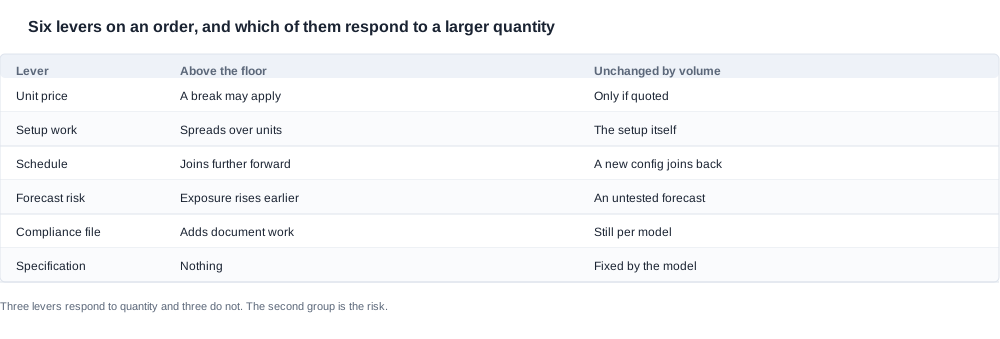

The three things that do not change
The forecast is the first, and it is the one where a larger order is actively more dangerous rather than merely riskier. A buyer who raises a first order above the floor is committing more cash, earlier, against a demand assumption that has not been tested by a single sale. The additional units do not reduce the variance of the forecast; they scale the exposure to it. The inventory that a larger order creates is inventory in a channel where price protection is rarely complete and where a slow-moving model becomes a discount problem rather than a stock problem. This is the reason a second order is usually a better way to buy volume than a larger first one, and the reason the quantity decision belongs in the same conversation as the forecast rather than after it.
The way to evaluate that exposure is not complicated, and it is worth doing before the conversation rather than during it. A buyer who is choosing between two volumes is comparing three quantities: what the units cost, what the deposit takes out of the cash position before the units sell, and how long the units sit before they sell. The second and third are the ones that make a larger order worse rather than better, and they are the ones a unit-price comparison leaves out entirely. Where the demand evidence is thin, the criteria that usually settle the choice are the length of the exposure period and the flexibility of the order — whether the units can be split, whether the deposit can be staged against a schedule, and whether the configuration itself can be revised at a later point. Those three answers come from the supplier, and they belong in the same request as the break.
The compliance position is the second, and it is worth being blunt about it because a large order sometimes produces a large invoice from a compliance adviser. No per-model certification row appears anywhere in this catalogue, and the catalogue text carries no reference to CE, FCC or RoHS. A larger order does not publish a document, and it does not resolve the seven open items that sit in the record for the range: two children's entries that publish identical specifications with the difference unconfirmed, one camera page that publishes two names and two case capacities without stating which name goes with which capacity, one entry whose product category is recorded as uncertain, two catalogue index anomalies, three entries published without a model number, and no published photographs, video or test reports for any of the twenty-eight entries. Every one of those has to be closed with a written answer, and the cost of closing them is largely fixed rather than per-unit.
The specification is the third, and it is the one that determines whether a bigger order is a bigger order or a different order. The cell a model carries, the resolution class it publishes, the charging method it publishes, whether a charging-case row exists for it and what that row says are all fixed by the model. Nothing about them changes because the quantity changes. A programme that wants a different cell capacity, a different charging interface or a different case capacity is asking for a different configuration, and that configuration carries its own floor, its own setup work and its own documentation — which is the point at which a buyer who has exceeded one floor discovers that there are several of them.
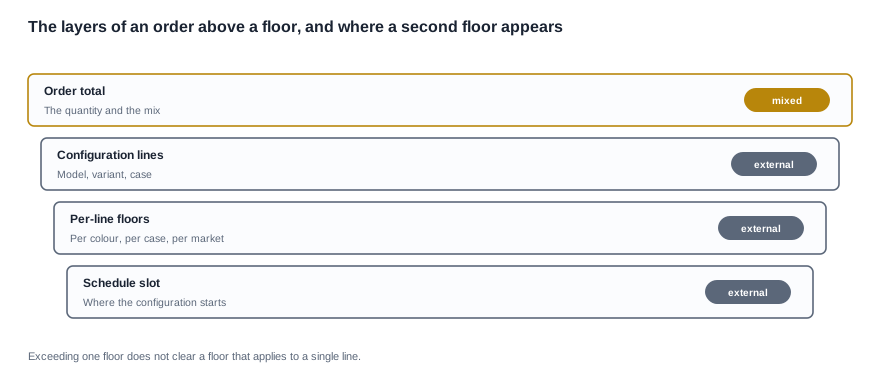

Where a second floor hides in this range
The structure of an order in this catalogue is worth looking at concretely, because the published record shows which entries can even be split, and the answer is narrower than most buyers assume.
Only two entries publish colour at all: the V03 Pro, with three options, and the V06, with four. For the remaining twenty-six entries the published record contains no colour row, so a question about a per-colour minimum is only a live question for those two, and for every other model the split has to be established before it can be asked about at all. The charging-case position creates the same kind of split in a different direction: five camera models publish a case capacity: 1400 mAh on the CY03 and the L1 Pro, and the CY05, a 900 mAh alternative on the L2 Utral alongside its 1400 mAh figure, and 1200 mAh in a folding case on the MT6. Two further entries, the KY06 and the MT5, show a case without a figure, and four publish no case row at all: the V06 and the V03, and the V03 Pro and the S7. An order that mixes a case configuration with a no-case configuration is mixing two order lines whether or not the buyer thinks of it that way.
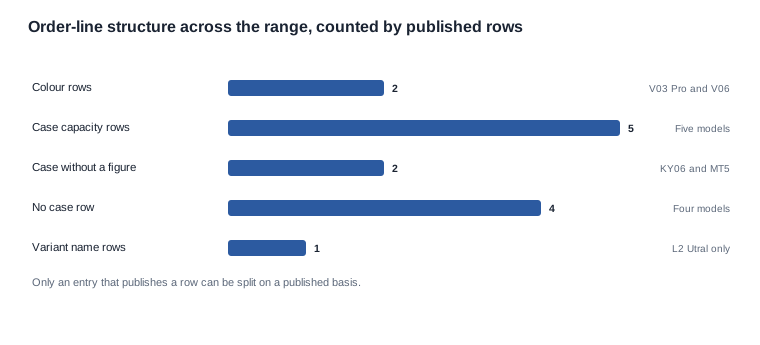
One entry in the range publishes a variant name at all. The L2 Utral carries two parallel names and a case-capacity row reading 900/1400 mAh, and the catalogue does not publish which name corresponds to which capacity. For a buyer placing a large order, that is not a cosmetic ambiguity: an order of the 900 mAh configuration and an order of the 1400 mAh configuration are different products with different packing, different documentation and, quite possibly, different floors, and the record does not say which name means which. Resolving that correspondence in writing is a precondition for placing a large order against that entry at all.
| Ordering lever | Published on | What it splits | What to establish |
|---|---|---|---|
| Colour options | V03 Pro, V06 | A colour line per option | Whether a floor applies per colour |
| Case capacity | Five camera models | A case line and a no-case line | Which configuration is being ordered |
| Variant names | L2 Utral | Two names, two capacities | Which name goes with which capacity |
| Entry without a model number | Three entries | Not orderable by name | How the entry is referenced in the order |
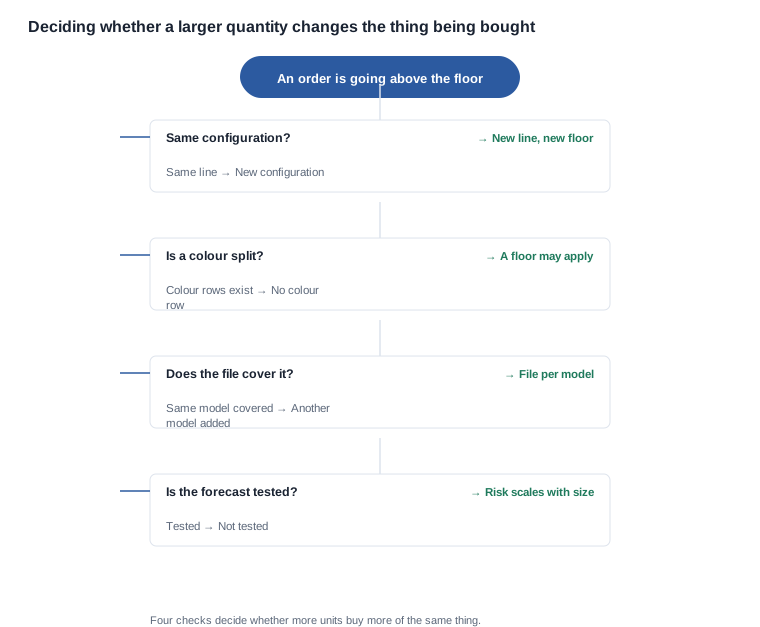
What to write into the order before the quantity goes up
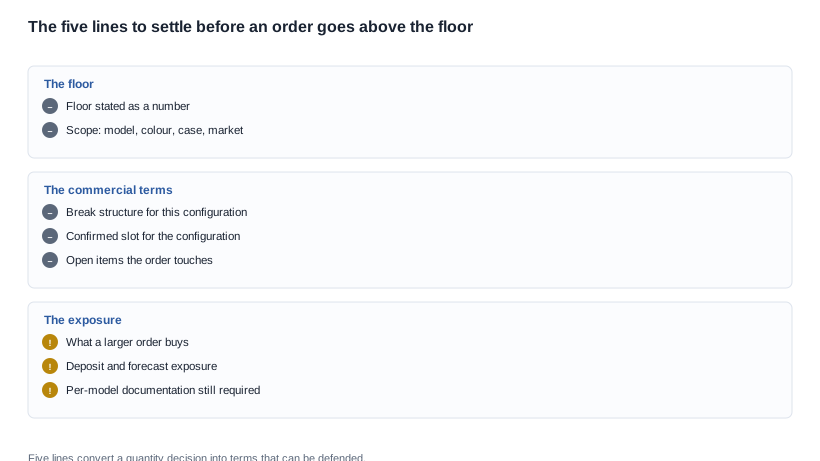
Five items belong in the order documentation before an order goes above the floor, and each of them is a line that prevents a specific argument later. The first is the floor itself, stated as a number with its scope: per model, per configuration, per colour and per market, because the record shows that an order can carry more than one of those at once. The second is the break structure, stated for the configuration and the quantity being ordered rather than in general terms. The third is the slot, confirmed for the configuration rather than for the model.
The fourth is the treatment of the open items: which of them touch the configurations in this order, who is closing them, and by when. The fifth is the split between what a larger order buys and what it does not — the setup work spread, the schedule position and the price effect on one side, and the deposit exposure, the forecast exposure and the per-model documentation on the other. A buyer who writes those five lines has converted a quantity decision into a set of terms, which is the only form in which a quantity decision survives contact with a supplier.
The five lines are easier to write than they are to agree, and the reason is that each of them asks a supplier to commit to something its own process may not have an answer for. A floor with a scope, for example, requires somebody to say which scope applies to which configuration, and a supplier that has been quoting a single number for years has to decide whether it wants to keep doing that. A buyer should make the request anyway, because a supplier that answers it has told a buyer something about how it will quote the next order as well.
The same is true of the break. A supplier that will state a break for a configuration and a volume has done the work of deciding which units inside a mixed order qualify, which is a harder question than it looks, and the answer is a term a buyer can plan a channel around. A supplier that will not state it has left the buyer to assume the most optimistic reading of a price list, and the difference between those two positions is worth more than the size of the break itself in most first orders.
How the five lines are checked before a buyer commits is a short routine rather than a long one. Before the order is placed, the criteria are: the floor carries a scope, the break is stated for the configuration being ordered, the slot is confirmed rather than assumed, the open items the order touches are named with an owner and a date, and the exposure on the deposit and the forecast is written down as a figure the buyer has accepted. If any of those five is missing, the quantity decision is not yet ready, and the gap is cheap to close now and expensive to close after the deposit. The trade-off a buyer is actually making is not between a smaller and a larger order; it is between an order that carries known terms and one that carries an assumption, and only the second of those is a gamble.
The decision itself is a risk decision rather than a pricing decision, and it is worth naming that clearly inside a procurement file. A buyer evaluating whether to exceed the floor should be answering one question: does this programme have demand evidence good enough to support the larger exposure, and is the exposure being taken in the form with the shortest half-life? If the answer is that the demand is assumed rather than tested, then the conservative move is to buy the configuration, confirm the market, and let the second order carry the volume — which is also the order in which the break, the slot and the setup costs all work in the buyer's favour.
What happens if I exceed MOQ: the three-part answer
Published: no minimum order quantity, no unit price, no price tier, no lead time, no production capacity and no warranty term for any of the twenty-eight entries, across the eleven camera models, the eight audio models, the three sport models, the three children's entries and the three entries published without a model number. What is published that bears on how an order is structured: colour on two entries only, three options on the V03 Pro and four on the V06; a charging-case capacity on five camera models, a case without a published figure on the KY06 and the MT5, and no charging-case row on the V03 Pro and the V03, and the V06 or the S7; a variant-name row on the L2 Utral alone, published alongside two case capacities with no stated correspondence; and seven open items in the record for the range. Not published: the minimum order quantity in any form, the unit price, the volume breaks and their thresholds, the production capacity, the lead time, the setup charges and how they are spread, the warranty period, and whether any floor applies per model, per configuration, per colour or per market. Ask the supplier: the floor with its scope stated, the break structure for the configuration and quantity, the confirmed slot, the treatment of the open items the order touches, and the split between what a larger order buys and what it commits.
For a buyer placing a first order in this category, our position is that the minimum order quantity is a term to be established rather than a number to be found, and that the useful question is not what it is but what it applies to. The published range shows that an order here can carry a colour line, a case line and a variant line at the same time, which is why a floor with an undefined scope is not a floor a buyer can plan around. What the published material does give is the structure to ask against: five lines to settle, three things that change with quantity, three that do not, and a set of open items that a larger order makes more expensive rather than less.
Related reading
- The floor itself, defined — what is MOQ
- What moves a floor — what affects MOQ
- How floors are structured across an order — MOQ structure for wholesale
- When mixing models is the answer — can I mix models to meet MOQ
- The checklist for a first order — MOQ checklist for a first order
Send the model, the configuration, the colours, the case configuration and the volume, and the floor and the break can be quoted against one order instead of against the range.


