

How do I claim warranty on smart glasses? Not with a form — with a set of records that the supplier agreed to accept before the first order went out. The catalogue publishes no warranty term, no service period, no remedy menu and no per-model service row for any of the twenty-eight entries, so nothing in the published material can be quoted to a customer as a promise. What the catalogue does publish is a hardware sheet: cell capacities and rated runtimes, a charge-time ceiling of two hours or less on every entry, charging methods on twenty-four of them, resolution classes on the eleven camera models, IP54 on the V06 and the S7, colour options on the V03 Pro and the V06, charging-case capacities on five camera models, and a single weight figure in the whole range — 158 g for the MT6 glasses body, excluding its foldable case.
That splits the question cleanly. Published: the hardware rows listed above, and the existence of an after-sales section on the site. Not published: the warranty period, what starts it, the remedy set, the exclusions, the return freight responsibility, the turnaround, the treatment of data on a returned unit, and whether returned components are reused. Ask the supplier: those items in writing, per model, before the first purchase order is placed — and a decision on which party's claim record is authoritative.
There is a second problem here that is specific to this category and that a generic warranty template does not solve. The published figures are ratings, not test records, and a claim is adjudicated against a document. A customer who reports that the unit "does not last" is making a statement about a runtime, and the catalogue publishes a runtime band with no test condition behind it — so the claim cannot be evaluated against the published row, and the dispute has nowhere to go. The same is true of a feature that stops working: no firmware version and no update policy appear anywhere in the catalogue, so the unit cannot be placed against the build it shipped with. A warranty process for this range has to capture the missing context itself, or it will spend its life arbitrating rows that cannot arbitrate anything.
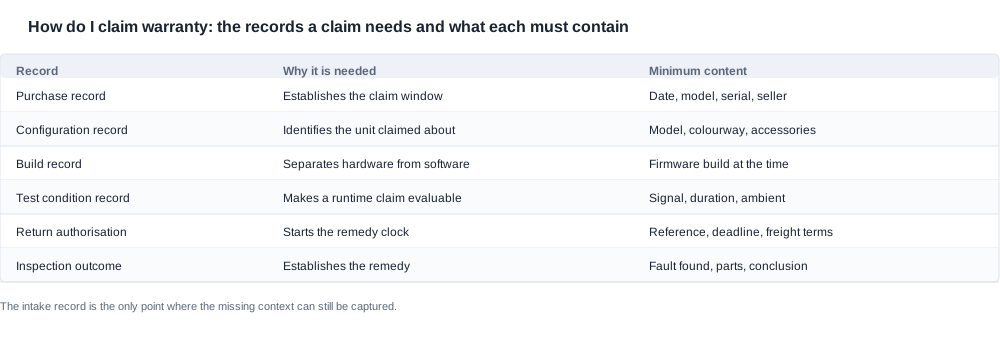
How do I claim warranty: the four records a claim needs
What the catalogue publishes and what it does not
The list above is the entire published basis for a claim, and it is worth stating plainly that a customer service agent cannot cite any of it as a warranty entitlement. The battery capacities are published — 40 mAh on the A05 and the A06, 70 mAh on the A07, 100 mAh on the D11 and the D12, 115 mAh on the D17, 290 mAh on each of the L1 Pro and the L2 Utral, and the CY05 and the CY03, and the cell pairs published as 55 mAh × 2, 70 mAh × 2 and 90 mAh × 2. The rated runtimes are published alongside them, from about six hours on the G07 and the YK12 through to a rated twenty hours on the three kids models — the A05, the A06 and the A07. The catalogue simply does not publish a service term, an exclusion list or a remedy set for any model.
What that means practically is that a claim cannot be started from the catalogue. It can only be started from a document the supplier has provided and the channel has agreed to honour, which means the first work in this category is not a claim form but an agreement.
Why a published rating cannot adjudicate a claim
Three examples show how this works in practice, and all three are drawn from rows the catalogue does publish.
A battery claim is the first. The D11 publishes 100 mAh and about seven hours; the A07 publishes 70 mAh and about twenty hours; the CY03 publishes 290 mAh and about seven hours. A customer reporting a short runtime is therefore reporting a deviation from a band whose measurement conditions are not published — no signal type, no duration, no ambient condition, no statement of whether the figure is a best case. The claim is not wrong; it is unevaluable. The only way it becomes evaluable is if the intake record captures the conditions, so that a second unit can be measured the same way and compared.
A feature claim is the second. The catalogue names no firmware build for any entry and sets out no update policy, so "the translation stopped working" and "the assistant stopped answering" have no build to be tested against. The intake record has to capture the build identifier, and where the unit cannot report one, that absence becomes part of the record.
An ingress claim is the third. IP54 appears on the V06 and the S7 and on no other model. A water-resistance claim on one of those two models has a published basis; the same claim on any other model in the range has none, which does not make it false but does mean the claim has to be settled by the supplier's own assessment rather than by a catalogue citation.
The weight figure and the return cost calculation
One published number does have a direct commercial use, and it is worth isolating: the MT6 glasses body weighs 158 g that carries the 265 mAh cell and the camera inside it, with the foldable charging case left out of the figure, whose weight is not published. That is the only product weight available, so a channel that ships the MT6 can estimate return freight per unit while a channel that ships any other model cannot. The consequence is that freight allocation, which is usually the least discussed term in a warranty arrangement, is one of the terms a buyer is least able to negotiate on informed terms for most of the range.
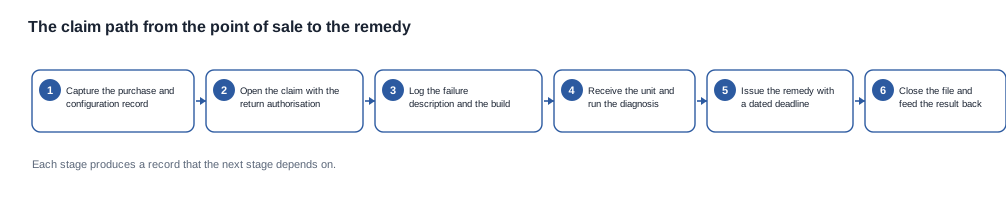
The claim path, stage by stage
A warranty process that survives contact with a real claim is a sequence, and the sequence below is organised around the moment a dispute becomes expensive: the intake. Everything in the first stage exists to make the second stage possible.
Stage one: the record created at the point of sale
The point of sale is the only moment when the channel holds complete information, and it is the moment at which most of it is discarded. The record that has to exist at that moment contains the date of sale, the model string, the serial or lot identifier, the seller, the configuration and colourway, the accessories supplied at the time, and — for a channel that stocks more than one assembly — whether a charging case was included.
That last item is not a formality in this range. The catalogue publishes a charging-case capacity on five camera models, shows a case without a figure on the KY06 and the MT5, and carries no charging-case row at all on the V03 and the V06, and the V03 Pro and the S7, so a case in the box at the point of sale is information the catalogue cannot supply. A claim file that does not record what was in the box cannot adjudicate a charging failure later. The whole structure of the case question is set out in does the charging case need its own report, and the point that carries into warranty is the same one: the case is a separate assembly, with its own cell and its own service life.
Stage two: the intake record
The intake record is where a claim becomes evaluable, and it has four fields that a generic form does not have. The failure description in the customer's own terms, with the sequence of events rather than the conclusion. The build identifier, or an explicit statement that none could be retrieved. The test condition, where the failure is a runtime or a battery complaint — the signal, the duration and the ambient condition. And the accessories in the box, which determine whether the assembly under discussion is the device or the case.
The reason these four fields matter is that they are the ones that cannot be recovered later. A unit returned to the factory without them arrives as an object rather than as an argument, and the factory's only available answer is a judgement about a judgement.
Stage three: the diagnosis and its evidence
The diagnosis has to be recorded in a form the channel can read, because the channel is usually the party that has to accept the outcome and communicate it. That means the fault identified, the parts involved, the checks run, and the result of each check — plus, for a water or impact case, the specific point of ingress or the specific point of deformation.
The evidence standard matters as much as the diagnosis. A conclusion stated without the checks that produced it cannot be re-checked, and a channel that accepts such a conclusion will accept the next one too. The buyer should agree the format in advance rather than discover it during a quarterly review.
Stage four: the remedy, the deadline and the escalation
The last stage is where most warranty arrangements are actually decided, and the terms that matter are commercial rather than technical. Which remedies are available — repair, replacement, refund, or a combination — and whether the channel's commercial recovery from the supplier follows the remedy or is set independently of it. Who carries the return freight in each direction, and what happens to a unit whose fault is not covered. The turnaround commitment, and what happens automatically when it is missed. The escalation path when the first diagnosis is rejected, and who has the final word.
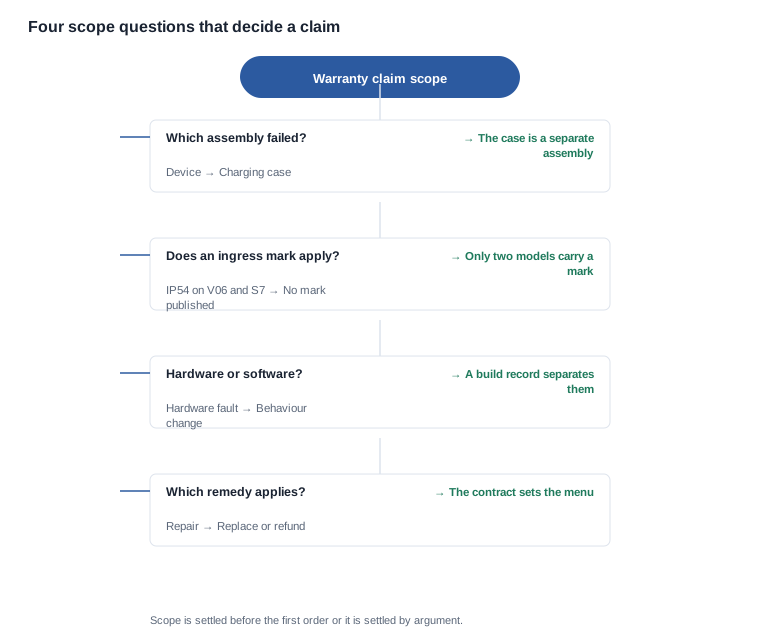

The four scope questions that decide whether a claim succeeds
Most warranty disputes are not disputes about the technology. They are disputes about scope, and scope is settled in advance or not at all. Four questions do most of the work.
Is the failing part inside the covered assembly? A camera model is a device with a battery, a camera module, a radio, a frame and, on some models, a charging case. A claim that names a part has to be mapped to the assembly and to the supplier's position on that part's coverage. The catalogue publishes no spare-parts rows and no serviceable-part rows, so this mapping is entirely a matter of agreement.
Is the charging case inside the covered assembly? This is the sharpest scope question in the range for the reason the catalogue creates: whether a case is supplied at all is published for only part of the line, and the models where it is not published are exactly the models where a claim about the case will arrive with no documentation behind it. Deciding this per model before the first order is worth more than any general clause.
Does the ingress marking bear on the claim? IP54 is published on the V06 and the S7 only, and it covers the assembly as published rather than any individual part. Whether the marking survives a service event, and whether a unit that has been opened is still within the marking, are the two questions a channel will be asked after its first water claim.
Is the failure a hardware failure or a software failure? This is the question the build record exists to answer, and it is the one most often left unresolved. The catalogue publishes no firmware version and no update policy for any model, so the separation has to be made from the unit at intake. The outcome of the separation is commercially significant: a hardware failure is a warranty event, and a behaviour change after an update is not.
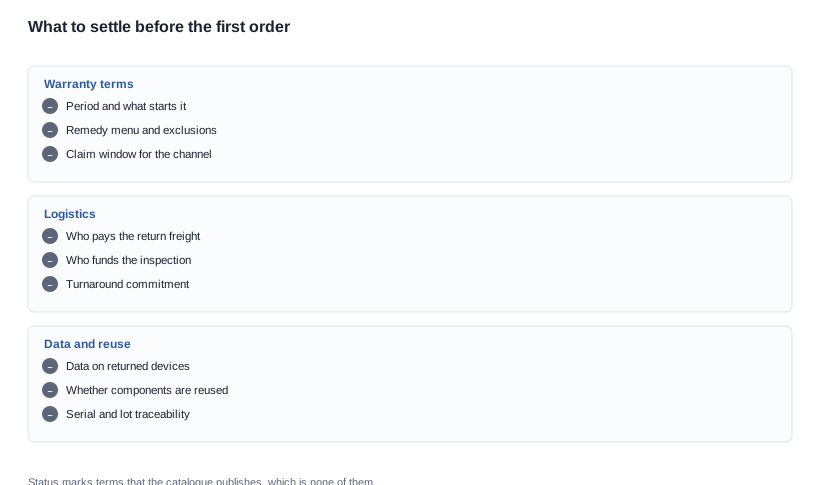
What to settle with the supplier before the first order
The list below is the warranty half of the agreement, and each item is a term rather than a request. A buyer who settles these before the first purchase order has a claim process; a buyer who tries to settle them after the first season of claims has a negotiation.
- The period and what starts it. Published: no warranty term for any model. Not published: the duration, the trigger date, and whether the period runs from the sale, the despatch or the delivery. Ask: the term per model, the trigger, and whether the period is a contractual warranty or a commercial undertaking.
- The remedy menu and the exclusions. Published: nothing. Not published: which remedies exist, what is excluded, and whether the exclusions vary by model. Ask: the menu in writing, with the exclusions listed rather than implied.
- The claim window and the process. Published: nothing. Not published: how long a claim remains open, what the channel must supply, and what happens to a claim that arrives after the window. Ask: the window, the required claim contents, and the address the channel files against.
- The freight and inspection allocation. Published: one weight figure in the range, for the MT6 glasses body at 158 g excluding the case. Not published: who pays return freight, who funds the inspection, and whether freight is credited on a covered claim. Ask: the allocation, with the cost model stated for the models being ordered.
- The turnaround and the missed deadline. Published: nothing; no lead time, no turnaround and no service period is published for any model. Not published: the diagnosis window, the remedy window, and what happens when either is exceeded. Ask: the commitment and the automatic consequence.
- Data on returned units. Published: nothing; the catalogue publishes no data-handling statement. Not published: what happens to the content on a returned device, who may examine it, and what is returned to the customer. Ask: the data position in writing, and confirm it in the customer-facing terms.
- Reuse of returned components. Published: nothing. Not published: whether repaired units, returned units or harvested parts re-enter the supply chain as new or refurbished stock. Ask: the position, because it affects what the channel can lawfully and safely sell.
- Which claim record governs. Published: nothing. Not published: whether the supplier's own record or the channel's record is authoritative when they disagree. Ask: the governing record and the dispute route for the two views. A channel that keeps its own claim record with the conditions attached is the party that can evidence a trend; the trend is what turns a warranty process into a negotiating position at the next price discussion.
Choosing between two suppliers on the strength of the warranty terms
A warranty arrangement is one of the few documents a buyer can read before committing and still learn something about how the counterparty operates, because its terms are specific where a product page is not. When two suppliers offer terms that look similar, the comparison worth making is between the quality of the written position: whether the period is defined by a trigger a channel can evidence, whether the remedy menu is written as a list rather than described, whether the freight allocation is stated for each configuration, and whether the data and reuse positions are given as commitments or as intentions. How to choose between the two sets of terms then becomes a checklist rather than a preference, and the checklist can be applied to each answer as it arrives so that the comparison is not skewed by whichever document is longer.
The red flags in this category are consistent. Terms that begin with an expectation of good faith and end without a commitment. A remedy menu that offers repair as the default without a stated turnaround, which converts a service problem into a working-capital problem for the channel. A freight clause that assigns cost by case rather than by configuration, which is a clause that will be read differently in every dispute. Before you order, evaluate the terms against the criteria that matter to the channel, compare two supplier responses line by line, and treat the questions to ask about data and reuse as gating items rather than as details to be settled later.
The commercial position of the claim cost
Where the cost actually sits
Warranty cost is rarely the largest cost in a channel, but it is the least controllable one, because it arrives as a consequence of decisions made elsewhere: the configuration chosen, the packaging chosen, the market chosen and the claim window chosen. It also arrives late. A first bulk order that ships cleanly can mask a claim profile for a season, which means the cost appears in the wrong financial period and is then attributed to the wrong decision.
The terms that move this cost most are unglamorous. The claim window sets how long the exposure runs. The remedy menu sets the unit cost of each outcome. The freight allocation sets the cost of every claim regardless of its outcome. The data and reuse terms set the cost of claims that are not about faults at all. A buyer who prices the warranty arrangement before placing the order is making a decision; a buyer who accepts the default terms is inheriting a number.
Why the channel's own claim record is the data that matters
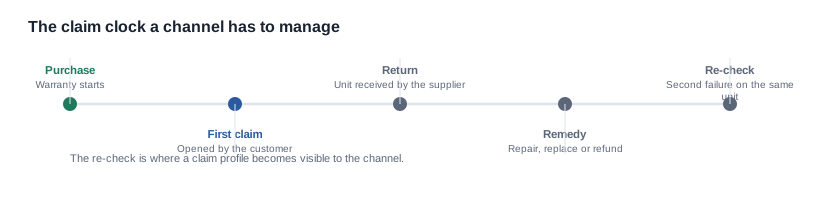
The second-order value of a warranty process is the record it produces, and this is where a well-built claim file pays back twice. A channel that records, for every claim, the model string, the configuration, the build where one was captured, the fault mode and the remedy applied ends up with the only dataset that describes how its own products behave. That dataset is what makes the next negotiation with a supplier substantive rather than rhetorical: a claim rate by configuration, a fault mode that repeats, a remedy whose cost is higher than the alternative, and a series that points at a specific configuration rather than at a model in general.
It also changes the relationship with the supplier. A channel that arrives with a record can discuss a specific change to a specific configuration; a channel without one can only discuss a general complaint, and the supplier's answer to a general complaint is a general improvement. The warranty file is the cheapest piece of market intelligence available to a distributor, and it is built out of records that a careful intake process produces anyway.
The process the supplier offers for a claim is therefore worth reading as a document in its own right, not only as a service. The terms, the remedy menu, the turnaround, the data position and the freight allocation describe how the counterparty expects to operate for the whole life of the agreement. A buyer reading them before the first order learns more about the relationship than any reference programme will tell them.
The after-sales material for this range sits on the after-sales page, with the three working documents behind it in warranty policy, returns and RMA and quality claims. The warranty set-up question for a channel is in OEM ready platforms warranty setup, and the return-and-returns position for a specific application is in smart glasses for content creation warranty and returns. On the product side, the assembly boundary that decides a charging claim is in does the charging case need its own report, and the build-record problem for a feature claim is in does the camera record continuously.
Related reading
- The three working documents behind a claim — warranty policy
- The return and authorisation process — returns and RMA
- How a quality claim is assessed — quality claims
- The assembly boundary behind a charging claim — the case and its own documentation
- The build-record problem behind a feature claim — the recording behaviour question
- Setting up a warranty position for a channel — OEM ready platforms warranty setup
- The application-level returns position — content creation warranty and returns
- The reference page for service terms — after-sales
Send the models, the markets and the claim record you already hold, and we will tell you which warranty terms decide the cost and which records have to be captured at intake.


