

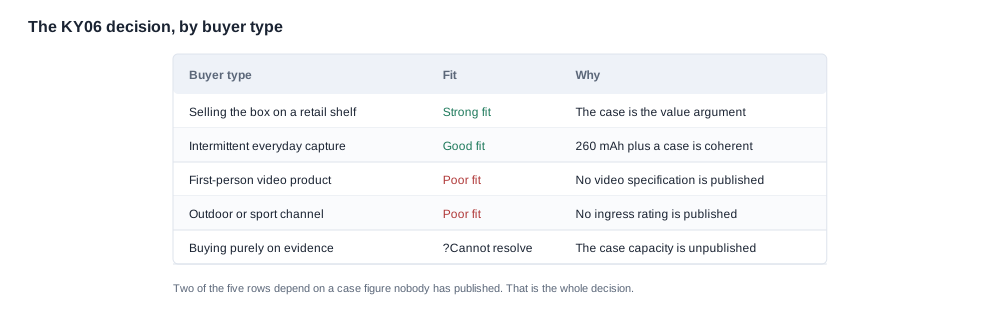
The conclusion is uncomfortable for anyone hoping for a clean recommendation: on this model the case is the product, and the case capacity is not published. Magnetic charging with a case is the differentiator that separates it from cable-only models in this range, and the one number that would let you judge whether that differentiator is worth anything is exactly the one nobody has given us.
So this model is a good fit for a specific buyer and a poor fit for anyone buying on evidence. Here is which is which, and here is the order to ask the questions in.
KY06 smart glasses: the published rows and the one that is missing
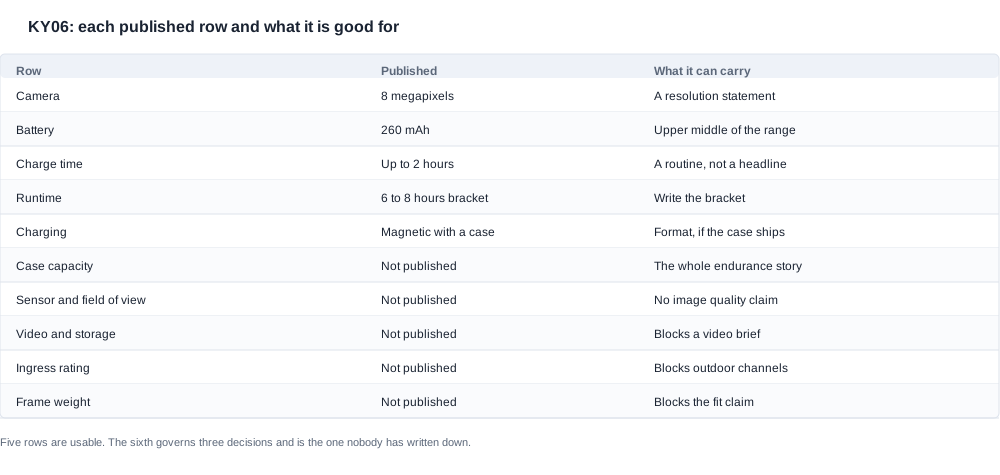
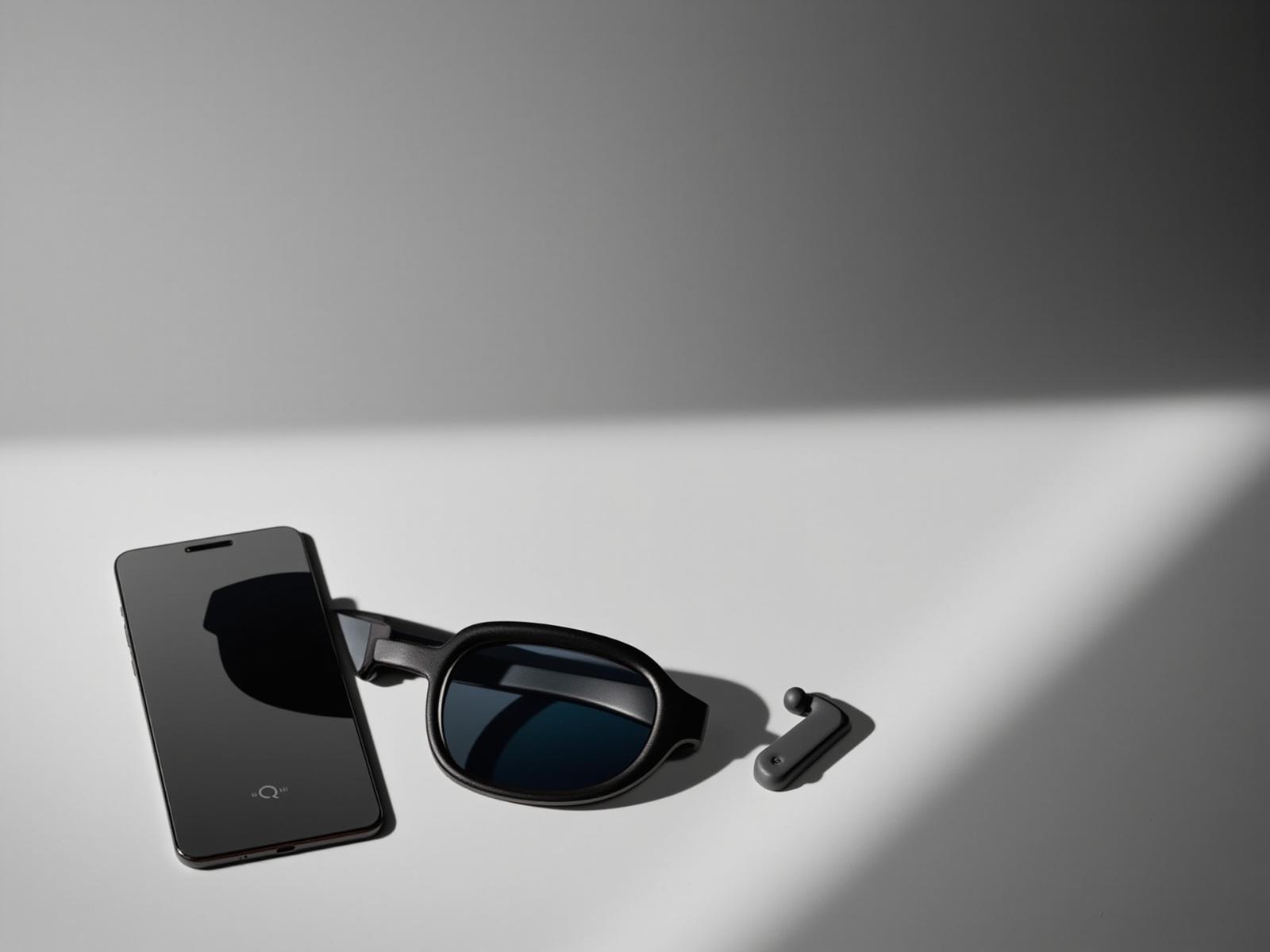
The published configuration is an 8-megapixel camera, a 260 mAh cell, a charge time of up to two hours, a rated runtime of six to eight hours, magnetic charging, and a charging case. Six rows, and five of them are ordinary for this part of the range.
The sixth is not. A case is the only item on that list whose value cannot be assessed without a figure, because a case changes three separate things at once: the endurance the customer experiences between charges, the weight and volume they carry, and the unboxing. The first of those makes the case a product feature. The second makes it a freight decision. The third makes it a merchandising decision. One number — the case capacity — governs all three, and it is not published for this model.
Two details in the published rows matter more than they appear.
Six to eight hours is a bracket, not a specification. No test condition is published for either end, and the two-hour spread is wide enough that the difference between the pessimistic and the optimistic reading is most of a working day. A listing that quotes "up to 8 hours" is making the optimistic claim; a listing that quotes "6–8 hours" is making the honest one. Write the bracket, and note that our battery life guidance covers the questions to ask before publishing any runtime figure in this category.
Eight megapixels describes stills and nothing else. It is a count of pixels on a sensor whose model is not published, so it supports a resolution statement and not an image quality statement. Any listing that uses it to imply a photograph will look good is making a claim the data does not carry. The camera imaging guidance explains why that distinction decides whether a camera claim survives a retailer or regulator review.
The 260 mAh cell sits at the upper middle of the camera range rather than the top, which means the frame is not the endurance story on this model — the case is. That is worth stating plainly to any buyer who is choosing on capacity alone, because they will otherwise pick a larger-cell model whose case position the catalogue does not document and conclude they have made the wrong trade.
The buyer it fits: someone selling the box
A magnetic-charging case raises perceived value, changes the unboxing, and lets you defend a higher retail price than a cable-only frame. If your channel is a marketplace listing, a gift-oriented shelf, or a first-time customer who has never charged a wearable before, the box is doing the work and this model's format is the reason it can work.
Two things have to be true for that argument to hold, and neither is published. The case must be in the box at your quantity rather than quoted as a line item, and its capacity has to be large enough to be worth the freight it adds.
The first is a commercial question with an easy answer that has not been asked yet. A bundled case and an optional case are different products with the same part number, and the difference shows up as your cost rather than as a concession from the supplier. Ask whether the case is bundled at your quantity, whether it can be quoted separately for a second tier, and whether the packing list names it. A supplier who can answer all three is describing a product programme; a supplier who answers only the first is describing a bundle.
The second is the capacity question, and it is the one to chase. A case below roughly the frame's own capacity is a docking convenience rather than a second charge, and a case at or above it changes the customer's routine entirely — they stop thinking about the product between uses. Both are legitimate products; they are not the same product, and the difference to the customer is the difference between charging at a desk and never thinking about charging at all. We cannot tell you which one this model has.
There is a third condition that is easy to forget. A case in the box changes your packed weight, and packed weight changes your freight band, your pallet configuration and your returns rate. If you are moving this model through a marketplace, the dimensional weight will be calculated on the case even when the case is empty, because nobody measures the battery inside it. Model the shipping cost with the case in, not with the case beside the product, and ask for the packed dimensions rather than the product dimensions. The charging solutions guidance covers the arithmetic, and the entry-level analysis in the camera range overview covers where this model sits against its neighbours.
How to evaluate a case that has no published capacity
Because the capacity is unpublished, the sample programme has to measure it rather than read it. That is straightforward and it takes about an hour, and it is the difference between buying a case and buying an unknown.

First, weigh the empty case and the case with the frame in it. The difference gives you the case's own shell weight, and the total gives you what the customer carries. Write both down, because the second one is the one your freight model needs.
Second, charge the case from empty and time it. Ask the factory what state the case is in when it arrives — full, part-charged, or discharged for shipping — because that answer decides whether a customer can use the product the moment they open the box. A case that arrives flat is a bad first impression on a format whose entire argument is the box.
Third, put the frame in and read the case's own state indication. Whether it has an indicator at all is worth knowing, and a case whose state is invisible is a case the customer will over-charge or under-charge indefinitely.
Fourth, measure what the case actually delivers. Fully charge the case, insert a frame that is deliberately flat, and time the charge to the state the wearer would call full. If that time is close to the frame's own two-hour charge time, the case is not delivering a second charge — it is delivering a cable replacement, and you should market it that way rather than as an endurance product.
Fifth, check whether the case charges the frame's own cells or an internal battery, and what happens to the case if the frame is absent. A case with an internal cell is a product with a second battery, its own cycle life and its own warranty obligation. A case that is a powered dock is a simpler product with a smaller promise. The two are described identically in most listings, and the difference is a support cost.
Sixth, and last, ask whether the case is available in this model at all, in writing. If it is, the model has a format. If it is available only as an accessory for a sibling, the format belongs to the sibling and this model is a cable product with an aspiration.
The buyer it does not fit: anyone with a hard video requirement
An 8-megapixel figure describes stills. Sensor model, field of view, video resolution and frame rate are not published for this model or any other in the range, and neither are storage capacity, file format or overwrite behaviour.
If your product concept is first-person video, no model in this range can be signed off against that brief from the documentation. That is a range limitation rather than a weakness of this model, and it is better discovered now than after a production run, after tooling, after artwork and after a launch date booked with a retailer.
The specific questions to ask are short. What is the video resolution and the frame rate, and are they adjustable? How much storage does the frame hold, in what format, and what happens when it fills? Does it overwrite the oldest files, stop recording, or refuse to unlock? Each of those three overwrite behaviours produces a completely different customer experience, and only one of them is what a customer would assume by default. A camera that stops recording silently is the one that generates the worst reviews.
And ask whether recording is continuous or triggered, and whether there is any indication to the wearer that recording is happening. That last question is not a technical one. In several markets a wearable camera that records without a clear indicator creates a privacy exposure for the brand selling it, independent of any regulation that applies to the product itself. A brand that cannot answer the indicator question has not finished its compliance review, and it should not be printing that the product is unobtrusive.
There is also a data position question. Where does the footage go, is it stored on the frame only, and can it be retrieved without a proprietary application? A buyer whose customer expects to move files to a computer will find the answer inconvenient rather than impossible, but "inconvenient" is a support cost and it should be priced.
If your channel is outdoor, the absence of a rating is disqualifying
No ingress protection rating is published for this model. Our sport smart glasses range is where that question is at least addressed, and even there the rating is a catalogue marking rather than a test report we can point to.
If your channel is cycling, running, or any environment with sweat or rain, the absence of a rating is disqualifying rather than inconvenient. The cost of getting this wrong is asymmetric: a customer who is disappointed by a battery figure returns the product and buys something else, while a customer whose camera fails after rain returns the product, tells everyone why, and damages the whole listing rather than the one unit.
Ask for the rating, ask for the test report behind it, and ask whether the case carries the same rating as the frame. A case is a second enclosure with its own seals, and a frame rated for spray with a case rated for nothing is a product that fails in the pocket rather than on the ride. If no rating exists, the honest listing omits every water-resistance word, and the channel decision is whether you can sell into that channel without one.
A related disqualifier for outdoor channels is the form factor itself. A camera frame worn for a long effort needs to stay on the head through movement, and no frame weight or temple dimension is published for this model or any other in the range. That is a measurement you take on a sample in ninety seconds, and until it is taken there is no fit claim, no comfort claim, and no basis for a size guide.
And the buyer it does fit: intermittent everyday capture
The published figures are an 8-megapixel camera, a 260 mAh cell, a charge time of up to two hours, a rated runtime of six to eight hours, and a case. A cell at the upper-middle of this range plus a case is a reasonable proposition for a customer who captures in bursts — a seller filming short clips of their own stock, a traveller recording a trip, a buyer who wants the product available without carrying a cable.
Note the range rather than the figure. Six to eight hours is a bracket, not a specification, and no test condition is published for either end. If your customer is out for ten hours in a single session, this model is not the answer and no case changes that, because the frame's own endurance is the limit.
The customer who fits is better described by behaviour than by profile. They photograph something, they do not record something. That is the distinction worth testing against your own proposition, because it decides whether the missing video specification is a blocker for you or a detail somebody else raised. For a buyer whose whole concept is capture, the video gap disqualifies this model regardless of the case. For a buyer whose concept is convenience capture, the video gap is a documentation task rather than a product risk.
A useful way to run that test is to write the customer's day in one sentence and see where the camera is in it. If the camera appears in the sentence as a background capability — available when needed, forgotten otherwise — this model fits. If the camera appears as the reason the sentence is interesting, then the model's eight-megapixel stills figure and its complete silence on video are a mismatch, and no case capacity fixes that.
What to ask in the first email
In this order, because the first three can change the decision and the rest complete it.
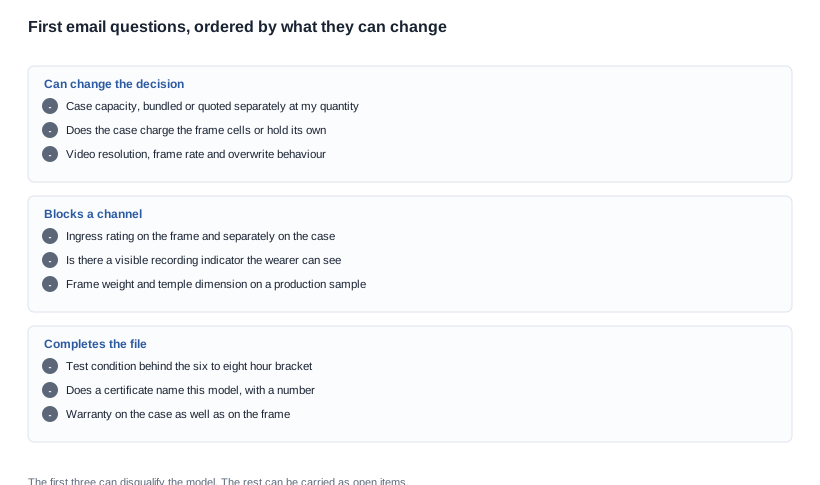
- What is the case capacity, and is a case included at my quantity as a bundled item or a quoted line?
- Does the case charge the frame only, or the frame and its own cells together? That answer decides whether the case is a dock or a second-day battery.
- What test condition produced the six-to-eight-hour range, and were the camera and the audio active during it?
- What video resolution and frame rate does it record, and what are the storage capacity and the overwrite behaviour?
- Is there a recording indicator the wearer can see, and is recording continuous or triggered?
- What ingress rating applies to the frame, and separately to the case, and is there a test report behind either?
- What is the frame weight and the temple dimension, and can they be measured on a production sample?
- Does a certificate name this model? We hold no CE, FCC or RoHS document for this model, and the catalogue names none of the three; numbers, issuing bodies, validity periods and covered model schedules are not published because none sits behind them.
Then the commercial set, which is unpublished for every model in this range and is most of the actual negotiation: minimum order quantity, lead time, price, incoterms, payment terms, deposit structure, the warranty position on both the frame and the case, and the quality control record that will travel with the shipment. Ask separately about the case warranty, because a case with its own cell has its own cycle life and its own failure mode, and a single warranty paragraph covering "the product" will not resolve the question when a customer calls about a case that stopped holding charge.
Where we can answer these faster: the MT5 comparison sets out the lighter alternative on the same camera platform, and the MT6 comparison covers the only model in the range with a published weight.
Two questions belong before the first email rather than in it. Ask whether the eight-to-eighteen-month cycle of this kind of product has produced a second hardware revision on this platform, because a model that is about to be revised will be quoted attractively and delivered on the old revision, and the difference shows up in your returns rather than in your inbox. And ask whether the case and the frame are packed and shipped as one carton or two, because a split shipment changes the unboxing that is the entire reason to buy this model, and it also changes your freight calculation.
Finally, on due diligence. A buyer taking this model into a retailer will be asked for a technical file, a declaration and a certificate, and none of the three is published for any model in this range. That is a shared condition rather than a fault of this model, but it means the same work is needed whichever camera model you choose, so it is worth doing once, carefully, and reusing. Ask for the certificate numbers, the issuing bodies and the covered model schedules in the same request; a supplier who answers for the company but not for the model has told you something important about what the certificate covers. And ask for the quality control record format that will travel with the bulk order — a record that lists quantity and appearance will not settle a question about what was in the carton.
What we will and will not state
We can tell you what the KY06 is published as, and we can tell you that its main commercial argument rests on a case whose capacity we cannot quote. We will not attribute a case figure from another model, we will not claim a video specification, we will not present a catalogue marking as an ingress test result, and we will not put a number next to eight megapixels that implies a photograph will look good.
What we will do is narrow the decision. Send us the channel, the target retail price, the quantity and what your customer actually does with the device on a typical day, and we will tell you whether this model fits — and if the answer depends on the case, we will tell you that first rather than after you have written the listing.
Related reading
- The range covering this model — AI camera glasses
- How case capacity changes the product — smart glasses battery life
- Outdoor-rated alternatives — sport smart glasses
Send the channel, the price, the quantity and the customer's day, and we will tell you whether the case carries it.


