

The MT6 smart glasses how it compares question is worth answering carefully, because the honest answer is that most comparisons buyers want to make cannot be made from the catalogue at all. Eleven camera models share a set of published rows. Some of those rows group them cleanly; others leave them indistinguishable. Where the rows group models, the grouping is structural and worth using. Where they do not, the useful output is the question to ask rather than the model to choose.
The MT6 sits in the middle of this picture rather than at either edge. It is an eight megapixel model in a group of eight, it shares its roughly seven-hour runtime with four other models, it carries a 265 mAh cell that no other model shares, it has the only published mass figure in the entire catalogue, and it is one of four camera models with no published charge method. That combination is specific enough to be a position, and the position is describable without claiming it is better than anything else.
MT6 smart glasses how it compares: the rows that group models, and the rows that do not
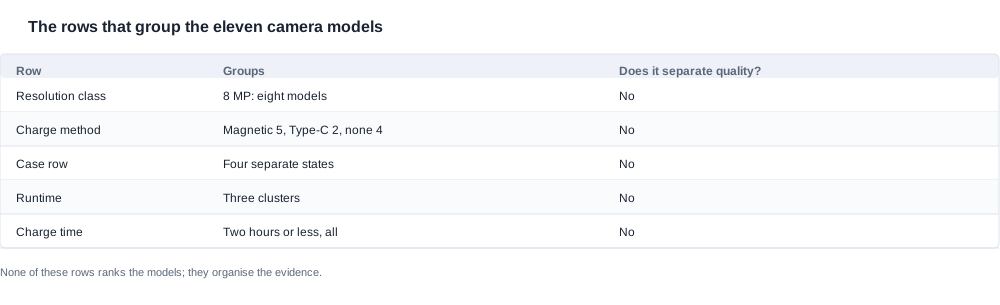
Start by sorting the eleven camera models by what actually separates them. Three rows do real work here. The resolution class splits the group into eight models at eight megapixels and three at thirteen. The charge method splits it into five magnetic, two Type-C and four unpublished. The case row splits it three ways — a published capacity, a case without published capacity, and no case row at all for four models.
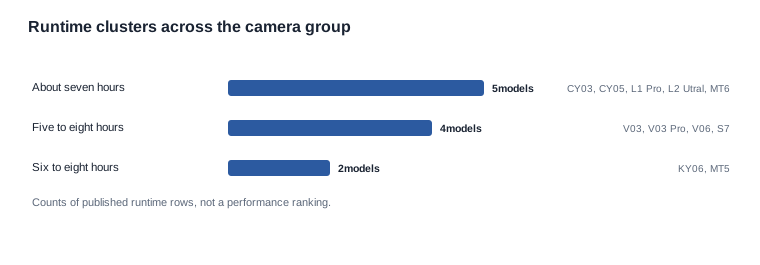
Everything else either clusters the models together or fails to separate them. Runtime produces three clusters rather than a ranking: five models at roughly seven hours, four at five to eight hours, two at six to eight hours. Battery capacity spans 220 mAh to 290 mAh without any of the differences being explained by anything published. Charge time is two hours or less for every model in the range, so it separates nothing at all.
That is the honest map. A comparison built on it tells you which candidates to shortlist and which questions remain open. A comparison that reaches beyond it is inventing differences, and the place it usually fails is the camera.
What the resolution class does and does not separate
Eight of the eleven camera models publish the eight megapixel resolution class: the KY06 and the MT6, the V03 and the V06, and the CY05 and the CY03, and the MT5 and the V03 Pro. Three publish thirteen megapixel: the S7 and the L2 Utral, and the L1 Pro.
That split is real and citable. It is also the full extent of what the catalogue says about imaging on any of these models. No sensor model, no field of view, no frame rate, no video format, no stabilisation row and no low-light description appear anywhere. So the split tells you which three models carry a higher published pixel figure, and it tells you nothing about which one produces a better photograph, because there is no published basis on which to say so.
For procurement purposes this has a specific consequence. If your decision depends on imaging quality, the resolution class is not a proxy for it, and a shortlist built on it is a shortlist of the wrong models. If your decision depends on a citable specification — what you may print on a product page, what a distributor may quote — then the class is exactly the right filter, and eight models including the MT6 qualify.
The questions to ask, in either case, are the same: which sensor is fitted, what the field of view is, what the maximum recording mode is, and whether the tested configuration is the production configuration. Those answers come from a supplier document or a sample, not from the catalogue. The reasoning behind why an unpublished sensor limits an imaging evaluation is covered in AI camera glasses imaging.

Battery and runtime: reading three clusters without implying an order
Five camera models publish roughly seven hours: the L2 Utral and the L1 Pro, the CY03 and the CY05, and the MT6. Four publish five to eight hours: the S7 and the V06, and the V03 Pro and the V03. Two publish six to eight hours: the KY06 and the MT5.
Read those three clusters correctly and two things become clear. First, a model publishing roughly seven hours has committed to a figure rather than a range, which is a stronger form of commitment — though without stated conditions, it is not yet a comparable one. Second, a model publishing five to eight hours has committed less precisely, and a buyer should resist reading the top of the range as a target.
Battery capacity does not track runtime cleanly, and the temptation to assume it does produces most of the bad comparisons in this category. Capacities run from 220 mAh through 260, 265 and up to 290 mAh, and the largest cells sit in the models at roughly seven hours, while some of the smaller cells sit in the models with the widest runtime ranges. Nothing published explains the relationship, so a buyer who assumes capacity drives runtime will misjudge at least one of the two.
The MT6's own position is worth stating precisely because it is easy to misdescribe. It publishes 265 mAh and roughly seven hours. No other camera model publishes 265 mAh, so its capacity is unique within the group; its runtime is shared with four others. If your requirement is a committed runtime figure rather than a range, five models qualify and this is one of them. If your requirement is a specific cell capacity, that requirement is met by a single model — and a requirement that only one model meets is worth questioning, because it may be a preference rather than a constraint.
Charge time is published for every model in the range at two hours or less, and it therefore separates nothing. The background on why a published ceiling cannot be compared across models without stated start conditions is in AI camera glasses battery comparison.
The charging documentation split, and why it matters for a shortlist
The charge method is the row that best separates models by documentation maturity rather than by product design. Five models publish a magnetic row — the V03 and the V06, and the KY06 and the S7, and the MT5. Two publish Type-C — the V03 Pro and the L2 Utral. Four publish nothing: the L1 Pro and the CY05, and the MT6 and the CY03.
All four of the unpublished group do publish a case capacity, so the gap is specifically about method. That is a useful narrowing: you are not asking whether a case exists, you are asking how the device connects to it.
The case row splits differently again. Five models publish a capacity: the CY05 and the L1 Pro, and the CY03 — each at 1400 mAh, the L2 Utral with a row reading 900/1400 mAh, and the MT6 with its 1200 mAh folding case. Two have a case without a published capacity: the KY06 and the MT5. Four carry no case row: the V06 and the S7, and the V03 and the V03 Pro, and what those four carry in the carton is not published.
The distinction between the last two groups is the one most often collapsed, and it is a real difference in evidence rather than a technical nuance. "No case row published" is an absence of information; "published without a case" is a statement about the product. A buyer who treats them as equivalent will either miss a case that may well exist or assume one that does not.

Two rows nobody publishes in the camera group
Bluetooth version is published for the audio models and for none of the eleven camera models. Ingress protection is published for two models in the entire catalogue, both of them camera models, and the MT6 is not one of them. Weight is published for one model in the entire catalogue, and that model is the MT6, at 158 grams for the body including battery and camera and excluding the case.
Colour options are published for two models only, again both camera models, and the MT6 is not one of them. So if your decision depends on colour, on ingress protection or on a documented radio version, this model cannot be shortlisted on those grounds at all — not because it lacks them, but because nothing is published.
How to build a shortlist from this
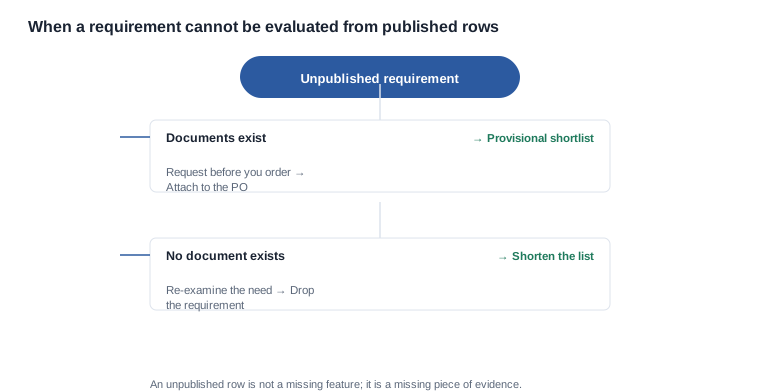
The method is short. List your requirements. Mark each one as either published or unpublished for each candidate. Keep only the candidates that satisfy every published requirement. From those, note which requirements are satisfied only provisionally, because they depend on a supplier answer. Then send the same written question set to every remaining supplier, so their answers are comparable.
Applied to this range, that method produces a shortlist whose length depends entirely on your requirements rather than on a general impression of quality. Requirements built around a committed runtime figure, a published case capacity and a citable resolution class retain a group of models including the MT6. Requirements built around a documented charge method, a documented ingress rating or a published mass figure narrow sharply, sometimes to a single candidate, which is a signal to re-examine the requirement rather than to adopt the model.
A comparison worth extending is in MT6 versus the V03 Pro, and the full set of rows for this model is in MT6 smart glasses specifications and features. The gaps on this page are itemised in MT6 smart glasses limitations, and the cross-model question is also handled in MT5 versus CY05 use case.
The trade-offs nobody publishes as a table
Three trade-offs run through this range, and none of them has a published resolution. They are worth naming because they are the actual decisions, and a buyer who cannot see them will negotiate on the wrong variable.
The first is documentation maturity against specification depth. A model that publishes a charge method but no case capacity gives you one fewer question and one more unknown than a model that publishes a case capacity but no method. Neither is better; they are different shapes of risk, and the shape should match what your operation can absorb. An operation with a strong technical file can absorb more unknowns than one that relies on a supplier's summary.
The second is range against commitment. A model publishing five to eight hours has committed less than a model publishing roughly seven hours, and a buyer who treats the top of a range as a target will build a replenishment policy that the product cannot support. Where the requirement is a planning number, prefer the model that committed to a figure; where the requirement is tolerance to variable use, a range may be perfectly acceptable and easier to source.
The third is uniqueness against documentation. The only published mass figure in the catalogue belongs to this model, which is genuinely useful for freight planning and genuinely awkward as a comparison, because there is no second figure to compare it against. Uniqueness is not a ranking signal. It is a fact that helps in one place and does nothing in another.
Before you order: a shortlist checklist
Six questions, applied to any candidate in this range before a supplier conversation starts. Which of my requirements are published for this model. Which depend on a supplier answer. Which can be measured on a sample. Which would change my channel copy if the answer went the other way. Which supplier could plausibly answer them from their own technical file rather than by running a test. And what the order looks like if none of them are answered this month.
The last question is the one most buyers skip and the one that protects them. A plan that depends on documents arriving within a specific window needs a fallback, and the fallback is usually a delay rather than a substitution. Buyers who name the delay in advance can negotiate the lead time around it; buyers who discover it discover it at the point where cancelling is expensive.
The same checklist applies to the supplier rather than only to the model. Ask what the supplier's technical file looks like for a model they have shipped repeatedly, and ask to see a redacted version. A supplier who has a file for one model will usually have one for yours. A supplier who does not will be building yours during your first order, which is a lead time you should be pricing.
How to evaluate a supplier answer in a comparison
When a supplier answers an open question, the answer does not stand alone — it stands next to the answers they gave to every other candidate. Four checks make the comparison fair. Ask all candidates the same question in the same words, at the same point in the process. Record the answer with its date, so a later supplier cannot be credited with an answer given earlier by someone else. Separate the answer from the pitch, since a confident answer with no specification behind it is worth less than a hesitant one with a report number. And check consistency, because a supplier whose answer on the charge method contradicts its answer on the case configuration is telling you something about its own documentation.
That last check is the most informative and the least used. Contradictions rarely appear in the answer itself; they appear between answers, where nobody is looking. A supplier who says the case charges the body and also says the case requires a separate cable for each model has either not thought it through or has copied from another quotation. Either way, the comparison you are building is built on an unstable foundation, and that is worth knowing before you negotiate price against it.
Negotiating against an evidence gap
Where your shortlist depends on an unpublished row, the negotiation changes shape. You are no longer comparing specifications; you are asking each supplier to close a gap, and the supplier who can close it fastest has an advantage worth more than a small price difference. Ask each candidate what the evidence costs, what the lead time is, and whether the resulting document covers the configuration you would receive. Treat the answers as a quotation line, because they are one.
Three structures work. Price the test as a separate line, so that you can compare it against the cost of a supplier who already holds the evidence. Attach the result as a condition, so that a supplier who cannot produce it has a defined consequence. Or stage the order, taking a smaller first quantity against the evidence and releasing the balance once the documents arrive, which is usually the cheapest option and the one suppliers accept most readily.
Whichever you choose, write it into the purchase order rather than the conversation. The gap on this model is specific — the charge method for the MT6 is not published, and neither is the ingress rating, the sensor detail or the approval scope — and each of those is a document to be requested rather than a feature to be assumed. The gap is not a reason to exclude the model. It is a reason to write better questions.
Recording the comparison so it survives the next order
A comparison is worth exactly as much as the record behind it. Keep one page per candidate model, and on it record only what is published, with the row you took it from, plus a separate column for supplier answers with their dates. Two columns, clearly separated, because the most common failure in a later dispute is a supplier answer that has been folded into the specification over time and then treated as though the catalogue had always said it.
Add a third column for measurements you took yourself, with the conditions attached. Measured rows are the most valuable and the most often discarded, because they belong to no supplier and no document. A runtime you measured under a stated workload, a case recharge count you ran to a stated end condition, a body mass you weighed across a stated sample — those numbers are yours, and without them a repeat order restarts the work from nothing.
The result is a comparison that improves with each order rather than being rebuilt each time, and a risk register that shows which unknowns have actually closed. Buyers who keep the two columns separate find that the supplier answers converge over successive orders, which is usually the first sign that the relationship is becoming durable, and a useful signal even when the numbers themselves have not moved.
What we can compare, and what we refuse to compare
We will map the published rows across this camera group and show you exactly how the eleven models divide, because that structure is real and useful. We will also tell you where the rows run out, which for the camera models is sooner than most buyers expect: eleven models, five specification rows each, and not one of them describing the camera beyond a resolution class.
What we will not do is rank them, name one as the strongest, or infer a specification that a neighbouring model publishes and this one does not. Those conclusions are not in the record, and a buyer who acts on one of them has accepted a risk that nobody has priced. Our position is that the honest output of a comparison at this level of documentation is a shortlist, a list of open questions and a supplier who will answer them in writing — and that a range which publishes no charge method, no ingress rating, no colour options and no mass figure for ten of its eleven camera models is best served by buyers who ask those four questions before they commit.
The one figure the catalogue does publish for this model is a body mass of 158 grams, excluding the case. It is genuinely useful for freight planning, and it is not a comparison point, because nothing else in the range offers a figure to compare it against.
Related reading
- The camera range this model belongs to — AI camera glasses
- Every published row on this page — MT6 smart glasses specifications and features
- The gaps, itemised — MT6 smart glasses limitations
- Battery clusters across the group — AI camera glasses battery comparison


