
Smart glasses lead time has a slightly rude answer, and it is not the one most buyers expect. The question is not whether the supplier is fast. The question is who absorbs the cost when the date moves three weeks. If that cost lands on you and cannot be recovered, you need a lead time — and you need it with the long pole named. If the cost is absorbed by a partner's flexibility or by your own inventory, a lead time buys you nothing, and what you actually need is a re-order trigger point.
That distinction decides more programmes than order size, supplier location or the confidence with which a date was quoted. Two buyers can be working on the same model with the same factory, and one of them needs a schedule while the other needs a trigger.
We publish no lead time, no capacity figure and no output rate, so this article is about which kind of answer each programme needs rather than about any particular duration.
Smart glasses lead time: decide who absorbs the cost of a slip
Two kinds of date, and only one of them needs a lead time
There are two kinds of delivery date in this category, and buyers confuse them constantly because they arrive in the same format — a number on a quotation.
A locked date is one that something outside your control depends on: a retail season, a trade show, a partner's range plan, a shipping window, a regulatory filing date. When a locked date slips three weeks, the loss lands on you, it is immediate, and it is not recoverable by any commercial argument afterwards. This is the only kind of date for which a lead time is a real procurement instrument, and even here the useful answer is a date plus the stage that sets it.
A floating date is one that you are free to move. On a first trial order, on a repeat order against existing stock, and on any programme with no external deadline, a three-week slip is an inconvenience rather than a loss. In that situation a lead time is a parameter in a margin model, and the number worth having is the one that triggers a re-order, not the one that describes production.
The practical consequence is that a buyer who asks for a lead time without asking who bears the delay will receive a figure that is useless for the decision. This is why the question has to be asked before the schedule conversation starts, not after the first date arrives and turns out to be a guess.
Where the loss of a late delivery actually lands
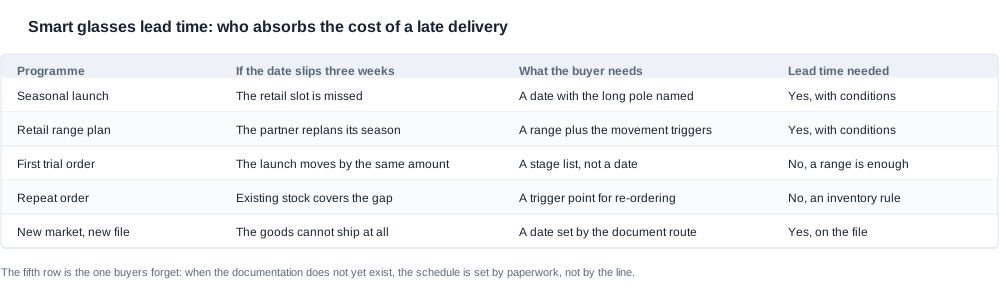
Work through the five programme shapes in the table, and the deciding variable is consistent. Where the loss of a delay is recoverable, the schedule is not the constraint; where it is not recoverable, the schedule is the only thing that matters.
The seasonal launch is the clearest case. A missed season is gone for a year, the marketing plan was built on the date, and the inventory has to be written down or carried for longer than anyone planned. This is where a lead time with conditions attached is worth the effort of asking for it.
The retail range plan is the same pressure one step removed. A partner is planning their own season against your date and will ask what makes it move. A bare date is a promise you cannot keep and cannot explain; a date with its conditions attached is an answer you can defend in a range review.
The first trial order is where buyers most often spend effort they do not need. On a first order the binding constraint is almost never the line: it is the configuration, the documentation and the sample, and those stages are usually ahead of production. Optimising a schedule before those are settled optimises the wrong thing and produces a date that is both precise and meaningless.
The repeat order is the case where a lead time matters least. The stages that consumed the first order's time are behind you, the remaining time is mostly materials, and stock usually covers a three-week gap. The number worth having is the re-order trigger, and the risk worth managing is inventory rather than schedule.
The fifth row is the one that catches buyers out: a new destination market where the documentation does not yet exist. Here the goods cannot ship at all until the file is complete, so the schedule is set by paperwork rather than by production, and a schedule built on factory output will be wrong by the entire duration of the document work.

What a lead time is made of when no figure is published
The seven links, and which one is the long pole
A lead time is not a number, it is a chain of seven links, and only one of them is usually the factory.
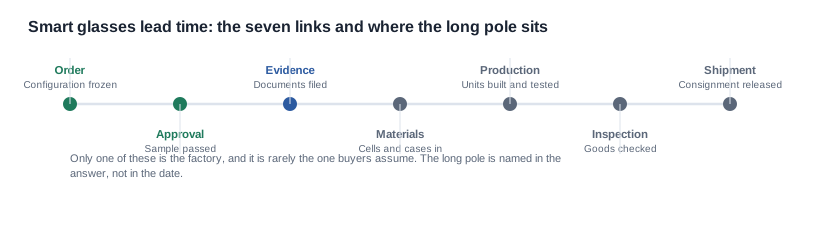
The links, in the order they occur, are: freezing the configuration; approving the sample against a written list; filing the conformity evidence; getting the materials — cells, cases, packaging — into position; building and testing the units; checking the finished goods; and releasing the consignment. Most buyers model only the fifth link, and then measure their schedule against a promise that was really about the third.
The long pole is whichever link is currently slowest, and it moves. On a first order into a new market it is frequently the evidence. On a repeat order with a stable configuration it is usually materials, because the line is running standard product. On a custom programme it can be the artwork or the firmware, neither of which is visible in a production schedule.
The two stages that are routinely mistaken for production work
Two of the seven links are invisible as factory work altogether, which is precisely why they are underestimated.
The first is the documentary stage. Conformity evidence, the battery transport file for the lithium cells, the destination declaration and the labelling review are all schedule items, and all of them sit on the critical path in a new-market programme. None of them produces units, so none of them appears on a factory plan, and a buyer who builds a schedule from the factory's plan alone will discover the missing weeks at the point where they can no longer be compressed.
The second is the approval stage. A sample tested against a written list, artwork approved, a firmware version signed off — these are days of elapsed time that consume nothing, because no production capacity is used. In a category where the configuration changes between the quotation and the first production run, this is often where the schedule is actually won or lost.
There is a third, quieter item worth naming: the packaging and artwork route. A private-label programme has an artwork approval cycle, a print cycle, a delivery of printed materials to the factory and a packing-line changeover. None of it appears in the published catalogue, all of it is real, and all of it is invisible to a buyer who has not asked for the stage list.
Asking for a schedule in a form that can be verified
Four questions and the answers worth trusting
- Which stage sets the date for our configuration? A supplier who names a stage has a schedule. A supplier who says "the line" has not yet looked at the programme.
- What are the units per week for our configuration in our month? A plant-wide rate or a daily total is not an answer to a planning question, because it tells you nothing about what your order displaces.
- What does our order displace in the plan? This is the question that reveals whether the position is real, and it is the one most often deflected.
- Which three assumptions does the date depend on? The configuration, the documentation status and the material position. A date with three assumptions attached is a plan; a date without them is an aspiration.

Two of the four are worth pressing on. The displacement question is the one that separates a real slot from a courtesy answer, because a supplier with genuine spare capacity can say what it pushes aside and one without it will answer with vagueness. The assumptions question matters because it tells the buyer which parts of the schedule are actually fixed by the other party and which parts are the buyer's own to manage.
The two answers that mean the supplier has a number rather than a plan
A usable schedule can be checked against four things. It names a configuration. It names the stage that sets the date. It says what moves that stage. And it states units for the buyer's own order rather than a plant average.
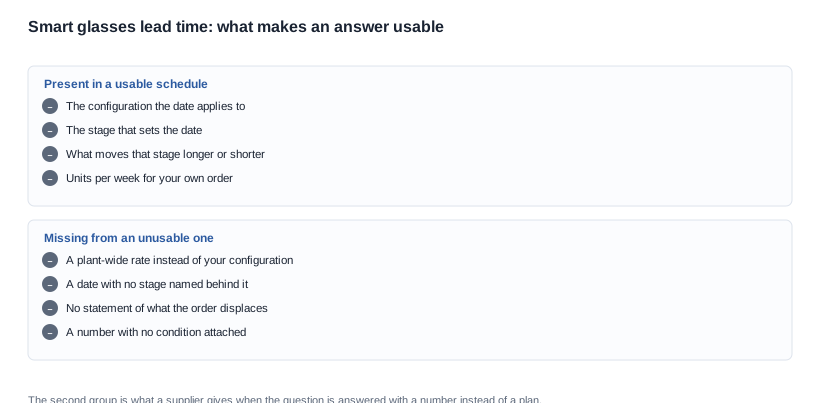
Against those four, a weak answer has a recognisable shape. A date with no stage behind it. A rate for the whole plant. Nothing about displacement. And a number with no condition attached — "about six weeks" without the configuration, the documentation status and the material position.
There is a fifth failure that is easy to miss because it sounds rigorous: a schedule expressed as a range with no conditions, which is the same as a single number with more room around it. A range is only useful when the buyer knows what moves the ends of it. Without that, the range is not uncertainty, it is vagueness.
How to compare two schedule answers from different suppliers
Two buyers comparing quotations in this category routinely compare the wrong field. The date is the field that is easiest to read and the least informative, because the two suppliers are answering the question about different programmes: one is planning around a standard configuration with existing materials, the other is planning around a private-label bundle with a print cycle nobody has scheduled. The criteria that actually separate the two answers are the four above — configuration, long pole, what moves it, and units for the buyer's own order — and a shortlist built on those four will not rank the dates wrongly.
Three practical rules apply to how to compare them. First, normalise before comparing: write both answers against the same configuration, or the comparison measures the difference between two programmes rather than the difference between two suppliers. Second, compare the long poles rather than the totals, because two suppliers with the same total duration and different long poles carry completely different risk for a buyer with a fixed date. Third, price the total cost of the schedule, which is the material cost of holding stock early, the cost of the documentation route and the cost of a schedule change, because a shorter date that forces earlier stock is not a shorter programme.
The questions to ask are the same in both cases, and the answers worth trusting are the ones that name a stage. The red flags are consistent too: a plant-wide rate, a date with no stage behind it, nothing about displacement, and a number with no condition attached. When to escalate from a question to a requirement is a decision about the programme rather than the supplier: escalate when the date is locked and the long pole is on the buyer or on a third party, because at that point the schedule has to be managed rather than negotiated.
The trade-offs are worth naming precisely, because they are the ones that repeat. A tight date from a supplier who has not named the long pole is worse than a loose date with the long pole stated, because the first looks actionable and is not. And a schedule agreed without a movement trigger is not a schedule at all; it is a date with a refresh, which is a pilot programme that has not been recognised as one.

What the published rows say about the schedule
Where the configuration pushes the schedule
The published catalogue rows are not schedule rows, but they determine which schedule stage is live, and a buyer who reads them as schedule data will mis-plan.
The charging interface is published for 24 of the 28 models — 17 on magnetic charging and 7 on Type C. The MT6 and the CY05, and the L1 Pro and the CY03 publish no interface row, although all four do publish a charging-case capacity. On those four models the connector question is a schedule input rather than a published row, because the answer may require a different tooling or a different packaging route.
The charging case is published in three different states across the 11 camera models. Five publish a capacity, two publish a case without a capacity, and four publish no case row at all — the S7 and the V03 Pro, and the V06 and the V03. A model published with two case capacities — the L2 Utral genuinely has 900 or 1400 mAh — produces two material sets and two packing routes, and that is a materials-stage item, not a specification detail.
The radio version is not published for any of the 11 camera models, and the catalogue text carries no touch row for any model, on the K01 or on anything else, so the touch behaviour of the temple is a question for the supplier rather than a catalogue fact. For a camera programme this means the radio parameters sit on the documentary stage of the schedule whether or not the destination market needs them.
Why charge time and run time are schedule rows and not consumer rows
Charge time is published for all 28 models: 26 of them written as a ceiling of two hours or less, and the D17 and the ZH12 written as about one hour. A ceiling of two hours or less is an upper bound, and the two faster models should not be presented as though the other two exceeded two hours.
The schedule point is different and more useful. The published charge time has no starting state and no termination criterion, so it cannot be converted into the duration of a mid-shift interruption, and it cannot be used as a case turnaround figure either. A buyer planning a shift pattern needs to ask for the starting state and the termination criterion separately; until they do, the published number tells them the unit can be brought to a full charge in two hours or less and nothing about what happens in between.
Run time is the other published row that belongs to the operational schedule. It is published per model and it is what determines how many units a user carries through a shift, which in turn drives the size of the re-order and the depth of the buffer. It is a planning input, and it is the row that justifies the inventory trigger point in a floating-date programme.
A worked illustration: a launch slot that could not move
Nothing below describes a real order. The company, the dates and the volumes are illustrative, and the purpose of the illustration is the sequence of decisions rather than the outcome it produces.
A brand-side buyer has a launch tied to a retail season. The season date cannot move, because the retailer's range plan is published. The model is a camera model in the 8 MP class, the order is a first order for that model in that destination, and the buyer has one supplier quotation with a date attached to it.
Step one is the loss test. The season is locked, so a three-week slip is unrecoverable and lands on the buyer. This is a locked date, and the buyer needs a schedule rather than a trigger point.
Step two is the long pole. Asking which stage sets the date for this configuration returns a stage that is not production: the destination declaration and the labelling review have not been started, because the buyer is the importer of record in this market and the document is the buyer's own. That makes the documentary stage the long pole, and it means the factory's production rate is not the constraint.
Step three is the configuration check. The model publishes a case row, so the packing route is settled, and the model is in the group that publishes an interface row, so the connector is known. The buyer writes those two facts into the milestone list and stops asking the supplier about them.
Step four is the material position. The order needs the printed artwork for the private-label bundle, and the print cycle sits between the artwork approval and the packing changeover. The buyer adds a milestone for it, with an owner, because it is a stage the supplier does not own and therefore one the supplier will not report on.
Step five is the conversion. The date becomes six milestones, each with an owner and a movement trigger, and the first two — the declaration and the labelling review — sit with the buyer. The buyer's own actions are now visibly the critical path, which is a different position from the one the buyer started in when they believed they were waiting on a factory.
The interesting outcome is that the buyer's urgency should have been directed at their own paperwork, not at the supplier's schedule. A buyer who had started by asking for a tighter date would have been negotiating the wrong link.
The lead time buyer checklist is the item list for the four questions above, and the lead time worked example works a second shape of programme through the same stages.
The lead time we will not put in writing
The boundary we hold: we publish no lead time, no capacity figure and no output rate, because our internal position on them is not settled, and a date we cannot commit to in writing is not a lead time. We will not present a production estimate as a schedule commitment, and we will not quote a duration for a stage we do not control.
What we publish is the configuration data a schedule is built on: cell capacity, charge time and run time for all 28 models, a charging interface for 24 of them, a camera resolution class for all 11 camera models, a charging-case capacity for five of those, an ingress marking on two rows and a body weight for one. What we cannot publish is the schedule itself, and the gap between those two lists is exactly the part of the lead time a buyer has to ask for.
The capacity side of the same question sits under production capacity assessment, and the wider framework under lead time and production schedule.
Tell us what you are planning, which market it goes into and what happens if the date moves, and we will tell you whether you need a schedule or a trigger point — and which stage of the seven is most likely to be your long pole.