

A worked lead time example is offered here as a structure rather than as a schedule, because no production duration and no capacity figure are published for this operation, and a worked duration would be a number nobody could defend. What can be worked through honestly is the shape of the schedule: which stages exist, which of them disappear between a first order and a repeat, and which one is the long pole in each case.
The example that follows is a hypothetical scenario assembled to show how the reasoning works. The brand, the model line, the market and the two quantities are all assumptions chosen to exercise the decision points. No order that has been placed is described, no customer is named, and no figure in it is a quotation.
Smart glasses lead time: what a worked example can and cannot show
The scenario and its assumptions
The assumption is a brand opening one camera platform in one colourway for one destination market, with a first order that the factory quotes at whatever its commercial floor turns out to be, and a second order four months later for a larger quantity against the same configuration.
Four assumptions underneath it matter more than the scenario itself, because they are the ones a real buyer has to test before using any of the reasoning.
The first is that the configuration is genuinely fixed. If a second colourway or a different charging case is added, several of the stages below re-open, and the comparison between first and repeat order largely disappears. The L2 Utral is the clearest case in the published range, because it publishes two case options at 900 mAh and 1400 mAh, and because the carton is sized by the case, so a change of case is a change of production item and a change of packaging.
The second is that the destination market does not change. The document route is per model and per market, and it is additive work rather than a stage that re-runs. A new market in the second order adds a parallel workstream, and it does not make the first market's route faster.
The third is that the second order is a repeat of the same configuration rather than a new build on the same model. A new colourway on a model that has already been built is closer to a first order in document terms than a repeat order, because the route has to be checked again for that string.
The fourth is that nothing about the demand changes between the two orders. The example is about the schedule, and the schedule is one of several inputs to the quantity decision rather than a substitute for it.
What this example cannot show, and what it can
It cannot show a duration, and any worked example that appears to is doing something else. A worked duration would have to assume a configuration, a quantity, a factory queue and a documentation route, and each of those assumptions would be doing more work than the result. A number produced that way is not a quotation and it is not an average; it is a set of four assumptions wearing a number's clothes, and the useful part of it — the reasoning about which stage binds — is thrown away along with the assumptions.
What the example can show is the shape of the schedule and the shape of the change between two orders, and both of those are robust to the specific numbers. That the first article disappears on a repeat is a structural fact about approval, not a fact about this factory's speed. That the document route is the long pole in a new market is a structural fact about the order of operations, not about capacity. That a second order is less uncertain rather than merely faster is a structural fact about what has been decided.
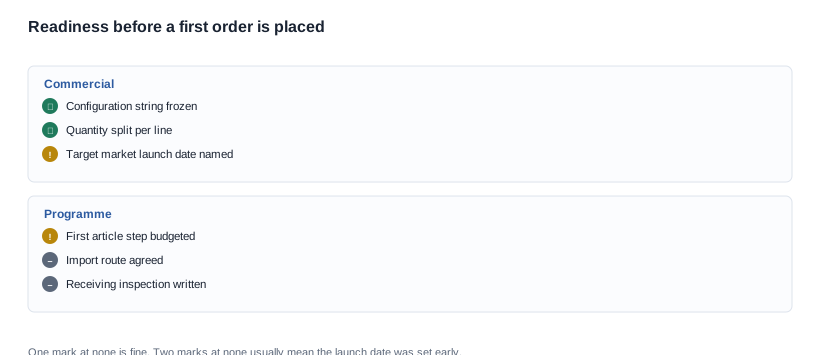
The practical way to use it is as a template for your own order. Take the seven stages, put your own configuration against each one, and mark which of them you can see and which you cannot. The stages you cannot see are the programme. A worked example is worth nothing if it is read rather than filled in, and the whole value of the exercise is in the rows where the buyer has to write "unknown" and then go and find out.

The first order, stage by stage
The seven stages, and what each one actually costs
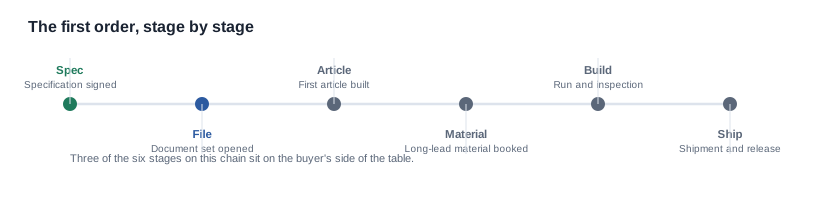
Specification. New, written and signed. This is the stage that most often sits unowned, and it is where the first order genuinely spends its time — not in the factory, but in agreeing what is being built. It is also the stage where the buyer should be doing the most work, because everything after it inherits whatever was decided here.
The cost of a specification is not the writing. It is the number of decisions in it, and in this category a specification is wider than a model code. A camera platform carries a resolution tier, a cell capacity, a charging method and a case option; it carries a colourway, a firmware scope, an artwork revision, a packaging configuration and a destination list. Each of those is a decision somebody has to make, and each one that is left open becomes an open item that the schedule has to carry. The published configuration options are the easiest way to see the scale of it: three colourways on the V03 Pro, four on the V06, and two charging case options on the L2 Utral at 900 mAh and 1400 mAh. A programme that has not chosen between those has not chosen what it is buying, and the factory cannot schedule it.
There is a related cost that shows up later rather than now. Four camera models in the range — the MT6 and the L1 Pro, and the CY05 and the CY03 — do not have a published charging method at all, and the V03 Pro has no charging case. Those are not obstacles to a programme; they are simply the kind of detail that has to be closed with the supplier before a configuration can be frozen, and they are much easier to close at the specification stage than at the first-article stage.
Tooling. None, for a standard platform. This is the single largest reason a standard OEM programme moves faster than an ODM one, and it is the reason to choose the programme for that reason rather than for the unit price. A new mould or a new temple shape converts the tooling line from zero into a one-time cost and a new model, and it also adds a stage that has to be scheduled.
The document set. Built for the model strings in the order, and it is real work rather than administration. Where a model is not already in the file for the destination market, this is the long pole, because the schedule is then set by documentation rather than by production. A brand that recognises this early will not plan a launch date that assumes a production schedule.
The first article. One production unit, built and checked against the written specification. This is the stage that catches a specification nobody actually agreed, and it is worth the time it takes precisely because it is cheap compared with a shipment that has to be reworked. The catalogue publishes runtime for all eleven camera models — the V03 and the V03 Pro at five to eight hours, the KY06 and the MT5 at six to eight, the CY03 and the L1 Pro, the CY05 and the MT6, and the L2 Utral at around seven, and the V06 and the S7 at five to eight — and it publishes charge times for all twenty-eight models, twenty-six of them at two hours or less with the D17 and the ZH12 at around one hour. What it does not publish is defect rate, yield or rework policy, and that gap is precisely what the first article exists to close on the buyer's side.
Materials. The long pole in a market where the documentation is settled, because the main controller is the item with the least flexibility. This is where the buyer's cash is exposed, and where the state of the supply chain matters more than the skill of the factory.
Production and inspection. The run itself, and the gate before the balance of the order is released. An inspection that waits on a document is a stage rather than a formality, and the order in which the inspection instruction and the document set are ready determines which of the two ends up holding the other up.
Shipment. The document set — invoice, packing list, bill of lading, origin, and the battery transport test summary, mandatory since 2020-01-01 — together with the mode, which the battery rules constrain rather than follow.
The repeat order, and the three stages that disappear
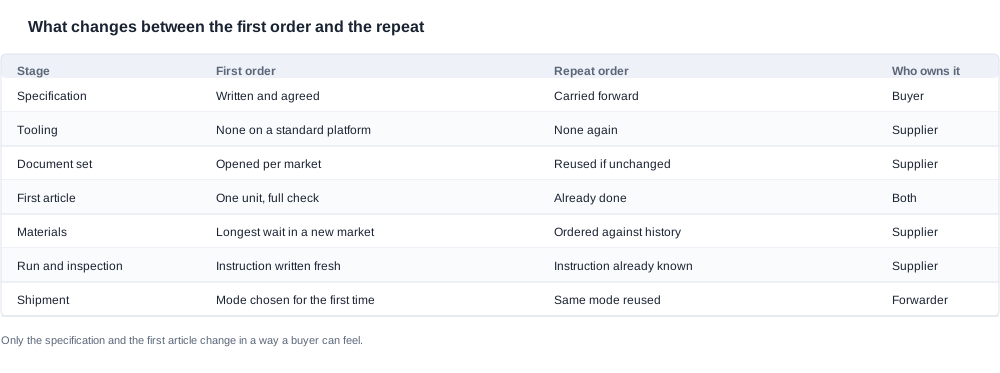
Comparing the two orders is where the example earns its keep, because the difference between them is not a matter of speed. It is a matter of which decisions have already been made.
| Stage | The first order | The repeat order | Who owns it |
|---|---|---|---|
| Specification | Written and agreed from scratch | Carried forward unchanged | Buyer |
| Tooling | None on a standard platform | None again | Supplier |
| Document set | Opened for the model and market | Reused where the string is unchanged | Supplier |
| First article | One unit built and fully checked | Already done for this configuration | Both |
| Materials | Longest wait in a new market | Ordered against a real history | Supplier |
| Run and inspection | Instruction written from scratch | The instruction is already known | Supplier |
| Shipment | Mode chosen for the first time | The same mode reused | Forwarder |
Three stages genuinely disappear: the specification, the first article, and most of the document work. Two stages change character without disappearing: materials move from a guess to an order placed against a known requirement, and inspection moves from a document being written to a document being followed.
Two stages do not change at all, and they are the two that most often surprise a buyer planning a second order. The tooling line is zero the first time and zero the second time only because the programme was built on an existing platform — a programme that introduced a new mould has a tooling stage on both orders, and the second one is cheaper but not free. And the shipment stage is identical in structure on both orders, because the document set and the mode have not changed; a buyer expecting the second shipment to be simpler because the first one went well is assuming that a shipment gets easier with repetition, and it does not.
What the comparison tells you about the second order
The useful conclusion is not that the second order is faster. It is that the second order is less uncertain, and the two are not the same thing. Uncertainty is what makes a schedule a problem, and it is concentrated in exactly the stages that do not repeat: agreeing what is being built, and having a unit approved against it.
A buyer who has already paid that cost once and who has a real order history rather than a forecast is in a materially better position for the second order, and the position is worth something at the point of negotiating quantity. A programme that has one completed order behind it can be planned; a programme that has not can only be guessed at. This is also the point at which the difference between an OEM programme on a standard platform and an ODM programme is felt most clearly, because in the ODM case the tooling and the document work do not disappear on the second order, they simply get cheaper.

Where the long pole actually sits
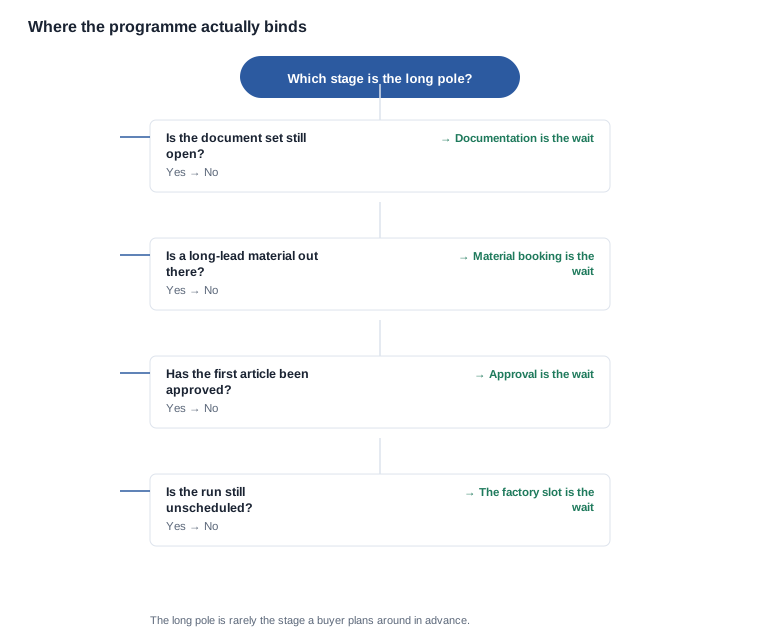
A brand that has planned around production is planning around a stage that is usually not the constraint. The long pole in a new programme is most often at the front of the chain and on the buyer's side of it.
The four candidates below are the ones worth testing, and the order in which they are tested follows the order in which they usually bind. The point of running the test is that each one has a different owner and a different lever, and guessing wrong wastes a quarter of a programme.
The document route. Binding when the model is not already in the file for the destination market. The lever is the choice of market and the timing of the request, and it belongs to the buyer's compliance function. The published position is that certificate numbers, issuing bodies and validity dates are not available, so what a buyer can work with is a described route with stage boundaries rather than a reference to a certificate that might already exist.
Material booking. Binding in a market where the documentation is settled and the demand is real. The lever is volume concentration and early commitment, and the exposure is cash rather than time. The catalogue gives a buyer the cell capacity per model, which is what makes a concentration question answerable at all: a commitment on a single 265 mAh line is a different commitment from the same volume spread across 220, 260, 265 and 290 mAh lines.
The first article approval. Binding when the specification was rushed, which is common on a programme where the launch date was set before the product was designed. The lever is the approval response window.
The factory slot. Binding only when the other three have been closed, which is why it is last. It is the stage most buyers plan around, and it is the one that is usually free.
On the repeat order the long pole moves, and the move is worth anticipating because it happens in a predictable direction. The document route loosens, because the file exists. The first article loosens, because the approval is done. Material booking tightens, because the requirement is now a fact rather than a forecast and a factory can buy against a fact more aggressively than against an estimate. The stage that tends to tighten last is the inspection, because an inspection instruction written for a first order tends to be broader than the evidence the programme actually needs, and a buyer who has paid for a wide first inspection tends to keep paying for it.
That last effect is worth watching for on its own. Programmes frequently carry a first-order inspection specification into their second order because nobody has reviewed it, and the inspection then becomes a larger share of the repeat order's schedule than it was of the first order's. Reviewing the acceptance criteria between orders is one of the cheapest schedule improvements available, and it is entirely within the buyer's control.

The five decisions the example forces on a buyer
Running a scenario like this is only useful if it ends in decisions rather than in a picture. Five follow from the structure above, and they are worth writing down in the same order every time.
- Which stage is the long pole for this specific order, and who owns it? Not the factory. If the answer is a buyer-side stage, the lever is also buyer-side, and the schedule can be improved before anybody is asked to perform better.
- Does the second order repeat the structure, or re-open it? Every stage that re-opens is a stage that has to be funded twice. The test is specific: same model string, same colourway, same case option, same destination market, same firmware scope.
- What is the total cost of the delay, rather than the delay itself? A late order on a seasonal programme costs storage, marketing spend on a launch without the product, and a discount on the leftover. This is the number that decides whether a schedule risk is worth carrying, and it is the number a range should be tested against.
- Which one-time costs disappear on the repeat, and which do not? Tooling does not disappear on a standard platform because it was zero to begin with; a mould introduced for the programme does not disappear; the first article disappears; most of the document work disappears. The list is the negotiation, because each surviving item is something the buyer can pay to have removed.
- What would have to be true for the date to hold? The answer is a named document or a named approval, in almost every case, and it is the same answer whether the order is a first order or a repeat. If the answer cannot be named, the date is a hope rather than a plan.
What Cynrin will and will not put against a schedule
The working rule we apply: we publish no production lead time, no capacity figure and no daily output, and we will not print a schedule we cannot commit to in writing. A lead time is a commitment, and a commitment belongs in a quotation against a defined configuration, not on a web page that applies to no order in particular.
What we can do is take a buyer's plan and mark which stages it has, which it has omitted, and which of the two stages disappeared between the first order and the second. We will build the milestone schedule for a configuration you name, with a start condition, an owner and a date on each stage, and we will mark the stages that remain open rather than filling them with a typical figure. We will describe the document route per model and market, and we will say plainly where it crosses a boundary we do not control — the euro radio requirement sits under the Radio Equipment Directive (EU) 2014/53/EU and the electromagnetic compatibility requirement under a separate directive, and those are two obligations rather than one.
What we will not do is put a number against a stage we have not scheduled, and we will not let a total stand in for a plan. We will also not describe a configuration as reorderable without checking what is behind it, because the catalogue's option counts make it easy to build a colourway or a case option that turns out not to be repeatable at a useful quantity, and that is a worse surprise than a slow first order.
The scheduling context sits under lead time and production schedule, the buyer's own list is in the lead time buyer checklist, the capacity side is covered in production capacity assessment, and for anyone deciding whether they need a capacity figure at all, who needs smart glasses lead time sets out who should be asking.
Related reading
- The buyer's list — lead time buyer checklist
- Who needs what — who needs smart glasses lead time
- The capacity side — production capacity assessment
- The wider framework — lead time and production schedule
Send us your plan and we will tell you which stages it has and which it has omitted.


