

You should be looking at the V03 Pro if your brief needs photochromic lenses, a stated Type-C interface, or three retail colourways. You should look elsewhere if your proposition leads on image quality — the V03 Pro is an 8 MP model, not a 13 MP one — or if it depends on a charging case, which is not listed for it.
V03 Pro smart glasses are the model you buy when the feature list, not the camera, is doing the selling. That is a narrower brief than most buyers arrive with, and it is a better one, because four of the rows that justify this model are published and checkable while the row that does not justify it is published only as a number. The reasoning is one catalogue row at a time, and the shortlist question is whether your customer notices a lens.
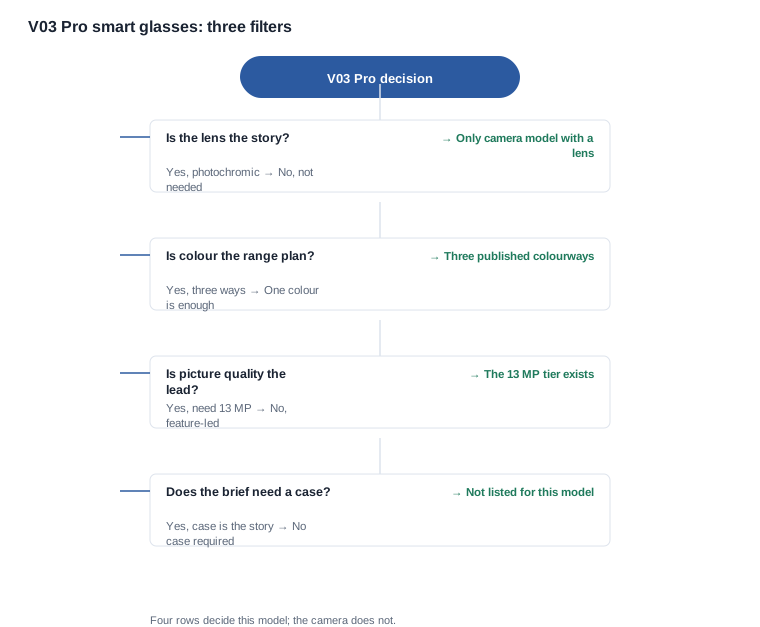
V03 Pro smart glasses and the four rows no sibling publishes
A photochromic lens. This is the strongest single reason to pick this model, and it is also the row no other camera model in the range carries. The camera family publishes lens features on this model alone, which means a brand selling an adaptive-lens proposition has no direct substitute on the same platform. That is a real competitive position, and it is worth more than a resolution step in a channel where the shelf is full of products claiming similar numbers.
A Type-C charging interface, stated. Most rows in this catalogue do not name their interface. This one does, which removes a packaging question, an instruction-sheet line and a certification question about what is in the box. In a direct-to-consumer channel it also removes an accessory from the carton, which reduces the packed weight and the customer's first-week friction at the same time.
A flexible temple. Published on this model and not on the sibling V03. It is a mechanical row rather than a headline, and its commercial value is in returns rather than in click-through — a temple that can be adjusted takes pressure off the contact points that generate discomfort complaints.
Three published colourways: orange, cream white and black. Three is enough to build a retail range without new tooling, and for a channel buyer a colour ladder is often worth more than a resolution step. The question to ask is which colours exist in which configuration, because a colour in a listing that cannot be ordered is a return waiting to happen.
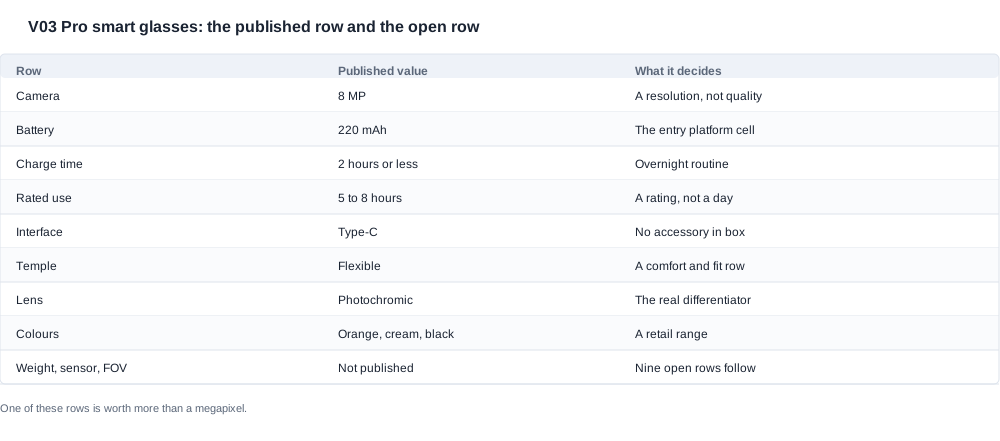
And two rows that are ordinary on purpose. A 220 mAh cell, shared with the sibling V03 and the MT5, and a rated endurance range of 5 to 8 hours with no test condition published. Those are platform rows, not differentiators, and a buyer should treat them as such rather than as evidence for or against the model.
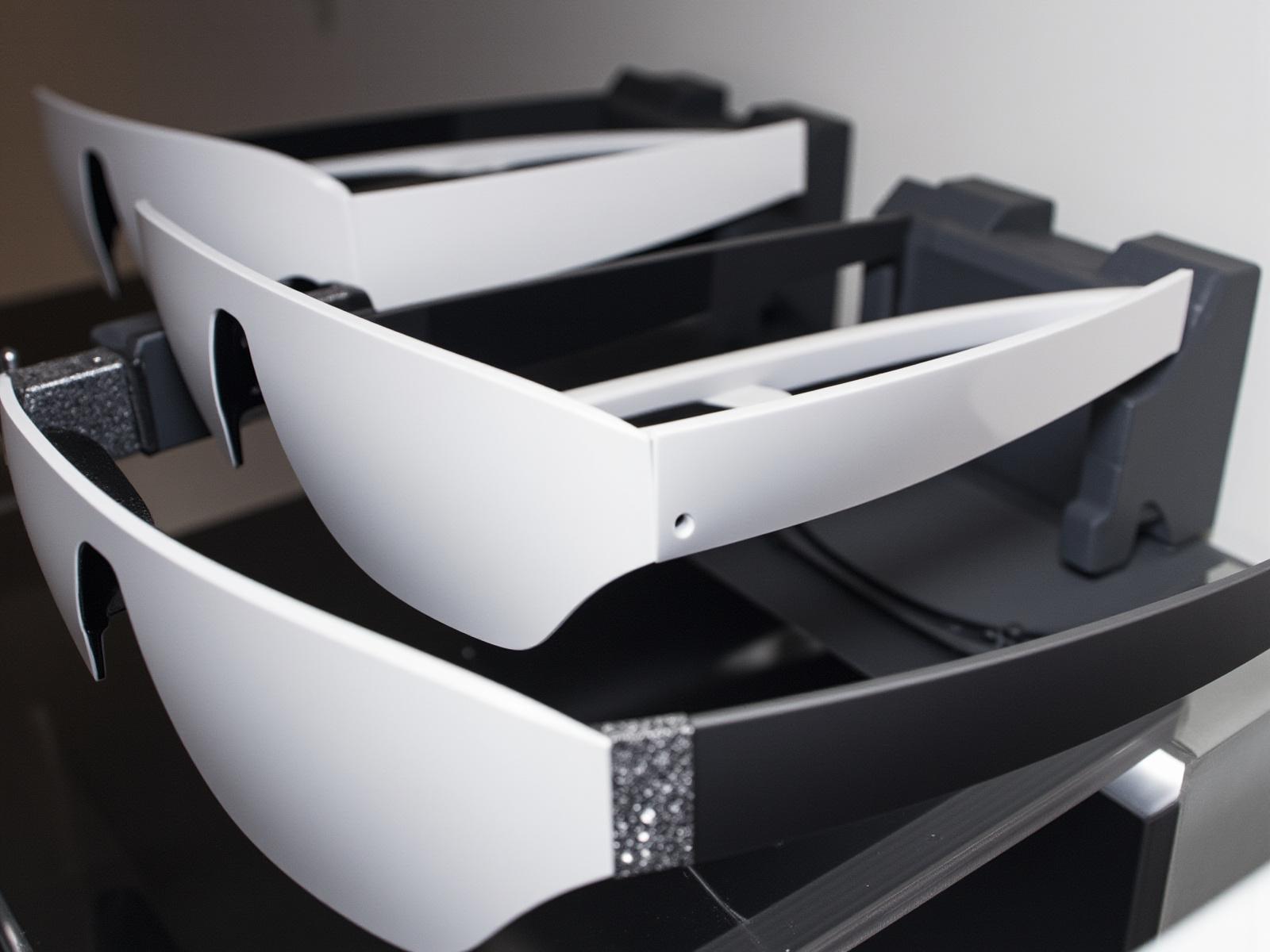
The photochromic lens: what can be committed to today
You can commit to the feature. The catalogue states that this model carries a photochromic lens, and that is a commitment a brand can make on a product page, in a packaging panel and in a channel briefing.
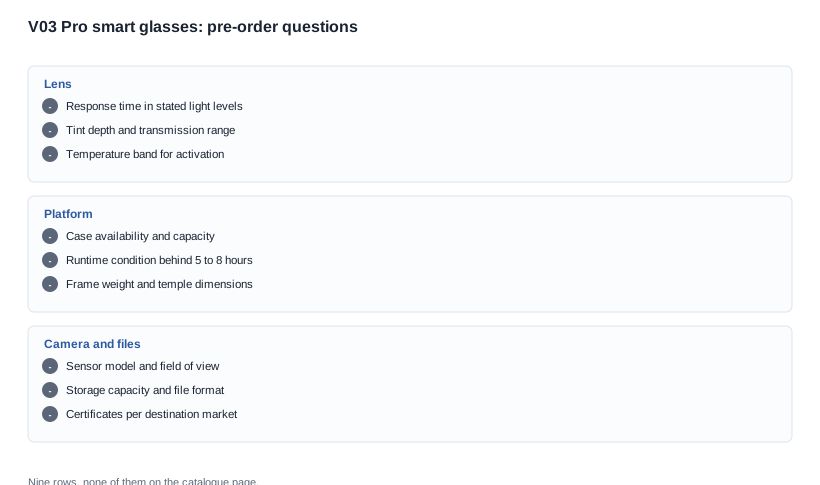
You cannot commit to its performance. Response time, tint depth, transmission range and the temperature band over which the lens activates are all unpublished, and all four are exactly what a buyer compares between suppliers. A photochromic lens that takes two minutes to darken and one that takes ten seconds are the same product on a specification page and completely different products in a customer's morning. Our photochromic lens technology guidance covers the parameters that decide that difference.
The three measurements that settle it. Time to reach a defined tint depth, from a defined starting light level. The tint depth reached, measured rather than described. And the temperature band over which the lens darkens, because a lens that performs in a temperate climate may not perform in a hot one. All three are sample-stage measurements, all three are cheap, and a brand that has them has an argument that a brand with only the feature name does not. The photochromic smart glasses range page covers what is and is not known about the format.
The commercial consequence of getting this wrong. A channel that sells an adaptive lens and cannot describe its performance will get returns concentrated in one climate band, and it will get them late, because the customer has to wait for a sunny morning to discover the problem. That is the most expensive failure mode on this model, and it is entirely avoidable with three measurements on one sample.
The buyer who should not chase this. If your market is temperate, indoor-weighted and your customer will not notice a difference in tint depth, the lens is a differentiator in a listing and not in the hand. In that case the colour row is doing the work, and the decision should be made on the colour and interface rows instead.
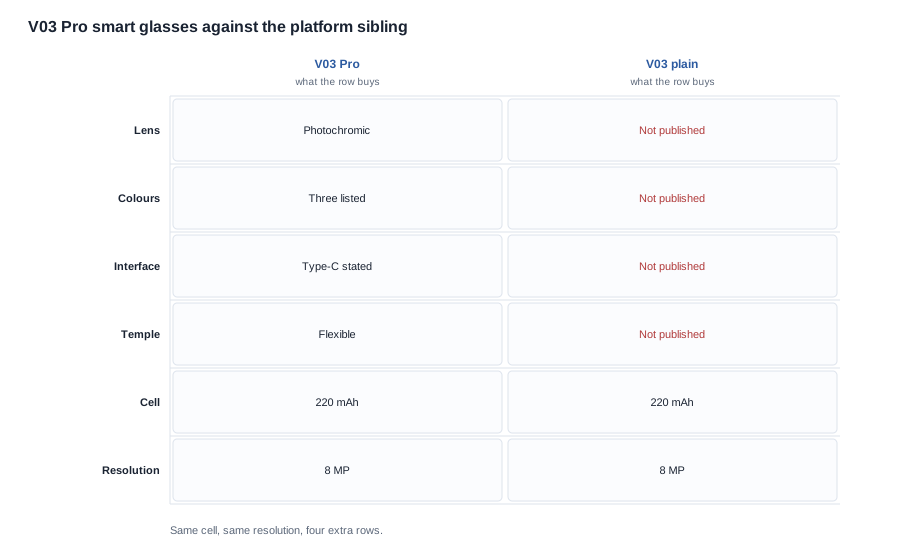
Platform economics behind the entry decision
The 220 mAh platform carries three models. The V03, this model and the MT5, which carries a sport positioning. One cell size, one charging method, one accessory family, one firmware branch across the three. For a brand building a range rather than a single SKU, that is the argument that matters more than any single feature row: the operational cost of a second platform is larger than the specification difference between two models on the same one.
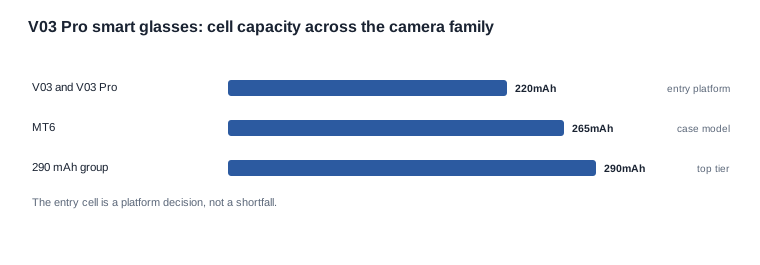
The cell size is a platform decision, not a shortfall. The entry platform sits at 220 mAh while the mid-range MT6 carries 265 mAh and the top group carries 290 mAh. A buyer choosing the V03 Pro over a larger-cell model is buying the platform's accessory sharing and its feature rows, not accepting a smaller battery as a compromise. If the customer's day genuinely requires the larger cell, that is a different brief and a different model.
The rated range is a better disclosure than a point figure. Five to eight hours says more than one condition was measured, and it also says the result depends on what the camera is doing. Plan the product on the bottom of the range. The absence of a published test condition is the single most common gap across this entire catalogue, and it is worth asking every supplier the same question in the same words so the answers are comparable. Our comparison method for battery figures covers the procedure.
The case question, stated honestly. No charging case is listed for the V03 Pro. In a category where the case is often the retail story — the L1 Pro, the CY05 and the CY03 — each at 1400 mAh, the MT6 at 1200 mAh with a folding form, the L2 Utral at a 900 or 1400 mAh option — a brief that depends on the case needs a different model. Ask whether a case exists for this model before designing a proposition around one, and treat the answer as a fact to be established rather than an assumption.
The total cost arithmetic a buyer should run before choosing. Three lines decide whether the entry platform is the right base for a range, and none of them is the unit price. The first is the number of SKUs a channel has to hold: a platform shared across three models means one accessory family, one instruction-sheet set and one spare-parts line, where a second platform means three of each. The second is the reorder path — a channel that runs out of the wrong inner frame or the wrong charging accessory mid-season is out of stock on a product it has already advertised. The third is the certification footprint, which is per product family rather than per model, and which means a range built on one family spreads a fixed compliance cost across more units than a range split across two. None of these lines appears on a product page, and all three of them are where the margin actually sits.
And the trade-off the arithmetic does not capture. A shared platform also means a shared weakness. If the entry cell turns out to be wrong for your customer's day, you cannot fix it on this model without changing platforms, and changing platforms means re-doing packaging, certification and accessory inventory across three SKUs rather than one. Buyers who are confident about the duty cycle should take the platform saving. Buyers who are not should take the model with the cell that matches the day. That is a judgement about risk, not a specification comparison, and it is the question to put to whoever signs the range plan internally.

Which buyer profile closes, and which one should not, for the V03 Pro
A brand whose differentiation is a lens rather than a camera. This is the core profile, and it is a real one in a market where most camera glasses compete on megapixels that nobody can compare. A photochromic lens gives a product page a paragraph that a resolution figure cannot, and it gives a channel briefing a reason to put the product on a shelf next to sunglasses rather than next to action cameras.
A channel building a retail range on colour. Three published colourways across a single accessory family is enough to build a shelf ladder without new tooling, and the per-configuration availability question is the only thing standing between that plan and a listing with an unorderable colour on it.
A brand whose packaging standard is Type-C. If the rest of your range charges over Type-C, a model that states it removes a line of work from packaging, from the instruction sheet and from the certification file.
A brand whose customer records intermittently rather than continuously. A five-to-eight-hour rated range on a 220 mAh cell suits a product used in short sessions rather than one where the camera runs for hours.
The profile that should not buy it. A brand whose proposition leads on image quality. At 8 megapixels with no sensor model, no field of view and no video specification published, this model cannot support a quality-led claim, and the 13 MP models exist for that brief. Buyers who pick this model for the resolution number usually end up with a return, because they are comparing a parameter against an outcome.
The second profile that should not buy it. A channel that cannot execute a colour range, and a channel that requires a certification file it does not yet hold. Neither is a disqualifier in principle; both are schedule problems, and they are cheaper to discover now than during artwork approval.
How to evaluate a shortlist that contains this model. Put three models beside each other and write, for each, the sentence a customer would read on the product page to justify the price. On this model that sentence has to be built from the lens, the colours and the interface. On a 13 MP model it can be built from the resolution tier. On a model with a case it can be built from the case. A shortlist where two models produce the same sentence has not been shortlisted, it has been counted — the duplicate sentence is the signal that the tier structure needs a different axis, usually a mechanism, a lens or an interface rather than a number.
The question to ask a supplier that most changes the answer. Not "what is the camera" — that question produces a number everyone publishes. Ask instead: which of the four differentiating rows on this model has a written test behind it, and who ran it. A supplier who answers with a document produces a range plan; a supplier who answers with a description produces a marketing exercise. That single question, asked identically across a shortlist, is the fastest way to tell which model in the group can carry a claim and which one can only carry a feature name.

Verification steps and the criteria before the purchase order for the V03 Pro
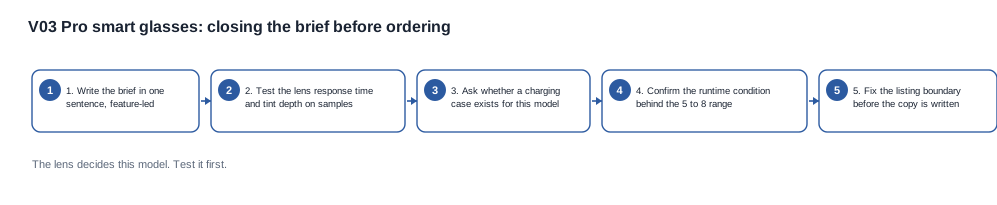
Step one: write the brief in one sentence, feature-led. If the sentence cannot be written without the word megapixel, this is the wrong model and no amount of further verification will change that. If the sentence mentions a lens, a colour or an interface, the rest of the process is about execution rather than about whether the product is right.
Step two: test the lens. Response time, tint depth, temperature band. One sample, one sunny surface, three measurements, written down with the conditions. This is the step that separates a brand that can sell the feature from one that can only mention it, and it is the step most often skipped because it is not on the catalogue page.
Step three: ask the platform questions in one written request. Whether a charging case exists for this model. The runtime condition behind the 5 to 8 hour range. The frame weight and the temple dimensions. The colour availability per configuration. And the certification position per destination market. Grouped into one request, these get answered; asked in sequence over several calls, they do not.
Step four: fix the listing boundary before the copy exists. Published rows you may print: the resolution figure as a resolution, the cell capacity, the charge time, the rated range as a range, the Type-C interface, the flexible temple, the photochromic lens, the three colourways. Open rows you may not: the sensor, the field of view, the video specification, the runtime condition, the weight, the ingress position and the certificate coverage. Deciding this while the product page can still change is worth more than any copy edit afterwards.
Step five: put the pass lines in the agreement. The published rows for the configuration ordered; the lens measurements taken on your own sample; the weight as measured rather than as estimated; the certification position per market stated as a fact; the warranty period with a stated response; and the minimum order quantity, the lead time and the price for the configurations ordered.
Terms, red flags and the position we take on the V03 Pro
What this model's position is worth commercially. A feature-led product on a shared platform, which means a brand can build a range upward from it without adding a second cell size, a second accessory family or a second firmware branch. The lens row is what makes it worth more than the plain V03 on the same platform, and the interface row is what makes it cheaper to ship than a model that requires an accessory in the box.
Open to negotiation, and worth the time. Unit price and volume tiers across a bulk order; packaging specification per colour, which on a three-colourway model is three specification lines rather than one and is the item most often forgotten; delivery splitting so a first tranche can be validated before the balance ships; payment terms with nodes against inspection rather than against shipment; the warranty period with a stated response time; return terms for defective units; and the terms of a pilot order.
The fixed part of the cost stack comes from the process, not the conversation. Certification cost and its lead time are set by the procedure and the testing body. Tooling is the line worth separating out, because it is frequently amortised across a first order while certification cost attaches to a product family — and a bundled quotation makes the two look like one decision. Certification cost is not negotiable; the schedule around it often is.
Red flags worth naming at the quotation stage. A supplier who quotes the lens feature without any performance parameter. A supplier who offers a case for this model without a capacity. A supplier who treats the three colours as available in every configuration. A supplier who quotes a single-figure runtime where a range is published. Each of those is a question to ask rather than an objection to raise, and each of them is far cheaper to ask before the purchase order than after the first shipment.
Where we stand. Our position is that the V03 Pro is a good fit for a channel that sells features the catalogue actually states, and a poor fit for one that sells image quality it cannot evidence. Buyers who pick it for the right reason rarely get a return; buyers who pick it for the resolution number usually do. We will publish the photochromic lens as a feature and not as a measured performance, we will publish the 5 to 8 hour range as a rating, and we will not estimate a weight, a sensor, a field of view or a certificate number that the documentation does not contain.
And where it sits against the rest of the range. The published V03 Pro specification list is the honest baseline. The V03 Pro best-for analysis covers the merchandising decision, and the certification checklist sets out what to request per destination market. Where we cannot answer — and the lens and weight questions will come up — we will say so rather than estimate.
Clauses for the agreement. The published rows for the configuration and colour ordered; the lens response and tint measurements taken on your own sample; the weight and dimensions as measured; the runtime condition; the certification position per market; and the warranty period with a stated response. Clauses to leave out entirely: any image quality claim, any runtime point figure drawn from a range, any weight not measured, and any lens performance figure that has not been measured on a sample.
Related reading
- Where the 13 MP options sit — AI camera glasses
- What is and is not known about the lens — photochromic smart glasses
- Matching a model to your market — selecting smart glasses by market
Give us the target market, the quantity and the required configuration, and we will reply with what is available and what is not.


