
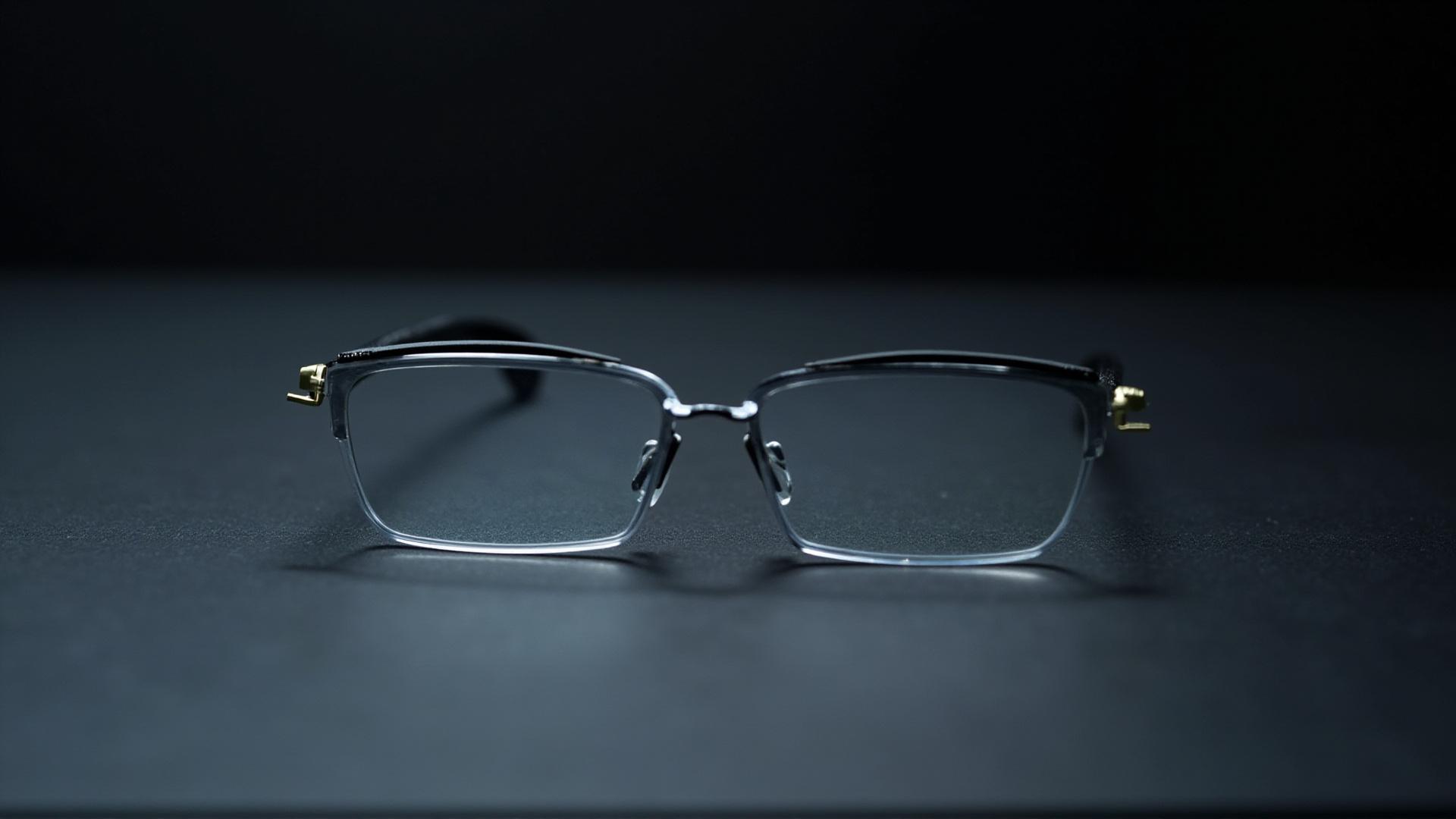
A search for v03 pro smart glasses best for is usually asked by someone who is not looking for a product review. They are looking for permission, or for a refusal, to make a model the starting point of a camera programme. The honest answer is that the published row does not settle the question on its own. It gives you a cell, a runtime band, a charge ceiling, an interface, a blank and a lens. It does not give you the commercial frame: the minimum, the schedule, the certification scope, the weight, the radio version.
So this article builds that frame. It names the published row precisely, sets out the programme shapes the V03 Pro genuinely fits, lists the questions that decide whether it is the right starting point, and then sets out where CYNRIN would place it in a camera programme and what will and will not be committed in writing before any tooling is committed.
If you have not yet narrowed the category, start with the AI Camera Glasses hub. This article assumes you are choosing a starting model for a camera programme rather than choosing a pair of glasses for yourself.
The published row for the V03 Pro
The V03 Pro is published as V03 Pro AI 智能拍照眼镜(变色镜片配置). Six fields are populated, and they are the entire published record for this model.
- Cell capacity — 220 mAh.
- Runtime — 5~8 h.
- Charging time — ≤2 h.
- Charging method — Type C.
- Bluetooth — not published.
- Lens configuration — photochromic, with three lens colour options.
The row has to be read in the context of the camera group it belongs to, because two of the six fields only mean something relative to their neighbours:
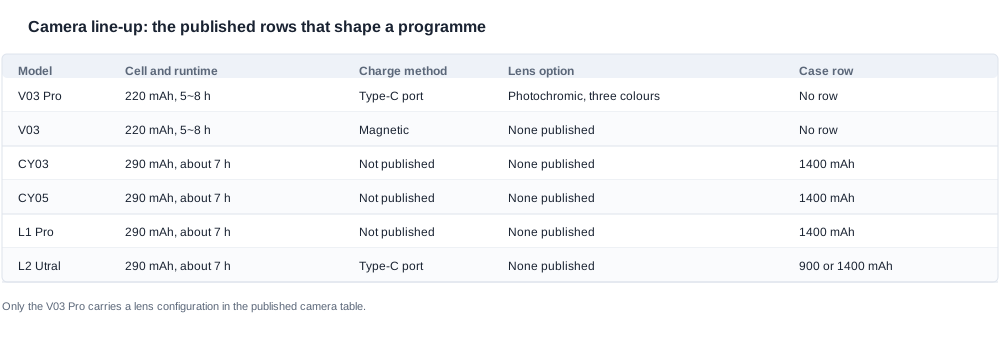
- V03 Pro — 220 mAh, 5~8 h, ≤2 h, Type C, photochromic lens, no charging-case row.
- V03 — 220 mAh, 5~8 h, ≤2 h, magnetic charging, no lens configuration, no charging-case row.
- CY03 — 290 mAh, ~7 h, ≤2 h, charging method not published, case 1400 mAh.
- CY05 — 290 mAh, ~7 h, ≤2 h, charging method not published, case 1400 mAh.
- L1 Pro — 290 mAh, ~7 h, ≤2 h, charging method not published, case 1400 mAh.
- L2 Utral — 290 mAh, ~7 h, ≤2 h, Type C, case 900 or 1400 mAh.
Three structural facts come out of that list, and each of them shapes the decision.
First, the V03 Pro and the V03 are the same power platform — 220 mAh, 5~8 h, ≤2 h — and the V03 Pro is the newer-shaped of the two in interface terms only. If you are comparing them on paper, the V03 and V03 Pro specification comparison is where the published rows sit side by side; the battery picture does not separate them.
Second, the V03 Pro is the only camera model in the published table that carries a photochromic lens configuration, and the only one offering a set of three lens colour options. That is the single strongest reason to start a programme here rather than on the plain V03. It is also the reason the colour story has to be commercially real before you commit, because three options is three SKUs, three packaging artworks and three demand curves. The V03 specifications cover the base model for comparison.
Third, neither the V03 Pro nor the V03 has a charging-case row, while the CY-series, the L1 Pro and the L2 Utral all do. If your programme sells a case as part of the kit, that is a structural difference in what you can offer, not a preference. The published charging case options for AI camera glasses walk through the case configurations that appear in the range.
One more published detail belongs here because it is the kind of thing that gets copied into a spec sheet by accident: the Bluetooth column is blank for every camera model in the table. The V03 Pro therefore has no published radio version, and the only safe wording for a customer-facing specification is that the version is not published and must be confirmed by the supplier.
The programme shapes the V03 Pro fits into
A "programme" here means a camera glasses line you intend to build, brand and sell, not a single pair of glasses. The shape of that programme decides the model far more than the specification sheet does, because the published V03 Pro row has two notable features — a photochromic lens with three colour options, and no charging case — and each of those pulls the model towards one kind of programme and away from another.
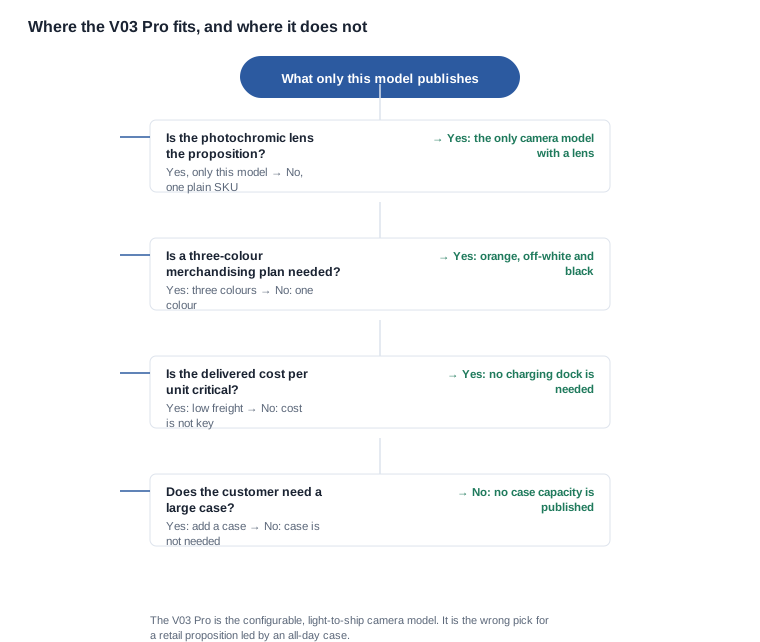
Shape one: the multi-colour hero line. The programme where the lens is the story. Outdoor and field capture, sport, lifestyle retail, anything where a shopper is meant to see three colour options on the shelf and pick one. In that programme the V03 Pro is the strongest candidate in the camera range, and the published reason is simple: no other camera model carries a photochromic configuration or a lens colour option set. The photochromic buying guide covers what the lens choice means for the use case, and the photochromic common questions handle the objections a buyer or a shopper raises about a reactive lens — which is the objection you will inherit when you put this product in a retail channel.
Shape two: the single-SKU volume line. The programme that wants one camera SKU, one colour, one artwork and as little inventory risk as possible. Here the plain V03 is usually the more natural starting point: the same 220 mAh cell and the same 5~8 h band, with a magnetic charging interface and no lens dimension to forecast. Choosing the V03 Pro for this programme means accepting the lens complexity for a reason other than the lens. That reason can be legitimate — a channel that already sells photochromic eyewear, a brand whose positioning requires a distinctive lens — but it should be a stated reason, not an inherited one.
Shape three: the case-led kit. The programme that sells the charging case as part of the bundle. This is where the published rows separate cleanly: CY05 and CY03, and L1 Pro publish a 1400 mAh case, and the L2 Utral publishes a case at 900 or 1400 mAh, while the V03 Pro and the V03 publish no case row at all. The V03 Pro is therefore not a starting point for a case-led kit unless the supplier confirms a case for it in writing, with a capacity, a packed weight and a lead time. This is also where the shipping weight question becomes real rather than academic, because a case changes the carton, the volumetric cost and the returns handling.
Shape four: the compliance-led export line. The programme where the deciding row is not on the spec sheet but in the file. Here the published position for the V03 Pro is that no certification claim is published for it at all: the catalogue body text does not contain the terms FCC, CE, RoHS or RED, and the export certification page is an image page carrying no per-model certification row. In that programme the V03 Pro can still be the right starting model, but only if the supplier produces a technical file, the applicable test reports and a declaration of conformity for the destination market, tied to this model and this production batch. That is a document question, not a product question, and it is the one that decides this programme.
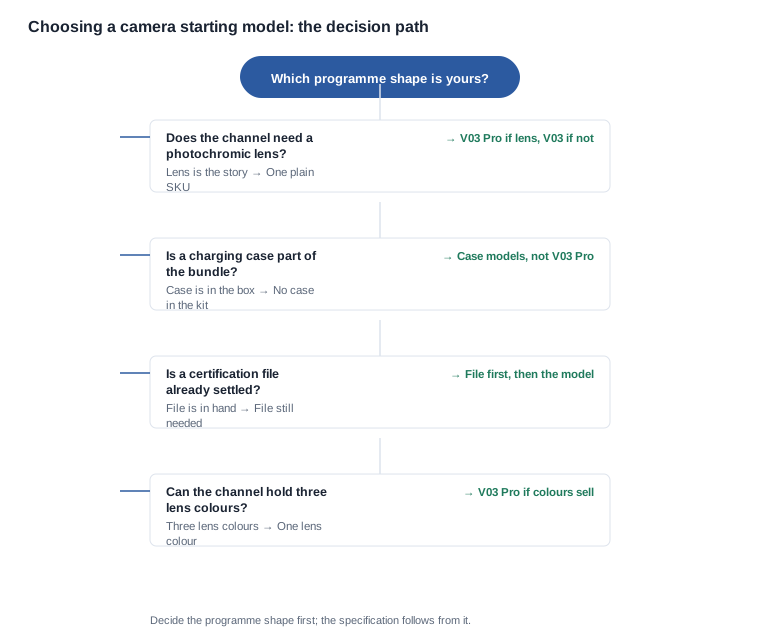
The practical test is simple: the V03 Pro is the right starting point when your programme needs a lens story and can absorb the SKU complexity that comes with it. It is the wrong starting point when your programme needs one simple unit, a case-led bundle, or a certification position that has already been settled without it.
How to evaluate the fit before you spend anything. The published rows separate on four criteria that a programme can be scored against without guessing anything, and running that score before the first enquiry saves a lot of wasted cycles.
- Lens requirement — does the channel need a photochromic configuration at all? If the answer is no, the lens dimension of the V03 Pro is dead weight in your plan.
- SKU tolerance — how many lens colour options can your inventory, your packaging operation and your warehouse carry? One colour is a different programme from three.
- Kit requirement — is a charging case part of the bundle? If yes, the published rows point away from the V03 Pro and towards the CY-series, the L1 Pro or the L2 Utral.
- Compliance posture — do you already hold, or need to obtain, market-specific certification for this model? If the answer is that you need the file before you can decide, the V03 Pro cannot be selected on the published row alone.
Score each one honestly, then take the result into the enquiry rather than waiting for a quotation to reveal it. A programme that passes the first two criteria and fails the last two is not a V03 Pro programme; it is a conversation about a different model, and it is far better to have that conversation at the start than after the artwork is drawn. A programme that passes all four is exactly the shape the published V03 Pro row was written for, and the questions in the next section become a matter of filling in values rather than deciding whether the model fits at all.

The questions that decide whether the V03 Pro is the right starting point
Because the published row is short, the decision has to be made on questions rather than on reading. These are the rows that are not published for the V03 Pro and therefore have to be asked for, with a note on why each one changes the answer.
- Bluetooth version. Not published for any camera model in the table. It matters if your channel copy, or a customer's technical file, names a radio version.
- Ingress rating. An IP code appears against only two models in the published library, V06 and S7, where it reads IP54. The V03 Pro has no published ingress rating, so a missing rating must be reported as missing rather than assumed to be low or to match the neighbouring rows.
- Weight. The only published weight in the library is the MT6 at 158 g for the glasses body, excluding a 1200 mAh folding case. The V03 Pro weight is not published, and it cannot be inferred from a neighbouring model because the lens configuration is different.
- Control method, audio topology and language set. The library contains no capacitive-touch row for any camera model, no translation row, and a surround-sound annotation only against the D11. So none of the three is published for the V03 Pro.
- Price, MOQ, lead time, warranty, incoterms, payment terms, deposit, tooling cost, bulk order tiers, quality control and acceptance criteria, shipment options, and the private label minimum per lens colour. None of these appear in the published material, and all of them belong in the quotation and the contract.
- Certification and compliance scope. Not published for this model, as set out above.
There is a second reason to work through this list rather than around it. A camera programme is usually decided by people who did not sit in the specification conversation — a channel manager who saw a shelf mock-up, a marketing team that needs a launch date, an operations lead who needs a carton size. Each of those decisions inherits whatever the published row left open, and each of them then becomes harder to unwind as the programme matures. The risk is not that the V03 Pro is the wrong model for the job. The risk is that the right model is specified in a way nobody wrote down. Closing these rows at enquiry stage is the cheapest insurance available in a sourcing relationship, because every answer you lock in early becomes a term you can enforce, and every answer you leave open becomes a negotiation later, usually at a point where you have less choice and less leverage.
The V03 Pro specifications and features article covers the published row in more detail, and the V03 Pro limitations article covers the honest constraints of the configuration. Two further items belong in the same evidence pack: the response behaviour of the photochromic lens, which is covered in the photochromic response time piece and which interacts with the runtime band, and the lens behaviour in low light conditions, which is the other half of the same question.
We will not present a specification difference the catalogue does not publish, so a buyer choosing a starting model for a camera programme should confirm the unpublished rows before the tooling is committed.
The questions to ask, in the order that unblocks the most downstream decisions first:
- Which runtime condition does the 5~8 h band describe, and can that condition be written into the quotation?
- What is the measured weight of the glasses body and the packed weight per retail unit, per lens colour?
- Is a charging case available for the V03 Pro, with a capacity, a packed weight and a lead time?
- Which Bluetooth version is fitted and confirmed for this production batch?
- Is an ingress rating available for this model, and under which test condition?
- What is the MOQ per lens colour, and does a mixed-colour order count against one minimum or several?
- What is the lead time, and does it run per colour or per order?
- Which certifications and test reports cover this model for our destination market, and can we review the technical file?
- What warranty period and coverage apply, and which exclusions are written into the contract?
- What quality control criteria apply at the pre-shipment inspection, and who signs them off?
- What are the incoterms, the payment terms and the deposit schedule for the first order?
- Does the factory support a visit or an audit, and what does the due diligence pack contain?

Where CYNRIN fits the V03 Pro into a camera programme
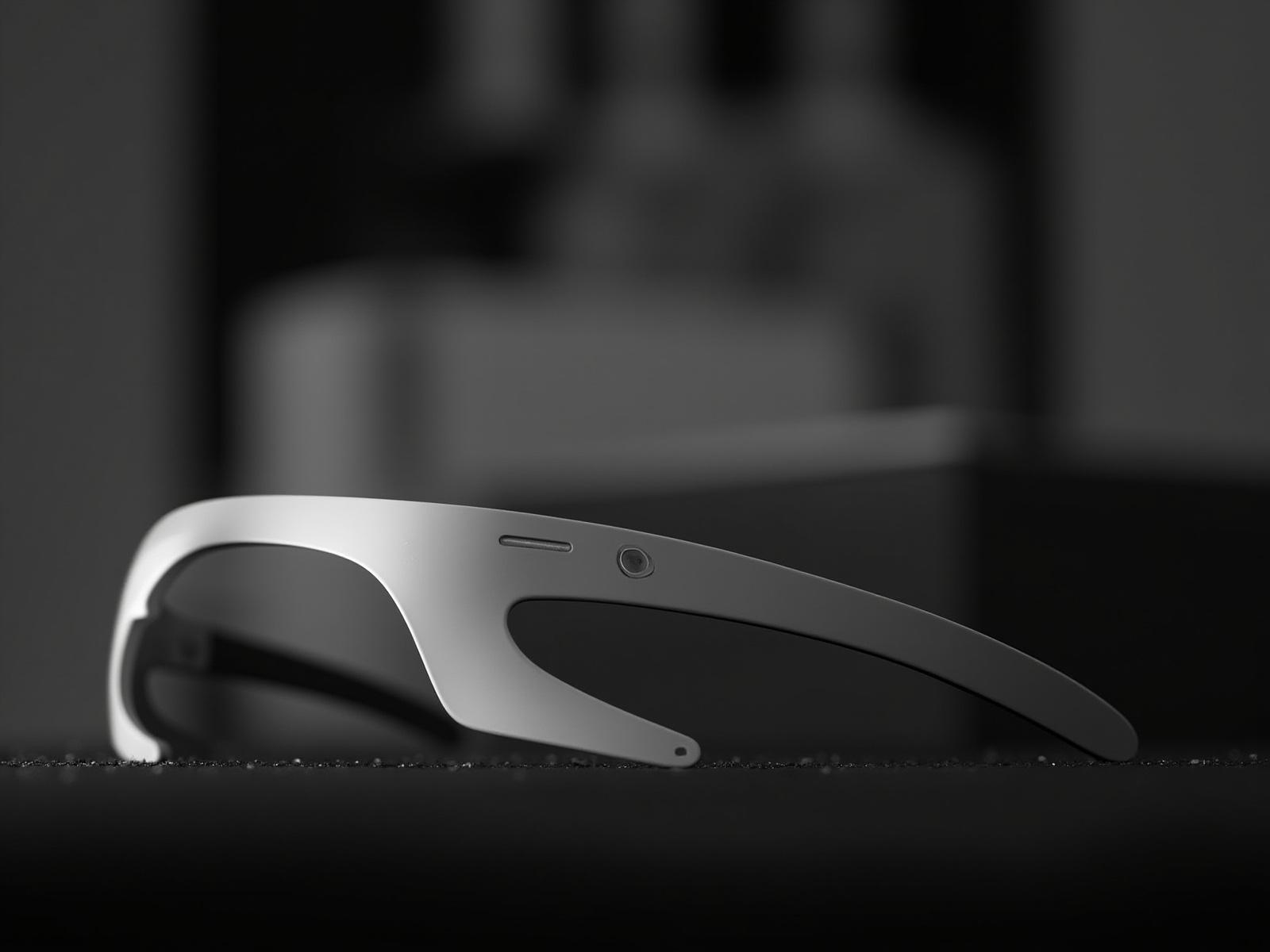
CYNRIN is Shenzhen Kingring Technology Co., Ltd., and the way we would place the V03 Pro in a camera programme is worth stating plainly, because the value of this model is not that it wins a specification comparison. It is that it is the camera model in the range built around a lens story, which is exactly the shape most brand programmes need when they want the product to be merchandisable rather than merely functional.
Where the programme is multi-colour, outdoor-facing, or sold through a channel that already understands photochromic eyewear, the V03 Pro is our starting camera model: a 220 mAh cell, a 5~8 h runtime band, a ≤2 h charge ceiling and a Type C interface, with the photochromic configuration and three lens colour options carried in the published row rather than bolted on as a custom request. The Type C interface also simplifies the charging story for a channel, because it removes the accessory question that a magnetic-dock model raises when a case is not part of the kit.
How we would run that programme:
- Sample order first. We would expect a scoped sample order covering the configuration and the lens colour options you intend to sell, so that the runtime band, the lens behaviour and the physical presentation can be evaluated in your own use conditions rather than from a table.
- Private label and packaging. The colour naming, the artwork and the box structure are agreed before the first bulk order, with the minimum per lens colour stated in writing rather than assumed to be the same across colours.
- Tooling. Any tooling requirement is scoped and priced as a separate line in the quotation, so the amortisation is visible before the deposit is paid rather than appearing later as a unit cost.
- Quality control. Acceptance criteria are defined before production, the inspection points are agreed, and a pre-shipment sample is signed off against them.
- Technical file and declaration. The documentation needed for the destination market is collected and reviewed against the model, the factory and the batch before shipment, so that the compliance position is a fact rather than an assumption.
- Shipment and terms. Incoterms, payment terms, the deposit balance trigger and the warranty period are written into the purchase order and the contract.
How to evaluate the answer. What matters is not the sample in the box but the paperwork around it, and it is worth running that as a checklist with named owners on your side.
- Specification checklist — every figure you intend to print appears in a document the supplier has signed, with the test condition attached to the runtime band and the model name attached to every report.
- Physical checklist — the sample matches the configuration you will ship: the lens colour option, the charging interface, the packaging artwork and the accessories in the box.
- Commercial checklist — the minimum, the lead time, the deposit, the payment terms, the incoterms, the warranty and the quality control criteria all appear in the quotation and the contract, and the same figures appear on the purchase order.
- Due diligence checklist — the factory visit or audit is scheduled and scoped, the due diligence pack has been delivered, and the questions it raises are answered in writing rather than verbally.
Two of those are where programmes fail in practice. The first is the specification checklist, because an unsigned figure travels faster than a signed one and reliably ends up on a listing page before anyone has checked it. The second is the commercial checklist, because a warranty period or an acceptance criterion that exists only in a conversation is not enforceable on the day a batch arrives short of the agreed standard. Both failures are cheap to prevent and expensive to unwind.
What will not appear on this page is a minimum, a schedule, a certification claim, a warranty period or a price. Those are confirmed in the quotation and the contract for your order, because a published page that carries a number nobody has yet negotiated is exactly the kind of number that later becomes somebody's expectation. The published row for the V03 Pro is short, and the honest way to handle it is to treat it as the part that is fixed and to ask for the rest in writing.
A short set of trade-offs is worth keeping in view as you decide. The lens story against SKU complexity. The photochromic configuration against a plain camera model with the same power figures. Type C against magnetic charging. A model without a published case against the case-led models in the range. A runtime band against a fixed hour figure your marketing wants to print. None of these is a decisive argument on its own; together they describe a model that suits a specific programme very well and a different one not at all.
If the V03 Pro fits the programme you are building, the next step is a written answer to the twelve questions above, and a sample order scoped against them. If it does not fit, the published rows for the plain V03, the CY-series, the L1 Pro and the L2 Utral cover the alternative shapes, and the same questions apply to whichever of them you choose.


