

Bone conduction glasses technology: the gain figure is commercial, not technical
Why 35 dB is a commercial fact and not a technical detail
Our catalogue publishes one bone conduction entry, and the most commercially significant number on that entry is not the cell, the runtime or the charge time. It is the published amplification gain of 35 dB. A gain figure of that order, in a product that sits on the face rather than in the ear, gives a buyer a route into the market for group training, outdoor team communication and environments where the person has to hear both the surroundings and a partner. It also gives a buyer a classification risk that has to be managed deliberately, because how a market treats the product depends on how it is presented and what it is presented as. The decision is therefore a commercial one made long before the tooling is cut: which markets, which channel, which wording, and whether the product is positioned as an open-ear audio product or as an amplification product. This is also why the missing model designation on that entry is a procurement blocker rather than a cosmetic gap. A product without a designation cannot be listed on a certificate, cannot be described at customs, and cannot be ordered against a configuration string. Get the designation and the wording settled, and the rest of the programme is a normal sourcing task.
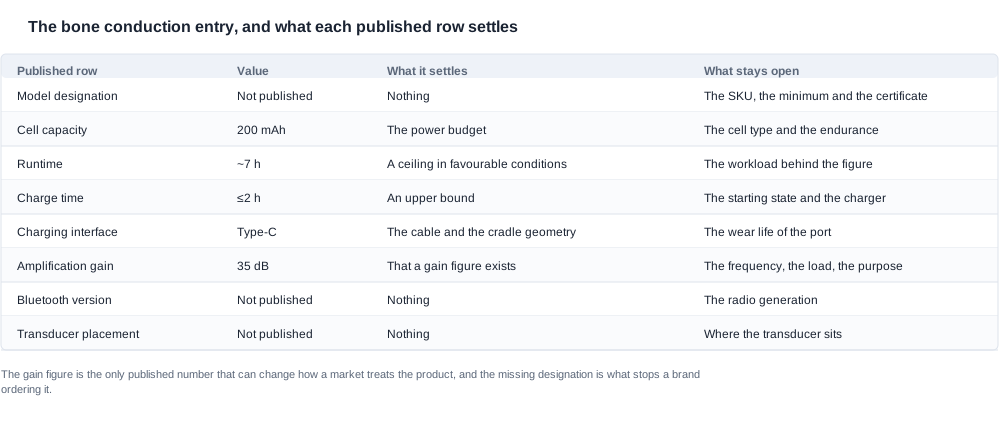
The three requests that bring this category to a buyer
The reader is a brand-side product owner, a channel buyer, or a product manager who has been asked whether the category is worth entering. The situations are specific and they arrive in a particular order.
The first is a channel that has asked for the product. A training company, a sports retailer, a corporate wellness buyer or a distributor has asked for a bone conduction option, and the request has reached the product side as a line on a quarterly plan. The second is a compliance review that has flagged the product. A marketplace, a corporate procurement questionnaire, an insurer or a regulator has asked a question about the product's classification, and because the entry publishes a 35 dB gain figure, the question is not hypothetical. The third is a quotation comparison in which a bone conduction option sits alongside ordinary open-ear audio models, and the buyer needs to know what is genuinely different about the option rather than being told it is the same thing with a different name.
The fear underneath the enquiry is rarely the unit price. It is shipping a product into a market where it is treated as a regulated device when the business model assumed it was an audio accessory, with the associated certification, labelling and listing obligations landing after the artwork is approved. It is also shipping a product that cannot be ordered properly, because there is no designation to put on the purchase order, and discovering that the certificate, the customs line and the packaging all need the same string.
The reader's position in the chain determines what they can control. A brand owner controls the claim wording, the market list and the artwork, which is where most of the risk in this category actually lives. A channel buyer controls neither and can only write acceptance criteria and a market list into the purchase order. A distributor who holds a brand in several territories has to be sure the same product is not being presented differently in each one, because a product that is compliant in one market and regulated in another cannot be shipped on one packaging design.

The bone conduction row, and what each published value settles
The published data for this entry is short enough to read in one paragraph, and every row in it does something specific.
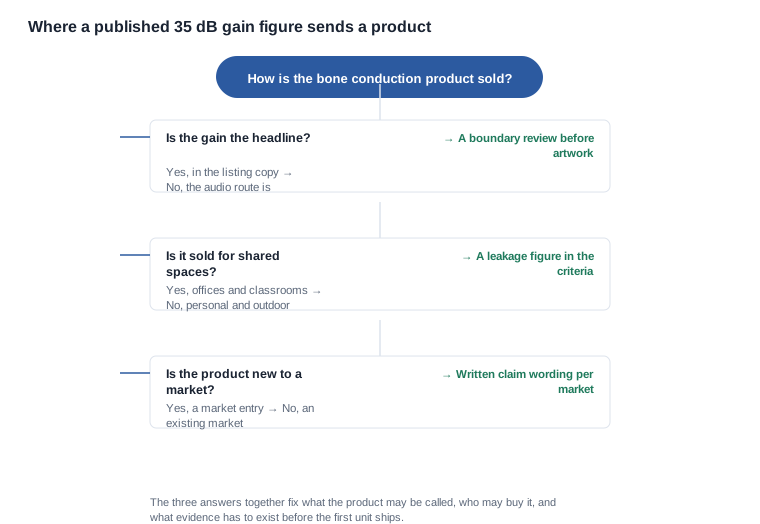
The cell is 200 mAh, which is larger than every audio model in the range and smaller than the 290 mAh camera models, and the runtime is quoted at around seven hours. The charge time is two hours or less and the charging interface is Type-C. The amplification gain is 35 dB.
Those four numbers settle the power budget, the endurance, the charging arrangement and the existence of a gain figure. They settle nothing about the acoustics, and that is the part that decides the programme.
What is not published is substantial. There is no model designation, and the entry is identified in the catalogue only by its product name. There is no Bluetooth version, which is unusual because the audio models around it all publish one. There is no transducer placement, no frequency response, no leakage figure, no intelligibility measurement, no weight, no ingress rating and no indication of whether the gain is adjustable.
The gain figure in particular needs a condition attached before it can be used for anything, and this is not pedantry. A gain figure measured at one frequency into a given load is not the same number as a broadband figure, and a gain figure produced by an adjustable amplifier is a different commercial proposition from one fixed at the factory. The threshold to hold is straightforward: the figure with its frequency, its load, its measurement configuration and a statement of whether it is adjustable. The catalogue does not publish those, so they are rows to be requested rather than rows to be compared.
The designation gap deserves separate attention because it is unusual and it is expensive to discover late. A model designation is what appears on the certificate, on the packaging, on the customs declaration and in the factory's own configuration system. Without one, a buyer cannot obtain a conformity document that names the product, cannot describe the product to a customs broker with any precision, cannot set a minimum order quantity against a named build, and cannot receive a spare part that matches the units in the field. It is not an administrative irritation; it is the string that the rest of the documentation hangs on. The control is to make the designation a condition of the first order rather than a request attached to it.
One warning applies to the whole category and it is the one most often missed. Amplification figures from different suppliers are not directly comparable, and the reason is that the measurement is part of the product. A figure obtained with a free-field microphone on an open frame describes a different quantity from one obtained through a coupler on a sealed one, and neither describes what a person hears. The number is useful for a classification review and for a brand-to-brand comparison on the same basis. It is not a substitute for listening to a sample in the environment the product is sold for.
Nine questions that keep a bone conduction programme inside the boundary
- What is the exact model designation for this product, and by when will it be assigned and confirmed in writing?
- Is the 35 dB gain a free-field figure, and at what frequency, load and measurement configuration was it taken?
- Can the gain be adjusted, by whom, and does an adjustment change the conformity position of the product?
- Where does the transducer sit in the temple, and is the placement repeatable across a production run?
- How much of the audio reaches the surroundings at a stated volume, measured in a defined environment?
- What intelligibility is achieved in a named environment, at a stated source level and distance?
- What contact is required at the temple for the published gain to hold, and how much of the performance depends on it?
- In which destination markets will the product be sold, and has the classification question been reviewed for each of them by a compliance function?
- What wording will the listing, the packaging and the sales material use, and who owns the review of that wording?
Questions eight and nine are the ones that decide the commercial outcome, and they are the ones that a factory cannot answer for you. The classification of a product that amplifies sound and sits on the face is jurisdiction-specific, and in the United States the device definition in 21 CFR 800.30 turns on intended use rather than on engineering, which is precisely why the wording is a procurement decision and not a marketing afterthought. In other markets the equivalent test may sit in a different place entirely. What a factory can do is publish the parameters, and what a brand has to do is take them to its own compliance function before the artwork is released. Our medical boundary page describes the general approach we take to this class of question, and the same discipline applies here.
Question five is the one that decides whether the product can be sold into the environments that make it interesting. A product whose audio is clearly audible to other people in the same space cannot be sold into a classroom, a meeting room or a customer service floor, whatever its gain figure says. That is a channel constraint rather than a preference, and it belongs in the acceptance criteria rather than in the product page.
Question seven is the one that determines how a return profile will develop. The published gain holds for a particular contact condition at the temple, and a product that is sold with an expectation of a stable gain needs that condition to be repeatable rather than dependent on how the frame sits on a particular head.

What a buyer can measure, and what has to be documented
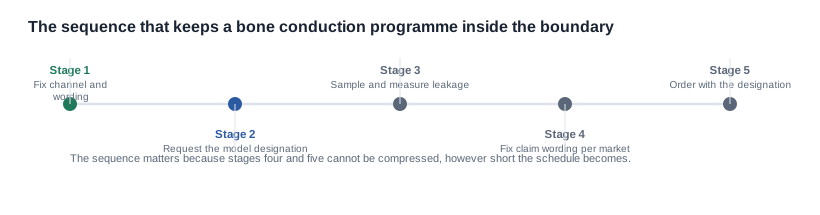
The verification work in this category divides into two halves. Some rows can be measured on a sample by the buyer, and some rows only exist as documents that a factory or a laboratory can produce. Confusing the two is what makes a programme slow, so the sequence below keeps them apart.
Step one: obtain the designation in writing, before the quotation is compared. A short written confirmation naming the model, the build and the electrical configuration is enough to start. Its value is that everything downstream needs it, and the cost of obtaining it is one message.
Step two: ask for the gain figure with its conditions, and treat a bare number as an absent row. Frequency, load, configuration, and whether it is adjustable. If the supplier cannot state them, the figure is a marketing number and the claim that depends on it should be narrowed until it is not.
Step three: measure the leakage yourself, in a defined condition. Set the product at a stated volume, place it in a defined position, and measure what reaches a defined distance in a defined environment. The point is not to produce a laboratory-grade number. The point is to find out whether the product belongs in the environments your channel sells into, and a rough measurement that is consistent is more useful than a figure with no condition attached. The bone conduction audio page covers the published rows, and the spec sheet explained article goes through the rows a buyer should expect to find on a supplier's data sheet.
Step four: measure intelligibility in the environment you are actually selling into. A workshop, a street, a training room, a warehouse aisle. Intelligibility is not the same quantity as gain, and it is the one a customer experiences. A supplier who is confident in the product will facilitate this test, because it is the test that is worth passing.
Step five: check the contact dependence across more than one unit and more than one head. A gain figure that holds on the evaluation unit and not on production units is a placement tolerance problem, and it is a quality control question rather than an acoustic one.
Step six: run the classification and wording review per market, before the artwork is released. This is a document review, not a laboratory test, and it is the step that most programmes leave until the listing is live. Our cost versus performance analysis covers where the cost of this route sits relative to ordinary open-ear audio, and the supplier question list sets out the wider set of commercial questions around the category.

Where bone conduction programmes fail commercially
The listing that reads as assistive listening. The symptom is a marketplace or corporate buyer reading the product page and asking whether the product is a regulated device. The root cause is that the gain figure was put into the copy without a framing, and framing is what determines the reading. The control is to write the wording, have it reviewed, and put the claim register in place before publication. Nothing in this failure is technical.
The product that could not be ordered. The symptom is a quotation, a specification and a certification request all waiting on a model string that nobody had assigned. The root cause is that the entry is identified by product name rather than by a model designation. The control is to make the designation a precondition of the first order and to have it quoted on the purchase order.
The leakage that nobody measured. The symptom is a channel that discovers the product is audible to other people in the space it was sold for, and a returns problem that is attributed to quality rather than to a design property. The root cause is that leakage was treated as a preference. The control is a leakage figure in the acceptance criteria, measured at a stated volume in a stated environment.
The contact dependence that appeared on the second production lot. The symptom is a cluster of returns describing poor audio, concentrated in one batch rather than spread across the range. The root cause is a placement tolerance that was never specified. The control is to specify the contact condition, put it in the quality control plan, and check it per lot rather than per first article.
The gain tuning that moved. The symptom is a batch whose audio differs from the approved sample, with no hardware change. The root cause is a firmware or configuration change with no advance notice. The control is a change-notice obligation covering firmware, as well as components.
The market that treated the product differently. The symptom is a consignment held or a listing removed in one territory while the same units sold freely in another. The root cause is that the classification and wording review covered the home market and was assumed to cover the rest. The control is a per-market review with the outcome recorded, and a market list in the agreement.
This is ordinary ground for any bone-conduction product, and none of it would justify changing supplier. Each one is a document, a clause, or a sequence that was put in place before the first shipment rather than after it.
The missing designation, and what it costs a brand
The commercial terms of this category are unusual in one respect, and it is worth separating the parts that move from the parts that do not.
What moves in a negotiation is the market list, the wording review, the change-notice period, the support time during evaluation, the artwork round count, and the timeline for the designation being assigned. The market list is the largest of these by some distance, because a market that requires a new conformity route is a different programme from one where the existing scope already covers the product.
What does not move is the transduction route, the cell, the charge time, and the meaning of the gain figure. The gain figure is a characteristic of the product rather than a commercial variable, and the only legitimate response to it is to write the claim so that it reflects the measurement. Conformity cost and time for a given market are fixed per product family and sit in a queue at the test laboratory, and pressing on them produces a longer schedule rather than a shorter one. The designation is not negotiable either: it is a fact that has to exist, and the only commercial question about it is when.
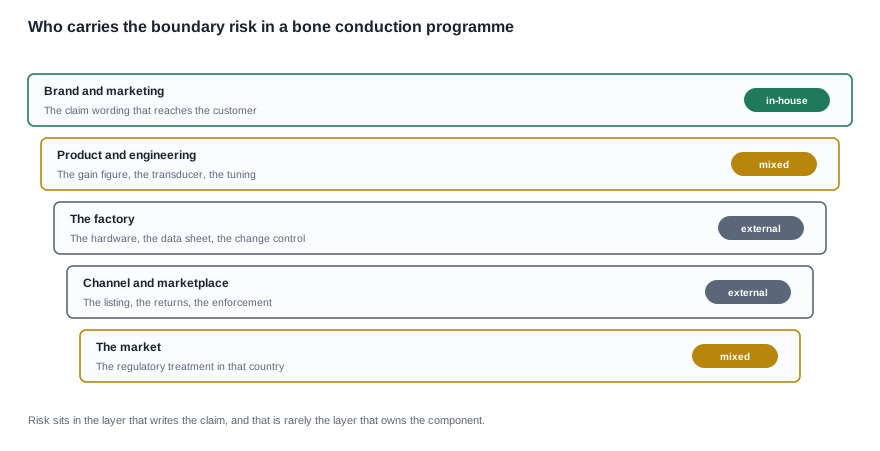
Before you order, the bone conduction checklist is short: get the designation assigned, get the gain figure with its conditions, get a leakage figure for a shared-space condition, and get a per-market wording review. How to compare two quotations in this category is to lay out the market list, the designation timeline and the wording review side by side, because the trade-off between a cheaper unit and a market that has to be excluded from the launch is invisible until the rows are next to each other. The red flags worth naming are a gain figure with no conditions, a product with no designation, and a leakage claim that was never measured. Those three are the usual pitfalls, and which model a brand ends up with is decided by which of them it refused to accept at quotation stage.
The documents worth collecting before the deposit are: the written model designation, the gain figure with its frequency, load and configuration, the statement of whether the gain is adjustable, the leakage measurement at a stated volume and environment, the intelligibility result per target environment, the contact condition at the temple, the conformity scope for each destination market, the classification and wording review outcome per market, and the change-notice route.
The clauses worth writing into the purchase order are: the model designation as a named field, the gain figure with its conditions, the approved claim wording, the market list, the leakage acceptance criterion, the change notice covering firmware and components, the re-issue obligation for the documentation pack when the wording or the market list changes, and a warranty scope that is explicit about what the product is and is not represented to do.
On our own side, the boundary is this. We publish the cell, the runtime, the charge time, the charging interface and the amplification gain for this entry, and we publish them because they are in our documentation. We do not publish a model designation, a transducer placement, a frequency response, a leakage figure, an intelligibility result, a weight, an ingress rating or a Bluetooth version, and we will not fill any of those rows with a figure from elsewhere in the industry. We will also not make an assistive listening claim about this product, and we will not tell a brand that it may. The parameters we publish are the input to a classification review that belongs to the brand and to its own compliance function, and our job is to make sure the parameters are the real ones.
That is the commercial substance of why bone conduction matters to a buyer. The route solves an environment problem that in-ear audio cannot solve, and it carries a gain figure and a missing designation that together decide how the product has to be presented, documented and ordered. Send us the markets, the channel, the environments you are targeting and the wording you have in mind, and we will tell you which of those inputs the published rows already settle, which of them have to be requested from the engineering file, and what has to be in place before the first unit ships. We will also tell you plainly where we cannot go, because a product in this category that is presented more widely than its classification allows is a problem for the brand that owns the listing, and not for the factory that built it.
Related reading


