

Bone conduction glasses technology: which requirement you pay for
Cost against performance cannot be settled with a unit price, because the two biggest cost drivers in this category are not published and the largest performance figure carries a compliance condition attached. But there is a better way to run the comparison, and it is not a comparison of two products at all. It is a comparison of two requirements.
The bone conduction entry in our catalogue is a single product with a 200 mAh cell, a charge time of two hours or less, roughly seven hours of rated runtime, Type-C charging, an amplification gain of 35 dB, and no model number. We publish no unit price, no minimum order quantity and no lead time for any model in the range, so this article compares structures rather than amounts.
The argument is simple. A premium is justified when a requirement exists that only one of the two routes can meet. That requirement, written in one sentence, is the entire justification. If you cannot write it, you are not buying a premium, you are buying a specification, and a specification without conditions is not a reason to spend more. A 35 dB figure is the most aggressive parameter anywhere in our catalogue, and it is simultaneously the reason the product is interesting and the reason it needs careful handling.
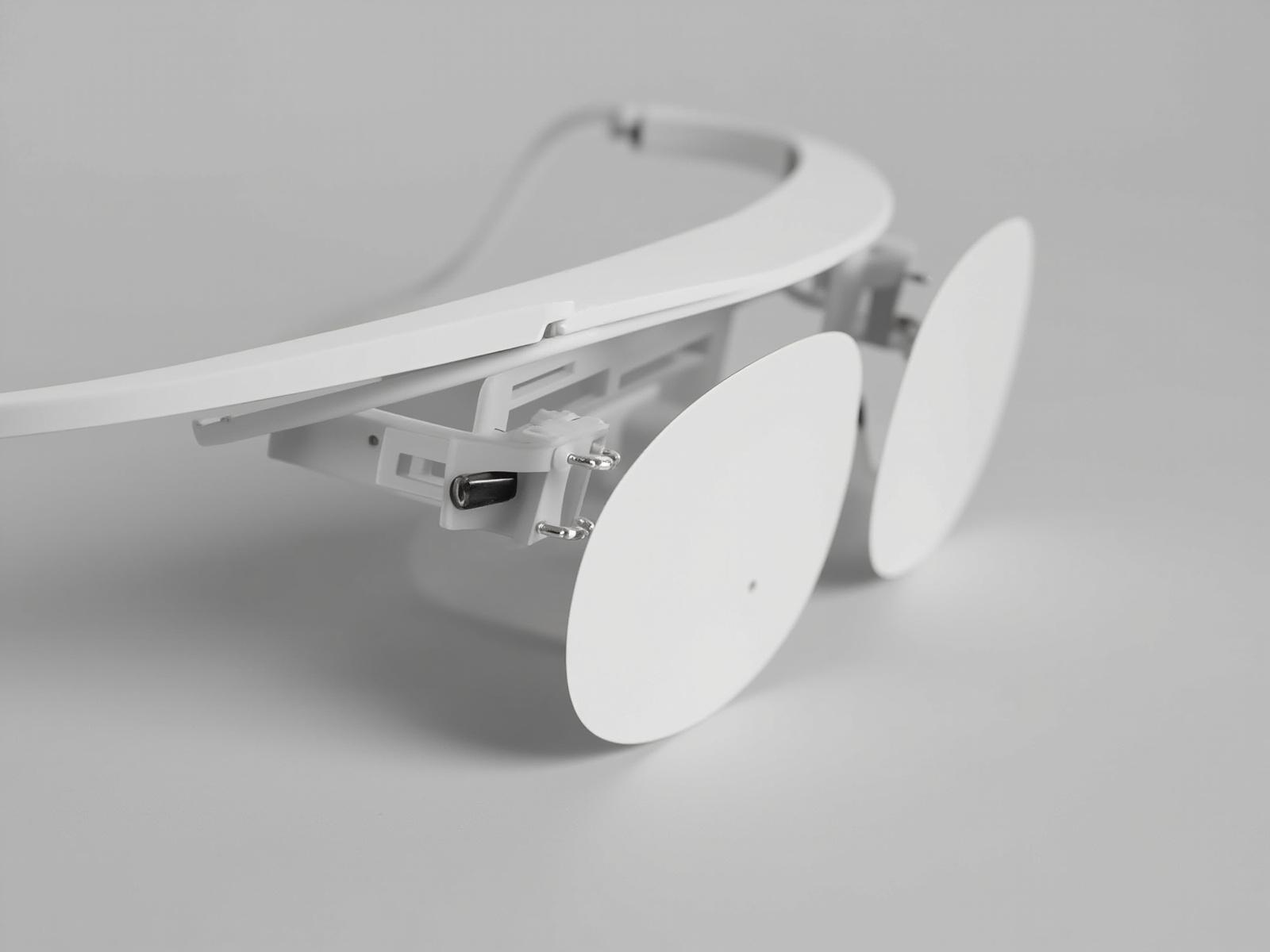
Who makes this call, and what they usually get wrong
The reader is a brand product lead or a channel buyer choosing between two routes for a requirement that has come from a customer, a channel feedback form or a competitor's launch. The most common thing they get wrong is not the price comparison. It is the assumption that the two options are versions of the same product, one better and one cheaper.
They are not. They are different architectures with different properties, different failure modes and different documentation burdens, and the published positions in our range show that clearly. The open-ear audio class publishes model designations, cells from 55 mAh paired units up to 100 mAh, Bluetooth V5.3 and V5.4 variants, roughly six to eight hours of rated runtime, surround audio, with the IP54 marking published only on the V06 and the S7, and case capacities of 900, 1200 and 1400 mAh. The bone conduction entry publishes five rows: a 35 dB amplification gain, a 200 mAh cell, the charge time, the runtime and the interface. It publishes no model designation, no certification status, no acoustic measurement, no microphone specification, no frame weight and no ingress rating.
That asymmetry has a commercial consequence which is easy to miss and expensive to discover. The premium route in this comparison is the one that arrives with less documentation behind it, not more. The cost of entry into the amplified route is therefore higher, not lower, in exactly the areas where a launch is most likely to go wrong: the model string, the market position, and the evidence for the acoustic behaviour.
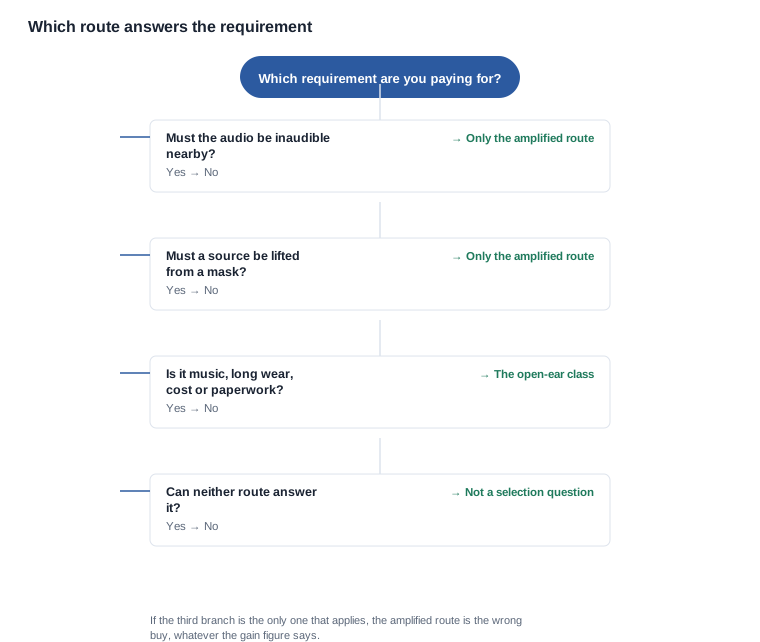
The second thing they get wrong is treating the gain figure as the performance. A gain figure describes electronics, and the 35 dB number carries no frequency range, no input level and no measurement point in our published material, and it is a maximum rather than a condition. What a given person perceives depends on the environment, the fit, the source and the setting. The performance of this product is a field observation, and the way to get one is the case study protocol described under bone conduction case study template.
The requirement matrix: eight demands and the route that answers each
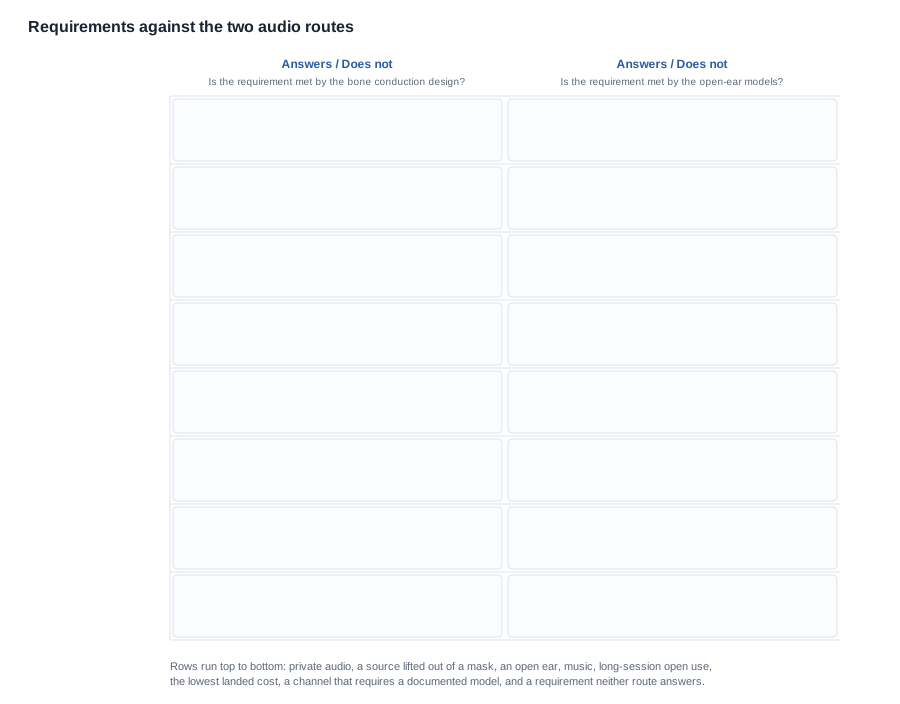
Read the matrix by quadrant, because the quadrant is the decision. Top-left, where only the amplified route answers, is where a premium is justified. Bottom-right, where only the open-ear class answers, is where the amplified route is the wrong buy. Bottom-left, where neither answers, is not a product selection question at all.
Nobody nearby can hear the audio. Only the amplified route answers this, because the output is a mechanical vibration in the skull rather than a sound wave in the room, and an open-ear frame leaks more the louder it is played. If this is your requirement, the amplified route is not a premium version of the same product — it is the only design in the range that answers it, and the comparison stops there.
A source has to be lifted out of a background mask. Only the amplified route answers this. Decibels are logarithmic, so a 6 dB increase is roughly a doubling of sound pressure, and a 35 dB gain is a hearing-assistance level of amplification figure — the environments where it helps most are the ones where ambient sound masks the target. No amount of open-ear volume solves this, because the problem is the mask rather than the volume.
The ear has to stay open while a source is heard. Only the amplified route answers this. Nothing sits in or against the ear canal, so there is no heat, no pressure, and no loss of awareness of the surroundings, and the two do not compete for the wearer's attention.
Music quality. The open-ear class answers this, and the amplified route does not. Low frequencies do not carry through the skull efficiently, and the result sounds thin in a way customers describe as broken rather than as a design trade. If the product promise is sound quality rather than amplified listening, the amplified route is the wrong product, and no amount of gain compensates for a missing low end.
Long-session use in an open environment. The open-ear class answers this. Bone conduction transfers energy through the skull and the contact points on the temple take the load, so long sessions produce contact fatigue, and how soon that arrives depends on the individual and the fit. A buyer who has not tested it on a real person is guessing at the most common long-term complaint in this category.
The lowest landed cost. The open-ear class answers this, and it is worth being careful about how the answer is reached. Our catalogue publishes no unit prices, so this is a statement about where the engineering and documentation cost sits rather than about a quotation: the amplified route carries a precision transducer, a housing designed around a contact geometry, an acoustic design phase and a documentation burden that is higher because the entry has no model designation.
A channel that requires a documented model. The open-ear class answers this. Its models publish designations, cells, protocol versions, runtime bands and ingress markings, and a channel onboarding can be completed against those. The amplified entry cannot complete one, because the model string has to be created first.
A requirement neither route answers. This happens more often than buyers expect, and it is worth recognising early. A requirement that neither architecture meets is usually a requirement about the customer, the environment or the service rather than about the hardware, and it will not be solved by choosing a better product.

What the premium buys, and what it does not buy
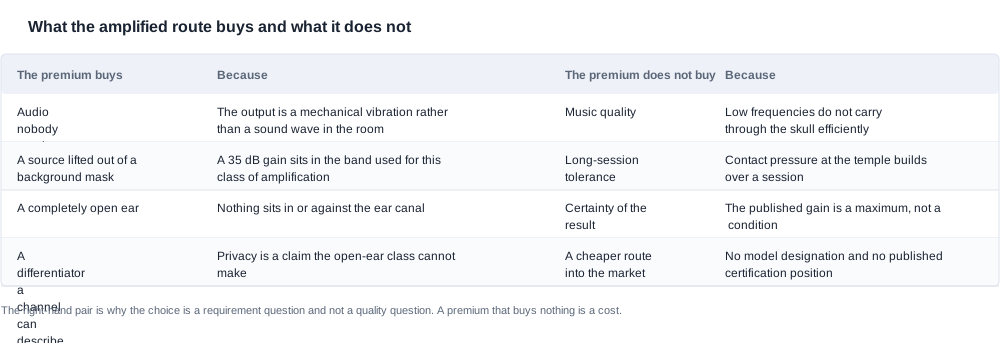
What it buys: privacy that no other design in the range offers. A bone conduction device produces no sound in the room. The output is a mechanical vibration in the skull, not a sound wave, so a colleague cannot hear what is being listened to. For a customer whose use case is amplified listening in an office, on a train or in a meeting, this is not a refinement — it is the feature the product exists for.
What it buys: assistance in a noisy environment. A 35 dB gain is a hearing-assistance level of amplification figure, and the environments where it helps most are the ones where ambient sound masks the target. That is a real property of the architecture, and it is the reason a buyer in an industrial or warehouse channel should look at it at all.
What it buys: a completely open ear. Nothing sits in or against the ear canal, so there is no heat, no pressure and no loss of awareness of the surroundings. For someone who needs to hear traffic or colleagues while also hearing an amplified source, the two do not compete.
What it does not buy: music. That is covered above, and it is the one most often discovered by a customer rather than by a buyer.
What it does not buy: long-session tolerance. The complaint pattern is contact pressure, and it is not captured by any specification, which means it is only discovered by testing on real people over a real session. Our published position on comfort under extended wear is Not published, and it is not something we would estimate.
What it does not buy: certainty. The 35 dB figure is a maximum output rather than a condition, and what a given person perceives depends on the environment, the fit, the source and the setting. A case study is the only way to establish it, and that is a cost of evidence rather than a property of the product.
What it does not buy: a cheaper route into the market. This is the one that surprises buyers, and it is worth saying plainly. A product with no model designation and no published certification position does not go to market faster than a product with both. It goes to market with a claim to be established, a file to be assembled and a string to be created — and those are the costs that decide whether a launch lands on the date it was set for.

Choosing a route, and proving the choice
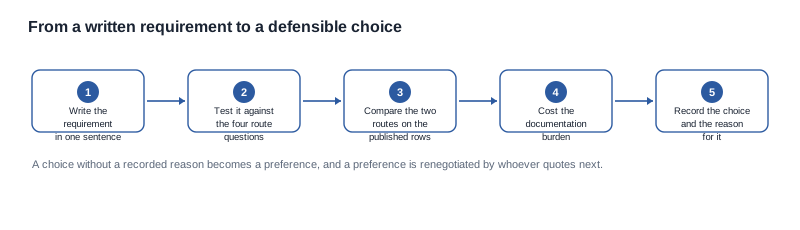
The sequence is short and it is designed to be auditable later, because a route decision that cannot be explained a year later is a decision that gets reopened every time a quotation arrives.
Write the requirement in one sentence, with the environment in it. "Private listening in a shared office" is a requirement. "Better audio" is not, and it cannot be evaluated against either route.
Test it against the four route questions. Does the audio have to be inaudible to everyone nearby? Does a source have to be lifted out of a background mask? Is the requirement music, long wear, cost or documentation? Can neither route answer it? One of the four answers decides it, and if the third is the only one that applies, the amplified route is the wrong buy regardless of what the gain figure says.
Compare the two routes on the published rows, not on impressions. The open-ear class publishes designations, cells, protocol versions, a runtime band and ingress markings on the sport models. The amplified entry publishes five rows and a maximum gain with no conditions. Comparing two routes on what is actually documented is a fairer comparison than comparing them on a demonstration.
Cost the documentation burden, not just the unit. For the amplified route that means the claim review, the market position, the model string, the file assembly and the measurement work. For the open-ear route it is close to zero, because the documentation is already in place.
Record the choice and the reason. The reason must be the requirement. If the reason is the price, the decision will be revisited by the next quotation, and it should be.
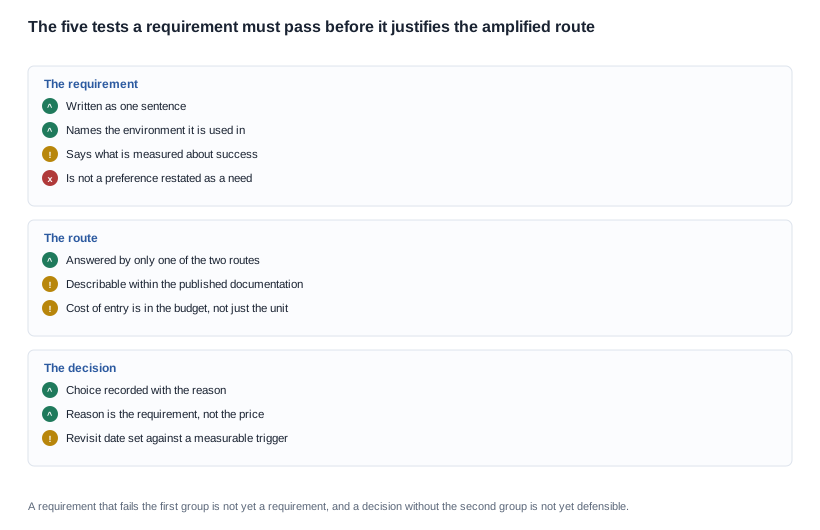
The checklist exists because the most common failure in this comparison is not choosing wrongly. It is choosing correctly for a reason that was never written down, so the decision cannot be defended when a channel asks why one model is priced and positioned differently from the other.
What a wrong route costs, and what we will and will not recommend
Choosing the amplified route for music. The symptom is a returns cluster described as "broken sound" and a review section full of it. The root cause is that the route was chosen for the number rather than the requirement. The prevention is to write the requirement first, and to let the matrix decide.
Choosing the open-ear route for a privacy requirement. The symptom is a customer complaint that people can hear the audio, in a setting where the whole point was that they could not. The root cause is that the requirement was recorded as "better sound" and never as "private". The prevention is to require the requirement to name the environment.
Choosing on the gain figure. The symptom is a specification sheet that ranks two routes on an amplification number. The root cause is that a maximum was treated as a condition. The prevention is to refuse the comparison until both sides state their conditions, and to remove the row if they cannot.
Budgeting the unit price and discovering the documentation. The symptom is a launch that slips for reasons that do not appear in the cost model. The root cause is that the cost of entry was never in the model, because it is paid in time rather than in money. The prevention is to add the documentation phases as lines before the quotation is accepted.
Treating the two routes as versions of one product. The symptom is a range that has acquired two languages, one support script and two sets of documentation, none of which was in the plan. The root cause is that the comparison was framed as better versus cheaper. The prevention is to treat them as separate categories with separate claims, which is also the answer if you ever put them in the same range.
What can be negotiated around the choice is the cost of entry rather than the price: the phase structure of the quotation, the tooling amortisation volume, the sample and measurement work as a quoted line, payment nodes per phase, per-configuration documentation, the pilot quantity, and the acceptance window that lets a lot be refused at inspection against written criteria. What cannot be negotiated is the laboratory cost and queue, the nature of tooling, the acoustic design work, or the claim decision — which belongs to the party placing the product on a market.
A worked scenario: an open-plan workshop requirement
Below is a constructed sequence. It is not a client project, and it shows how the trade-off would be worked through rather than what it returned.
Assume a business channel buyer whose customer has asked for a headset for open-plan work because earbuds are not permitted on the factory floor. The buyer has two quotes: the amplified route, and an open-ear model from the same range, at a lower price with documentation already in place.
The requirement is written. The buyer writes it in one sentence: "the user hears an amplified source in a noisy workshop, the ear stays open for safety, and nobody in the workshop hears the audio." That sentence is the whole decision, and it names the environment, which is what makes it testable.
The matrix is applied. The first two clauses — a source lifted out of a mask, an open ear — are answered only by the amplified route. The third clause — nobody nearby hears it — is answered only by the amplified route. Nothing in the requirement points at music, long open wear, cost or channel documentation, so the third branch of the decision test does not apply.
The premium is checked against what it buys. The buyer runs the what-it-buys table and finds that three of the four items on the left-hand side are load-bearing for this requirement, and that the one on the right-hand side that matters here — certainty of the result — is an evidence cost rather than a product cost. The buyer therefore budgets the measurement work, which is the correct response to it.
The documentation burden is costed. The buyer asks the supplier for the model string and the certification status and gets a partial answer, so the cost of entry for this route is higher than the unit price suggests. The buyer adds that to the model, sets a pilot quantity as the first commitment, and attaches a payment node to the documentation pack.
The choice is recorded. The reason is the requirement sentence, not the price, and a revisit date is set against the first returns data. The result is a defensible choice that can be explained to a channel buyer who asks why this model is not like the others, and an open-ear model is still in the shortlist for a different requirement — the customer who wants music — rather than being discarded.
What we will and will not recommend
A gain figure is a specification and a perceived benefit is an outcome, and we will not present one as the other. We publish the 35 dB, the cell, the charge time and the runtime because the catalogue states them, and we publish the absence of a model number, of any customisation capability and of any measured performance data for this entry with the same prominence.
We will not write a hearing-improvement claim, and we will not let the gain figure appear in customer-facing copy without the conditions that make it meaningful. We will also tell you when the open-ear class is the better buy, and we will do it in writing. That is not a courtesy; it is the same comparison in the other direction, and a supplier who only ever argues for the more expensive route is not making a comparison.
The mechanism is described under bone conduction audio technology, the regulatory boundary is set out under medical device boundary, and the specification behind the decision is under bone conduction key specifications. The alternative architecture is under open-ear audio specifications, and the range is under bone conduction glasses range.
Three things to send with the requirement
Send the requirement sentence and the environment. We will tell you which route answers it, and where the answer depends on a condition nobody has stated yet.
Send the two published rows you are comparing on. We will tell you whether they are comparable measurements or two different ones, and what to remove if they are not.
Send the open-ear model you are comparing against. We will tell you which requirements it answers better, because a shortlist with both routes in it is worth more than a decision made in one direction. The evaluation route is under sample evaluation.
Related reading
- The specification behind the decision — bone conduction key specifications
- Choosing between the two audio routes — bone conduction cost vs performance checklist
- What a supplier claim has to include — bone conduction manufacturer claims
Tell us the requirement behind the purchase and we will tell you which of these two designs answers it, and what still has to be tested.


