

Open ear audio glasses: a platform decision, not a variant
Why the audio route is settled once and not revisited
Open-ear audio is where a smart-glasses programme quietly acquires a second product, and the point at which most programmes notice is far too late. The audio route is not a feature you add to a frame at the end of the build; it is a platform decision, because it determines the transducer, the acoustic path through the temple, the power budget, the mechanical profile and the sound signature that a channel has to sell. Once the tooling is cut, it is not revisable without recutting. What makes it matter commercially is that the published data in our range lets you see the platform genealogy directly in the cell configurations, and the same cell configuration produces two different published runtimes in one group of four models. A buyer who reads the published rows quickly will pick the wrong model for a shift-length use, and a buyer who reads them carefully will know in week one which platform a supplier is actually offering. Read the cell count, read the runtime attached to each model rather than to the group, and treat the audio route as the first architecture decision in the programme rather than the last.
The three decisions that bring an open-ear question to a buyer
The reader is a brand-side product owner, a channel buyer assembling an audio range, or a category manager comparing a set of supplier options. The situations are recognisable and they arrive in a particular order.
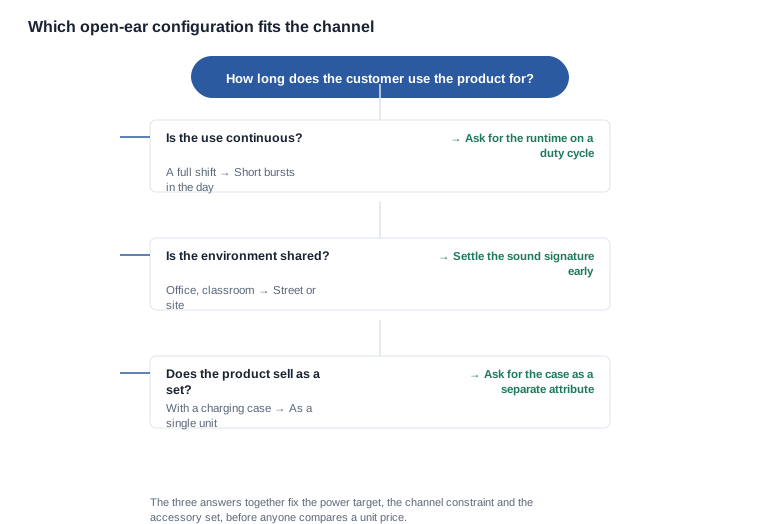
The first is a range decision. A buyer is putting together an audio range for a channel and has several model options, most of which look like the same product with a different price. The question is which of them are genuinely different, and the answer is visible in the published rows if the buyer knows which columns to read. The second is a shift-length problem. A corporate or industrial buyer has specified that the product must last a full working day, and a supplier has quoted a model whose published runtime is around six hours. The third is a channel that has sold a product into an environment where the sound was the wrong for the room, and somebody now has to work out whether the product can be fixed or the channel has to be changed.
What the buyer is afraid of in each case is specific. It is committing a programme to a platform that only works for short sessions and discovering it at the first pilot. It is comparing two quotations whose headline products look alike and finding that one of them has a smaller cell count than the other, so the two are not comparable at all. And it is a returns profile that is blamed on the product when it is actually the channel expectation that is wrong, which is a problem that cannot be fixed with a firmware release.
The chain position you occupy decides the levers that are open to you. A brand owner controls the platform choice, the configuration string and the listing, and therefore controls most of the risk. A channel buyer controls the purchase order and the range assembly, so the runtime, its duty cycle and the case arrangement have to be written into the order as acceptance criteria. A distributor who holds a brand in several territories has to be sure the same model is not being sold in one place as an all-day product and in another as a casual one, because the published runtime does not carry a duty cycle and the expectation does.

What the published audio rows say, and the label trap inside them
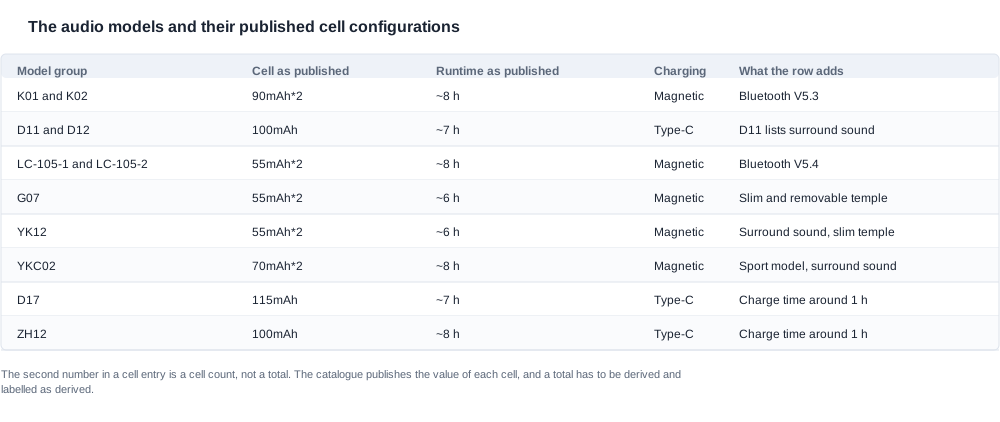
Eight catalogue entries are audio products: the YK12 and the D12, the G07 and the LC-105-2, the LC-105-1 and the D11, and the K01 and the K02, and the three sport models — the YKC02, the D17 and the ZH12 — publish the same kind of rows and are read the same way. Their published rows are the clearest in the catalogue, and reading them correctly takes two things a buyer usually does not have: the habit of reading a cell entry as a cell count, and the discipline of reading the runtime attached to a model rather than to a group.
The second number in a cell entry is a cell count. The catalogue publishes values such as 90mAh2, 70mAh2 and 55mAh2. The published number is the value of each cell and the suffix is how many cells there are. It is not a total, and a buyer who reads 55mAh2 as 55 mAh in total is reading a number that is half or a third of the real one. Totals are useful for reasoning about headroom, and a buyer is entitled to derive them, but they have to be labelled as derived rather than presented as published. In this article and in the tables that go with it, the catalogue form is what appears, and any total is marked as a derived figure.
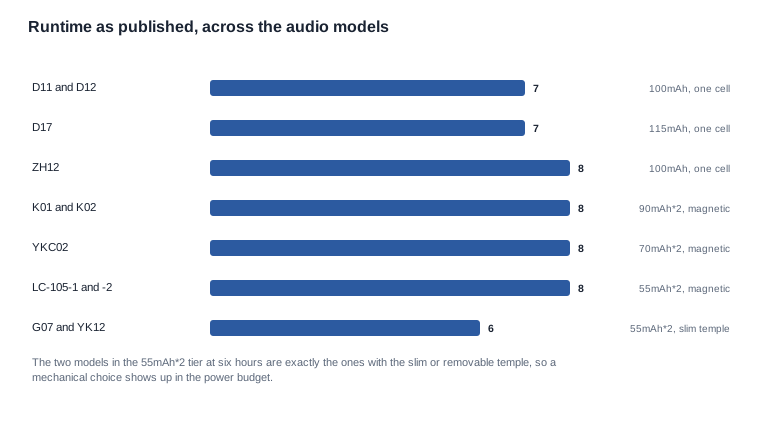
The runtime is attached to the model, not to the cell configuration. The clearest case in the range is the group of four models that share the 55mAh*2 configuration. The LC-105-1 and the LC-105-2 are published at around eight hours. The G07 and the YK12, which carry the same published cell configuration, are published at around six hours. A buyer who reads the group and takes the highest figure will be out by a third on two of the four models, and the two that differ are precisely the two with the slimmer and removable temple. That is not a catalogue error to be annoyed about. It is the platform telling you something: the mechanical choices that make a product more elegant or more adaptable are paid for out of the same power budget, and the published data shows the price.
The labels inside the catalogue are not applied consistently. On the D17 and the ZH12 pages the charge-duration label carries a charging time of around one hour, alongside a separate runtime label. On the V03, the KY06 and the MT5 pages, the same label carries a runtime of five to eight hours and six to eight hours respectively, with the charge time of two hours or less sitting under a different label. A buyer reading by column heading rather than by position will take the wrong number out of the catalogue, and the only reliable protection is to confirm, for each model, which of the two published durations is the charging time and which is the runtime.
Read as a group, the published cell configurations also reveal the platform families. The two-cell 90mAh2 configuration belongs to the K01 and the K02, the two-cell 70mAh2 configuration to the YKC02 sport model, the two-cell 55mAh*2 configuration to a group of four, and the single 100mAh cell to the D11 and the D12. Two further sport models, the D17 and the ZH12, sit on single cells of their own and carry the fastest published charge times in the range. What that pattern gives a buyer is a reliable signal: a shared cell configuration is a strong indication of a shared audio platform, and a shared platform is what lets several models sit under one documentation scope and one approval cycle. Where a model departs from the cell configuration of the products it otherwise resembles, it is usually a different platform, and it should be budgeted as one rather than treated as a variant.
One warning applies to any comparison made across suppliers. Published runtimes are not directly comparable, and the reason is almost always the workload rather than the product. A figure measured with continuous playback, a figure measured with intermittent use, and a figure measured with a phone in a call are three different measurements, and none of them states its conditions. Until the duty cycle is attached, two numbers in the same row are two different measurements, and the threshold to hold is a duration with a stated workload behind it.

Nine questions that settle an open-ear platform before the tooling
- Which audio route does the quoted configuration use, and is that route a platform with variants or a one-off build?
- What is the cell configuration in the quoted variant, expressed as the published value and the cell count?
- What runtime is published for that specific model, rather than for the group it resembles?
- What workload was the published runtime measured under, and what is the charge time with its starting state?
- How much of the product's sound is audible to other people in a shared space, measured at a stated volume?
- What does the audio route add to the temple profile, and which mechanical features are affected by it?
- Can the runtime be extended or shortened by a firmware power profile, and who controls it?
- Is a charging case part of the configuration, and what is its capacity as a separate attribute from its function?
- What is the minimum order quantity for each variant, and which of them share a common platform and a common documentation scope?
Question one is the one that saves the most money, because a platform with variants gives a buyer a range without a second approval cycle, while a one-off build gives a buyer a product and a second set of costs. The two are not distinguishable from a unit price, and they are very distinguishable from the lead time.
Question three is the one that prevents the range error described above, and it is a question with a surprisingly high hit rate of being ignored. Ask for the runtime of the exact model in the exact variant, in writing, because the answer is a model-level figure and a group-level figure are both defensible sentences in a conversation and only one of them is true.
Question five is the channel constraint. An open-ear product is audible to the people around it, and that is a fact about the architecture rather than a defect. A channel selling into an office, a classroom or a service floor needs to know what the product sounds like from a metre away before it commits, and that figure belongs in the acceptance criteria rather than in the discovery stage.
Question seven is the one that separates a product from a platform. A power profile that the brand can select is a commercial lever: a longer-runtime variant and a shorter-runtime variant for the same hardware is a range decision a brand can make without a new tooling round.

Where open-ear audio programmes lose money
The range that was assembled on a group figure. The symptom is a product in the range that underperforms the expectation set by its siblings, and a returns cluster from one customer segment rather than a spread. The root cause is that the runtime was read at group level and the two shorter-runtime models were not separated out. The control is to quote and compare at model level, and to publish the runtime with a duty cycle.
The shift-length programme that bought a six-hour model. The symptom is a pilot that ends with staff swapping devices mid-shift, or charging at a time that the operational routine does not allow. The root cause is that the requirement was written as a number without a workload, so a model that satisfied the number on the bench did not satisfy it in the shift. The control is to write the workload into the requirement before the shortlist is drawn.
The case that was not in the quotation. The symptom is a first shipment with an accessory set that does not match the listing, and a customer who cannot find a way to charge the product during the day. The root cause is that the case was treated as a packaging item rather than as a configuration attribute. The control is to request the case capacity and the case function as two separate answers, and to put them in the configuration string.
The platform change discovered after the tooling. The symptom is a change request that carries a much larger cost and schedule than anyone expected. The root cause is that the audio route was treated as a feature rather than as a platform, so the change route was never established. The control is to freeze the platform at the point the order is signed and to write the change route for it.
The firmware that changed the power profile. The symptom is a batch whose runtime differs from the approved sample, with no hardware change. The root cause is that the power profile was not pinned and no change notice was required. The control is to pin the firmware version and add a change-notice clause.
The expectation the channel set. The symptom is a returns reason of "the sound was not what I expected", concentrated in the shared-space channel. The root cause is that a product which is audible to others was sold as a private listening product. The control is to write the sound signature into the listing and the support script, not to treat it as a detail.
Each of these is a normal part of comparing open-ear audio, and none of them would be a reason to change supplier. Each one is a question answered earlier, a row quoted at model level, or a clause written before the first order.
The terms worth negotiating, and the rows we publish and withhold
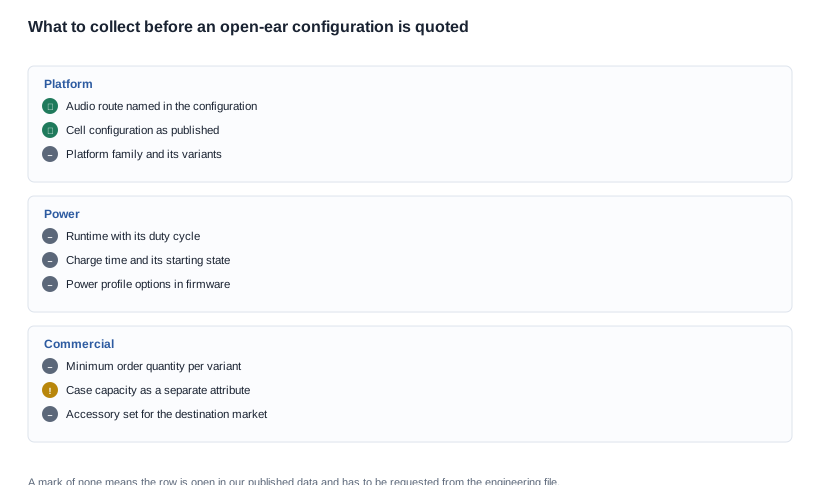
Before you order, the open-ear checklist is short: the audio route and the variant in the configuration string, the published cell configuration for that variant, the runtime for the specific model rather than for the group, the charge time with its starting state, the shared-space sound figure, the case capacity and function as two answers, and the firmware version. How to compare two quotations in this category is to lay those rows out in the same order before any number is compared, because the trade-off between a lower unit price and a platform that only works for short sessions is invisible until the rows sit side by side. The red flags worth naming are a runtime quoted at group level, a case that is treated as a packaging item, and a shared-space product presented as a private one. Those three are the usual pitfalls, and a buyer who closes them at quotation stage avoids a pilot that has to be run twice.
The commercial shape of an open-ear programme is set by two things: the platform and the accessory set. Everything else in the negotiation is smaller.
What moves in a negotiation is worth naming. The minimum order quantity per variant moves when you commit to a variant count rather than a unit count, and a platform with several variants on one documentation scope is worth more than a price concession because it removes a whole approval cycle. The firmware power profile and the resulting range structure are negotiable and are a marketing asset. The accessory set is negotiable per destination market. The artwork round count is negotiable and each round is a week, so one extra round for the shared-space wording is cheaper than a reprint. The sound signature figure is negotiable in the sense that a measured figure is available on request, and it is worth more to a buyer than a generic claim.
What does not move is the audio route itself, because it is a tooling and platform fact rather than a commercial variable, and no unit price turns a magnetic-charged platform into a cable-charged one. The cell configuration is a hardware commitment, and changing it is a new product rather than a setting. The published runtime for a given model is a measurement, and pressing on it produces a different measurement rather than a different number. Conformity cost and time are fixed per product family and sit in a queue at the test laboratory.
The documents worth collecting before the deposit are: the configuration string naming the audio route and the variant, the published cell configuration for that variant, the published runtime for that specific model, the charge time with its starting state, the shared-space sound figure, the case capacity and case function as two items, the accessory list per destination market, the firmware version of the approved sample, and the change-notice route.
The clauses worth writing into the purchase order are: the audio route and the cell configuration as named configuration fields, the runtime for the specific model with its duty cycle, the shared-space sound figure as an acceptance criterion, the case capacity and function, the accessory list per market, the pinned firmware version, a change-notice clause covering firmware and the power profile, and a re-issue obligation for the documentation pack when the platform or the variant set changes.
On our own side, the boundary is this. We publish the cell configuration, the runtime, the charge time, the charging interface and the Bluetooth version for every audio model in the range, and we publish the feature labels such as surround sound and slim temple exactly as our documentation states them. We do not publish the transducer type, the acoustic path, the sound signature figure, the shared-space leakage figure, the duty cycle behind any runtime, the power profile options, the weight of any model other than the MT6, or the minimum order quantity for any variant. We will not fill a runtime with a figure that is not attached to a workload, and we will not present a group figure as a model figure, because both errors are cheap to make and expensive to discover after a pilot.
Send the models, the quantities, the use pattern and the destination markets, and we will tell you which configurations exist, which of the published rows settle the platform question and which have to come from the engineering file, and exactly what to put in the order to close the rest. The open-ear audio page carries the published audio rows, how to choose open-ear audio glasses covers the selection logic in more detail, and the bone conduction and open-ear comparison article is where the two audio routes are set against each other.
Related reading


