

A Bluetooth version is the one row on a smart-glasses specification sheet that is always present, always checkable and almost never decisive. That combination is what derails procurement conversations. A buyer sees a version on a product page, compares it with the version on a competitor's page, and concludes that a product difference exists. Usually it does not. What the version actually changes is narrow: the radio approval route in each destination market, the oldest device in the customer fleet that will still connect, and whether the radio module can be treated as a configuration or has to be treated as a development.
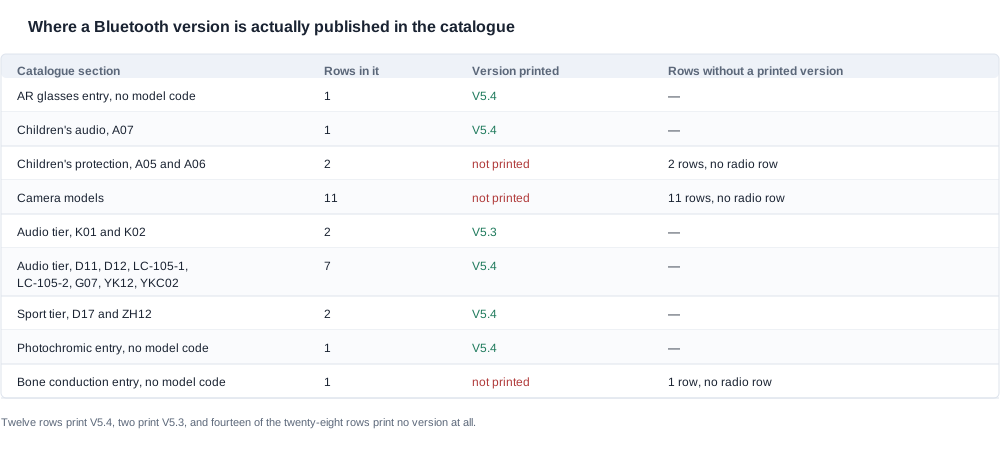
Three facts from our own catalogue frame everything below. Twelve of the twenty-eight rows publish Bluetooth V5.4. Two publish V5.3. Fourteen publish no version at all, and that last set includes all eleven camera models. A row with no version is not a missing feature; it is an open commercial question that only a supplier can close, and a camera product is a radio product whether or not a product catalogue says so.
The decision in front of a buyer is therefore not which version to buy. It is what to write on the product page, what to put in the order acknowledgement, and what to check on the sample before the listing goes live. Those three decisions are worked through below in that order.
Smart glasses Bluetooth version: a commercial decision
The person holding this page is usually a brand-side product owner working alongside a procurement manager, and the version question reaches them as one line in a comparison table between two quotations that otherwise read as interchangeable. The situation is one of three: a quotation to compare, a new programme to open, or a market to enter. In every one of them the real question is the same — which of the suppliers in front of you can actually build and document what you have written down, and what happens to your schedule when they cannot.
What the buyer is afraid of is not an old radio. It is a consignment that is not the unit that was signed off, a paper trail that holds the boxes up at a frontier, and an opening production run that becomes a returns burden nobody carried. A version is small in engineering terms and large in all three of those ways, because the radio is the part of the product that a border official and a channel buyer can both check.
The supply chain position of the version row explains why it behaves this way. The claim is published by the brand, on the brand's page, in the brand's words. It is supported by a third party, in a qualification record that belongs to the radio module rather than to the finished product. And it is paid for by the buyer, in the qualification and the testing that sit behind the module. The number itself is almost free to publish and expensive to retract once a channel has indexed the page and built a comparison around it.
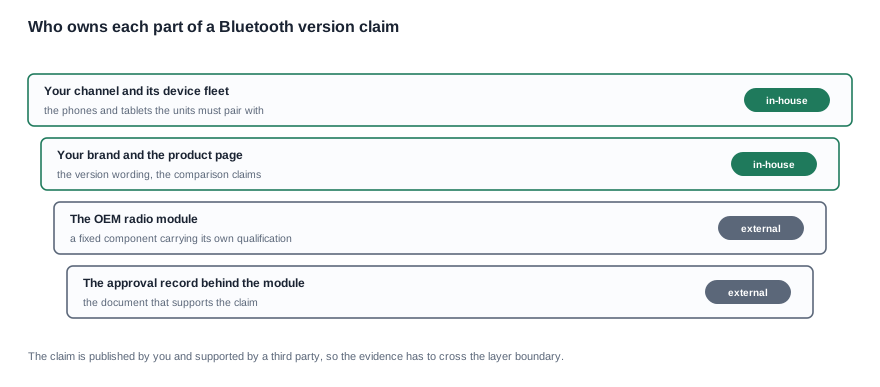
That asymmetry has a commercial consequence which is worth stating plainly. Because the claim is yours and the evidence is somebody else's, a version written on a listing creates a permanent obligation that the supplier can discharge once and you cannot discharge at all. If the module changes in a later production run and nobody told you, the page is still saying something the hardware no longer supports. The only real control is a clause that puts the module reference into the order acknowledgement and obliges the supplier to notify you before the radio changes.
A second consequence follows for the channel buyer. A version that appears on a page invites a comparison against a competitor's version, and the comparison will be made by someone who does not know what the version does. The cheapest defence is not a longer disclaimer in the listing; it is a line that says what the version is for. A page that says which devices the product connects to, and which it does not, ends the comparison. A page that only prints "Bluetooth 5.4" invites the comparison and loses it.
Where the catalogue prints a Bluetooth version and where it prints nothing
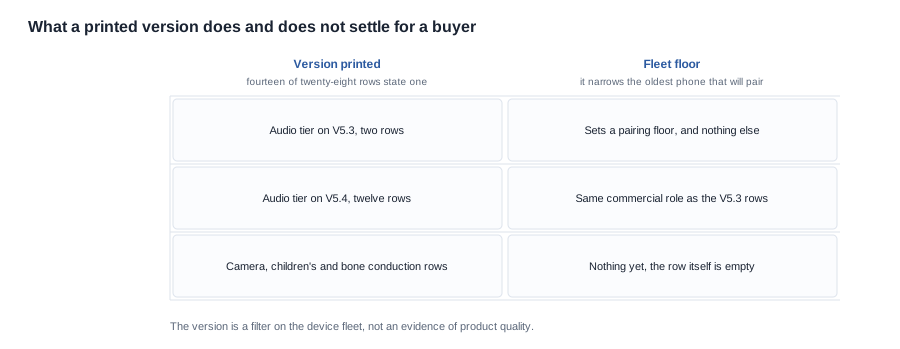
Twelve catalogue rows print Bluetooth V5.4: the A07 children's audio model, the AR entry that carries no model code, the photochromic entry that also carries no model code, the D11 and D12 audio models, the LC-105 pair, the G07, the YK12, the YKC02, and the D17 and ZH12 sport models. Two rows print V5.3: the K01 and the K02. That is the complete set of version data we publish, and it covers fourteen of the twenty-eight rows in the range.
The other fourteen rows publish no version. They are the eleven camera models — the MT6 and the S7, the V03 Pro and the V06, the CY03 and the MT5, the L1 Pro and the KY06, the CY05 and the L2 Utral, and the V03 — plus the A05 and A06 children's protection models and the bone-conduction entry.
It is worth being precise about that second list, because it is easy to misread. A camera row in our catalogue prints a pixel count, a cell capacity, a charge time, a rated runtime and a charging method. It does not print a radio version, and the absence is not a claim that the camera models have no radio. The MT6 and the CY03, and the L2 Utral all capture images and stream them, which cannot be done without a radio. The rows simply do not carry that line, because the catalogue is a product document and the radio position lives in the technical file, where it belongs.
Two entries in that list of fourteen carry no model code at all, and that has a commercial consequence of its own. The AR entry and the photochromic entry are described by their technology rather than by a SKU, which means they cannot be named on a certificate, on a purchase order line or on a customs declaration without a model designation being created first. A buyer who wants to order either of them should treat the model designation as a precondition of the quotation rather than as an administrative detail to be sorted out later.
The comparison trap is the reason this section matters more than a specification table usually does. A range in which the K01 and the K02 sit on V5.3 and the LC-105 pair, the G07 and the YK12 sit on V5.4 gives a channel buyer a visible reason to prefer one model over another, and our own published data does not support the difference. The version in our catalogue tracks the module that happened to be in each design, not a product hierarchy. A range with that property is a range where the copy has to be careful, because a buyer who notices the gap will ask what else differs, and the honest answer is sometimes nothing at all.
The second trap is the comparison across suppliers. Two suppliers quoting V5.4 are not quoting the same radio, because the version says nothing about the chipset behind it, the antenna, the transmit power or the supported profiles. What a version comparison settles is the generation of the protocol. What it does not settle is range, latency, the audio path, the power draw or the stability of the connection in a busy environment. A buyer who builds a channel's product selection on the version comparison is selecting on the one variable that tracks nothing in our published data.
The three decisions a Bluetooth version actually changes for a buyer
The regulatory route. A version does not change which framework applies to a product, because the framework applies to the radio function and the radio function is what it is. In the European Union the Radio Equipment Directive (EU) 2014/53/EU governs radio equipment, and it is the directive to cite in a technical file for a Bluetooth product. The Electromagnetic Compatibility Directive (EU) 2014/32/EU is a different instrument with a different number, and it covers electromagnetic compatibility rather than radio; the EN 301 489 series is a family of harmonised standards cited under the EMC regime, not a directive in its own right. In the United Kingdom the route is UKCA marking with its own technical requirements, which is a separate submission rather than a second label on the same approval. In the United States the relevant route is FCC equipment authorisation.
What the version does change inside that route is the technical description. The radio generation, the supported profiles and the declared specifications are part of what the technical file has to describe, and a supplier who quotes a version cannot describe the radio without the module behind it. This is why the useful question is never "which version do you have" but "which module, and what is the qualification record for that module".
The compatibility floor of the customer fleet. This is the one place where the version is genuinely decision-relevant, and it is decision-relevant about your channel rather than about the product. The version sets a floor under the oldest host device that will connect. A brand whose customers are on current phones has no problem here at all. A brand selling into a fleet that includes older budget Android devices, or into institutional equipment that is replaced on a four-year cycle, has a real constraint, and the constraint is visible in a pairing test in about thirty seconds. Ask for the oldest device the product will connect with, in writing, and then test that device on the sample rather than accepting the answer.
Whether the radio module is fixed. A version is a property of a module, and a module is normally fixed on a platform for the life of the platform. That makes a version requirement a product requirement rather than a configuration option. "Upgrade to V5.4" is a development with a new qualification, a new authorisation route and a new schedule, not a line on a purchase order that a factory can action next month. Buyers who treat it as the latter pay for it twice, once in the engineering and once in the delay.
Beyond those three, there is a list of things the version does not determine and a buyer should stop expecting it to determine. It does not settle acoustic performance, because that is a property of the chamber, the transducers, the processing and the seal of the unit. It does not settle connection range, because that is set by transmit power and antenna configuration. It does not settle latency or the audio path, because those follow the profile and codec negotiation rather than the version string. It does not settle runtime, because the radio is one contributor to the published runtime figures among load, environment, temperature and starting state. And it settles nothing at all about image quality, which for the camera models is a function of the sensor, the optics and the processing pipeline.
There is also a certification distinction worth making explicit because it is used imprecisely in this category. Bluetooth SIG qualification is attached to a specific implementation and a specific product design, not to a version string and not to a brand. A supplier holding qualification for one model has not thereby qualified another, even where the two share a radio module. If the buyer is shipping a private-label configuration, the design certification and the product approval are separate exercises, and the second one is yours to commission.

Verifying a radio claim before it reaches a product page
Verification in this category is almost entirely documentary, and it moves quickly once you know which four items to ask for. The order below is deliberate: each step assumes the previous one has passed, and a failure at any step tells you what the next step would have told you.
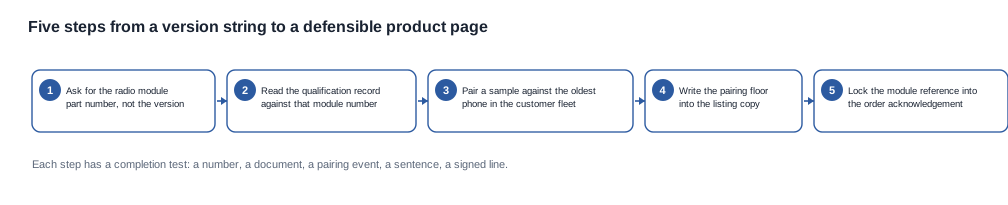
Step one, ask for the module rather than the version. A version string is a label. A module part number is a component identity, and a component identity can be verified, compared between production runs and written into a purchase order. The supplier's answer to "which module" is a short string; the answer to "which version" is a marketing adjective. Ask for the part number, the supplier of the module, and the quantity of that module the supplier has on hand or on order.
Step two, get the qualification record and check what it covers. The document that matters is the record that names the module or the product design, and you need three things from it: the identifier, the issuing body's own accreditation, and the scope. Check that the scope includes the radio functions you are shipping and the band you are shipping into. An identifier alone is not coverage; a record that stops at a variant is not coverage of your variant either.
Step three, read the supported profiles and the default behaviour. The version tells you the protocol generation. The profile list tells you what the product can actually do, and the default negotiated behaviour tells you what it does when it has a choice. A product that supports a high-quality codec but negotiates the lowest common denominator with the phones in your fleet is a different commercial product from one that does not, and the difference is only visible in the profile list.
Step four, run your own pairing test on a sample, on a protocol you write down first. The protocol that closes the gap is short: connect to the oldest device in the fleet, connect to the newest, confirm both re-establish the link after a power cycle, and observe what happens when the host has a second active Bluetooth device. Write the protocol before the first reading, because a protocol designed afterwards is a description rather than a measurement.
Step five, put the criteria and the measurement into the purchase order. The module reference, the profile list, the minimum supported host device, and the notice obligation for any radio change. If those four things are only in an email thread, they are not binding on the next production run.
The red flags in this category are unremarkable individually and expensive together. A version quoted without a module behind it is the first. A qualification record that names a brand or a family rather than a model designation is the second. A range that mixes two protocol generations while implying a product hierarchy is the third. A page that compares version numbers with a competitor is the fourth, and the cheapest to fix because it is a copy decision rather than an engineering one.

The controls that keep a Bluetooth version claim true
Once the claim is published, three things have to stay true: the module in the shipped units is the module that was qualified, the listing wording still matches the shipped behaviour, and nobody has published a version the units cannot do. Each of those is a control, and each is cheap to set up in a purchase order and expensive to retrofit after a channel has built a comparison around the page.
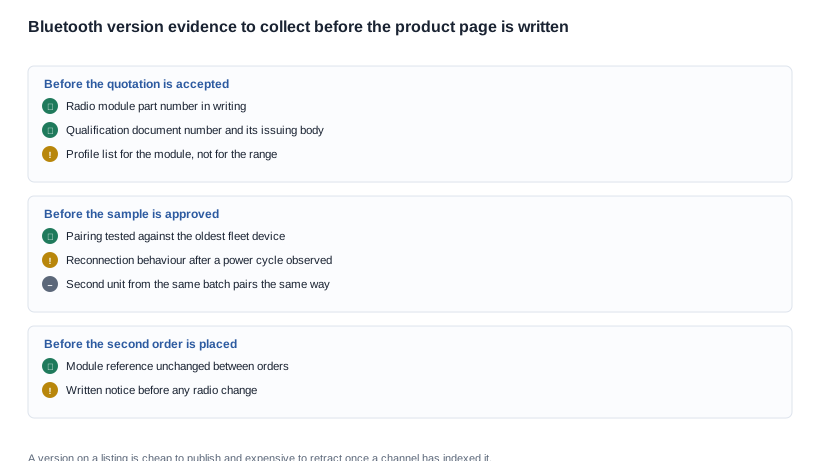
The first control is the module lock. The order acknowledgement names the module part number for the configuration being produced, and any change to it requires notice before the change is made, with a stated consequence. This is the control that turns a version from a piece of copy into a contractual fact. A supplier who is asked to notify a buyer before touching the radio has a different relationship with the request than a supplier who is asked to keep the page accurate.
The second control is the wording discipline on the listing. A version belongs in the specification block, next to the cell, the runtime and the charging interface. It does not belong in a headline, and it does not belong in a comparison against a competitor's version, because a buyer cannot make a meaningful comparison from it and the listing ends up answering a question nobody asked. The useful thing to publish instead is the compatibility statement: which host devices the product connects to, and the minimum host device it supports.
The third control is the sample protocol, written before the sample is tested. A pairing test that is planned in advance produces a result that can be filed and compared with the next supplier's result. A pairing test that is improvised produces an opinion, and opinions do not survive a purchasing review.
On the commercial side, the split between what can be negotiated and what cannot is unusually sharp in this category. What can be negotiated is everything around the version rather than the version itself: the wording of the specification block, the compatibility statement, the module lock, the notice obligation, the scope of the qualification evidence the supplier will provide, and the profile list. What cannot be negotiated is the radio approval route itself, its cost and its duration, because that is a queue at a test laboratory and a fixed cost per product family. Nor can a version requirement be softened by commercial pressure, because a radio generation is an engineering fact.
The clauses worth having in the agreement are short. The module part number, written on the order. The supported profile list, attached. The minimum host device, stated. A notice obligation before any change of module, radio or antenna. A requirement that the qualification and approval evidence be reissued against the exact model designation the units are shipped under, and a warranty written against the shipped configuration rather than against a family. None of these is unusual, and together they are the difference between a version that is a fact and a version that is a hope.
What our own Bluetooth version data settles, and what it does not
The short answer: we publish the rows we hold and mark the rest as open, and we would rather show you fourteen empty fields than fourteen plausible values.
What we publish for the fourteen rows that carry a version is the version itself, and alongside it, where the row states it, the cell capacity, the charging interface, the charge time, the rated runtime and the colour options. For the K01 and the K02 the published set is V5.3, two cells of 90 mAh, magnetic charging, a charge time of two hours or less and a rated runtime of about eight hours. For the D11 and the D12 it is V5.4, a 100 mAh cell, Type-C charging and a rated runtime of about seven hours. For the LC-105 pair, the G07, the YK12 and the YKC02 it is V5.4 with two 55 mAh cells, magnetic charging, and a rated runtime of about eight hours for the LC-105 pair, about six hours for the G07 and the YK12, and about eight hours for the YKC02.
What we do not publish, and will not estimate, is the transmit power, the antenna configuration, the supported profile list per model, the codec negotiation behaviour, the latency of the audio path, and the module part number. Across the whole catalogue, one weight is published — 158 g for the MT6 glasses unit, excluding its foldable charging case — and no model publishes a bare frame weight. Across the camera models, no sensor part number, no field of view and no video container is published. The certification numbers, the issuing bodies and the test report references are not published either; the catalogue carries an export-certification page with image content instead of text content, it has no per-model certification row, and its text names no CE, FCC or RoHS, and we would rather say that than print a reference that cannot be checked in a register.
We also make no vision, health or hearing-efficacy claim for any product in this range, in any market. A product that streams audio or images is not a clinical device, and a listing that implies otherwise is a regulatory exposure rather than a marketing decision.
If you tell us the device fleet your channel sells into and the markets the units ship to, we will tell you which of our rows is relevant, which parts of the radio position our documentation answers today, and which parts have to be established on your own units. The background on the technology is under Bluetooth connectivity and versions, the field-by-field version list is in Bluetooth version spec sheet explained, the common errors are collected in Bluetooth version common mistakes, and the introductory version of this topic is Bluetooth version for beginners.
Related reading
- Bluetooth connectivity and versions
- Bluetooth version spec sheet explained
- Bluetooth version for beginners
- Bluetooth version common mistakes
Fleet and market are all we need to point you at the one question worth asking.


