

The YK12 is the audio frame in this range that publishes two things at once: a slim temple and surround sound. Everything else about it is deliberately ordinary — Bluetooth V5.4, a 55 mAh × 2 battery, magnetic charging at up to two hours, and a rated runtime of about six hours.
That combination points at one specific buyer, and if it is not your buyer this is a short article, because the alternatives in this range are more differentiated than this model is. The six-hour runtime is also the shortest published figure in the audio range, shared with the G07, and a buyer whose customer intends to wear the product all day without charging should look at that first rather than last. What follows is the published row, the platform it belongs to, and the two lists — the buyers it serves and the buyers it does not.
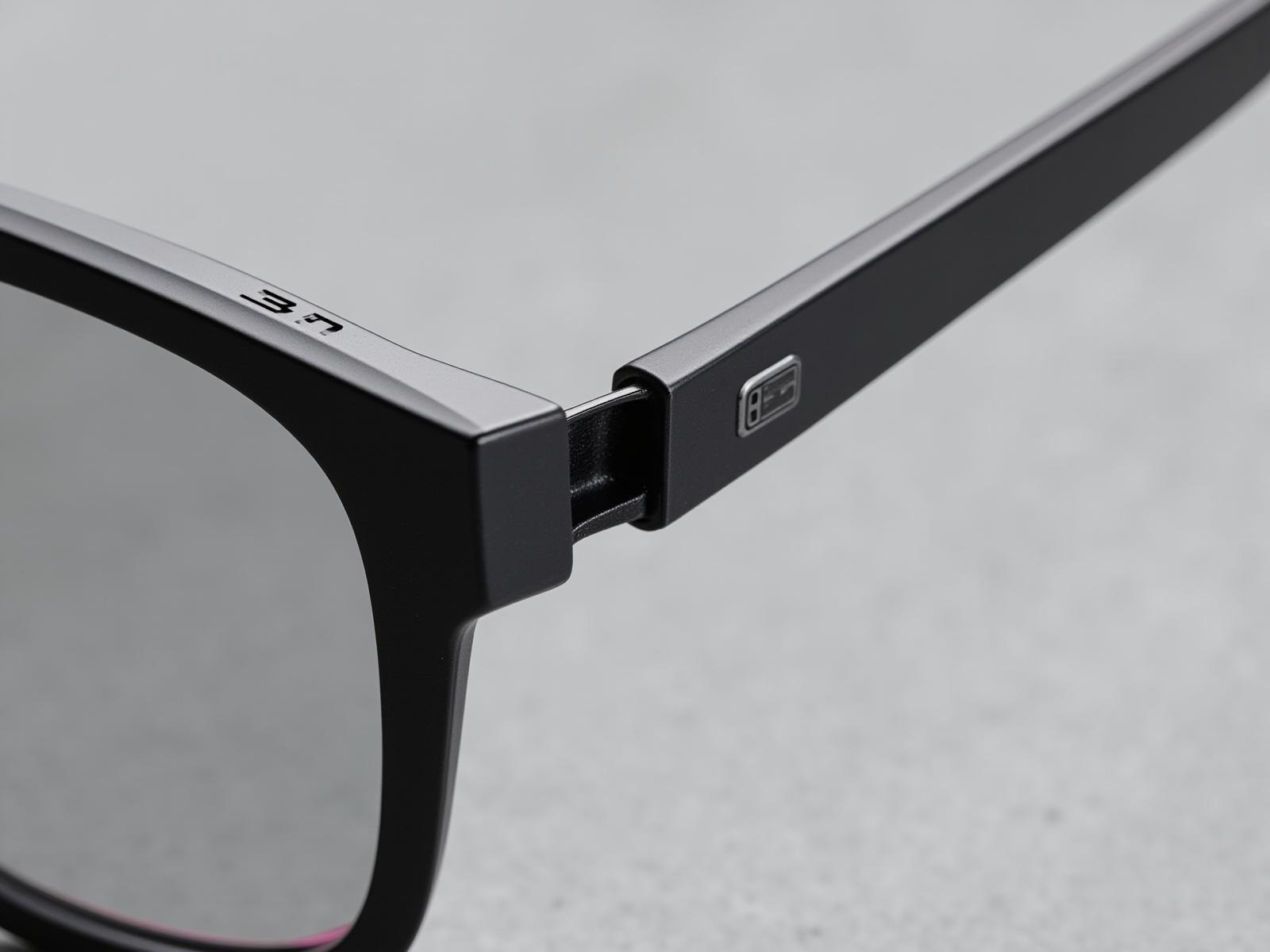
YK12 smart glasses and the two published features that justify the model
A slim temple, published as a row rather than implied by a photograph. That is the single physical feature that sells an open-ear frame into a channel that is not a gadget channel, and it is the reason this model exists alongside the LC-105 pair. It also reduces the contact area against the side of the head, which tends to reduce the pressure marks that come with a full day of use — though that second claim needs a weight figure to stand on, and the weight is not published for this model.
Surround sound, published as a row. The claim can be stated on a product page, but it cannot be quantified, because no leakage measurement, driver size, frequency response, microphone count or pickup distance is published for this model or for any other in the range. Our open-ear audio guidance covers the trade-offs that those missing figures would have covered, and the practical version of the question — what does the customer hear differently — is a question to put to a supplier rather than a number to assume.
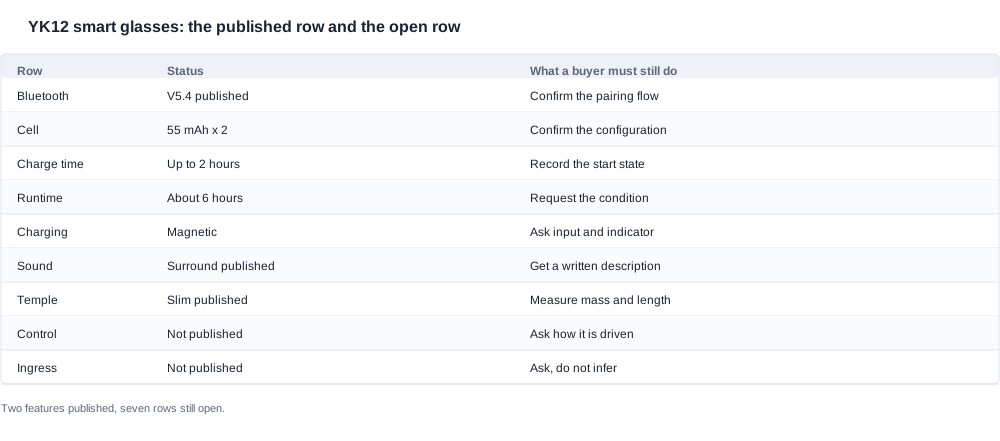
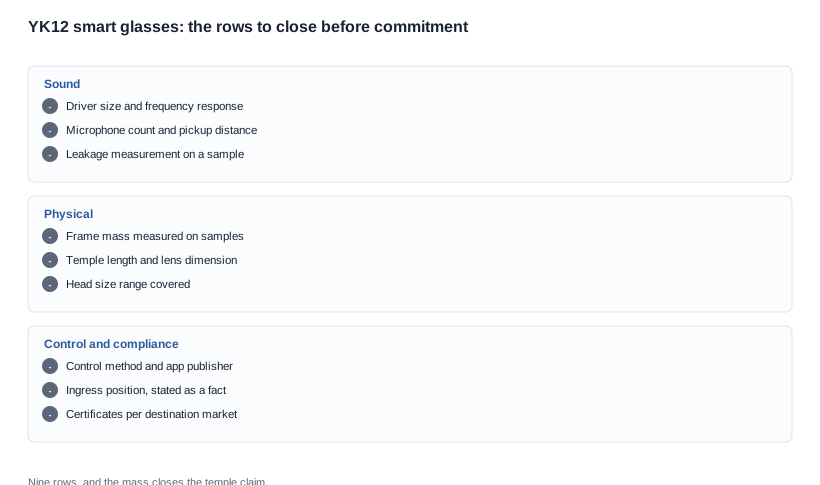
The ordinary rows, read in full. Bluetooth V5.4, 55 mAh × 2, a charge time of up to two hours, a rated runtime of around six hours, and magnetic charging. That is genuinely everything, and it is worth saying plainly: there is no frame weight, no temple length, no lens dimension, no head-size range, no control method and no ingress protection rating for this model. A buyer who needs those rows cannot have them from a catalogue page and has to get them from a sample.
The platform question: three finishes of the same cell
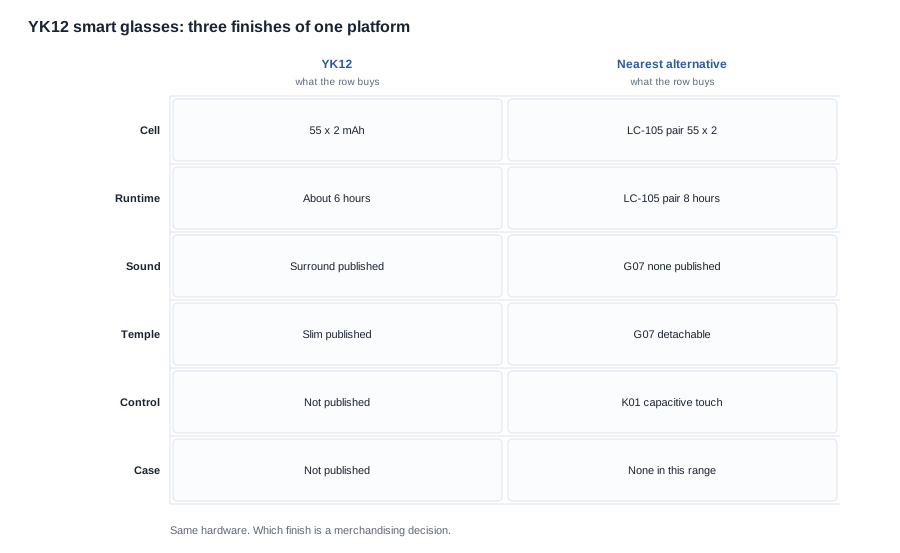
The 55 mAh × 2 arrangement is a platform, not a coincidence. The same cell configuration appears on the LC-105-1, the LC-105-2 and the G07. The G07 publishes a detachable temple and this model publishes surround sound; the LC-105 models publish neither. So this model is one of three finishes of a shared platform, and the decision is about the two features that differ, plus the rated runtime difference that the catalogue does not explain.
That makes the merchandising decision cheap and the specification decision expensive. One cell, one charging method, one accessory family and one firmware branch across three models means a brand running a range on this platform carries one accessory line rather than three, and one certification footprint spread across more units. Against that, the platform's weakness propagates: if the 55 mAh × 2 cell is wrong for the customer's day, it is wrong on all three models, and the fix is a platform change rather than a model change.
The runtime difference is the part to interrogate rather than accept. This model publishes approximately six hours and the LC-105 pair publish approximately eight on identical cells, identical charge time and identical charging method. A two-hour spread on identical hardware describes a measurement convention, not a product difference. A buyer treating it as a product difference will pick the wrong model and will pick it for a reason that cannot survive a second question from a supplier.
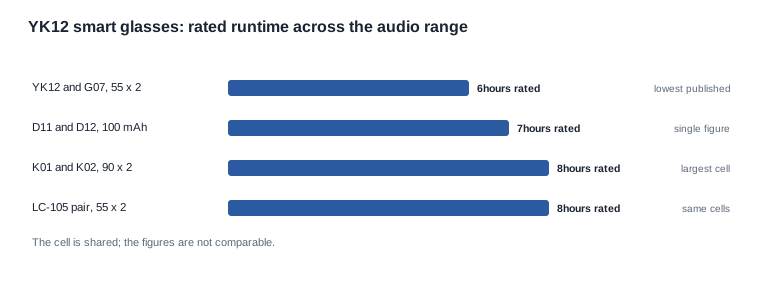
The practical version of that question, for a buyer running a range. Ask each supplier on the platform for the same three things — the runtime condition, the measured frame mass, and the control method — and score the answers rather than the figures. Two of the three finishes will answer the runtime question differently despite identical hardware, and that difference tells you more about the documentation quality of each supplier than any specification on the row does. A platform shortlist scored on the completeness of its answers is more robust than one scored on published numbers, because published numbers in this category are not comparable and the completeness of an answer is.
And where this model sits in the wider ladder. The range has a clear three-band structure: the 55 mAh × 2 models at six to eight hours, the 90 mAh × 2 models at about eight hours with AI translation on the K01 and no touch control row published for any model, and the 100 mAh Type-C models at about seven hours with surround sound on the D11. This model sits in the bottom band and carries the sound claim, which makes it a workable rung in a three-tier range rather than a top-of-range product — and that is the honest way to position it.
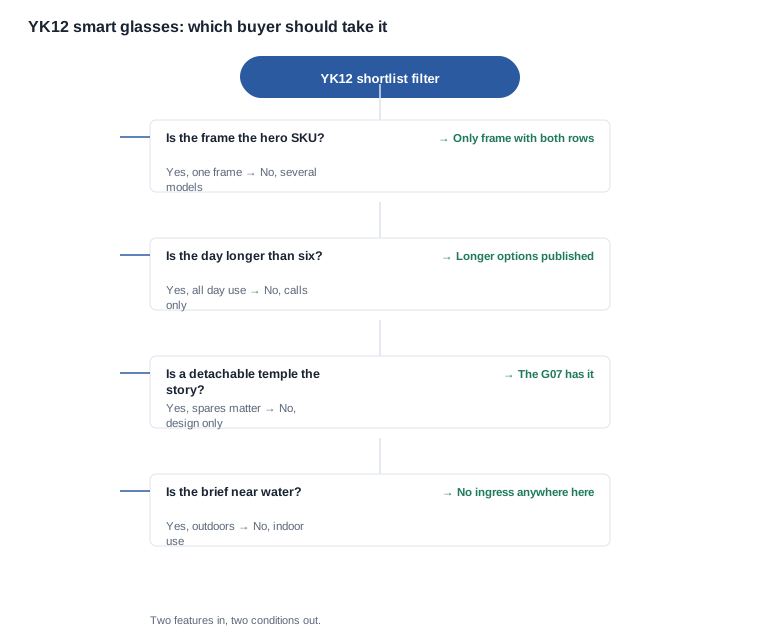
When this model is the right answer
A buyer whose customers make calls. This is the case the platform is built for. Open-ear audio with surround sound is the whole product, and a six-hour rating covers a working day of intermittent calls. Magnetic charging means a customer can top it up between uses without finding a cable, and if the customer's volume is dominated by calls and meetings the shorter runtime is not the constraint it sounds like.
A buyer in a fashion or lifestyle channel where the frame has to read as eyewear. The slim temple is published specifically for that purpose. A slim temple and a sound claim together give a listing something to say that a plain frame does not, and this model is a stronger choice for that channel than any of the plainer audio frames in the range.
A brand that needs two features in one SKU. The LC-105 models publish no feature at all; the G07 publishes a detachable temple but no sound claim; the D11 publishes a sound claim but no temple description. If the brief requires a sound claim and a slim silhouette in a single frame, this is the only model in the range that provides both, and the alternative is two SKUs where one was planned.
A brand building a good-better-best ladder and wanting the bottom rung to be sellable. A bottom rung with no feature is a price entry that closes nothing. A bottom rung with a published sound claim and a published temple is a product that can be explained in one sentence.
And the buyer who is comparing this model against a platform variant rather than against a rival. If the shortlist contains the LC-105 pair, the decision is not about quality — it is about what the range needs to say. A plain bottom rung is fine when the range's message is price. A bottom rung with two published features is better when the range's message is design, because it gives the brand something to write on at the price point where customers are most price-sensitive. That is a marketing decision rather than a sourcing one, and it should be made by whoever owns the range plan rather than by the buyer running the comparison.
The buyer whose channel has a returns problem rather than a stock problem. This model has the shortest published runtime in the range and an unpublished frame mass, and both of those feed returns — the first through customers finding the day longer than the figure, the second through the frame not sitting as the customer expects over a long session. A channel measuring its returns by reason code will find those two reasons concentrated on this model, and a brand that fixes them on a sample fixes them for the whole channel at once.

When this model is the wrong answer
If the customer needs a longer day than six hours. The alternatives publish more: the LC-105-1 and the LC-105-2 publish around eight hours on the same cell arrangement, and the YKC02 in the sport family publishes 70 mAh × 2 with roughly eight hours. A runtime difference of two hours is not a detail at retail, because it decides whether a customer charges the product overnight or puts it down at lunchtime.
If the channel sells on the frame's mechanical features. The G07 publishes an ultra-slim and detachable temple, which is a service-cost story and a retail-sizing story as well as a design one. This model's temple is slim but is not described as detachable, and the difference between a user-replaceable temple and a factory-only one is a question worth asking in writing before choosing on that axis.
If the product needs ingress protection. No rating is published for this model or for any other in the audio range. If the brief is outdoor, sport or anything near water, that is a blocker rather than a detail, and it is why the sport family exists as a separate line with a marking on it.
If the customers need a specific application or input method. This model's published row does not mention touch control, an application, translation or any AI function. Where those are required, the published options in this range are the K01 for AI translation and no published touch control row, and the camera models for an AI voice assistant. We are not able to tell you what this model does beyond the two features its row names, and a listing that assumes otherwise is a listing about a different model.
If the retail story is the charging case. No model in the audio range publishes one. The camera family does, and a buyer whose channel proposition is the case is looking at the wrong family.
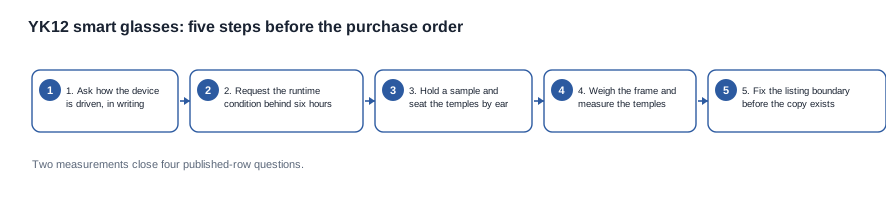
Verification steps and the criteria before the purchase order for a YK12 shortlist
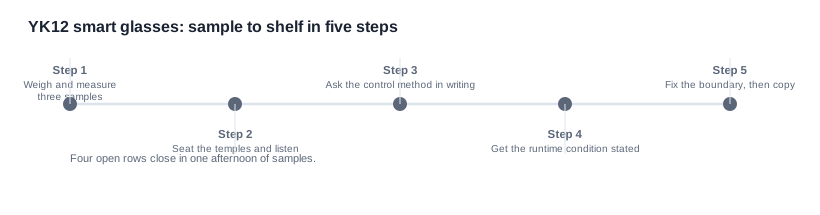
Two measurements close four questions. A calibrated scale and a ruler close the frame mass, the temple length and the lens dimension, and with them the substantiation for the slim temple claim. On this model the missing weight is not a documentation detail — it is the number that makes the headline feature true, which makes a scale the highest-value instrument in the whole verification exercise.
Then two questions that cost nothing. How is the device driven, and by whom is the application maintained? And what condition was the six-hour figure measured under? Ask the second question of the LC-105 pair's supplier as well, because identical hardware with a two-hour gap is the fastest way to establish which of the two figures describes a conservative test.
Then one audio test. Seat the temples properly on a sample and listen with them positioned as they would be after a day's use rather than as they arrive in the box. The family description includes directional audio, and the sound depends on where the temple sits. On this model the adjustment instruction and the audio instruction are the same instruction, and a manual that says so plainly is doing something most open-ear listings never do.
Then fix the listing boundary before the copy exists. Published rows you may print: the Bluetooth version, the charge time, the cell configuration, the rated runtime as a rating, the charging method, the surround sound claim and the slim temple. Open rows you may not: the control method, the acoustic figures, the frame mass, the temple dimensions, the ingress position, the case, the minimum order quantity, the lead time, the price and the certificate coverage.
Then walk the artwork against the boundary, not just the product page. Every open row has a second place it appears: the control method on the packaging as an icon, the runtime on the back panel as a single number rather than a range, the sound claim in a marketing line where a quantified version is easy to write by accident, and the temple in a design note that implies a measured mass. Ten minutes of artwork review against the open-row list catches all four, and a reprint catches them later at ten times the cost.
And the criteria to score a shortlist on. Write the sentence a customer would read to justify the price on each model in the shortlist, then count how many of those sentences are supported by a published row. A model whose sentence rests on two published rows and two open ones is a product page that will generate support contacts; a model whose sentence rests on four published rows is one that will not. This is the fastest evaluation method available on this range, and it costs nothing but a sheet of paper and an afternoon.
Terms, and the position we take for the YK12 in a shortlist
What this model's position is worth commercially. A two-feature SKU on a platform that already carries two other models, which means the accessory family, the packaging format and the cell configuration are shared with them. For a brand building a range that is the argument; for a brand launching a single product it is a neutral fact, and the sound claim has to carry the listing on its own.
Open to negotiation, and worth the time. Unit price and volume tiers across a bulk order; the dock as a bundled or separate accessory line with its own minimum order quantity, which is the decision that determines whether a mid-season channel can serve a replacement; packaging specification; delivery splitting so a first tranche can be validated before the balance ships; payment terms with nodes against inspection rather than against shipment; the warranty period with a stated response time; return terms for defective units; and the terms of a pilot order.
The line that cannot move. What a certification costs and how long the test takes are determined by the schedule and by whoever runs the test. Tooling is frequently amortised across a first order while certification cost is per product family — ask which one you are being quoted, because the two are frequently bundled into a single line that hides which is which.
The due diligence to pair with those terms. A technical file review covering certificate numbers, issuing bodies, validity periods and a covered model schedule that names this model rather than the platform. A sample order sized to the duty cycle the customer keeps rather than to the number of units needed for a demonstration. And a pre-shipment inspection with pass lines written before production — packed unit weight, accessory count against the packing list, and the charge state on arrival — with payment terms tied to that inspection rather than to shipment. Ask for all three in one written request, because a request list gets three answers and a sequence of calls gets one paragraph.
Red flags worth naming at the quotation stage. A supplier who describes a control method without confirming it for this model. A supplier who offers a case for this model without a capacity. A supplier who quotes a frame weight by reference to the G07 or the LC-105 pair. A supplier who collapses a rated approximation into a guaranteed figure. And a supplier whose minimum order quantity, lead time or price arrives without any of the three being stated as current.
Where we stand. Our position is that this is a well-made bottom-band audio frame whose two published features — a slim temple and surround sound — are exactly enough to justify it in a fashion-led or call-led channel, and not enough to justify it where a detachable temple, a longer runtime or a camera is what actually closes the sale. We will say that directly rather than present it as a universal recommendation, and we will not fill in the rows the documentation leaves out: there is no published weight, no acoustic specification, no ingress rating and no certification detail, and a number we cannot stand behind becomes a returns problem the first time a customer checks it.
Clauses for the agreement. The published rows for the configuration ordered; the control method confirmed against this model's name; the runtime condition; the frame mass and temple dimensions as measured; the acoustic description agreed in writing; the ingress position stated as a fact; the minimum order quantity, lead time and price; and the warranty period with a stated response. Clauses to leave out entirely: any quantified acoustic figure, any weather claim, any runtime figure presented as a working day, any weight not measured on your own samples, and any feature inherited from a neighbouring model on the same platform.
The published YK12 specification list is the honest baseline, G07 value analysis covers the platform alternative, and open-ear audio covers the format this model sits in.
The one-line version. If your brief needs a sound claim and a slim silhouette in a single frame and your customer's day is made of short sessions rather than one long one, this is the model. If either of those two conditions fails, a different model in the same range will serve you better, and we will say which one rather than defend this one.
Related reading
- The entries behind this model — YK12 specifications
- The other model on this platform, and what it adds — G07 value for money
- How open-ear audio actually behaves in a call — open-ear audio
Tell us the channel, the volume and the target market, and we will come back with what is available and what is not.


