
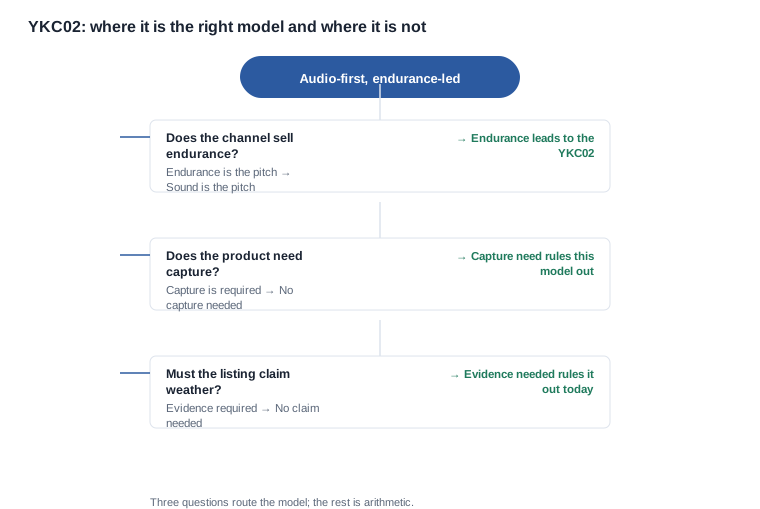
Our answer is short. This is the audio-first model in a sport range where two other models carry cameras, and ykc02 smart glasses are best for a buyer who wants endurance and durability of specification rather than capture. It is the wrong model for a product brief that needs a camera, wrong for a channel that must evidence a weather claim, and wrong for a customer who will not keep a dock.
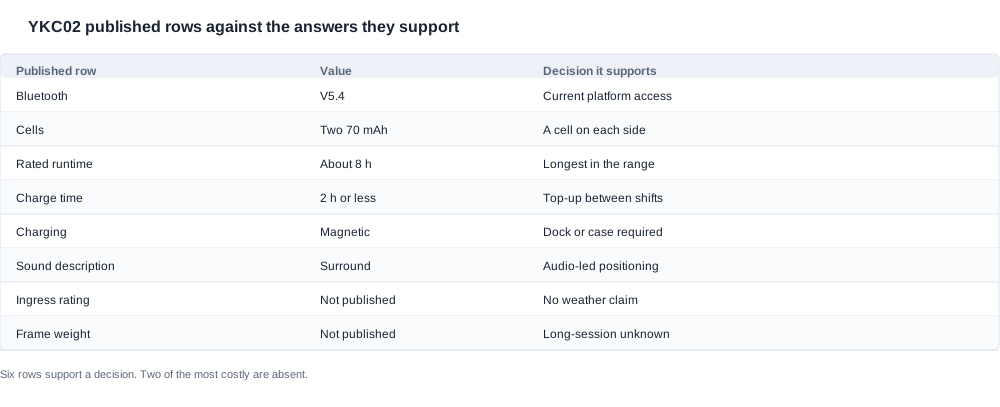
Its published configuration: Bluetooth 5.4, two 70 mAh cells, a charge time of up to two hours, roughly eight hours of rated runtime, magnetic charging, and a surround-sound description.
The reasoning below is written for a buyer who has to defend the choice in a range review, so it gives the disqualifying conditions first and the negotiable ones last.
YKC02 published configuration: what it supports and what it does not
| Published row | Value | Decision it supports |
|---|---|---|
| Bluetooth | V5.4 | Current platform access, and no legacy radio caveat |
| Cells | Two 70 mAh | A cell on each side, which is a repair and warranty fact |
| Rated runtime | About 8 h | The longest published rating in the audio range |
| Charge time | 2 h or less | A top-up between two activities rather than overnight |
| Charging | Magnetic | A dock or case the customer has to keep |
| Sound description | Surround | Audio-led positioning, with no acoustic figures attached |
| Ingress rating | Not published | No weather claim can be written |
| Frame weight | Not published | Long-session acceptance has to be established on a sample |
Six rows support a decision, and two of the most commercially costly rows are absent. That ratio is the story of this model: it is well documented on the electronics and undocumented on everything a customer touches.
What it is best for
A channel whose sell is endurance. Two 70 mAh cells giving roughly eight hours is the longest published runtime in the audio part of our range, and it comes from a sport model, which is the right place to be buying an all-day product from. If your listing leads on how long it lasts, this is the model to build the proposition on — with the caveat that the figure is a rating until a measurement protocol is agreed.
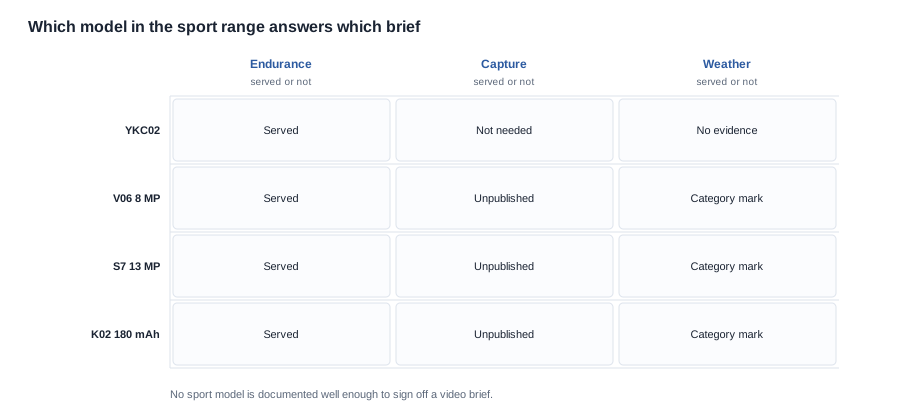
A channel that wants capture and does not have a camera answer. Two models in this range carry a camera: the V06 at 8 megapixels and the S7 at 13 megapixels. For both, the camera specification is entirely unpublished — sensor, field of view, video resolution, frame rate, storage and overwrite behaviour are all absent. A buyer who needs capture cannot verify what they would be buying. This model sidesteps that question rather than answering it, which is a legitimate strategy for a channel that has already decided not to sell video.
A channel with a serviceability argument. The two-cell architecture is stated, which implies a cell on each side. That is a real architecture fact, and it means single-side failure is a scenario worth designing a warranty response for — which is a service story, and service stories are something a distributor can sell rather than merely resell.
A channel that needs a short compliance surface. No camera means no recording claims, no video-quality questions, no storage behaviour and a materially smaller data question in markets where those attract scrutiny. For a brand entering a new market with the least possible compliance exposure, that is worth real money.
What it is not best for
Capture-led content. If your product is a camera, this is the wrong model — and the range's camera models are the wrong answer too, because their camera rows are unpublished. No model in our sport range can be signed off against a video brief from the documentation. That is an uncomfortable sentence for a buyer, and it is the honest one: the question is not which camera model to choose, it is whether the brief is answerable at all.
Channels where the customer already owns a cable. Magnetic charging means a dock or case the customer has to keep. Whether a case is included at this model's quantity, and what capacity it carries, is not published — and published case capacities elsewhere in this range run from 900 mAh to 1400 mAh, so this is a real cost line rather than a formality. For a channel that ships thin and prices tight, a cable-only model is a better commercial object, and this is not one.
Outdoor channels that need an evidenced rating. No ingress protection rating is published for this model. The sport category carries an IP54 marking, but we have not been provided with a test report behind it and we do not hold one. If your listing needs to say "waterproof", that is a document you need from a testing body, and this model does not currently have one. A category-level marking cannot be attributed to a specific model — that mistake reaches a marketplace listing and stays there.

Buyers who want a specification sheet. This model publishes six useful rows and leaves the acoustic section empty. No leakage figure, no driver size, no frequency response, no microphone count, no pickup distance, no frame weight, no dimensions. If your process requires a comparable specification table before a sample order, this model will look thin — and that appearance is honest rather than a defect.
Buyers who plan to private-label aggressively. The platform carries documented customisation axes at family level — logo, colour, packaging, temple shape, system and UI, Bluetooth name and firmware — but this model publishes no colour list and no interface statement of its own. A brand intending to build a colour range should establish the available colours in writing before committing, because a colour count is one of the most common sources of a minimum order quantity surprise, and a minimum order quantity surprise on a slow-moving colour is a stranded inventory line rather than a delay.
Buyers who need a service network rather than a service story. The twin-cell architecture gives a distributor something to say about serviceability, but there is no published indication of whether the cells are replaceable by a third party, whether a replacement cell is available as a spare part, or what the replacement procedure is. That distinction decides whether the service argument is a repair proposition or a replacement proposition, and it is a question worth asking before the story is printed on packaging.

The two rows that would change the answer
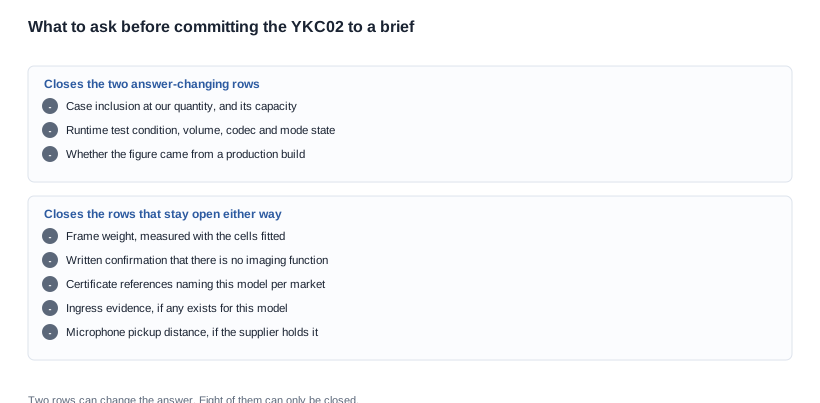
The case capacity and inclusion. If a case ships in the box, this model's endurance argument roughly triples and it becomes the strongest all-day product in its family. If the case is a line item, it is a much thinner proposition, because the customer has to buy a second object to get the benefit the runtime implies. Ask this first, and put the answer in the quotation rather than in a sales conversation, because "it depends on the quantity" is not an answer a channel can plan around.
The runtime test condition. Roughly eight hours from 140 mAh of total capacity is better than the capacity would suggest, which means the condition is doing the work. Volume, codec, distance, sample size, and whether it is a mean or a best case — none is published. If the answer is that it was measured with the surround mode disabled and your customer will run it enabled, the figure is optimistic and the listing should say so. YKC02 battery life analysis covers the arithmetic and the protocol in full.
The economic shape of an endurance-led channel. A product sold on all-day battery life has a different commercial rhythm from one sold on features. The customer compares runtime figures before they compare anything else, which makes the listing's first specification line load-bearing. It also means the return conversation is more likely to be about endurance than about quality, so the warranty response and the runtime wording have to agree with each other. And because the figure is contested across the whole catalogue rather than unique to this model, a channel that quotes runtime without its condition is in a weak position against any competitor who publishes theirs, regardless of whose number is larger.
How to sequence the two questions if you only have one round. Ask the case question first, because it is binary and it changes the product rather than the description: included or not, and at what capacity. Then ask the runtime condition, because it is the difference between a headline you can defend and a headline you have to caveat on every listing. Everything else in this article is a cost input that can be settled in the same round or the next one without affecting the decision.
The rows that stay open, and how to evaluate this model against a shortlist
Frame weight, temple length and lens dimensions are not published. Acoustic measurements — leakage, driver size, frequency response, microphone pickup distance — are not published for any model in this range. Certificate numbers, issuing bodies, validity periods and covered model schedules are not provided; our catalogue publishes no CE, FCC or RoHS text and no per-model certification row. The ingress rating, where it is marked at all, has no test report behind it.
On an open-ear wearable, frame weight is the row that most affects your return rate, and it is the one we would most like to give you. It also decides the packed weight, the freight class and the total cost of the shipment, so the same missing number appears in three separate places on a purchase order. Weigh a sample, record the figure with the cells fitted, and quote your own measurement rather than an adjective.
The compliance rows deserve one specific instruction. Request documents that name this model rather than documents that name the family. A certificate covering a product family tells you the supplier has run conformity work; it does not tell you this model was in scope when it was run. The YKC02 certification status page sets out all seven items and who resolves each one.
Put the brief first, not the specification. A shortlist built by comparing published rows will favour whichever supplier has documented the most, which is not the same as favouring the model that fits. Write the channel's actual proposition in one sentence, then ask each candidate model a yes or no question about it. If the sentence contains the word "record", this model and the other two are all disqualified, and no amount of specification comparison changes that. If it contains "all day", this model leads. If it contains "weatherproof", none of them currently qualifies on documentation alone.
The four commercial questions to settle in the same round. The unit price and the volume tiers, because a sport product is usually bought on a seasonal curve and the tier you land in changes with the quantity. The accessory minimum order quantity, which on a magnetic format is the dock rather than the frame. The lead time on the sample order and on the first bulk order stated separately, because a lead time quoted once for both hides the part you cannot control. And the payment terms with a deposit structure, where tying the final node to a passed quality control inspection is the cheapest due diligence available to a first-time buyer in this category.
Then the sample order, which closes what a document cannot. Weigh the frame with the cells fitted. Weigh a packed unit including the dock, because that figure sets the freight class and therefore the total landed cost on an incoterms basis. Run a real call outdoors in wind, because microphone pickup distance is unpublished and the only way to know it is to use it. And run the audio at a low volume in a quiet room and at a moderate volume on a street, which is the test a customer will perform without being asked.
The trade-off worth naming explicitly. This model trades capture and evidenced weather protection for endurance and a smaller compliance surface. In a channel that sells audio and endurance, that trade is favourable and the price point should reflect the absence of a camera. In a channel that sells recording, the trade is fatal, and no price makes it acceptable. Deciding which channel you are in before the shortlist is built is what prevents a good model from being bought for the wrong brief.
A compliance surface worth counting. For an importer placing consumer goods on a European market, the obligations divide into three groups that are easy to under-estimate. The radio side, which for this model sits under the radio equipment framework rather than under a general consumer regime, because a Bluetooth product is a radio product. The battery side, which is separate again and adds its own paperwork for a lithium cell in transit. And the general product safety side, which carries the economic operator details, the traceability obligation and the responsible-person designation on the packaging. A product with no camera removes the data and recording questions from that list, which is a real reduction, but it removes none of the other three groups.
What a distributor actually needs in the technical file. A model-level conformity reference rather than a family reference. The Bluetooth listing identifiers, which are usually the fastest of the seven items to obtain and the cheapest to verify. The cell test summary covering the fitted cell, because a summary for a different cell in the same family does not cover the cell that ships. And an index of what the file contains, so that a future question can be answered by turning to a page rather than by raising a new enquiry. The buyer review checklist sets out which of these can be closed from documentation and which have to be established on a sample unit.
Why the capture gap is a range problem and not a model problem. Two models in this range carry a camera, and neither publishes the sensor, the field of view, the video resolution, the frame rate, the storage behaviour or what happens when storage fills. That is not a documentation oversight we can route around — it means that no model in the sport range can currently be signed off against a video brief, and a brand whose proposition depends on recording has to solve that with a testing and evidence programme rather than with a model selection. Until then, this model's clean compliance surface is the most defensible thing a channel can offer, and it should be positioned as a deliberate choice rather than as a missing feature.
The boundary on what we will claim for this model
We can tell you what this model is published as, and we can say plainly that it is the audio-first option in its range, best suited to an endurance-led channel and unsuited to a capture-led one. We will not quote a case capacity, a frame weight, an acoustic figure or an ingress test report, because we do not hold them. We will not defend the eight-hour figure without its condition, and we will not attribute a category-level ingress marking to this model.
Send us the channel, the target retail price, the quantity and what your customer actually does with the product, and we will tell you whether this is the right model for that brief — or whether the brief needs a camera model, which in this range means a separate conversation about evidence rather than a selection.
One closing instruction that costs nothing and prevents most of the trouble. Write the listing boundary down before the copy is written, and send it to whoever writes the copy. The boundary is a short list: the radio version, the cells, the rated runtime, the charge time, the charging method and the surround-sound description may be stated; the runtime condition, any acoustic figure, the frame weight, the ingress position, the certificate coverage and the case availability may not. A boundary written before the copy exists costs one email. A boundary written after a listing has been corrected costs a customer review, a stock run and usually a refund.
And a closing word on the decision itself. This model is a good buy for an audio-led, endurance-led channel that has already decided against capture and does not need an evidenced weather rating. It is a poor buy for a channel whose proposition depends on recording, and a poor buy for a brand that intends to publish a specification table before placing an order. If you tell us the channel, the price point and the quantity, we will tell you which of those two situations you are in — and if the answer is that neither fits, we will say so rather than quote a price.
The activity profile that decides this purchase is in sports and outdoor, the rating question is in IP ratings and durability, and the channel a sport model sells through is covered in sports brands.
Five questions to close before you commit
- Is a case or dock included at our quantity, and what capacity does it carry?
- What measurement protocol produced the eight-hour rating, and was the surround mode engaged?
- What is the frame weight, measured with the cells fitted?
- Which test reports and certificate references name this model, for each destination market?
- Is there any ingress rating for this model, and if so what is the evidence behind it?
Related reading
- The activity profile that decides this purchase — sports and outdoor
- Whether the model can be described as weather resistant — IP ratings and durability
- The channel a sport model sells through — sports brands
- The platforms it competes with — sport smart glasses
Send the channel, the price, the quantity and what your customer does, and we will tell you whether this is the right model.


