

This ykc02 smart glasses buyer review checklist exists because the YKC02 is one of the simpler products in this range to review, and that is a compliment with a qualification attached. There is no camera, no remote and no sensing hardware, so the review is not about behaviour at all — it is entirely about the physical product and the paper that travels with it, and both are less well documented than the hardware figures suggest.
Eight checks, of which five can be closed before a sample order is even placed. The remaining three need a unit in your hand, and two of those need a session rather than an afternoon. That ratio is the useful thing about this model: the specification is thin, but almost all of the gaps are closable with two documents and an afternoon in a quiet room, rather than with an evidence programme.
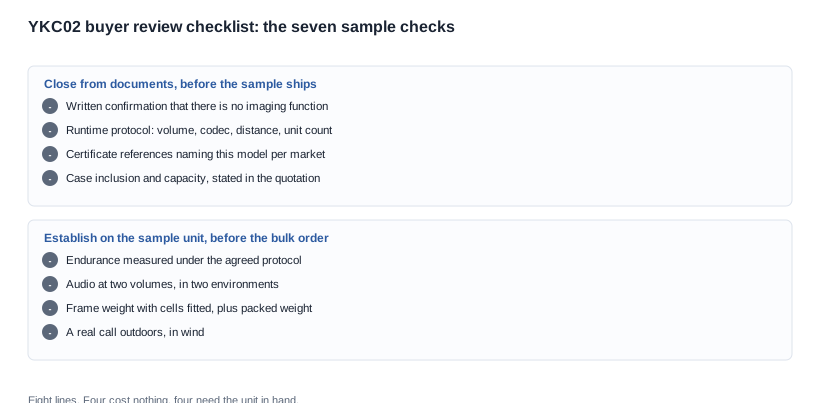
YKC02 review checklist: what the sample has to settle
The published configuration is Bluetooth 5.4, two 70 mAh cells, a charge time of 2 hours or less, about 8 hours of rated use, and magnetic charging. Five rows, and no test condition behind the eight-hour figure. Everything below is organised by what closes each row: a document, a measurement, or a decision you have to make yourself.
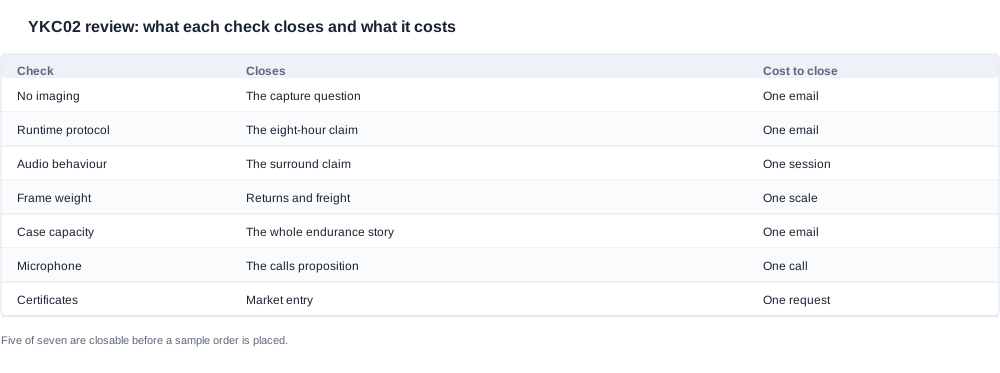
| Check | What it closes | Cost to close |
|---|---|---|
| No imaging function | The capture question, once and for all | One email |
| Runtime protocol | Whether the eight hours is a rating or a result | One email |
| Audio behaviour | Whether the surround claim can be described | One session |
| Frame and packed weight | Returns, freight class and total landed cost | One scale |
| Case capacity | Whether the endurance story is a day or a week | One email |
| Microphone | Whether the calls proposition holds | One call |
| Certificate references | Whether the product can enter each market | One request |
Five of the seven are closable before a bulk order, and two of those five cost nothing but a message. That is worth stating plainly, because buyers frequently order samples to resolve questions a supplier could have answered in writing, then discover on the sample that the question was never asked. The reverse is also true and more expensive: a question that is answered by a document rather than by a sample is answered before the deposit, before the tooling and before the packaging is committed.
A note on sequencing the review sheet for a buyer working to a deadline. Start with the two items that can stop you — the documents that name this model, and the runtime protocol. Then do the weight, because it needs a scale and five minutes and it feeds the freight quotation. Then the case question, which is an email but which holds up packaging. Then the two sessions — audio and the call outdoors — which need an hour between them and nothing else. The order is arranged by cost per minute of information gained, not by importance, which is usually the opposite of the order in which buyers attempt it.

Checks that documentation can close
The published specification, and the condition behind it. Ask what was running during the measurement, whether the link was active, whether the surround mode was engaged, how many units were tested, and whether the figure is a mean or a best case. About 8 hours is the top published rating in the audio range, and this model reaches it on 140 mAh across two temples. Ask for the protocol as a document rather than as a description, and if it arrives, keep it with the technical file — it becomes the reference point for every later conversation about this figure. The YKC02 battery life analysis covers the arithmetic, and the how to compare battery life method covers the comparison procedure across models.
The camera, confirmed absent. No camera is published for this model, and the sport camera models in this range are the V06 at 8 MP and the S7 at 13 MP. Confirm the absence in writing, so that the product page, the box artwork and the marketplace listing all say the same thing. The upside is a cleaner compliance and privacy story in a category where camera-equipped products attract more questions, and this is the right platform for a customer who wants a sport wearable with no recording function at all.
The charging case. Magnetic charging means a case or a pad in the box, and the case capacity is not published for this model. That single number decides the packed weight, the freight class, the transport documentation and the customer's weekly routine. Get the capacity, the case's own charging interface, its charge time and its weight — and ask whether it is included at your quantity rather than at some other one, because the threshold is where the minimum order quantity surprises tend to arrive.
The certification. Request the documents that name this model: test reports, certificate references with issuing body and expiry, the Bluetooth listing and declaration identifiers, the cell test summary referenced by the battery marking, and the technical file index. The certification status for this model sets out the full list and who resolves each item.
Why the Bluetooth identifiers are worth chasing first. They are usually the fastest of the seven items to obtain and the cheapest to verify, because a listing identifier can be checked against the public database in minutes rather than negotiated over a request letter. Ask for them in the first message, not in the fourth, and use the time saved to push harder on the items that genuinely take time — the model-level test reports and the cell test summary. A supplier who produces the listing identifiers quickly has usually produced the rest; a supplier who cannot produce them has usually not run any of it.
The distinction that matters most in a document request. A reference that names the family tells you the supplier has done conformity work on something. A reference that names the YKC02 tells you this model was in scope when it was done. Both documents can exist in the same file, and only one of them is evidence for this product. When you ask for the file, ask for the model-level references specifically, and ask the supplier to say so in writing if they do not exist for this model. That last part is the useful sentence, because a supplier who answers "we are certified" has told you nothing, while a supplier who says "these reports cover the platform, not this designation" has told you something you can plan around.
Checks that only a sample can close
The surround sound claim. Surround sound is named as a feature. No driver size, no frequency response, no description of the sound field and no leak rate are published — and the same phrase appears across several models in the range, which makes it a category description rather than a differentiator. On a sample, run the tests a customer will run without being asked: listen at a low volume in a quiet room, then at a moderate volume on a street, and check whether the open-ear placement leaks into the surrounding environment. Record what you observed in words, because words are what you can put on a listing and a decibel figure is not.
The frame weight. Not published, and no model in the audio range publishes one. Weigh the sample and record the figure with the cells fitted — a frame weighed without cells is not the frame a customer receives. It decides comfort across a long activity, it decides the parcel weight and therefore the freight class, and it decides the total landed cost on an incoterms basis. The weight comparison across the audio range explains why a shipping calculation without the number is a guess, and why the MT6's 158 g cannot stand in for this model.
The microphone. Not published, and this is a product that will be sold for calls. Test it on a real call, outdoors, in wind, and record the result rather than the impression. Do this check on a sample with the microphone at its shipped position, because a microphone that performs well held in the hand and badly on a face is a common and expensive finding. The microphone testing notes cover what to listen for, and the bluetooth audio glasses for calls piece covers the application. If the model is going to be sold for calls, this is the check that decides whether the proposition holds, and it is the one most often skipped because it requires someone else on the other end of the line.

Three measurements worth doing that are not on anyone's list. Weigh a packed unit including the dock, because that is the figure the forwarder will quote from. Run the endurance protocol on at least three units rather than one, because the spread between the best and the worst unit is what predicts your customer's experience. And charge a unit from flat using the adapter your customer already owns, because the two-hour figure assumes a current that may not be what their adapter supplies.
On sample quantities, which are usually too small. Three units is the practical minimum for anything involving a spread, and it is enough to notice a unit that behaves differently from the other two. Record the serial or batch identifier of every unit you measure, because a result without a unit identity cannot be traced back if a production run later needs to be isolated. If the supplier can only release two units, say so in your own notes — the limitation is then visible to whoever reads the file later, rather than being silently absorbed into a figure quoted as if it were a batch average.
What to record, in a form that survives. Weight in grams with cells fitted. Packed weight in grams including the dock. Runtime in hours with the protocol attached. Charge time from a stated starting state. Audio observations in words rather than adjectives, at two volumes and two locations. And a date on everything. A review sheet full of adjectives cannot be defended to a brand, a customer or a supplier, and the cost of converting adjectives into numbers is paid entirely by whoever happens to read the sheet next.

When a failed check stops the order
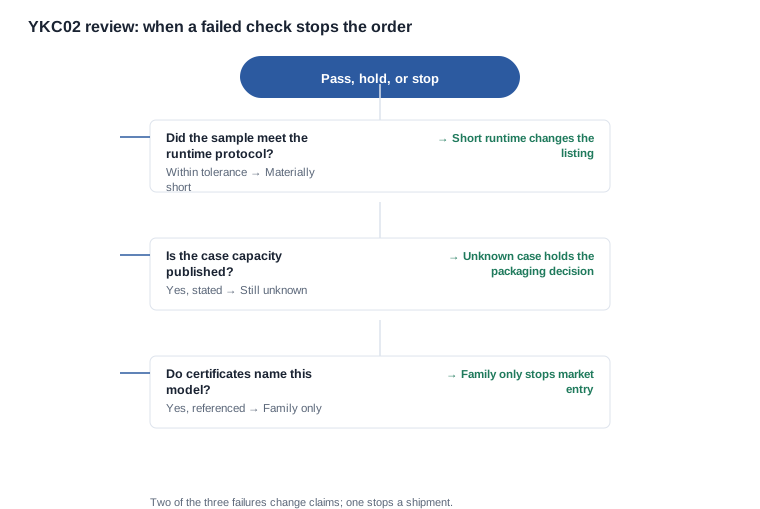
Not every failed check is equal, and separating the three categories prevents a good product being abandoned over a cosmetic one.
A check that changes a claim. The runtime result materially short of the published figure does not stop the order — it changes the listing, because the figure now has a condition attached to it that you can state. The same is true of the audio: if the surround description cannot be defended in words you observed yourself, describe the behaviour rather than the label.
A check that holds a decision. An unknown case capacity does not stop the order, but it holds the packaging decision, the accessory minimum order quantity and the freight class until it is answered. Put it in the quotation and treat "it depends on the quantity" as unanswered.
A check that stops a shipment. Certificate references that name only the family, rather than this model, will not stop a listing — they will stop market entry, and they will do it at a customs query rather than at a purchase order. That is the one failure on this list with no commercial workaround at the buyer's end, and it is the reason it appears first in every document request.
The remedy attached to each failure, and when to invoke it. A short runtime result is remedied by wording: the listing states the rating with its condition, and the support script carries the protocol. An unknown case capacity is remedied by a clause in the purchase order that ties the inclusion threshold to a stated quantity. Family-only certificates are remedied by a condition precedent — the bulk order is released only when model-level references arrive. Deciding the remedy while the check is being defined is what makes it enforceable, because a remedy negotiated after a failure is a negotiation, and a remedy agreed in advance is a term.
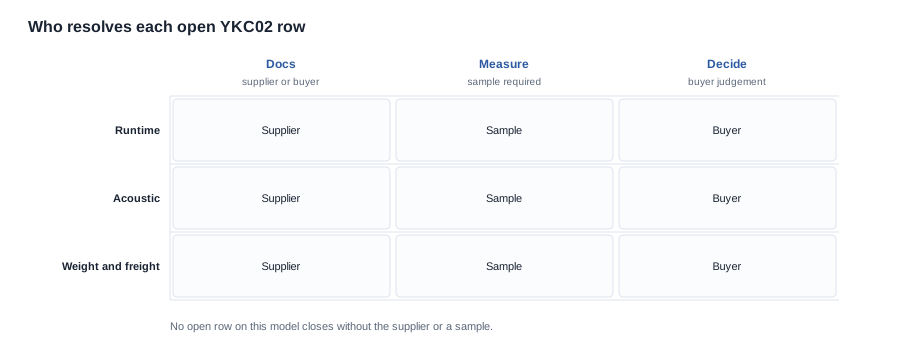
Where the negotiation actually has room. Unit price and volume tiers, the accessory minimum order quantity, packaging specification, delivery splitting, payment terms with a deposit structure, and the warranty period with a stated response time. Where the factory accepts an inspection point tied to the quality control items in this review — the cell configuration against the order, the firmware version, a measured sample against the agreed runtime protocol — that single clause is worth more than any unit price concession, because it converts every open row on this page from a hope into a remedy.
Recording the review so it survives the next order
A review sheet is only worth the effort if it is still usable six months later, and the reason most are not is that they record conclusions rather than observations. Write down what you measured and what you saw; write the conclusion separately, and date it. The conclusion can be revised when a production build changes. The observation cannot, and it is the observation that a supplier has to respond to.
Four things to record that buyers routinely omit. The firmware version on the sample, because a runtime result that differs from a later order is frequently explained by it. The unit identity, as above. The temperature and the day of any endurance run, because cell behaviour is seasonal and an unexplained discrepancy is often just a different month. And the person who ran the test, because a second reviewer with a different protocol needs to know whether they are measuring the same thing.
What a repeat order should re-verify. Not everything. The frame weight and the packing specification are stable across a production run and only need checking if the factory changes the build or the components. The endurance figure is the one worth re-measuring on every order, because it is the row most sensitive to firmware, to cell supply and to anything the factory changes quietly in the interest of cost. Ask what changed between the sample build and the production build, and ask for it in writing — the answer is usually short, and the question is the one that protects the number you have already published.
The supplier-change question worth asking once. If the factory moves the cell supplier, the amplifier, the transducer or the enclosure tooling between orders, the published specification does not change but the product does. A brand that has already written a figure into a listing needs to know whether that figure still describes what will arrive. Put a notification clause in the purchase order, so that a component substitution is something the supplier tells you about rather than something you discover in a return rate.
What to do with this review once the bulk order is placed. Archive the sheet with the technical file, not in someone's inbox. Put your own measured figures — the weight, the runtime with its protocol, the audio observations in words — into the internal specification, marked as buyer-measured, alongside the manufacturer's published rows. Keeping the two sets visibly separate is what stops a measured number from quietly becoming an attributed one, which is the failure mode that turns a defensible specification into an indefensible claim six months later.
One closing note on why this model reviews well. The absence of a camera, a remote and any sensing hardware removes an entire category of review — firmware behaviour, pairing flows, feature completeness, storage and overwrite rules, capture quality — and with it the largest source of surprises in this product category. What remains is a short, physical checklist that a buyer can complete in a day, and that is a genuine commercial advantage for a channel that would rather spend its due diligence budget on the range than on one SKU. The cost of the review is low; the value is that what it finds is about the product rather than about the paperwork, which is not always true of the simpler-looking models in this catalogue.
The boundary we will not cross on this model
The YKC02 is a straightforward product to evaluate and a straightforward one to ship, and the review should be built around the physical and acoustic facts rather than around the specification rows. We will not present the surround sound label as an acoustic specification, because no measurement behind it exists that we have seen. We will not present the 8-hour rating as a working day, because no condition behind it is published. And we will not quote a weight, a case capacity or a certificate number that the documentation does not contain.
The published YKC02 specification list is the honest baseline, YKC02 smart glasses best for covers where the model fits against the rest of the range, and the D17 versus YKC02 price positioning analysis covers where this model sits commercially.
Seven items for the sample review sheet
- The endurance figure, measured and recorded with its condition.
- Written confirmation that the product has no imaging function.
- The audio at two volumes, in two environments, on the actual frame.
- The frame weight in grams, with cells fitted, and the packed unit weight.
- The case capacity and inclusion, stated in the quotation.
- A real call, outdoors, with wind.
- The documents that name this model, per destination market.
Related reading
- This model's published figures — YKC02 smart glasses specifications and features
- Where it sits in the range — YKC02 smart glasses best for
- The case for the business — D17 versus YKC02 price positioning
Send us the volume and the markets, and we will tell you which of the seven checks we can answer from documentation and which have to be closed on a sample.


