

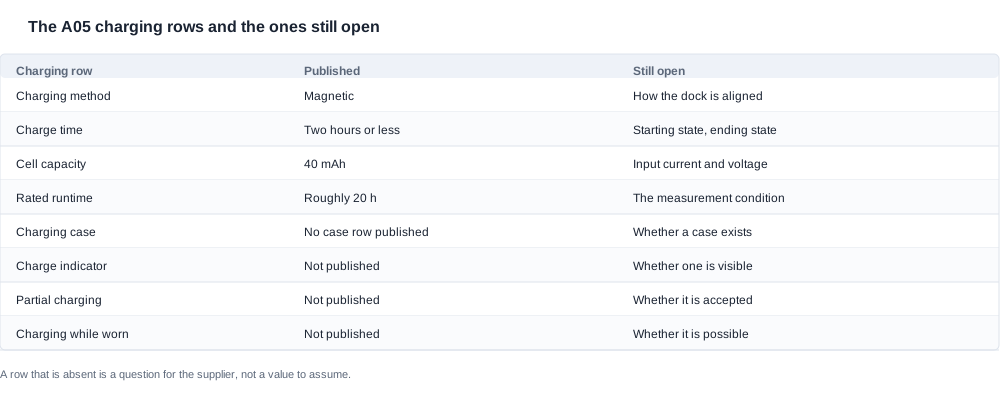
The published charging rows for the A05 smart glasses are a 40 mAh cell, a charge time of two hours or less, roughly twenty hours of rated runtime and magnetic charging. Forty milliamp hours is the smallest cell published in this category, and the charging method puts a dock in the box.
This article treats charging differently from the other specifications on this model, and the reason is not the electronics. It is that the person who charges a pair of children's glasses is usually not the person who puts them on, and that single fact changes every commercial decision around the charging arrangement — whether a case exists, what it costs, what it is made of, who replaces it and what the packaging has to say about it.
A05 smart glasses charging options: the question nobody asks
The charger belongs to somebody other than the one using it
On an adult device the charging object is possessed by the person using it, handled by that person and returned by that person, which means the charging arrangement is a personal habit and almost never a product problem. On a children's product the arrangement inverts. The dock ends up wherever a seven-year-old's belongings end up, the charging is performed by an adult who did not choose the accessory and may not have read the leaflet, and the failure mode is not a support call about a broken product — it is a replacement purchase.
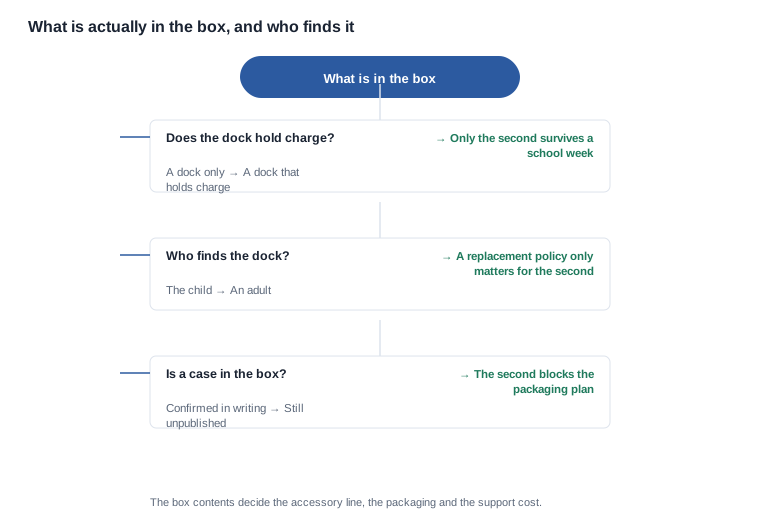
That has three commercial consequences which no specification row captures. The dock becomes a second item in the box with its own loss rate. The charging step becomes a routine that has to be designed for someone else's hands and someone else's attention span. And the charge time, which is a number on a specification sheet, becomes a number in a family's evening, because it competes with bedtime.
A buyer who treats charging as a hardware row will get the hardware right and the channel wrong. The A05 buyer review checklist covers where the dock tests belong in the sample-stage sequence, and this article covers what to ask for and what to negotiate.
What the catalogue publishes about charging, and what it omits
The A05's page publishes four charging-relevant rows: a 40 mAh cell, a charge time of two hours or less, roughly twenty hours of rated use, and magnetic charging. That is more than some models publish and less than the camera models publish.
The camera models in our range publish charging-case capacities, running from 900 mAh to 1400 mAh, plus a foldable case on one model. The A05 has no charging-case row at all — and the distinction between "not published" and "does not exist" matters. Four models in the camera range publish no charging-case row at all. The A05 is silent in the same way, which means the question is open rather than answered.
The omissions are more numerous than the publications. There is no input current or voltage. There is no indication of whether the frame accepts a partial charge. There is no statement about whether charging while worn is possible. There is no charge indicator behaviour. There is no case capacity, no statement about whether the dock charges itself, and no published condition attached to either the charge time or the runtime.
The dock as a separate product with its own cost line
Whether a case exists for this model, and what that means
Magnetic charging means a proprietary dock, and a proprietary dock is either supplied or it is not. The catalogue does not publish a charging-case row for the A05, so a buyer has three possible answers and no way to choose between them from the catalogue: the frame is supplied with a simple dock, the frame is supplied with a dock that also holds charge, or the frame is supplied with a cable-and-pad arrangement that the buyer sources separately.
Those three answers have materially different economics, and the difference lands outside the unit price.
A simple dock is a low-cost item with a high loss rate and no capacity. It is also the item that creates the mis-seating failure described below, because the only visible signal of a successful charge is a frame that sits seated on the dock. A dock that holds charge is a second battery, and it is a second battery that a family may lose, drop or fail to return, which makes it a consumable line in a retailer's business rather than an accessory in a box. A separately sourced arrangement pushes a proprietary accessory into the buyer's own supply chain, with its own minimums and its own lead time.
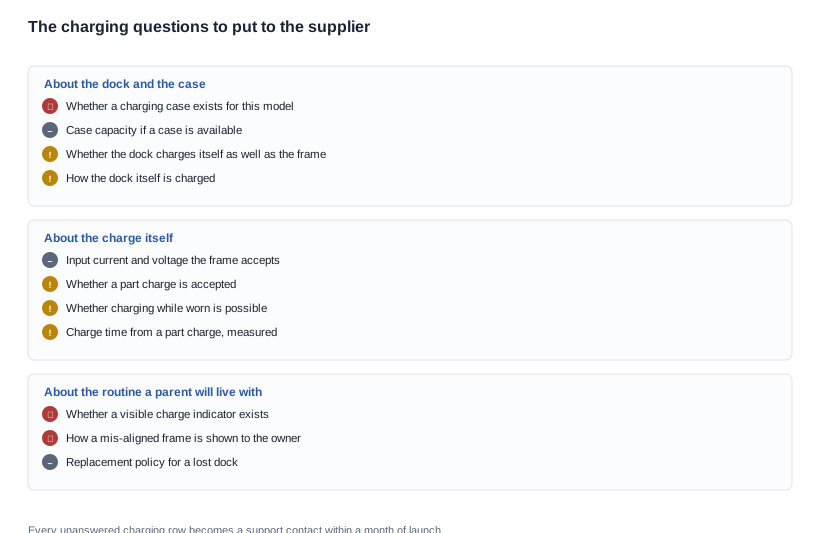
The question to ask is therefore not "is there a case" but "what is supplied at my quantity, what does it cost, and what happens to the warranty when it is lost". Write it as a question with three parts, because a supplier who answers it in one sentence has probably not thought about it.
The loss rate, the mis-seating failure and the indicator
A magnetic contact that is not seated is invisible to a child and usually invisible to an adult. The frame goes on the dock, sits correctly, and does not charge. The family's conclusion is that the product is faulty, and it comes back.
Whether a visible charge indicator exists on this model is not published, and that single row is worth more than a paragraph of marketing copy, because the indicator converts the most common support reason for a magnetic product into a non-event. If the answer is no, then the instruction leaflet has to carry a physical check instead — and the retailer's support script has to be written for it, because the retailer, not the supplier, will absorb the first contact.
The replacement policy is the other half of the cost. A dock that is cheap and replaceable is an accessory line. A dock that is expensive and proprietary is a customer service problem, and in a children's category that means a parent, which means a review, which means the reputational cost lands on the listing rather than on the supplier.
What the dock does to the retailer's own economics
The dock is also the first thing a retailer has to price into a category it is entering for the first time, and it is the piece most often left out of the commercial conversation because nobody owns it explicitly.
It is a line in the box inventory. If the dock is supplied, it is a unit that has to be counted, stored and shipped, and it may be supplied in a quantity that does not match the frame quantity. Ask whether the dock is packed one per frame or sold as a separate line, because that changes the picking process in a warehouse and the packing list in a carrier.
It is a replacement revenue line or a refund. Retailers in this category generally find that a lost accessory becomes either a spare-part sale or a full refund, depending entirely on whether a spare is available on the shelf. A buyer who negotiates a replacement allowance with the supplier is buying the ability to sell a spare rather than to refund a frame.
It is a packaging specification. The moulded insert that holds a frame and its dock is a tooling item, and tooling is normally amortised across the first order. Ask what the packaging specification includes and what a change costs, because the packaging is where the accessory is either protected or lost.
It is an assumption in every copy that mentions the routine. Any product page, listing title or instruction that tells a buyer how the product is charged is making a claim about an accessory the catalogue does not describe. Either the accessory is confirmed and specified, or the copy stays silent on it.
The two hours or less ceiling, and what it is not
A ceiling is not a promise about a partially charged cell
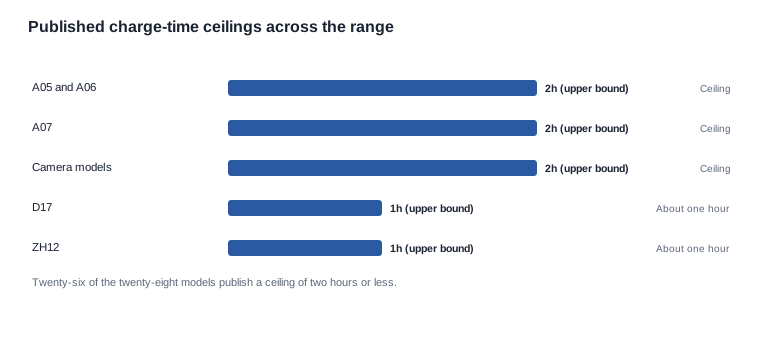
The A05 publishes a charge time of two hours or less. That is an upper bound, and the distinction is not pedantry — it is the difference between a true statement and a false one.
Two hours or less means the wait never exceeds two hours under the conditions the supplier measured. It does not mean the frame is full after any particular elapsed time, because the catalogue publishes no starting state and no termination criterion. It does not say whether the cell began empty, whether it began at half charge, or what charge level counts as complete. And it does not say the charge takes two hours or less from a part-charged cell, which is a different measurement with a different answer.
This is the point at which buyer copy most often overstates the claim, and the overstatement becomes a customer dispute. A product page that says the frame charges fully in under two hours has made a stronger promise than the catalogue supports, and a parent who measures two hours and five minutes from a half-charged cell has grounds to complain about a statement that was never warranted. Write the ceiling as the ceiling, and let the leaflet carry the condition.
The same discipline applies to the runtime figure. Roughly twenty hours on a 40 mAh cell is the highest published endurance in the range and the smallest published cell, and the family comparison is what proves it describes a light duty cycle rather than continuous operation. The A05 battery life analysis covers that reading in detail.
The input current and voltage are unpublished, and that changes the wait
On the smallest cell in the range, the charge rate matters more than it does elsewhere, because a low charge rate on a small cell stretches the wait disproportionately. A frame that reaches its ceiling in two hours on the supplier's adapter may take considerably longer on a laptop port, a low-output travel adapter or a power bank that has dropped into its low-current mode.
That is not a defect. It is a consequence of an unpublished input requirement, and the consequence lands on the family's routine rather than on the product's quality. A buyer who is building a support script needs to know whether "it takes longer than two hours" is a normal experience on a specific adapter or a symptom of a fault, and the answer comes from the input specification.
So the request list for charging is short and specific: the input current and voltage the frame accepts, the charge time from a part charge measured on a sample, the behaviour at a low cell level, and whether the dock has a charging indicator of its own.

The four charging questions a parent will actually ask
Can a child operate the dock at all?
If the dock has a magnetic alignment that forgives a slightly wrong placement, a seven-year-old can manage it. If it requires a precise placement or a connector to be pushed into a small hole, it cannot, and the parent will be doing it every night — which is fine, but only if the packaging and the leaflet assume so.
Test this on the sample with the age band you are targeting, not with an adult's hands. The age suitability analysis covers the seven items that decide the band, and this one belongs at the top of the list because it changes whether the charging step is a child's task or a parent's.
Partial charging, charging while worn, and the support desk
Can it be topped up partially? Not published. On a small cell with a long published runtime, topping up is how a parent avoids waiting, and if partial charging is not accepted then the routine becomes a nightly full cycle and the question becomes a recurring support topic rather than a one-off.
Can it charge while being worn? Not published, and on a product intended for long sessions it is a meaningful question. If the answer is no, the routine has to be built around taking the frame off, which on a children's product means the frame comes off anyway.
What happens at a low cell level? Not published, and this is where a published runtime figure starts to matter commercially. If the product's behaviour degrades in an undisclosed way at a low cell level, and the family experiences that as intermittent behaviour, it becomes a returns reason. Ask for the low-battery behaviour of the sensing and of the fogging element separately, because they may not be the same.
What to put in the agreement about charging
Which charging terms are negotiable
What is supplied in the box at my quantity. This is the first commercial question and it is a large one, because it decides whether the dock is a supplied accessory, a separately sourced proprietary item or an optional line. It also decides the packaging specification, and packaging is a negotiable term that is often agreed late.
The replacement and loss policy for the dock. If the dock is a low-cost item, a replacement allowance in the order is cheap insurance against a support-cost problem. If it is expensive, the price of that allowance tells you how the supplier sees the failure rate.
The instruction leaflet content. Who writes it, who approves it, and how many rounds it takes is negotiable, and it is the document that resolves the mis-seating and low-battery questions. Ask to write it from the answers rather than from the specification sheet.
The acceptance condition on charging. A charge time and an endurance figure with their conditions attached, and a stated behaviour for a part charge, belong in the purchase order. Without them, the numbers are marketing copy; with them, they are acceptance criteria you can withhold a lot against.
Payment nodes tied to the first shipment rather than the last. In a category where the routine is the product, the first shipment is the one that proves the routine.
The claims we will not help you write
We will not estimate a case capacity for this model, we will not interpret the twenty-hour figure without its condition, we will not quote an input requirement we do not hold, and we will not attribute a category-level lens or sensing feature to this model in a way that describes an outcome rather than a mechanism.
We will also restate the line we hold on every product in this category: we make no claim about myopia, vision development or eye health, and we hold no clinical data, no test protocol and no regulatory assessment. A children's product with sensing functions related to viewing habits sits close to a line where marketing language becomes a health claim, and the certification position for this category has not been provided to us at all. The sensing notes for the kids range set out what the published functions are, and the certification checklist sets out the document set a file should hold before any claim is made.
A charging arrangement worked through
This is a hypothetical scenario rather than a client project, and it is written to show the decision sequence.
Assume a retailer that has decided to carry the A05 for a parent audience, has asked for a charging arrangement, and has received three answers: magnetic charging with a dock supplied in the box, a charge time of two hours or less, and no charging case at this quantity. The retailer's concern is not the two hours; it is the box contents and the support cost.
The first decision is what the box contains. The retailer establishes that the dock is a simple dock rather than a case with a capacity, and that no second battery is supplied. That makes the accessory a low-cost line item with a meaningful loss rate, and it means the retailer's own packaging has to protect it, because a frame that arrives without its dock is a frame that cannot be charged.
The second decision is the instruction leaflet. The retailer asks whether a visible charge indicator exists, is told that the row is not published, and decides to write a physical seating check into the leaflet and into the support script. That converts the most likely support reason from a complaint into a two-second check the parent can perform.
The third decision is the acceptance condition. The retailer measures the charge time on a sample from a part charge and records the figure with its condition, then puts the measurement into the purchase order as a condition rather than quoting the published ceiling as a promise. The published ceiling stays on the product page as a ceiling, and the measured figure goes into the training material for the support desk.
The fourth decision is the loss policy. Because the dock is low-cost, the retailer negotiates a replacement allowance and publishes a spare-dock line in its own store. A product that has a spare part available is a product whose accessory loss stops being a refund.
The result is a charging arrangement designed around the person who performs it rather than the person who uses the frame. It is a less interesting outcome than a headline runtime figure, and it is the one that determines whether the product survives its first quarter in the channel.
What we publish about charging for the A05
We can give you the published charging rows for this model — the 40 mAh cell, the two-hours-or-less ceiling, the roughly twenty hours of rated use, the magnetic charging method — and we can tell you precisely which of the questions above are open and which are ours to answer. We will not fill in a case capacity, an input requirement or a runtime condition, and we will not help you write a health or vision benefit.
Send us the market, the channel, the age range and the wording you intend to use, and we will tell you which of these answers we can support today and which need a sample.
Related reading
- The category this model belongs to — kids smart glasses
- How the runtime figure should be read — battery life
- How certification is actually verified — certification checks
Send the market, the channel, the age range and the wording, and we will tell you which answers we can support.


