
The A05 smart glasses publish a 40 mAh cell and roughly 20 hours of endurance — the highest published endurance figure in the catalogue, on the smallest cell in it. That is not a contradiction, it is an architecture: a sensing product spends most of its life asleep, waking periodically to sample a sensor and sound a short reminder.
For a buyer, the practical consequence is that A05 smart glasses battery life cannot be compared with the runtime of an audio product, and a comparison that puts the two side by side will reach the wrong conclusion in both directions. It will look as though the A05 is the endurance champion of the range, and it will look as though twenty hours is a continuous-use figure when it is not. Both readings are wrong, and both of them are the kind of error that reaches a product page and stays there.
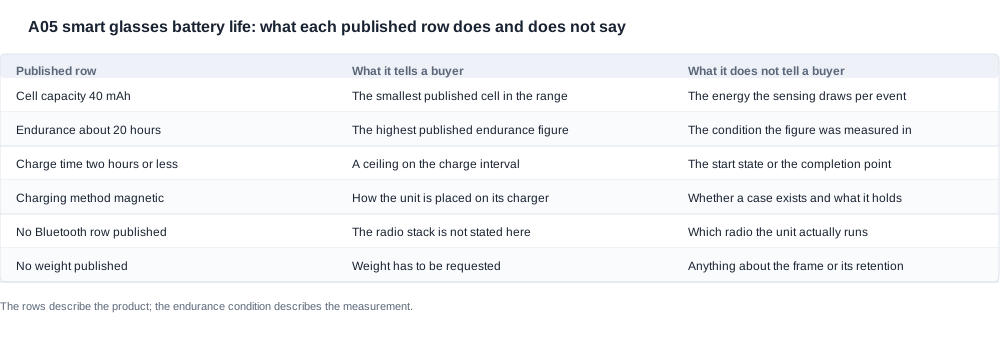
A05 smart glasses battery life: the published rows and what they settle
The published rows, and what each one settles
A 40 mAh cell. The smallest published cell anywhere in this range, against 70 mAh on the A07 and the YKC02, 100 mAh on the D11 and the D12, and 220 to 290 mAh on the camera models. The cell is small because the fogging element and its electronics take the temple volume that a battery would otherwise occupy.
About 20 hours of endurance. The highest published endurance figure in the catalogue. The A07 publishes the same figure on a 70 mAh cell, and that comparison is the clearest evidence for how the figure is produced: a sensing product and an audio product reach the same headline by completely different routes.
A charge time of two hours or less. Identical to the rest of the category. Two hours or less is a ceiling and not a measurement, so it is the right way to publish a charge interval and the wrong way to describe how long a charge actually takes.
Magnetic charging. The catalogue publishes the charging method for this model and does not publish a charging case row, which means the case question is open rather than answered in the negative.
No Bluetooth row and no weight row. The catalogue publishes a Bluetooth version for fourteen of its twenty-eight models and for this one it publishes none, and no weight is published for this model either. Both of those have to be requested in writing.
What the 20 hours actually is
It is a standby-and-detection figure, not an active-use figure, and the difference matters because the customer is a parent who will read "20 hours" as a working day.
A device carried by a child spends most of its time in a low-power state, waking periodically to check a distance sensor and a posture sensor and sounding a short reminder when a threshold is crossed. The active current is brief and the idle current is small. A device playing audio continuously is in a very different state, with the amplifier and the radio drawing steadily.

So the A05's figure describes a product that is carried and working intermittently through the day, which is exactly what it is designed to do. That makes the figure a good number for this product and a misleading number in a comparison table that also contains audio models. The A05 battery life analysis covers the same reading with the A06's architecture, and the how to compare battery life method covers why a rating without a condition is not comparable.
The architecture, not the cell, produces the number
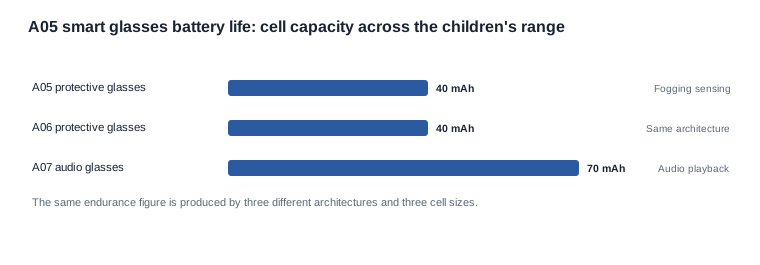
The three children's models in the catalogue make the point cleanly. The A05 and the A06 publish the same 40 mAh cell and the same endurance of roughly 20 hours, and they share an architecture: an electronic fogging device across three lenses, driven by a posture and distance sensor, with a short reminder when a threshold is crossed. The A07 publishes 70 mAh and the same 20-hour figure, and it is an audio product — the amplifier and the radio draw steadily rather than in bursts.
Two products with different cell sizes and completely different power draw arrive at the same headline. That is what makes the headline useless on its own, and it is also why a smaller cell is not automatically a cheaper product to build. The cell is the cheap part of the design; the duty cycle is what determines what the cell has to do.
What the catalogue does not publish about this model
It is worth being exact about the gaps, because the gaps are where the questions belong, and because a buyer who assumes a row is missing rather than unanswered will write a product page that says something we cannot support.
The catalogue publishes the cell capacity, the charge time, the endurance figure, the charging method and the special features of this model: an electronic fogging device across three lenses, with the correct and incorrect posture-and-distance conditions and the clear and fogged lens states. It publishes no charging case row, so the existence of a case and its capacity are open questions rather than published facts. It publishes no frame weight and no dimensions. It publishes no Bluetooth version, although it does for fourteen of the twenty-eight models in the range, so the radio stack for this model has to come from the factory in writing. It publishes no sensing duty cycle and no endurance test condition.
On certification, no CE text, no FCC text and no RoHS text appears in the catalogue, and no per-model certification row is published there. The export certification page is an image page, and what appears on it is a set of ten certificates — eight for appearance designs and two for utility models — presented as pictures rather than as text. We do not issue a certification reference unless we can reproduce it in writing, and we will not put one on a product page that we could not produce on request.
None of this makes the model less usable. It makes the row a specification of what the product is rather than of what has been assessed, and it gives a buyer a precise list of what to request before the product page is written.
Reading a published runtime figure honestly
Three questions to ask of any runtime number
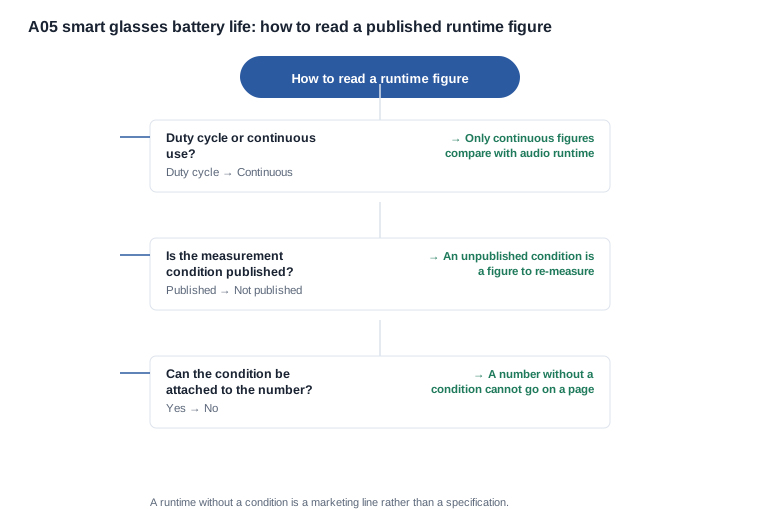
The questions to ask, and they apply to every runtime figure a supplier sends, not only to this one:
- Was the figure measured in a duty cycle or in continuous use? Only continuous figures can be compared with an audio product's runtime at all.
- Is the measurement condition published? If it is not, the figure is a number to re-measure on a sample rather than a number to publish.
- Can the condition be attached to the number on the page? A number without a condition cannot go on a product page, and this is the point at which most figures fail.
The third question is the one that decides the outcome commercially. A runtime figure that arrives with its condition attached can go onto a listing, into a comparison sheet and into a distributor's brochure, and it will still be defensible a year later. The same figure without its condition can only be used internally, and it will be quoted back to you by a channel partner as though it were a specification.
Why the charge figure cannot be read as a swap interval
The catalogue publishes a charge time of two hours or less for this model, and every model in the range. That is a useful ceiling and a poor basis for planning, for two reasons.
The first is that a ceiling is not a measurement. "Two hours or less" allows exactly two hours, which is a different assertion from a charge that completes inside two hours, and a buyer who publishes it as an estimate will be held to the estimate rather than the ceiling. The second is that no start state is published. A cell charged from empty and a cell returned at half capacity are different charge events, and without a stated starting point the figure cannot be used to work out how much interruption a shift involves.
The same reasoning applies to a charging case, and here the catalogue is silent rather than ambiguous. No charging case row is published for this model, so the question of whether a case exists, and if it does what capacity it holds, has to be asked in writing. It is the number that decides whether the routine is a nightly desk charge or a bag that travels with the child, and it is a question a buyer should ask before the product page is written rather than after.
What to request before the figure is published
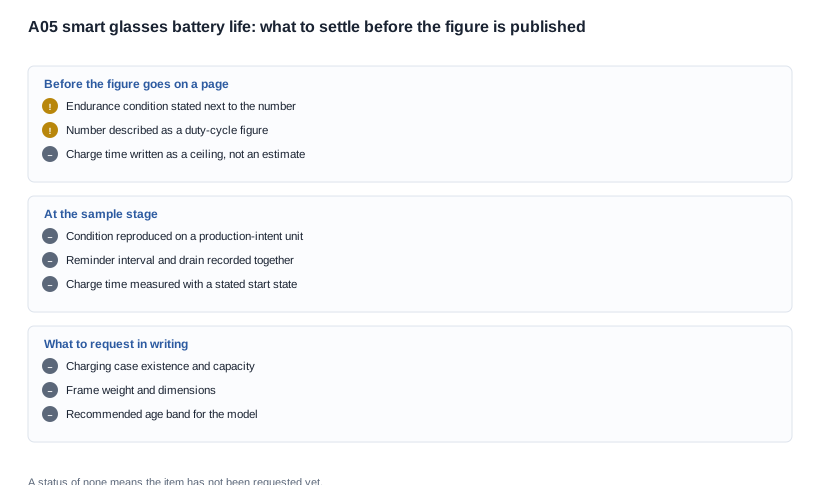
What follows is that list in a form that can be sent to a factory, and the same list works as a run against a sample:
- What was running during the endurance measurement — active sensing with the reminders firing, or the unit idle with the detection disabled?
- Was the Bluetooth link paired and active throughout the measurement?
- Was the measured sample the production configuration, on a new cell, and how many units were averaged?
- What is the sensing duty cycle, and how does the drain change with the reminder interval?
- What is the charge time from a stated start state, and how is completion determined?
- Is there a charging case for this model, and what capacity does it hold?
- What is the frame weight, and what age band is the model intended for?
Then measure it yourself on the sample, in the condition the product will actually be used in, and record the condition next to the number. A figure you took is worth more on a product page than a figure you were given, because you can attach the condition to it.
How to brief a factory so the answers are comparable
The endurance figure is only as good as the question that produced it, and suppliers answer an open question with the number they are used to quoting. Two ways of asking produce very different answers, and the second one is the one to use.
The weak way is to ask for the battery life. That gets the published figure back, because that figure is the easiest thing to send and the least informative thing to receive.
The strong way is to ask for the measurement rather than the result: what was powered and what was active during the measurement, whether the link was up, what state the cell started in, how many units were averaged, and what the reminder interval was. Those five details determine the number, and a supplier who can answer all five has a measurement rather than a marketing line. A supplier who answers three has a figure that came from a single unit on a single day, which is worth having and is not worth publishing.
The same structure works for the charge time. Ask for the start state, the completion criterion and the method rather than for the hours, and ask for the charge behaviour at a stated cell level rather than from empty, because a routine question is usually about the second half of the range.
For a buyer running a shortlist, the discipline is to put identical wording to every supplier so the answers can be compared rather than merely collected. Two suppliers will describe the same duty cycle in different words and both will be right, and the only way to see that is to ask the same question in the same form.

The five things a buyer usually gets wrong with this model
The comparison that does not compare
The most common error is putting this runtime next to an audio model's runtime in a single table with one column headed "battery life". The reader of that table concludes that a sensing product outlasts an audio product by a factor of three, which is an artefact of two different duty cycles rather than a property of the hardware.
The fix is not to remove the figure but to label it. "Endurance about 20 hours in intermittent sensing use" is a shorter claim than "20 hours of battery life" and it is the one that survives a customer who measures it.
The charge time read as a guarantee
"TWO HOURS OR LESS" on a product page will be read by a customer as "it charges in two hours", and a customer who finds it takes a little longer will treat that as a defect. The wording on the page should be the ceiling, and the page should not carry a claim about how long the charge actually takes until that has been measured on a production-intent sample.
The case assumed either way
A buyer who assumes a case exists will design a charging routine around it and be wrong. A buyer who assumes no case exists will decline the accessory and lose the convenience the accessory set was built for. The catalogue publishes no case row for this model, which is not the same as publishing that no case exists, and the honest position is that the question is open.
The weight assumed from the sibling model
The A05 and the A06 share an architecture and a cell, and it is tempting to assume they share a frame weight. The catalogue publishes no weight for either of them. The only weight published anywhere in the range is for a different product entirely, and it is a camera model with a charging case rather than a sensing model, so it cannot be used as a proxy.
The detection read as an outcome
This is the one that carries regulatory risk rather than commercial risk, and it is worth separating from the others. The published function of this model is a lens that clears and fogs, with a posture and distance sensor driving it. That is a device description. Turning it into a statement about a child's eyesight or development is a claim, and a claim the catalogue does not make and that we will not support. The kids smart glasses posture monitoring article covers what the detection functions are designed to observe, and the who should buy the A05 analysis covers the buyer fit.
A hypothetical programme, and where our position stops
One sourcing decision, worked through
The sourcing decision set out below is a constructed example. No customer, order or shipment is described in it, and the bundle and the volumes are chosen so that the reasoning is easy to follow.
The scenario is a channel buyer comparing two children's models for a gift bundle that will ship with a charging case, and who has been quoted a single "battery life" column for both.
The first step is the architecture question, and it produces the first finding: one of the two models is a sensing product with a 40 mAh cell and a duty-cycle endurance figure, and the other is an audio product with a 70 mAh cell. The same headline figure appears on both, for entirely different reasons. The buyer removes the column rather than ranking on it.
The second step is the accessory question, and it produces the second finding: the catalogue publishes no charging case row for the sensing model, while the gift bundle the buyer intends to ship has one. That makes the case a design question rather than an accessory question, and it has to be settled with the factory before the packaging artwork is quoted.
The third step is the charge interval, and it produces the third finding: the published ceiling of two hours or less cannot be turned into a shift interruption without a start state and a completion criterion, so the buyer asks for both and plans the routine around what comes back.
The fourth step is the sample measurement, and it is where the work pays off: the buyer reproduces the sensing duty cycle on a production-intent unit, records the reminder interval alongside the drain, and now holds a number with a condition attached to it. That number is the one that goes on the listing, and it is defensible because the buyer measured it.
The fifth step is the claim boundary, and the buyer confirms that the product page describes the lens behaviour and the reminder function and says nothing about vision or developmental outcomes. It is the cheapest line on the page and the one that cannot be withdrawn later.
The outcome is a listing with a defensible runtime figure, a charging routine designed around a case that has been confirmed rather than assumed, and a product page that a compliance reviewer can read without a conversation.
What we publish and what we will not convert
The 20 hours is the strongest single published number in this category, and it is easy to misread. We will publish it as a manufacturer rating, we will describe the duty cycle it rests on, and we will not convert it into a continuous-use claim, because the measurement condition is not published and the product's actual duty cycle is a low-power one.
We will also not present the detection functions as producing any vision, health or prevention outcome, because the category carries real regulatory risk and no supporting evidence is published for it. And we will not fill the open rows — the charging case capacity, the frame weight and dimensions, the sensing duty cycle, the endurance test condition and the certification position for each destination market — with typical figures from the category, because a buyer who builds a listing on an estimated number finds the error in the field, where the correction costs far more than the question would have.
The published A05 specification list is the honest baseline, and the A05 buyer review checklist is the sample-stage work in full.
Related reading
- The catalogue rows for this model — A05 smart glasses specifications and features
- The sensing side — kids smart glasses posture monitoring
- The method behind a defensible number — how to compare smart glasses battery life
- The carton decision — what to include in the box
Send us the application and the expected daily use, and we will tell you which published figures apply and which have to be measured on a sample.


