

The A05 smart glasses are a lens-type electronic fogging product with posture and distance sensing, a 40 mAh cell, a charge time of two hours or less, roughly twenty hours of rated use and magnetic charging. Before a buyer decides whether to stock it, three things have to be settled, and none of them is in the published specification: what the reminders actually do, what the fogging element is for, and where the data goes.
This article is the review sheet that settles them. It is deliberately ordered so that each check assumes the previous one passed, because in this category the cheapest failures are the ones you find before the purchase order rather than after the first shipment.
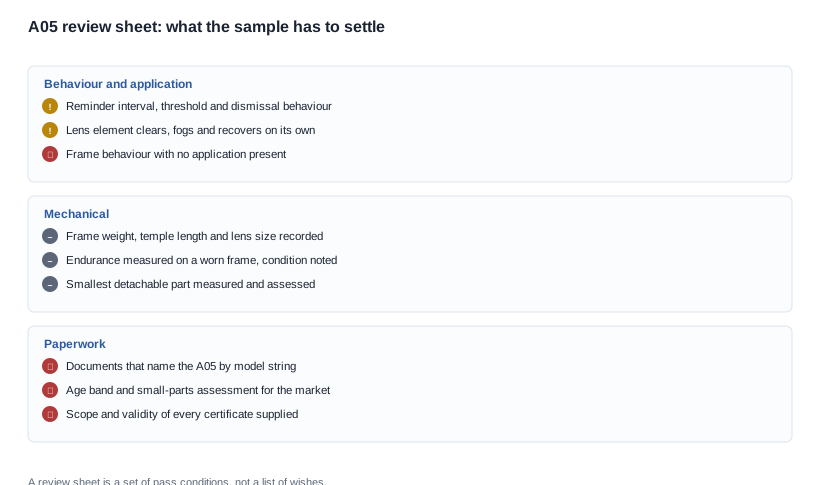
A05 smart glasses and the review sheet: what the sample has to settle
A review sheet is a set of pass conditions, not a list of wishes. Every line on it needs three things attached before the sample arrives: what is measured, what result counts as a pass, and what happens if it does not. A sheet without those three is a shopping list, and it will produce a conversation at the end of the process instead of a decision at the start of it.
Who runs the review and what it costs to run
Three buyers run this review for three different reasons, and the difference shows up in what they are willing to fail.
A brand-side product manager reviewing a supplier sample is trying to decide whether a new configuration can go into a range. Their cost of failure is a launch slip, and they can usually afford a slow answer.
A channel buyer reviewing a single unit before committing to a listing is trying to decide whether the copy they have written is defensible. Their cost of failure is a claims dispute with a customer, and a slow answer is expensive because the listing is already live.
An institutional procurement team reviewing a sample against a tender specification is trying to decide whether the product can be scored against a requirement document. Their cost of failure is a disqualification, and the deadline is set by someone else's committee.
The common thread is that in none of the three cases can the buyer accept a "not published" answer as a pass. The catalogue publishes five rows for the A05 and a pair of functional illustrations. Everything else on the sheet is something the buyer has to obtain, and a review that only confirms published rows is a review that confirms almost nothing.
The three questions that come before any measurement
What does the reminder do, and how often does it fire? The A05 publishes posture and distance sensing and nothing about the threshold, the interval or the sensitivity. That matters more than it sounds, because a reminder that fires every few minutes is dismissed inside a week, and a dismissed reminder is a product that has stopped doing the thing it was bought for. The posture monitoring analysis covers what the detection functions are designed to observe.
What is the fogging element for, and what happens when it activates? The catalogue illustrates a clear lens and a fogged one, which tells you the state is visible on the lens. It does not say what causes the fogging, how long the state lasts, whether it reverses on its own, or what happens as the cell runs down. A lens that stays fogged is an immediate rejection, and the instruction that prevents it has to exist in the box. The handling instructions for this category cover the handling side.
Where does the detection data go? The catalogue documents no application, whether one is required, what the detection produces, whether any of it leaves the device, who operates it or where anything is stored. That is the largest gap in the model's documentation, and it decides whether the product is a simple device or an operating commitment your organisation inherits. The privacy considerations piece sets out the questions in full.
All three are answerable in a single afternoon with one unit and a questionnaire, and all three are fatal to a listing if they are answered late.
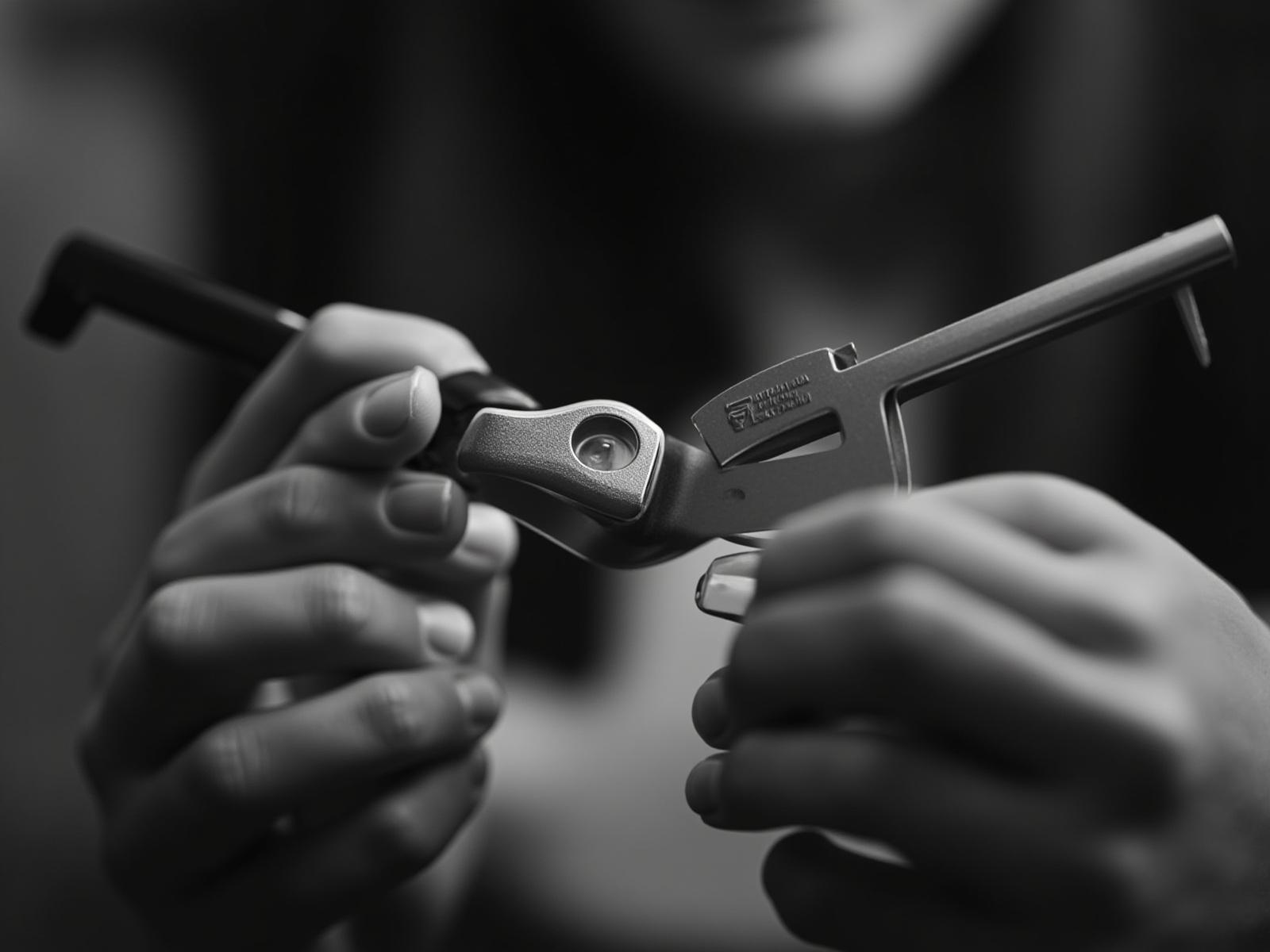
The behaviour checks: reminders, the lens element and the application
The behaviour checks are the ones that cannot be closed with a document, which is why they come first in the sheet. If a behaviour fails on the sample, no document rescues it.
Reminder interval, threshold and dismissal
Count the reminders over a full worn day rather than the first ten minutes, because the first ten minutes are the demonstration and the full day is the product. Record four things: how many fired, what triggered each one, whether the child could dismiss it, and whether it could be disabled. Record them for a child of the intended age band rather than for an adult, because a reminder an adult ignores is a reminder a child has already stopped noticing.
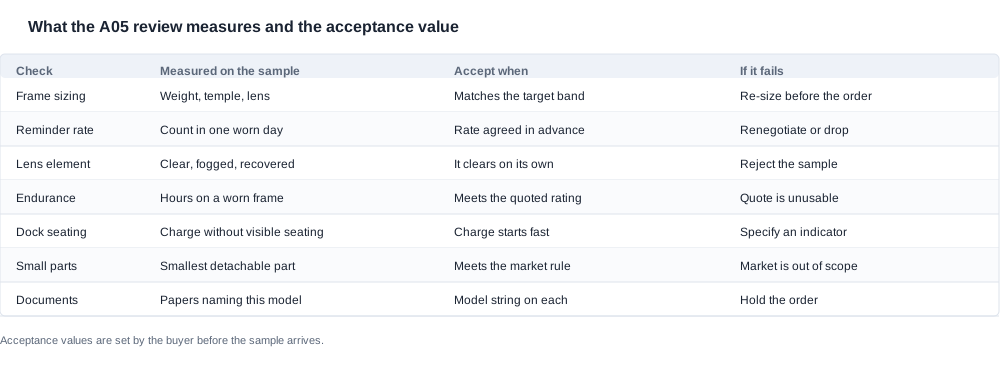
The acceptance value has to be set before the count, not after it. A buyer who has not decided what an acceptable reminder rate is will find one acceptable, and the sheet then records a number rather than a decision.
Two failure shapes are worth naming in advance. A reminder that fires continuously produces a child who switches the product off, which is a support contact about a product that is working exactly as built. A reminder that never fires produces a product indistinguishable from a working one, which is a complaint about a feature that a listing promises.
The lens element state, and whether it recovers
Drive the element deliberately through its three states: clear, fogged, recovered. The question is not whether it fogs — the catalogue illustration shows that it does — but whether the fogged state clears without intervention, how long it takes, and how the state presents when the cell is low.
This check has a second purpose that is easy to miss. A powered optical element that a child can reach is a durability question as much as a function question, and the catalogue publishes no cycle life for it. So the sheet should also record how the element behaves after repeated activation, and the supplier should be asked for the cycle life figure with a failure criterion, because a cycle count without a criterion is a quantity rather than a service life.
What the frame does with no application present
Put the phone in aeroplane mode and leave the frame running. Whatever the frame does next is the behaviour a customer will see on a day when the phone has no signal, which in a school is most days.
Record three outcomes: does the frame continue to sense, does it continue to remind, and does the charge level behave differently. A frame that stops sensing when the phone is unreachable is a product whose core function depends on connectivity that the catalogue never mentions. A frame that keeps reminding without connectivity is a product whose support script has to explain a reminder the parent did not expect.
This check also produces the answer to the largest documentation gap. If the frame is fully functional with no application present, the data question becomes a policy question you can manage. If it is not, you have an operating commitment, and it needs a written owner before the listing goes live.
The mechanical and endurance checks on the sample
The mechanical checks are the ones that decide the return rate, and in a children's category they are worth more attention than in an adult one because the frame is fixed and the head is still growing.
Sizing: weight, dimensions and the age band
Frame weight, temple length, lens dimension and the recommended age band are not published for any model in this category, and the A05 is a fixed frame with no published adjustment range. Weigh the sample and measure it, then put it on a child of the intended age for an hour rather than five minutes.
The acceptance value is not a number in grams; it is a decision about the band. A fixed frame serves a narrow band, and a narrow band is a range-planning problem rather than a product problem. If the band is wider than the frame can serve, the answer is not a better listing but a different model or a different frame.
Endurance measured on a worn frame
Roughly twenty hours on a 40 mAh cell is the highest published endurance figure in the range and the smallest published cell, and the combination tells you the rating describes a light duty cycle rather than continuous operation. The A05 battery life analysis covers why the published figure should not be read as continuous use.
Measure it on the sample while the frame is worn and sensing, and record the condition next to the number: what was active, what was idle, how many reminders fired, and how many units were averaged. A figure you took with its condition attached is worth more on a product page than a figure you were given, because you can defend it.
The measurement has a second purpose that matters commercially. The A07 publishes a 70 mAh cell and the same roughly twenty hours, and that comparison is what proves the rating is a duty-cycle figure rather than a capacity claim. Your own measurement is what confirms it for the configuration you are buying.
The charging dock, the indicator and the small parts
Magnetic charging puts a dock into the box, and the dock is a separate object with its own loss rate, its own return reason and its own cost line. Three checks belong here.
First, whether a visible charge indicator exists on this model. It is not published, and it is worth more than a paragraph of copy, because a frame seated on a dock that is not charging is reported as a defective product. Second, whether the dock charges the frame only, or the frame and itself together, and how the dock is itself charged — that is what decides whether the dock is a cradle or a second battery. Third, whether a charging case is available at your quantity, and if so at what capacity, because that is the number that decides whether the product survives a school week or needs a cable every night.
Then the small parts. A detachable accessory sets a floor on the age band independently of everything else on the sheet, so find the smallest detachable part on the sample, measure it, and assess it against the rules for the destination market before the age band is fixed. The age suitability analysis covers the seven items that decide the band and the safety requirements piece sets out the item list for this category.


The document checks that travel with the order
The document checks are cheap and they are the ones most often deferred, which is why they belong on the same sheet as the mechanical checks rather than in a separate compliance workflow that runs afterwards.
Documents that must name the model
Ask for the documents that name this model string: the applicable children's product standards for the destination market, the age grading, the small-parts assessment and the index of the technical file. The A05 certification status sets out the request list in full and the export considerations cover the paperwork that travels with the goods.
The catalogue publishes no per-model certification row for the A05, and the catalogue text contains no reference to CE, FCC or RoHS anywhere. What it does carry is a company-level export certification page whose content is images rather than text. A company-level page is not a substitute for a document that names the model you ordered, and a buyer who treats it as one will find out at a customs query or a tender scoring session.
The A05 and A06 question and what a certificate does not settle
The A05 and the A06 publish identical rows and carry the same catalogue product name. Ask which published rows they share and on what unpublished attribute they differ, and get the answer in writing before the artwork exists.
This is a compliance question as much as a commercial one, because a document that names one model does not automatically name the other. If you cannot tell the two apart from the documentation, you cannot tell which document applies to which unit, and a range of two indistinguishable models is a stock problem as well as a paperwork one. The A05 versus A06 specification comparison covers what the possible answers mean, and the A06 versus A07 form factor comparison covers the other product in the category.
Turning the review into order conditions
A review that produces a report produces a report. A review that produces order conditions produces a remedy, and the conversion step is short enough to do on the same day.
Which lines are negotiable after a failed check
A failed sizing check is negotiable through the range plan rather than through the product. You cannot make a fixed frame adjustable, but you can change which age band the listing addresses, or drop the unit from a range, or replace it with a model whose form factor suits the band.
A failed reminder rate is negotiable if it is a configuration matter. Ask whether the interval is a firmware setting, whether it is settable by the parent or only by the supplier, and whether a variant exists with a slower interval. If the interval is fixed and unacceptable, that is a product decision, not a negotiation.
A missing charge indicator is negotiable in the specification. Ask for the indicator as a requirement on the first order rather than as a complaint about the tenth thousand units.
A missing document is negotiable in the schedule. A pending document is a scheduling problem with a date attached, and the negotiation is about how that date is protected and what happens if it moves.
The lines a review cannot move
Certification cost and certification lead time follow the test house and the process, and pressure applied to either produces a longer schedule rather than a shorter one. A tooling cost is normally a one-off item amortised across the first order, and the questions worth asking are over what volume it is amortised and what happens to it if the programme is discontinued. The two are frequently bundled into one quotation line, so ask which one you are being quoted.
The third line is not commercial at all. No negotiation turns a behaviour reminder into a clinical intervention, and we hold no clinical data, no test protocol and no regulatory assessment for this category. Nothing in the agreement should create the impression that the sensing functions produce a vision, health or prevention outcome, and we will not support a listing that implies one.
A reviewed sample, worked through
This is a hypothetical review rather than a client project, and it is written to show the sequence rather than to report a result.
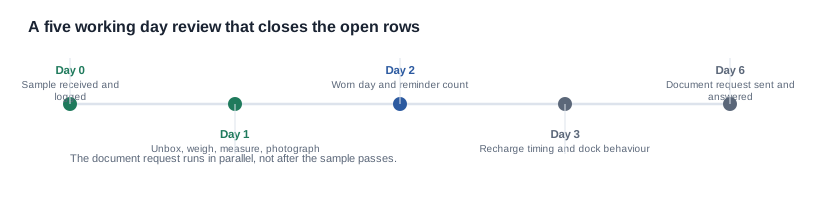
Assume a buyer who has one A05 sample, a target band of seven to nine year olds, two destination markets and a listing draft already written. The review sheet has seven behaviour and mechanical lines and three document lines, and the buyer has decided the acceptance values before the sample arrived.
Day one is measurement. The frame is weighed and measured, and the result is a fixed size with no adjustment range. The buyer's acceptance value was a band, and the measurement puts the frame at one end of it rather than the middle, which changes the listing copy but not the decision. The accessory is a magnetic dock, no case is included, and the dock has a visible charge indicator — a row the buyer expected to be absent, and the one that removes the most likely support reason from the list.
Day two is the worn day. The frame is worn for a full school day by a child in the band. Twenty-two reminders fire. The child dismisses most of them after the first week, and the buyer records the dismissal behaviour, because a dismissible reminder is a different product proposition from a mandatory one and the listing has to describe one of them accurately.
Day three is the recharge. The interval is measured from a full stop and from a part charge, and the part charge is accepted, which is the answer that matters most for a parent routine. The endurance figure measured on the worn frame is materially below the published rating once the reminder rate is this high, which is not a failure — it is exactly the condition the rating omits, and it gives the buyer a defensible number with a condition attached.
Day six is the documents. One request, naming the model and both markets. The answer supplies a document naming the A05 for one market and nothing for the other, which converts the second market from a listing plan into a dated schedule item. The A05 versus A06 question comes back as "the same product under two designations", and the buyer collapses the range to one unit before the artwork is approved.
The result is a listing with one narrowed claim, one measured figure with a condition, one market live and one dated, and a range of one unit instead of two. None of those decisions needed a price negotiation, and every one of them needed a review sheet.
What we can answer from documentation and what needs the sample
The A05's capability is documented and its behaviour and data position are not, and a buyer who reviews a sample against a written sheet will know within a day whether the product works for their channel. We will not present the sensing functions as producing any vision, health or prevention outcome, we will not present the twenty-hour figure as an active-use figure, and we will not state a certification status, an age band or a weight that our documentation does not support. The published A05 specification list is the honest baseline, and the who should buy the A07 analysis covers the camera-free alternative in this category.
Send us the buyer, the age band and the markets, and we will tell you which of the sheet's lines we can answer from documentation and which ones need a child on the sample.
Related reading
- What is published for this model — A05 smart glasses specifications and features
- The behaviour in detail — kids smart glasses posture monitoring
- The categorisation — kids smart glasses which model to pick
Send us the buyer, the age band and the markets, and we will tell you which of the seven items we can answer from documentation and which need a child on the sample.


