

The A06 and the A05 publish identical specifications, and the source does not state what differs between them. That is the whole of this comparison, and it is a more important finding than it first looks: two indistinguishable stock-keeping units in a category with a high compliance burden is a range-structure problem that has to be solved before it becomes a stock problem.
This article is about how to read a specification table formally, because the way these two models are usually compared — by scanning the values and looking for a difference — is exactly the method that produces the wrong answer. The values are identical. The interesting part is what the table's structure asserts, what its gaps assert, and what happens downstream when two designations with identical values still need two document files.
A06 and A05 spec comparison: what an identical row actually asserts
The formal reading of a published row
A published row is a claim. An absent row is not a claim in the opposite direction, and the distinction is what makes a spec table usable rather than misleading. A row that prints 40 mAh says the catalogue publishes a 40 mAh cell for that model. A row that prints nothing says the catalogue publishes no cell figure for that model. It does not say the cell is smaller, and it does not say the product has no cell.
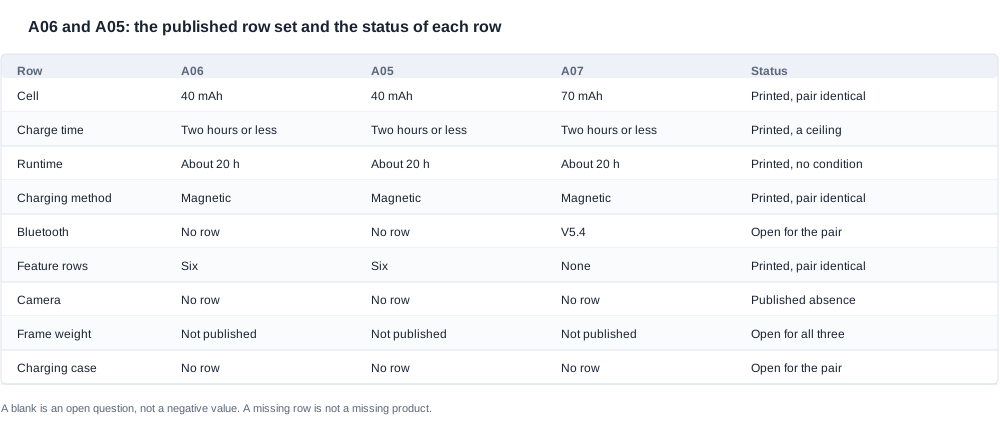
For the A05 and the A06, the published set is identical in every line: the six feature rows, the cell, the charge time, the runtime, the charging method, and the absence of a camera row. Read that way, the comparison result is precise and narrow. These two models are documented identically. That is a statement about two documentation sets, and it is the only statement the rows support.
Read the other way — the way most comparison sheets are built — the same table says something stronger and unsupported. A row-by-row sheet that treats a blank as a zero turns "no Bluetooth version published" into "no Bluetooth", and "no charging case row" into "no charging case". Both of those are false as claims about the product, and both will be caught by a customer who asks the supplier, because a supplier knows whether its product has a radio and what is in the box.
The rule that keeps a comparison honest is short: a blank is a question, not a zero. Once that rule is applied to this pair, the table stops looking like a set of differences and starts looking like a set of agreements, with a list of open items attached. That is a more useful document for a buyer, and it is the one the A06 and A05 battery and charging comparison uses for the electrical subset.
What an absent row is not
Three absences recur in this family, and each one has a specific, checkable meaning.
The absent Bluetooth row. Neither the A05 nor the A06 publishes a radio version. This does not mean they have no radio — a pair of children's smart glasses with an audio and a sensing design almost certainly connects — it means the catalogue does not print a version for them. The distinction matters because a buyer who writes "no Bluetooth" into a specification has published a claim they cannot support, and a buyer who writes "Bluetooth 5.4" has imported a figure from somewhere that is not our documentation. Neither is a safe position; the only safe one is to ask.
The absent charging case row. For the A05 and the A06, there is no case row. That is a statement about the catalogue and not about the box contents, and it is the reason a packing-content question belongs in the first exchange with a supplier rather than in a returns policy written after launch.
The absent physical rows. No frame weight, no temple length, no lens dimension, no colour option and no recommended age band is published for either model. Each of these is a real commercial variable for a children's product, and each of them is open.
The absent camera row is different in kind, and it is the one place where the absence is safe to rely on. A camera-free design is a deliberate product position in this category, it applies identically to all three models in the kids family, and it is one of the few things about this family that a channel can state without qualification. The A06 published specification list states it as a published absence rather than as a claim.
The catalogue's own precedent for telling the two apart
Our catalogue already contains the distinction this comparison depends on, in a different product group, and that is the most useful evidence available to a buyer.
The charging case is the clearest case in point. Across the camera group, five models publish a case capacity — 1400 mAh for three of them, 900 mAh and 1400 mAh as two listed options for another, and a 1200 mAh folding case for the MT6. Two further models publish a case without a capacity. One model is published explicitly as having no charging case at all. And three models simply have no case row anywhere in the catalogue. Those last three are not the same as the model published without one, and the catalogue keeps them apart.
The same pattern appears in colour. Only two models in the whole catalogue publish a colour row — one with three colours, one with four. For every other model, colour is simply not printed. A buyer reading those pages should not conclude that those products come in a single colour; the correct reading is that the catalogue does not print colour for them, and the question is answerable by asking.
And the pattern appears in ingress protection. An IP54 rating is published on exactly two models, both in the camera group, and both publish it as a feature row alongside other structural rows. No other model carries any ingress row, which means no other model can be described as splash-resistant — and equally, none of them can be described as not splash-resistant, because the row is absent rather than negative.
So the catalogue's own method is the one this article recommends: print a value where you have one, and print nothing where you do not — and let the reader tell the two apart. The buyer who asks for the missing rows is not being difficult. They are asking for the same thing the catalogue does for its own best-documented models.

A06 and A05: the row set, line by line
The rows that carry a value
Eight rows carry a value across the three kids models, and they are the entire comparison.
For the A06 and the A05, the six feature rows are the same set of six. A lens-type electronic element, an atomiser, a correct posture-and-distance state, an incorrect posture-and-distance state, a clear lens state and a fogged lens state. These are the catalogue's rows, printed for both models, and they describe a sensing arrangement rather than a specification of any measurable quantity.
The electrical rows are the same on both: a 40 mAh cell, a charge time of two hours or less, a rated runtime of about twenty hours, and magnetic charging. The charge time is a ceiling and the runtime carries no test condition, and both of those limits apply to this pair exactly as they apply to every other model in the catalogue.
The A07 differs on two lines and is identical on the rest. It publishes a 70 mAh cell against the pair's 40 mAh, and it publishes a Bluetooth version where the pair publishes no radio row at all. It publishes no feature rows beyond the standard five, it publishes no camera row, and it charges magnetically on the same ceiling.
One derived observation is worth stating because it disciplines the comparison. A 40 mAh cell against an approximately twenty-hour rating implies an average draw of roughly 2 mA, and a 70 mAh cell against the same rating implies roughly 3.5 mA. Both are calculations rather than published figures, and they show that the shared runtime headline sits on two different energy budgets. The A06 and A07 form factor comparison works through what that means for the physical design.
The rows that are open for both
Six rows are open across the A05 and the A06, and every one of them has a commercial consequence that a buyer has to plan around rather than wait for.
- Cell count — one cell or more behind the 40 mAh figure is not stated, and it determines what happens when one side of a pair fails.
- Input current and voltage — no supply specification, so the two-hour ceiling cannot be tied to a named adapter or to existing site infrastructure.
- Charging case and packing content — no case row, so the dock question and the "what is in the box" question are both open.
- Physical dimensions and weight — no frame weight, temple length, lens dimension or colour row, so sizing, return rates and age guidance are all unevidenced.
- Ingress protection — no row, so no outdoor or splash statement is available.
- Certification status — no per-model row exists anywhere in the catalogue for any model.
The pattern across all six is the same: each one is a row the catalogue publishes for other models. Capacities are published elsewhere, charging methods are published elsewhere, case capacities are published elsewhere, colour is published elsewhere, ingress is published elsewhere, and certification information exists at company level. None of these is a row the catalogue never prints — they are rows it prints selectively, and that makes them answerable.
That distinction is the practical output of a spec comparison. A row that the catalogue never prints is a permanent unknown, and a buyer should plan around it. A row the catalogue prints elsewhere and omits here is a temporary unknown, and a buyer should ask.
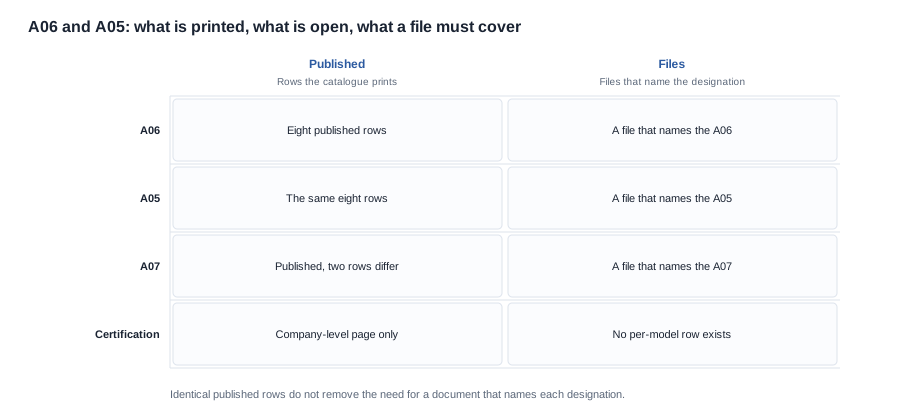
The matrix above separates three things that comparison sheets usually merge: what the catalogue prints, what it leaves open, and what a document has to cover. The third column is the one with the commercial consequence, and it is discussed below.
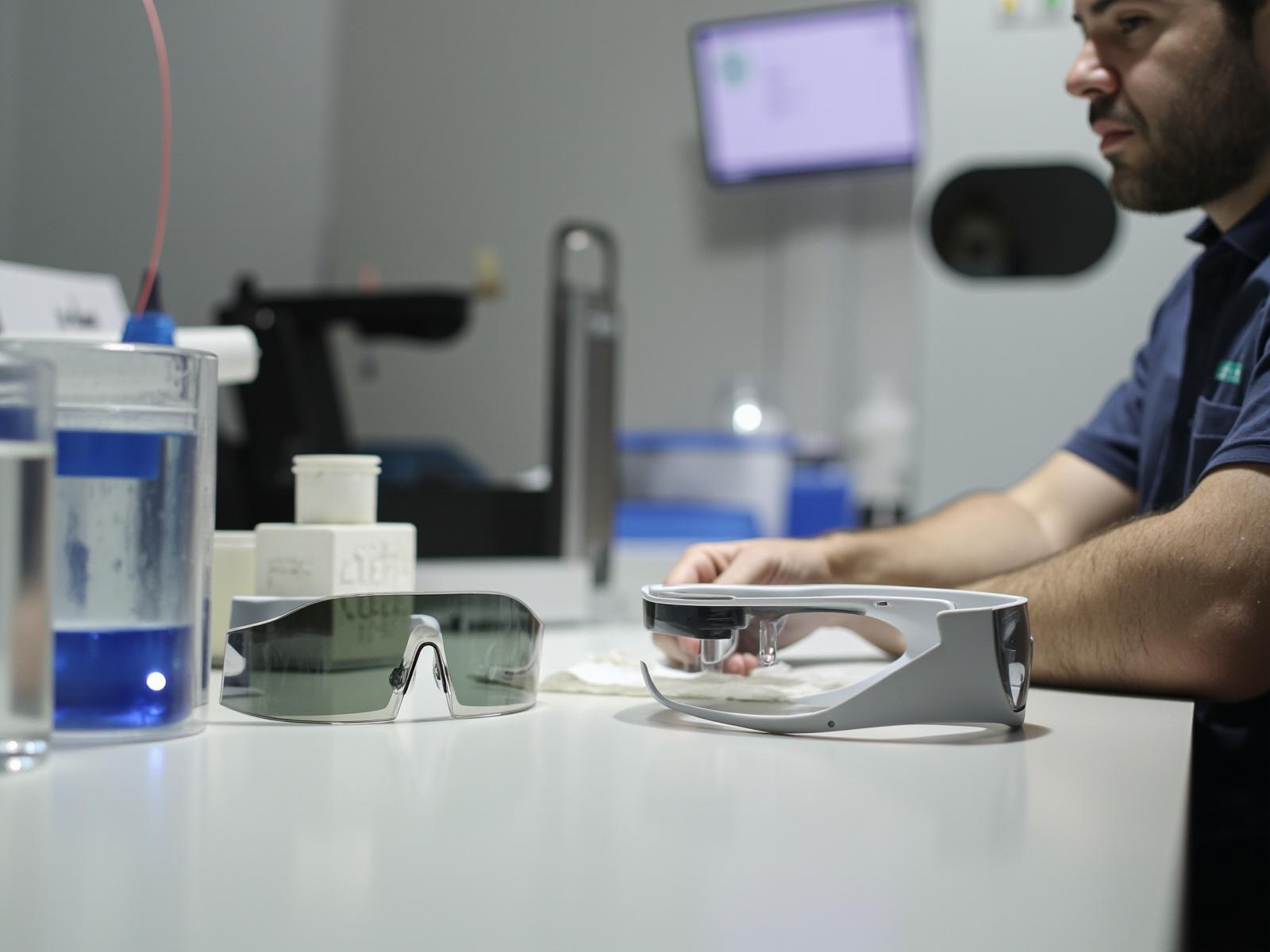
A06 and A05 certification: why identical hardware does not mean one file
The catalogue's certification position
The certification position in our catalogue is a company-level page, not a per-model row, and the difference matters for a buyer who plans to order both designations. The catalogue carries an export-certification page whose content is images rather than text, presenting ten patent certificates — eight appearance-design patents and two utility-model patents. The catalogue's text contains no reference to CE, FCC or RoHS, and there is no per-model certification row, no certificate number, no issuing body, no validity period and no covered-model schedule for any of the twenty-eight models.
So the honest position is that the certification status of the A05 and the A06 is not published per model. It is not "pending confirmation" — there is no such record in the catalogue. It is simply not printed, model by model, which is the same category of gap as the missing frame weight and the missing colour row.
A buyer therefore has to treat the conformity file as an item to be obtained rather than an item to be read. That is a normal position in a category like this, and the A06 certification status analysis sets out the request list, while the certification and compliance documentation framework covers the wider work.
Why a document names a designation
A test document is written against a designation, and that is the reason two identical specifications do not reduce to one file.
The principle is straightforward and applies to any category. A conformity assessment covers a product as identified. If a document names the A05, it covers the A05. It does not automatically extend to the A06, even where the two publish the same cell, the same charge time, the same runtime, the same charging method and the same six feature rows — because the identification of the product is the thing the document is about, and the catalogue itself publishes no row stating that the A06 and the A05 are the same product.
The practical consequence is a document-covering question, and it is cheap to ask. Ask whether the conformity file names both designations, and ask for the file that does. If the answer is that one file covers both, record it in writing and the question closes for both SKUs at once. If the answer is that two files are needed, the cost of a second test programme falls on the range plan, and it falls on the ladder that the two designations are supposed to support. Either way, the answer has to exist before artwork, not after.
There is a second document effect, and it is the platform one. If the A05 and the A06 are separated by a firmware branch, an application version or a component revision, then the application, the update path and the support script are separated as well — and none of that is visible in the published rows. The model readiness overview sets out where platform sharing is documented in this category, and it is a thinner set of axes than the audio models in the K-series carry.
The third document that has to name the designation
A conformity file is not the only document that names a model, and the other two are cheaper to fix and easier to forget.
The user-facing document set — the pairing instruction, the quick-start guide, the charging instructions, the support script, the safety information and the warranty terms — is written per designation by default, because it is written per product in the factory's own documentation. If two designations ship with two document sets, the customer receives two instruction packs for what looks like the same product, and the support load doubles with the product count.
And the packaging and the listing carry the designation in a way that a customer can see, which means the duplication question reaches the shelf whether or not the range plan ever resolved it. A buyer who has not closed the difference question is relying on the customer not to notice, and in a children's category the customers comparing two listings are usually the most careful readers of the specification table, because that is where the parent's safety and suitability questions are answered.

The sequence above is ordered by what blocks the most downstream work. The designation difference comes first because it determines how many of everything else follows. The conformity file comes second because it is the longest lead time in the sequence. The user-facing document set comes third because it is cheap to fix and expensive to discover late. The physical rows come last because they affect returns rather than launch.
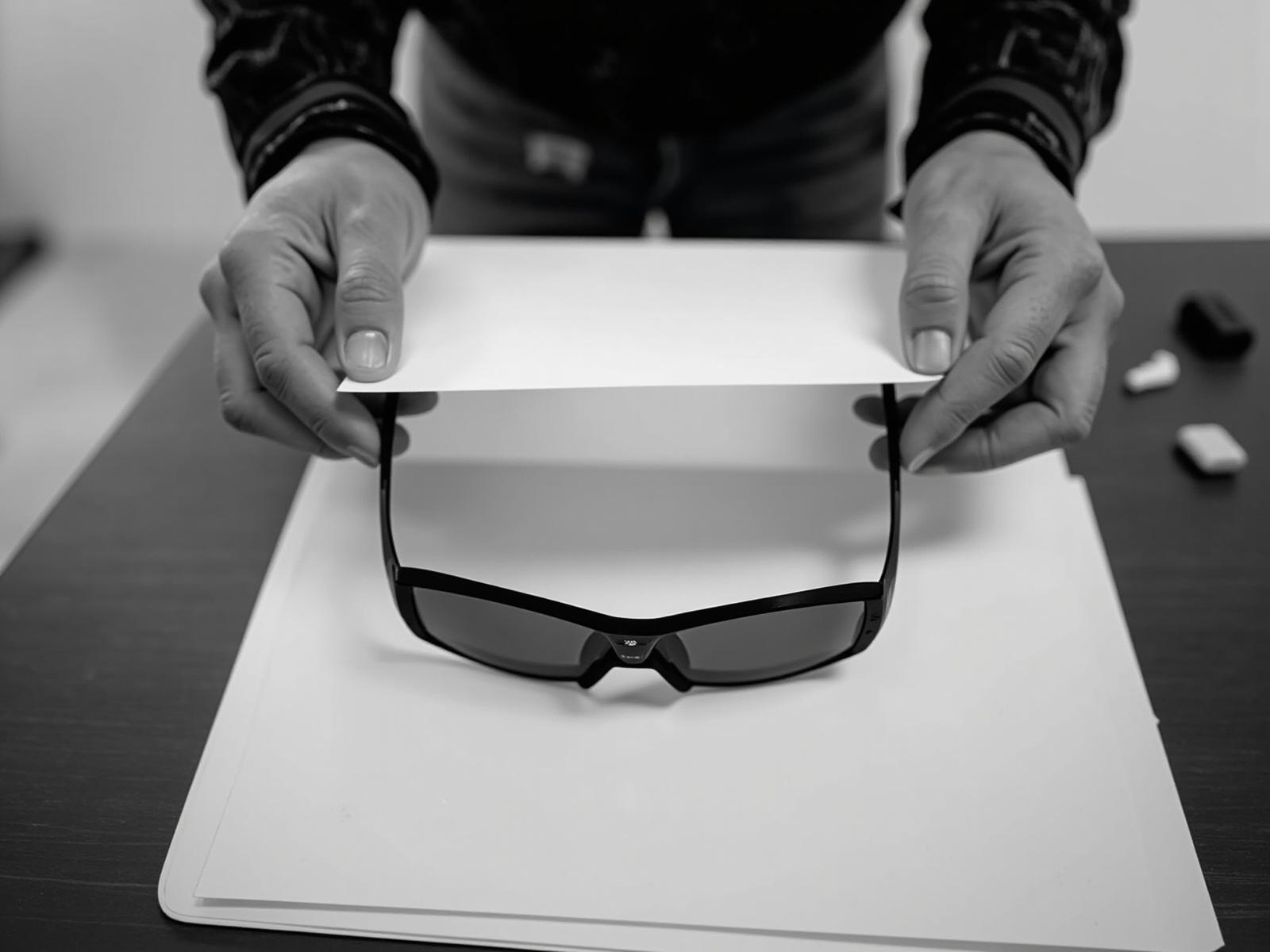
A06 spec comparison: reading the table before a selection decision
The evaluation method
A comparison table like this one does not score, and treating it as if it did is where the errors come from. There is no weighting that turns "identical on all published rows" into a preference, and no tie-breaker hidden in the blanks. What the table supports is a shortlist procedure.
Step one is to separate the rows into three bins: printed and identical, printed and differing, and open. For the A05 and the A06, bin one is the whole published set, bin two is empty, and bin three is the six open items. For the A07, bin two contains the radio version and the cell capacity. A buyer who skips this step will spend their time looking for a difference that is not there.
Step two is to write each open row as a question with a named owner. "Frame weight for the A05" is a note; "obtain the frame weight for the A05 from the factory and record it against the SKU" is a question with a deadline. The set of questions is what makes the comparison actionable, and the A06 and A05 price positioning analysis applies the same list to the commercial side.
The criteria for the shortlist should be set before the rows are read, and they should be written as criteria rather than as preferences. "The A06 must be orderable in the target market with a document that names the A06" is a criterion. "The A06 is the better model" is a preference, and a preference cannot be checked against anything. A buyer who sets criteria first and reads the table second cannot accidentally read a difference into a blank; a buyer who reads the table first and decides afterwards will find one, because a two-model range with a missing difference is an uncomfortable thing to carry.
Step three is to decide the range structure on the answers, and to set the decision point before the artwork rather than after. If the answer is a physical or packaging difference, two SKUs is a legitimate merchandising structure with a known cost. If the answer is an engineering difference, it changes the document file, the accessory list and the support load, and the cost of a second conformity programme has to be in the range plan. If the answer is that they are the same product under two designations, the range, the listing and the inventory logic should say so.
Step four is the one most buyers skip: re-run the comparison when the catalogue is next revised. A comparison table is a snapshot of documentation at a point in time, and a row that is open today may be printed tomorrow. A range plan that cites a table without a date is a plan that will drift.
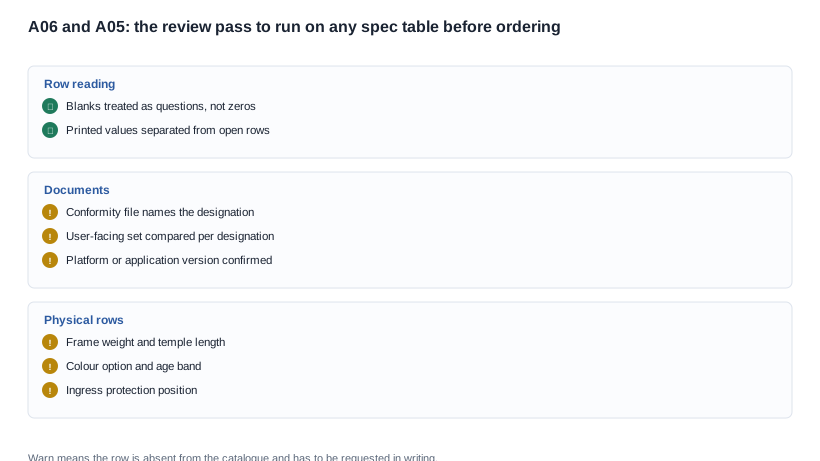
The checklist is short because the family is short, and that is a feature rather than a shortcut. Two models, eight published rows, six open items, one range decision and one document question. A buyer who runs this pass on this pair has, in an hour, the same position that a buyer who reads a competitor's comparison sheet would think they had — except that the position is true.
What we can confirm on the comparison
We can confirm that the A05 and the A06 publish identical rows in every published line, and that our catalogue contains no row stating a difference between them. We can confirm which six rows are open for both, and we can point to where the catalogue publishes comparable information for other models, which is what makes those six questions answerable rather than permanent. And we can confirm that the certification information in our catalogue is presented at company level, with no per-model row.
What we will not do is describe a difference the documentation does not contain. We will not present a blank as a negative value, and we will not import a radio version for these two models from another line in the catalogue. We will not quote a frame weight, a case capacity, a colour or a certification status that we do not publish. And we will not describe the posture-and-distance sensing states as producing any vision, health or prevention outcome — we hold no clinical data for this category, and the regulatory exposure in a children's segment is real rather than theoretical.
What we can do is make the comparison close faster. Send us the range you are planning, the destination markets and the document set you need, and we will tell you which published rows we can confirm today, which questions we can put to the factory in one exchange, and whether a two-SKU sensing range is viable or whether one model should carry the tier. The A06 and A05 battery and charging comparison covers the electrical subset in full, and the A06 and A07 use case comparison covers the choice this pair sits inside.
If you want to verify the reading rather than take it, the due diligence is short and the total cost of it is a single exchange. Send one written request that lists the six open rows and asks each of them by name, ask the factory to answer each against a specific model designation, and ask for the response in writing. That single request is what to ask us to put on your behalf, and it converts a set of open rows into a set of closed ones without any of the numbers being invented in the meantime. The usual pitfalls in this category are all downstream of skipping that step: an imported radio version, a case capacity quoted from a different model, a build-quality claim with nothing behind it, and a range that carries two designations the customer cannot tell apart. Which model you should order for a given requirement is answered by the A06 and A07 use case comparison, and how to choose between two identical rows is answered by the A06 and A05 battery and charging comparison.
Related reading
- The published rows for the A05 — A05 smart glasses specifications and features
- The categorisation — kids smart glasses buying guide
- The third model in the range — A07 smart glasses specifications and features
Send us the range you are planning and the markets, and we will tell you whether a two-SKU sensing range is viable. A06 smart glasses vs A05 spec comparison is a reading exercise first and a selection exercise second, and the reading has to come first.


