

The A05 and the A06 publish the same six rows, exactly, and there is no published difference between them to build a price ladder on. Both list a 40 mAh cell, a charge time of two hours or less, roughly twenty hours of rated use, magnetic charging, a lens-type electronic fogging element, and posture and distance detection. Our catalogue does not state what separates the two designations.
That is why a price comparison between these two models cannot be written from the catalogue, and why "which one is cheaper" is the wrong question. The useful question is narrower: what can you legitimately use to justify two price points for two products a customer will find indistinguishable? Four candidates survive scrutiny — the order minimum, the lead time, the packaging format, and channel exclusivity — and each of them has to arrive in writing before it goes anywhere near a price list.
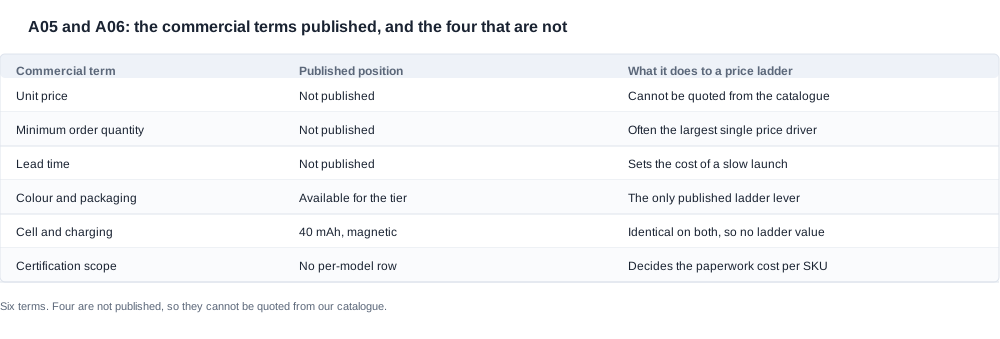
If none of the four arrives, the defensible outcome is one model carried well rather than two models carried badly. This article sets out the four levers, the sequence that turns them into a ladder a buyer can defend, the four points where a two-model ladder breaks, and what we will confirm for you versus what we will not invent.
A05 price positioning: the identical rows end the argument
Start with the fact rather than around it. Six rows are published for the A05 and the same six rows are published for the A06, and on every one of them the values match. The cell is 40 mAh on both. The charge time is two hours or less on both. Rated use is about twenty hours on both. Charging is magnetic on both. The lens-type electronic fogging element appears on both. Posture and distance detection appears on both. The catalogue is not approximately consistent between these two models; it is exactly consistent.
A buyer who finds this does not have a gap to solve with a spreadsheet. They have a question, and the question has one answer: what actually separates the A05 from the A06 commercially? The catalogue leaves that open, and any procurement team that compares two rows and finds them identical is going to ask it, in writing, on the first quotation.
There are three explanations for a pair of identical specification sheets, and each of them leads somewhere different.
They are one product under two designations. This happens legitimately when a supplier is running a segmentation exercise, a renamed line for a different retail tier, or a second reference for a packaging variant. If this is what it is, two SKUs fragment your channel for no gain. A buyer comparing your two listings finds no reason to prefer either, the review pages for both attract the same confused comments, and your inventory splits across two codes that move at half the rate of one.
A real commercial difference exists and was never recorded. A different order minimum, a different lead time, a different packing format, a different colour set, a different documentation scope. This is the most likely explanation and it is entirely legitimate. The problem is not the difference; the problem is that it is undocumented, which means it will not survive the handover to the next buyer, the next channel or the next quarter.
A technical difference exists and was not published. Possible, and it would explain why the two carry different designations. But your customer cannot see it, your own sales team cannot describe it, and your listing cannot be built on it. A differentiation your buyer cannot see is not a commercial asset; it is a liability at review time.
Why a price gap without a product difference is a positioning act
Once you accept that the two models are published identically, the price gap between them becomes something you decide rather than something you discover. That is not a problem to be solved; it is a decision to be made deliberately, because the decision carries obligations in both directions.
A price gap on two indistinguishable products tells a buyer that the more expensive one is somehow better, and it invites them to ask how. If the honest answer is "because the order minimum is higher and the pack is retail-ready", then that answer has to be visible somewhere a buyer can find it — the price list, the product page, the quotation. If the honest answer is "there is no reason", then the gap is a markdown waiting to happen, because the first competitor who prices the cheaper model below your lower price takes the whole tier.
The second reason a price gap on identical models is dangerous is channel-specific. Retail channels and marketplaces both punish duplicate listings harder than they punish a single thin listing. Two codes for the same frame, with a price difference and no visible difference, produce a comparison between your own two listings on a platform whose entire business model is comparing listings. You have built the comparison for someone else.
What identical rows do not mean
It is worth saying what this finding is not. It is not a quality judgement on either model, and it is not a statement that one of them is a second-rate variant. Published equality across six rows is a narrow fact, and both models carry the same published strengths: the highest rated-use figure in our catalogue on the smallest cell in it, a charge ceiling of two hours or less, and a lens-type fogging element with posture and distance detection.
It is also not a reason to delay. A buyer who hears "they are identical" and then does nothing has converted a documented gap into an undocumented risk. The gap is documented, which is the good position. The action is a short, specific question to a supplier, and it costs one email.

Four levers that create a real price gap without a product difference
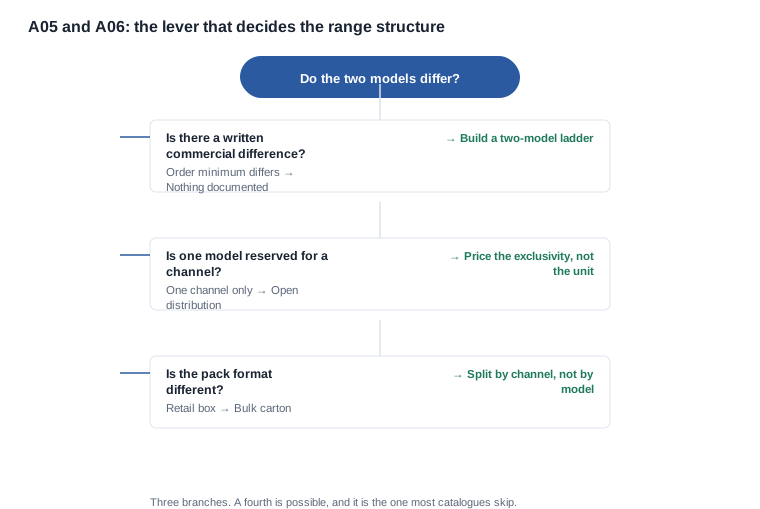
If the specification rows are identical, the price ladder has to be built from something other than the specification. Four levers do it, and they are worth ranking by how much of the gap they can actually carry.
The order minimum, which is usually the largest driver
When a buyer says two quotes for the same product differ by fifteen per cent, the order minimum is usually the reason, not the factory margin. A supplier who will run a colour at two hundred units and a colour at twenty thousand units is not charging you two different margins; they are amortising the same setup differently, and the effective unit price moves with the commitment.
This is the lever most likely to be real and least likely to be published. For the A05 and the A06 specifically, we publish no order minimum for either model, so any ladder built on it has to be built on an answer you obtain, not on a number you read. The useful form of the question is precise: what is the minimum for each model, is it the same for both, and does it change with colour or packaging? A supplier who answers with a tier table has given you the ladder. A supplier who answers with a single number has given you one rung.
The lead time, which prices the delay rather than the goods
Lead time is a cash cost before it is a price cost, and it is the lever a procurement manager will feel before a finance manager does. A shorter lead time on one model is worth real money to a brand with a launch date, and it is worth even more to a distributor whose channel will not hold a slow-moving SKU.
The number you need is not a single figure. It is the lead time for the specific configuration, in the quantity you are ordering, on a repeat order rather than on the first one. The first production run and the repeat run are different lead times, and a quotation that quotes only the first one will look better than the schedule actually is. For the A05 and the A06, no lead time is published at either model.
The packaging format, which is the one published lever
Colour and packaging customisation is published as available for this tier. That is the only commercial differentiator in our published material that is actually available to you, and it is worth understanding why it carries more weight than it appears to.
A retail-ready pack and a bulk carton are not cosmetic. The retail pack adds die-cut board, printed artwork, a manual, a warranty card and a barcode configuration, and each of those is a line on the purchase order. The bulk carton adds a layer of outer packaging, a different carton count per unit, and a different pallet configuration. Landed cost per sellable unit is not the same number in the two cases, and a channel that takes the product by the carton rather than by the piece sees the difference first.
The commercial caution is that packaging differences are visible to a buyer while specification differences are not. That is exactly what makes them useful as a ladder and exactly why they have to be stated plainly, rather than left for the customer to discover.
Channel exclusivity, which is a commercial lever rather than a physical one
Exclusivity is the only lever on this list that does not change the goods at all. If one model is reserved for a particular channel, a retailer or a regional distributor, then the two designations are genuinely different commercial products even though they are the same object on the same production line. The price gap then reflects a distribution right rather than a product difference, and you can defend it in those terms.
This is also the lever with the most legal and commercial baggage attached. Exclusivity that is not written down, with a territory, a duration, a minimum and a termination clause, is not exclusivity; it is a hope. If it is the basis of your ladder, it belongs in the agreement rather than in a conversation, and the termination terms matter more than the price.

Why unit price is the wrong number to negotiate
One practical warning, because it is the most common mistake in this category. If your comparison between the two models is built on unit price, you are comparing the wrong quantity. The number that moves a procurement decision is the effective unit cost after the order minimum, the packaging configuration, the freight class and the defect allowance are applied, and for a product with an unpublished frame weight and an unpublished ingress rating, the freight class and the defect allowance are both open.
Negotiating unit price on two models with identical specification rows also produces an outcome nobody wanted: the cheaper model becomes the default, the price ladder collapses into a discount, and the second model survives only because it is already in the catalogue. If you want two models, decide what makes them different before you negotiate what they cost.

How to build a two-model ladder a buyer can defend
The sequence matters more than the individual steps, because the failure mode is skipping ahead. Buyers negotiate price before they know what the two models are, then discover the difference afterwards and find that it cannot be stated to a channel.
Step one, write down the identical rows and mark them as identical. Six rows, two models, no difference. This takes five minutes and it does something important later: it gives you the authority to ask the question without appearing to be nitpicking. "Your documentation shows the same six rows for both models" is a much stronger opening than "I think these are the same".
Step two, ask for the commercial difference in one written sentence. Not a document, not a catalogue page — one sentence in an email. If the supplier can answer it, you have your ladder. If they cannot answer it in one sentence, the difference is either trivial or absent, and both of those are useful answers.
Step three, decide the range structure before you negotiate anything. If there is no difference, plan one SKU with the better commercial terms and keep the other as an alternate code that you can activate later. If there is a difference, decide which model sits above which and on what basis. Doing this after the price conversation is how a buyer ends up with a premium model whose premium they cannot explain.
Step four, attach the difference to the range in the price list itself. This is the step most often skipped. A minimum order quantity that exists only in an email is invisible to your own sales team, invisible to the channel, and invisible to the next person who takes over the account. Write it into the quotation, into the product page, and into the internal price list, so that the reason for the gap travels with the price.
Step five, put the acceptance criteria into the purchase order. For the A05 and the A06 the practical criteria are the configuration, the order minimum, the pack format, the lead time and the documentation scope. A criterion that exists only in correspondence is not binding on either side, and a supplier who ships a pack format you did not specify has met no obligation they broke.
What to put in the quotation so the ladder holds
A two-model price ladder needs a fixed skeleton, and the skeleton is what makes it survive a change of account manager. On each line of the quotation, name the model, the configuration, the order minimum for that model, the pack format, the lead time for the quantity quoted, the unit price at that minimum, and the documentation scope you require for that model.
Two of those seven fields are the ones that get skipped. The order minimum, because a quotation that lists a unit price feels complete without it. And the documentation scope, because it looks like paperwork rather than a commercial term. In a category where the catalogue publishes no per-model certification row at all, the documentation scope is not paperwork — it is one of the two things that makes the two models legally distinct, and it is the thing that tells a compliance reviewer at a channel why the two designations are not interchangeable.

Where a two-model price ladder breaks
Four failures account for most of the trouble, and none of them is visible while the ladder is being built.
The channel fragments. Two codes for one frame split your reviews, your search ranking and your inventory. In a tier where the buyer is often comparing listings rather than specifications, you have built the comparison yourself. The fix is to give the two models genuinely different packaging and genuinely different listing copy, so that a shopper who lands on either one arrives at the intended product.
A price gap with no visible difference invites a competitor into the gap. Any third-party supplier can see your two listings and price between them, and they will not have to beat your better model on merit. This is the specific reason a price gap on identical products is a liability rather than a strategy, and it is why the difference has to be visible in the product rather than only in your price list.
The paperwork names one model. A test report or a certificate that names the A05 does not automatically cover the A06, even where the two are electrically identical. The document names a product, and the designation is what an inspector reads. If you carry both models, the documentation scope has to name both, and that is a cost you should see in the quote rather than discover at the point of customs clearance or during a quality claim.
The returns rate is not in either price. Both models are sold into a category where the frame has to suit a growing head, and neither publishes its frame weight, its temple length, a detachable temple specification or a replacement-parts policy. A price comparison that ignores the return rate is comparing unit prices for two products with different landed costs. The A05 limitations analysis covers what is missing from the published rows in more detail.
What we will not price on, and what we will confirm
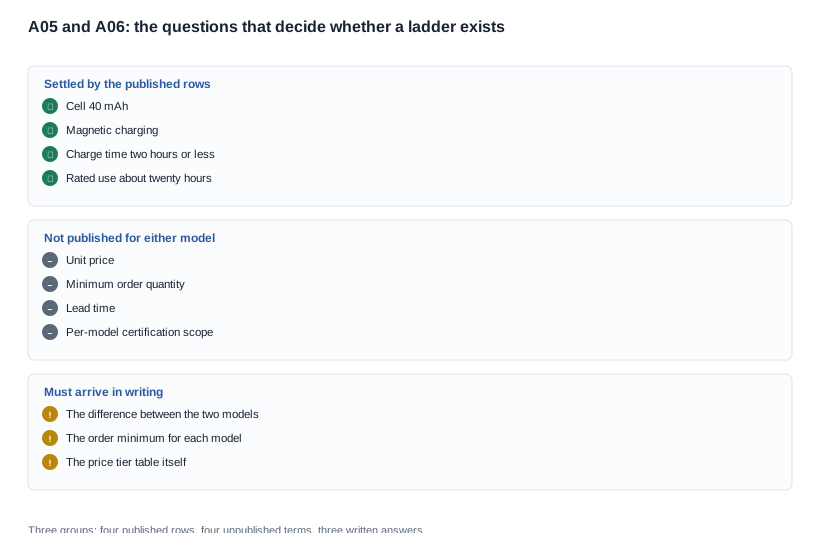
We will not manufacture a price difference between two models our own catalogue describes identically, and we will not present a commercial term as published when it is not. The order minimum, the lead time, the unit price and the certification scope for the A05 and the A06 are not published, and we would rather show you four empty fields than four plausible numbers you would have to reconcile with an invoice later.
What we will do is specific. We will confirm the six published rows for either model, which are identical. We will confirm the charging method, the charge ceiling of two hours or less, the rated-use figure of about twenty hours and the cell capacity. We will tell you whether a configuration you are planning to sell is actually available, and we will tell you plainly if the thing separating the two designations turns out to be nothing, which is the answer that saves you from carrying a second SKU.
We will also be direct about what we will not do. We will not publish a certification claim for either model, because our catalogue carries a company-level export certification page whose content is images rather than text, contains no per-model certification row, and mentions no CE, FCC or RoHS marking anywhere in its text. A buyer who needs CE, FCC or RoHS documentation for the A05 or the A06 has to obtain it in writing from us, and the scope of that request is a commercial term that belongs in the ladder.
Send us the volume, the target market, the channel and the two configurations you are pricing, and we will tell you which of the four levers exists, which does not, and what a single well-run model would cost you per sellable unit.
Related reading
- The published rows behind this comparison — A05 and A06 specification comparison
- The category price context — kids smart glasses price comparison
- Ordering a volume of this tier — kids smart glasses bulk ordering
Tell us the volume, the market and the channel, and we will say whether anything separates these two commercially or confirm that nothing does.


