

This comparison has an unusual result: there is no difference to report, and an importer needs to be able to prove that rather than assume it. The A05 and the A06 publish the same rows — a 40 mAh cell, a charge time of two hours or less, roughly twenty hours of rated use, magnetic charging, a lens-type electronic fogging element, and posture and distance detection — and our documentation does not state what separates them.
So this is not a page about which model has the better battery. It is a page about how a two-designation import is handled when the source data is identical. That comes down to four things: making "identical" a statement you can defend rather than one you have to take on trust; knowing which rows are genuinely open; spotting a supplier listing that claims a difference our rows do not support; and understanding that a document which names one model does not automatically cover the other.
If the answer you arrive at is that one model is enough, that is a good outcome and it is a legitimate procurement decision. The failure mode to avoid is the opposite one — carrying two designations because the catalogue looked richer, and discovering after the first shipment that nobody can say what the second one is for.
A05 spec comparison: identical is a claim you have to be able to prove
"When two models look the same" is not a usable finding. "Every published row for the A05 and the A06 carries the same value" is. The difference between those two statements is the difference between an impression and a specification check, and it decides what you can safely do with the result.
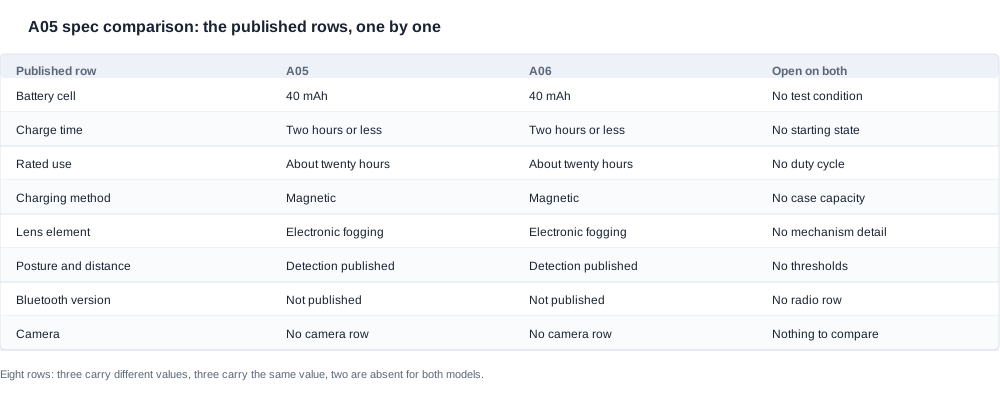
The check itself is short. Take the published rows for the two models side by side, and for each one write the value from the model A documentation and the value from the model B documentation. On the cell: 40 mAh and 40 mAh. On the charge time: two hours or less and two hours or less. On rated use: about twenty hours and about twenty hours. On the charging method: magnetic and magnetic. On the lens element: a lens-type electronic fogging element on both. On detection: posture and distance on both. Every published row matches, and the remaining rows are absent for both models rather than differing.
Once that is written down, it becomes the fixed reference for everything that follows. Every later question — about the supplier listing, about the invoice, about the document pack — can be checked against a page you already hold rather than reconstructed from memory during a negotiation. That reference sheet is also what you attach to a purchase order when you want a substitution to be caught at receipt rather than at a customs query six weeks later.
Why an importer carries a designation on four surfaces
The reason an importer needs this level of rigour is structural. A model designation does not stay in one place. It appears on the commercial invoice, on the carton, on the product listing your channel publishes, and on any conformity document that travels with the goods. Four surfaces, one string, and the string has to be identical on all four.
The moment it is not, the exposure is not abstract. A mismatch between the invoice and the document pack is a customs query. A mismatch between the carton and the listing is a channel rejection or a mis-shipped line. A mismatch between what the document names and what the carton says is a quality dispute in which the manufacturer can legitimately point at the paperwork. None of these are catastrophic on their own; all of them are expensive in time, and they all trace back to a designation that was changed or duplicated somewhere without a decision behind it.
This is the practical reason the identical-rows finding matters more to an importer than to a retailer. Two identical models create an invitation to carry both, and carrying both multiplies the number of surfaces on which a string has to stay consistent.
The three questions that are genuinely open
Everything above the published rows is settled, and everything below it is open. Three of the open items are worth separating out because they are the ones a supplier sheet usually fills in with something that is not in our documentation.
What physically distinguishes the A05 from the A06. Not published. Our own documentation holds the question open, and so does this page. A supplier who claims a difference should be able to name it in one sentence, and the sentence should be specific enough to appear on a product page.
The Bluetooth radio version on either model. Not published for the A05 or for the A06. This one bites hard, because a radio version is exactly the kind of row a retail specification sheet expects to contain, and an empty cell there tends to get filled by whoever wrote the sheet. If you are importing these models, the radio question is a due diligence item rather than a documentation detail.
Whether either model shows a visible charge state. No charge-indicator behaviour is published for either model. This is a returns-control question rather than a feature question: an indicator is what stops a child handing a flat pair back to a parent as a fault, and it is also what stops a channel's support line absorbing what is really a charging problem.
Two further items are open for both models and are not specific to this comparison: the frame weight and dimensions, which set the freight class and the size of the returns problem, and the certification scope, which is discussed in its own section below.

The published rows, line by line, and what each one leaves open
The table below lists every row our documentation publishes for the two models, side by side, with the question that each row leaves unanswered. Reading it in two passes is worthwhile: once for the values, and once for the empty column on the right, because the empty column is where the commercial exposure sits.
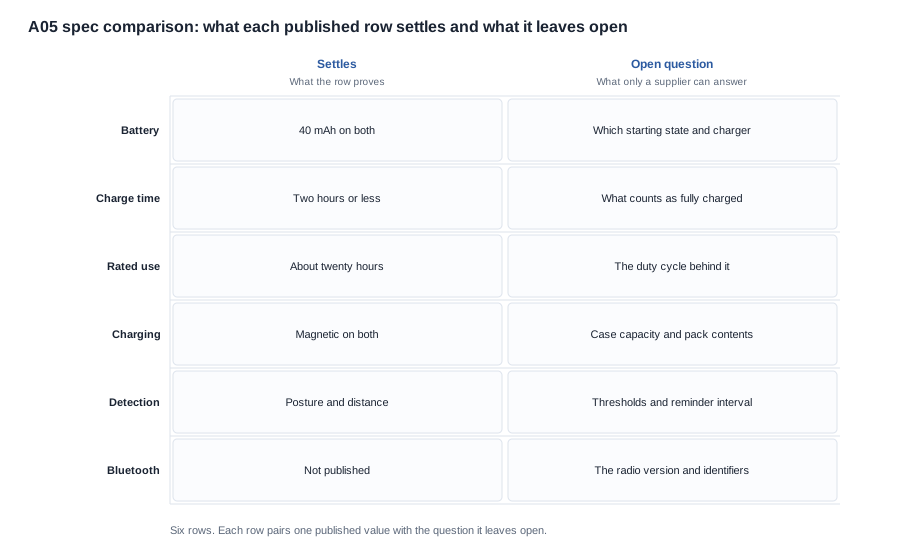
The 40 mAh cell. It is the smallest cell published anywhere in our catalogue, and it sits on the highest published rated-use figure in it. That combination is not a contradiction and it is worth understanding, because it is the single fact that most often gets misread. A device that spends most of its time asleep and wakes periodically to sample a sensor and sound a reminder draws a very different current profile from one that is processing continuously. The rating is describing a duty cycle, not a capacity.
The charge time of two hours or less. This is a ceiling, not a measurement, and the wording matters in a way that is easy to lose in a paraphrase. "Two hours or less" permits exactly two hours. "Under two hours" does not, because it asserts a stricter bound than the documentation supports. If your own spec sheet says under two hours, it says something our documentation does not, and a buyer who checks the two documents will find the discrepancy. Our battery specification guidance sets out how to phrase the rest of the power rows.
Roughly twenty hours of rated use. No test condition is published: not the starting state, not the reminder interval, not whether the device was connected. The figure is a rating under favourable conditions and nothing more.
Magnetic charging. Both models seat on a magnetic interface rather than plugging in. What that interface connects to is not published for either model — whether a case is supplied, and if so what its capacity is, is an open item, and it is an open item that changes the landed cost, the carton and the weekly routine of the end customer.
The lens-type electronic fogging element. The mechanism, its response time, its power draw and its cycle life are not published. The catalogue's own illustration contrasts a clear lens against a fogged one, which tells you the lens state is visible to the user, and therefore something a customer will inspect and something a returns line will receive a photograph of.
Posture and distance detection. The capability is published. The thresholds, the sensing range, the reminder interval, the trigger logic and whether a reminder can be dismissed are not. A procurement team whose brief depends on the detection behaviour has a sample question, not a document question, and that distinction should be settled before the order rather than after it.
The Bluetooth version and the camera row. Both are absent for both models, rather than different. A missing radio row and a missing camera row are two different absences, and conflating them is a common shortcut: the absence of a camera row is not the same statement as a published camera specification of zero.
A warning that applies to every row in the table
These figures are not directly comparable with other rows in our catalogue, and the reason is the measurement, not the product. The twenty-hour rating on the A05 and the A06 sits on a 40 mAh cell with a sensing duty cycle. Our audio models publish between six and eight hours on cells of 55 mAh, 70 mAh, 90 mAh and 100 mAh configurations, because a speaker and a radio-on stretch draw a different current profile from a periodic reminder. Neither number is wrong; they are measuring different work. A buyer who puts the two side by side in a spreadsheet is comparing a sleep test with a playback test.
The same caution applies to the charge ceiling. Two hours or less on a 40 mAh cell and two hours or less on a larger cell are both ceilings, and neither one tells you the starting state, the charger, or the temperature.

When a supplier listing claims a difference the catalogue does not show
Somewhere between a buyer's first enquiry and the first quotation, a supplier listing will arrive that tells you the A05 and the A06 are not the same. That claim is not automatically wrong — our documentation is a catalogue, and a catalogue is not a complete description of a product — but it is a claim, and the importer's job is to convert it into a row you can put on a spec sheet.
Three patterns account for almost all of it.
The listing is describing a different model. A familiar product with a familiar configuration has been substituted for the one you asked about. This is the most serious of the three, because every downstream document inherits the substitution. The check is a character-by-character comparison of the model string on the listing against the model string on your order, and any difference is a stop condition rather than a query.
The listing is describing a market variant. Some suppliers run the same frame under different designations for different territories, with different plug types, different packaging or different documentation scope. If that is what has happened, then the difference is real, commercially relevant, and simply not in our catalogue. It then belongs in your price ladder and on your spec sheet, and it has to arrive in writing with the designation attached to it.
The listing is describing a difference that exists in the product but was never published. Possible. But a difference you cannot see in the documentation is a difference your channel cannot see either, and if the listing and the documentation disagree, your customer will eventually find the catalogue and read it. The safe handling is the same in all three cases: ask for the row, ask for the document that supports it, and if neither arrives, treat the two models as identical in every artefact you publish.
The claims to remove from a sheet before it ships
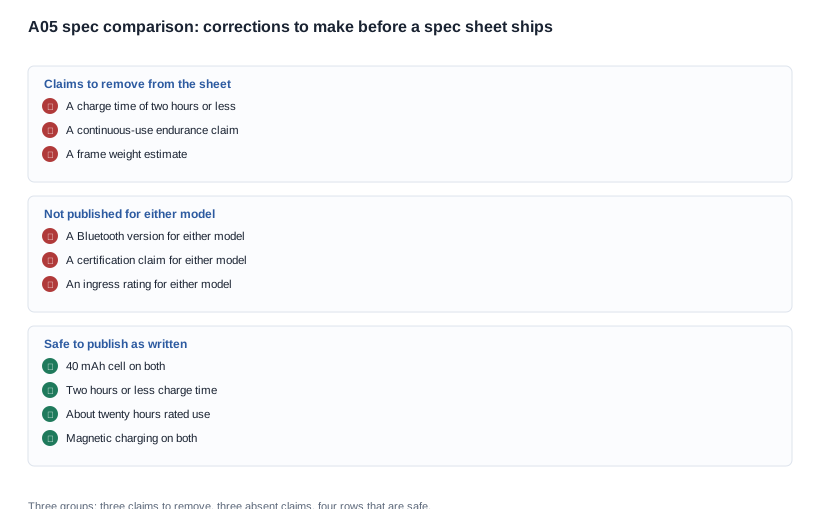
Some rows are the ones that cause the most trouble, because they are the ones that read as helpful. A charge time described as under two hours rather than two hours or less turns a ceiling into a stricter claim. An endurance figure presented as continuous use turns a duty-cycle rating into a working-hour promise. A frame weight estimated from the model family turns an absent row into an invented one.
None of these is defensible on a product page for a children's model, and the third of them also lands on a customs declaration or a freight calculation where an invented number becomes a cost that someone else pays. If a spec sheet needs a number our documentation does not hold, the correct move is to leave the row empty and mark it as a question to the supplier.
How a listing is checked against our rows
The mechanical version of this is straightforward. Take the listing, take our published rows, and mark each row of the listing against the reference. Three outcomes are possible for each row. It matches — record it and move on. It differs — raise it as a query, with the model string spelled out. It has no counterpart — that is the interesting one, because it means either our documentation is incomplete for that item or the listing is extending beyond what it can support, and both need an answer before the sheet is used.
The reference sheet has to be a controlled document. If it is a set of notes in one person's inbox, it will be interpreted differently the second time it is used, and a comparison that changes meaning between runs is not a control at all.

Documents that name one model and not the other
This is the item that catches out importers who have everything else right, and it deserves to be separated from the rest.
A conformity document names a product. It does not cover a family because the family shares electrical characteristics; it covers the designation that was tested, in the configuration that was tested, for the market it was tested for. A report that names the A05 does not automatically cover the A06, even where the two are electrically identical, because the designation is the thing an inspector reads and the thing a certificate holder is measured against.
The practical consequence is a documentation cost that scales with the number of designations you carry. One model means one name on the pack, one name on the invoice and one name in the file. Two models means either two names in the file or a written statement, from the issuer, that one document covers both — and issuers are cautious about the second, for the same reason the importer is.
A company-level page of images, and no per-model certification row
We are precise about this because a buyer's question here is entirely legitimate and a supplier's answer here is often less so. Our catalogue carries a company-level export certification page, and the content of that page is images rather than text: ten patent certificates, eight appearance-design patents and two utility-model patents. The catalogue text contains no reference to CE, FCC or RoHS marking, and there is no per-model certification row anywhere for the A05, the A06, the A07 or any other model.
That is the whole of our published position, and it has three implications for an importer. First, there is no certification evidence to attach to either model from us today, so the request has to be made in writing before the order. Second, no one can infer a certification status for either model from our company-level page, and a supplier who does so is making an inference we have not made. Third, the request itself is a commercial term that belongs in the quotation, with its cost and its lead time stated, because testing a specific model for a specific market is a scheduled, paid activity rather than an administrative formality.
The regulatory frameworks a buyer will be working against are ordinary ones and worth naming so that the request is precise. A wireless product with a cell falls under the radio equipment framework, the Radio Equipment Directive (EU) 2014/53/EU, as well as the battery transport rules that UN38.3 testing supports, and for a product intended for children the applicable children's product standards in the destination market add a further programme that has to be scoped with a test house rather than assumed. The child product compliance guidance sets out how that scoping works.
The four surfaces, one string
Pull the four surfaces together and the requirement is simple to state: the designation must be identical on the invoice, the carton, the listing and every document in the pack, and the documents in the pack must name the designation you are actually importing. A checklist is the right instrument for this because the four surfaces are checked at different moments — the invoice at the broker's, the carton at the port, the listing at the channel's review, the documents at your compliance review — and a mismatch found early is a query, while the same mismatch found late is a delay.
Running a two-designation decision without writing a second spec sheet
The sequence below is short because it is a decision about a single pair of models, and because the data available to support it is narrow. The point of running it in this order is that the commercial answer comes before the price conversation, which is the reverse of how most of these discussions start.

Pull the published rows for both models into one side-by-side sheet. This is the reference. Every later step is checked against it.
Mark every row that differs and name the difference. On the evidence we publish, nothing differs. Write that down rather than leaving the column blank, because a blank column is what gets overwritten by a supplier's PDF.
Treat an unmarked difference as a claim to confirm rather than a feature. This is the step that turns a comparison into a due diligence activity. If a difference is not in the reference sheet, it is not in your product, and the burden of adding it sits with the claim.
Check that every document you receive names the model you are ordering. Character by character. In a family where two designations publish identical rows, this is the check that catches a substitution, and it is the reason the identical-rows finding matters commercially rather than merely academically.
Record the answer in the purchase order, not only in the email thread. A criterion that lives in correspondence is not binding, and a lot that fails it is a lot you can refuse — which is the entire value of running the comparison properly.
The decision that follows from all of this is straightforward. If a difference arrives, you have the basis for two designations and the specification sheet becomes two short sheets rather than one long one. If nothing arrives, one model carried well is the stronger position, and the second model is better spent as an alternate code that can be activated later rather than as a live SKU that fragments your channel.
If your channel needs two children's models, the A07 is the one in this family that does not have this problem, because it publishes a different cell, a different radio version and no detection or lens-element rows. Whether that matters depends on whether you were planning to market the detection function at all, and the A05 and A07 comparison sets out that side in full.
The position is narrow and we will hold it. We will not invent a difference between the A05 and the A06 in order to make a range look better organised, and we will not publish a certification status, a frame weight or a charging-case capacity that our documentation does not contain. What we will do is send you the published rows for either model, tell you plainly which rows are open, and put the open items into a request you can send to a supplier — because a document request is a far better negotiating position than an assumption.
Related reading
- The commercial side of the same pair — A05 and A06 price positioning
- The published rows for one model — A06 specifications and features
- The document request for this category — kids smart glasses certification for kids products
Tell us the destination market and the two model designations you need, and we will confirm what documentation each one requires.


