

The A05 smart glasses publish a short row: a 40 mAh cell, a charge time of two hours or less, a rated use of roughly twenty hours, magnetic charging, a lens-type electronic fogging element, and posture and distance sensing with a reminder function.
Five things about that combination cause trouble before the product has left the factory. One of them is arithmetic. One of them is a missing document. One of them is a second model in the same family that publishes an identical row, which means a buyer cannot currently tell the two apart from the documentation at all. And two of them are physical facts about a fixed frame worn by a growing head.
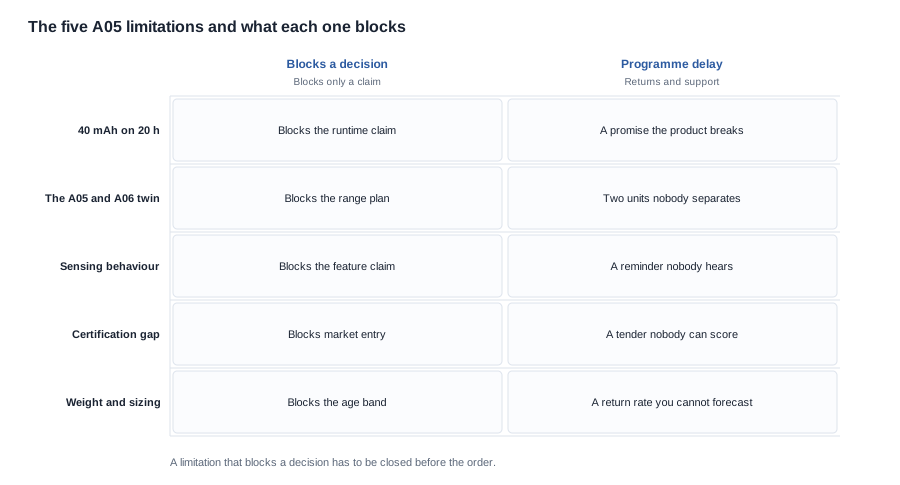
A05 smart glasses and the five limitations that decide whether a listing is possible
How to read a limitation in this category
A limitation in this category is not a fault and it is not a reason to decline the product. It is a specific gap between what a catalogue publishes and what a listing, a tender or a customer instruction has to be able to say.
The useful way to hold one is in three parts: what it blocks, what it will cost if it is left open, and what closes it. That third part is the one most catalogues never reach, and it is the reason a limitation is worth documenting rather than complaining about. A gap with a known remedy is a task. A gap without one is a decision to stop.
It also matters that limitations are not equal. Some of them block a decision — the range plan, the market entry, the age band — and have to be closed before the order. Others block only a sentence of copy, and can be managed by disclosing them honestly in the listing rather than by resolving them. Confusing the two is how a buyer ends up trying to close a limitation that cannot be closed, instead of pricing it.
Why two of these are arithmetic and one is a missing document
The first limitation is arithmetic: a small cell producing a long rating. The second is documentary: the same catalogue also publishes a second model with an identical row, so the identity question is unavoidable. The third is a combination — the mechanism is illustrated and documented, but the behaviour behind it is not, and behaviour is what a customer's daily experience is made of.
The remaining two sit in the physical and paperwork end of the range. One is that no certification evidence exists for this model in any document we hold. The other is that the frame's weight, dimensions and intended age band are not published, which is an inconvenience on an adult product and a commercial problem on a children's one.
What a limitation costs when it is left open
Each of the five has a different cost shape, and the difference matters more than the count.
The arithmetic limitation costs credibility, and it costs it quietly. Nothing breaks. A listing that quotes a twenty-hour figure next to a sentence about continuous use simply produces a customer who finds the product at a lower charge level than expected, and a support contact about a product that is working as built. The cost is a pattern of small complaints rather than one large one, and small complaints are the kind that do not show up in a quarterly review until they are already a pattern.
The twin-model limitation costs a range plan, and it costs it before anything is printed. The decision about how many units to carry has to be made before the artwork, the packaging and the listing copy are designed, so a question that is answered late is answered expensively. The cost shows up as rework rather than as loss.
The behaviour limitation costs the proposition. If the reminder interval turns out to be frequent enough that the product is switched off, the feature that the whole listing leads on does not work in practice. That is not a specification dispute; it is a product that does not do what it is sold to do.
The certification limitation costs a market, and a market is the slowest thing to recover. A withheld shipment, a delayed listing or a tender that cannot be scored all land in the same place, and the recovery time belongs to whoever owns the compliance function.
The sizing limitation costs a return rate, which is a number the buyer forecasts with. In children's eyewear, sizing is normally the largest single driver of returns, and it is the one most often left out of the planning because the catalogue seems to have answered the question by omission.
None of these five is a reason to decline the product. All five are reasons to decide now rather than at launch.
Limitation one: forty milliamp hours and a twenty-hour rating
This is the ratio that stops us. A 40 mAh cell delivering roughly twenty hours of rated use implies a very low average draw, and that in turn implies the device is genuinely idle most of the time.
What the family comparison proves
The proof is not inside the A05's own row. It comes from the A07, which publishes a 70 mAh cell and the same roughly twenty hours of rated use. A cell seventy-five per cent larger delivering an identical duration can only mean the duration describes a light duty cycle with long idle periods, and that the cell size is not what sets it.
So the published figure describes intermittent use, not continuous operation. If the customer is a parent expecting a child to use the frame through a school day and rely on it throughout, the number on the specification sheet is not describing that scenario, and a product page that reads as though it does is making a promise the product does not make.
There is a second-order consequence that costs money rather than credibility. If the figure is a duty-cycle rating, then the reminder interval is one of the inputs to it, and the interval is not published. A reminder that fires more often than the test condition assumed shortens the real runtime, and the difference between the published figure and the experienced one lands in the customer's inbox rather than in the specification.
The question that closes it
One email, and it either closes the gap or tells you the number is unusable for your listing: ask what was active, what was idle, at what reminder frequency, over how many units, and whether the figure is a mean or a best case.
If the answer is a defined condition, the limitation is closed and you have a defensible number with a condition attached. If the answer is a description of how the product is used rather than a test protocol, then the figure is a marketing number, and your listing should say what the product does rather than quoting a duration without its condition. The A05 battery life analysis covers the same reading in more detail.
Limitation two: the twin model
Another model in the same family publishes rows identical to the A05's — the same cell, the same charge ceiling, the same runtime, the same charging method, the same lens element, the same sensing function and the same catalogue product name. Our own documentation records the difference between them as an open item.
What it blocks and what it does not
It blocks the range plan. A buyer who cannot tell two models apart from the documentation cannot list either of them with confidence. Two units a customer cannot distinguish fragment the shelf space, split the reviews, divide the inventory and double the documentation work, for no commercial gain.
It blocks document scope. A document that names one model does not automatically name the other. If you cannot tell them apart, you cannot tell which document applies to which unit, and a range carrying both may be carrying two document sets where the budget assumed one.
It does not block the single-model purchase. A buyer taking one unit from this family is unaffected by the duplication, other than in the sense that the question should still be asked, because the answer determines what the unit actually is.
The one-line answer
Ask which published rows the A05 and the A06 share, and on what unpublished attribute they differ. Write the answer into the product file.
Two answers are both useful. If they are the same product under two designations, the range becomes simpler and the documentation becomes one set. If they differ on something that is not published, that attribute is the only thing you can position on, and it has to be confirmed before the artwork exists. The A05 versus A06 specification comparison covers what the possible answers mean.

Limitation three: the mechanism is documented and the behaviour is not
The A05's page is better illustrated than almost anything else in our range. It carries a set of functional illustrations contrasting correct and incorrect posture and distance, and a second set contrasting a clear lens against a fogged one. For a category where no product photograph, no video and no test report exists for any model, that is a genuine documentation asset.
What the illustrations settle
Two things, and both of them are commercially useful. The detection state is visible on the lens, which means the feature can be demonstrated and photographed rather than described in adjectives. And the fogging element has a visible state, which makes it a mechanism a customer can check rather than a promise.
The A05 specifications article covers the illustration set in more detail, and the sensing notes for the kids range set out what the published functions are.
What the sensing behaviour still needs
An illustration shows a state. It does not show a threshold, and in this category that is the whole of the commercial risk. Five behaviour rows are absent: the threshold at which a reminder fires, the interval between reminders, whether a reminder can be dismissed or disabled, whether the reminders are configurable from a parent device, and the sensing accuracy and range.
These are not technical niceties. A reminder that fires continuously is switched off inside a week, and a switched-off reminder is a product that has stopped doing the thing it was bought for. A parent who is told the product "corrects posture" and then finds it reminding every four minutes will not distinguish between a product that works and a product that is broken.
All five close with one questionnaire and one worn day on a sample. The posture monitoring analysis covers what the detection functions are designed to observe, and the A05 buyer review checklist sets out where the sample tests belong in the sequence.

Limitations four and five: certification, and sizing that is undocumented
The certification gap and its two faces
Children's products typically attract requirements in major markets that adult electronics do not. For the A05 we hold no certificate numbers, no issuing bodies, no validity dates and no covered-model schedules. The one compliance document in our catalogue is an export certification sheet, and it is made of images rather than of text; the sheet sits at company level, and the catalogue text names no CE mark, no FCC reference and no RoHS statement anywhere.
We will not tell you this product is certified, because we cannot show you a document. That is not caution for its own sake. It is the reason a listing cannot be written with confidence until the evidence exists, and it is the reason an institutional channel is a different conversation from a retail one.
The gap has two faces and both are commercially expensive. The first is market entry: a product without a per-model document set cannot be scored against a tender specification, and a buyer who discovers that at the tender stage has wasted the whole qualification cycle. The second is scope: because the A05 and the A06 publish identical rows, a document that names one may not name the other.
The child product compliance guidance sets out the framework, the certification checklist sets out the document set a file should hold, and the A05 certification status sets out the request in full.
The weight, the dimensions and the return rate
Frame weight, temple length and lens dimension are not published. For an adult wearable that is an inconvenience. For a product worn by a child whose head is still growing, it is the row that decides the return rate and the complaint rate.
Ask for the weight in grams including the cell, and the temple length and lens dimension in millimetres. Without them you cannot size a range, and a children's product that does not size correctly comes back. The age suitability analysis covers the seven items that decide the band, and it is worth reading alongside the small-parts assessment, because a detachable accessory such as the magnetic dock sets a floor on the age band independently of everything else.
There is a specific irony here that is worth naming. The A05's differentiating feature is posture sensing, and a frame that is too heavy causes the slouching that the sensing exists to correct. The product's own proposition depends on a number nobody has published.

Working through the limitations before the listing goes live
A listing decision, worked through
This is a hypothetical scenario rather than a client project, and it is written to show how the five limitations combine into one decision rather than five separate ones.
Assume a retailer that has decided to test the A05 in a single children's listing, with a target band of seven to nine year olds, one destination market and a copy deadline. The retailer has a supplier sample and no sample money left for a second one, which means every limitation has to be closed with the unit it already has.
The twin model is closed first, before anything is written. It costs one email. The answer is that the A05 and the A06 are the same product under two designations, and the retailer now knows that the listing it is building is a single-unit decision rather than the first of two, and that the documentation it needs is one set rather than two.
The sizing limitation is closed on the same unit. The frame is weighed and measured, and the result is a fixed size with no adjustment range. The band is narrower than the retailer's plan assumed, so the listing copy is narrowed rather than the product being rejected. The dock is measured as well, and it is the smallest detachable part on the frame, which sets the age band floor independently of the weight.
The behaviour limitation is closed with one worn day. The unit goes on a child of the band for a school day. The reminder count is recorded, the dismissal behaviour is recorded, and the lens element is driven through its three states. The count is higher than the retailer expected, and the retailer's copy changes as a result: the listing describes a reminder product rather than a monitoring one, which is a smaller promise and a more accurate one.
The runtime limitation is closed by disclosure rather than by a protocol. The supplier supplies the test condition in writing but it is a general description rather than a protocol the retailer can reproduce. The retailer therefore quotes the figure as a rated figure with a condition attached and does not use it in any sentence implying continuous use.
The certification limitation is disclosed and scheduled. The retailer is not in a position to run a determination before its copy deadline, so it selects the market, states the age band, and writes the evidence it holds into the file with a named owner and a date.
The result is a listing that is narrower than the brief asked for and a file that is honest about four of the five limitations. What the retailer avoided is the fifth problem: a listing that promised more than the sample could support, and a range plan built on two units the documentation could not separate.
Which limitations can be closed and which can only be disclosed
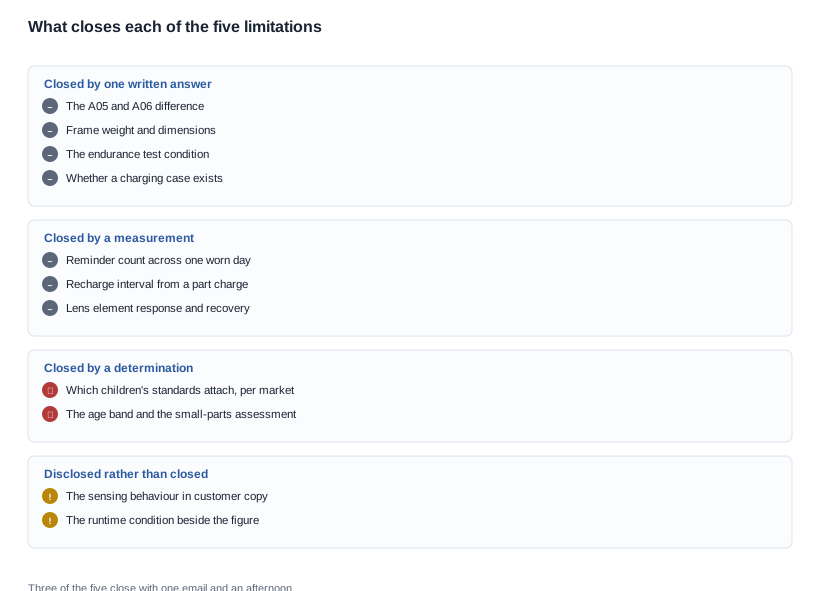
Three of the five close with one written answer and one afternoon with a sample. The twin model question closes with an email. The runtime condition closes with a test protocol. The sizing closes with a tape measure and a scale, and the behaviour closes with a worn day.
The fourth, the certification, closes only with a determination that the buyer's own compliance function owns, and the timeline belongs to the buyer's calendar rather than to the supplier's.
The fifth is the one that can only be disclosed rather than closed, and disclosing it well is a skill worth having. A listing that says the frame's weight is not published, that the sensing thresholds are not specified, and that the certification evidence is held per model and per market is a listing a professional buyer will trust more than a listing that fills the gaps with typical values. The RoHS and REACH guidance and the child product compliance pages set out the general framework that sits behind those disclosures.
The line that will not be crossed for any of them
A product for children, with sensing functions tied to viewing distance and posture, sits close to the edge where marketing language turns into a health claim. No claim is made here about myopia, about vision development or about eye health, for this product or for any other. There is no clinical data behind this, no test protocol behind it, and no regulatory assessment on file, and we will not support a listing that implies otherwise.
That line is not a limitation to be closed. It is a boundary, and the fact that it is permanent is what makes the other four limitations manageable: a buyer who knows exactly where the boundary is does not spend negotiating capital trying to move it.
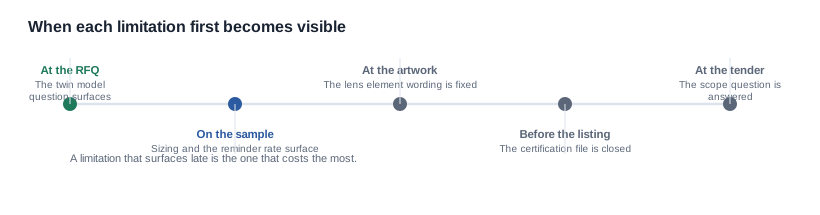
Send us the market, the channel, the age range you intend to serve and the wording you intend to use, and we will tell you which of these five limitations you can live with and which ones should stop the listing.
Related reading
- The published rows behind the five limitations — A05 smart glasses specifications and features
- The range these limitations belong to — kids smart glasses
- What a certificate has to name before it covers your order — certification checks
- Which general safety rules apply regardless of category — RoHS and REACH
- The question a regulator asks first about a children's accessory — child product compliance
Send the market, the channel and the wording you intend to use, and we will tell you what it blocks.


