

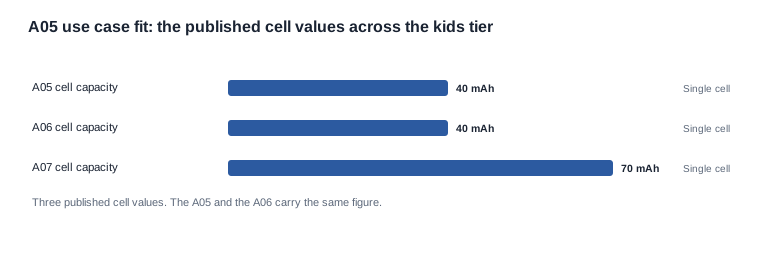
Two models, the same rated runtime, and a cell that is seventy-five per cent bigger on one of them. The A05 publishes a 40 mAh battery, magnetic charging in a time of two hours or less, and a rated runtime of approximately twenty hours. The A07 publishes a 70 mAh battery, the same charge ceiling, the same twenty hours, and Bluetooth V5.4 — a radio version the A05 does not publish at all.
The use case question is therefore not which one lasts longer, because the published answer is that they last the same. It is what the extra capacity is actually buying, and the answer is margin against a heavier load rather than additional hours.
This article works through what a runtime figure is standing in for, which three duty cycles the twenty-hour number does not describe, where the A07's larger cell actually pays off, and the paperwork difference that the radio row creates even though it changes nothing in the hand.
Where the extra thirty milliamp hours actually go: the A05 and the A07
The inference that settles the whole comparison is arithmetic, and it is worth stating plainly because it is the thing a comparison chart hides.
A cell that is seventy-five per cent larger, producing an identical published runtime, can only mean that the runtime is describing something other than the battery. If the runtime were a property of the cell, the larger cell would produce a longer day. It does not. So the published hours are describing a duty cycle: a product that spends most of its time asleep, wakes periodically to sample a sensor and sound a reminder, and sleeps again.
The consequence follows directly. The published hours will not move when you change the cell, and the extra thirty milliamp hours are not a longer day. They are a wider margin against a heavier day.
That is a real engineering difference and it is invisible in any comparison table, because a table that plots the two models against each other shows two bars of identical length and lets the reader conclude that the two are equivalent on power. They are equivalent at the published duty cycle. They are not equivalent at a heavier one, and the difference between those two statements is the whole buying decision.
The only number that transfers between the workloads
There is exactly one published quantity that carries across from one duty cycle to another, and it is the cell capacity. Everything else in the published row — the twenty hours, the two-hour charge ceiling — is a statement about a workload that has not been described.
This is the practical heart of the comparison. If your product brief puts the device into a heavier duty cycle than the one the rating was measured at, the cell capacity is what tells you how the two models will separate, and it separates by the capacity ratio. Seventy milliamp hours against forty is a factor of one and three quarters. We publish no measured hours at a heavier duty for either model, so we will not quote you a figure that would have to be derived, and what we will say is this: the ratio of the cells is published, the workload behind the rating is not, and a buyer who needs the second one should ask for it.
The same logic applies to the charge ceiling, and it is a caution as much as a reassurance. Two hours or less is a ceiling on a forty milliamp cell and on a seventy milliamp cell alike, and a larger cell does not turn it into a shorter charge. If your operation charges overnight and collects in the morning, the ceiling is satisfied by both models and the difference between them does not appear in your schedule at all.
What the cell difference does to the commercial conversation
The thirty milliamp hours are not a line on a quotation. They are an input to a decision about how long the product is expected to last between charges, and that decision reaches the commercial terms in three places.
It reaches the order minimum, because a device that has to be collected and recharged during a working day is a logistics problem rather than a product problem. If the routine involves a case that travels with the child, the number of units in circulation is higher than the number of units in stock, and that has to be modelled in the order quantity rather than discovered later.
It reaches the warranty exposure, because a product that runs out of charge at a predictable point in the day generates a specific and very common support case: the parent reporting a dead unit. The seating behaviour of the magnetic interface and the visibility of the charge state both bear on that, and neither is published for either model in this tier, so they are sample questions rather than document questions.
It reaches the channel's expectation, which is the one that costs the most when it is wrong. A listing that says twenty hours will be read as twenty hours of continuous use by every adult who reads it and by the customer support line that answers for it. The figure is defensible as a rating and indefensible as a promise, and the way to keep it defensible is to state the condition next to it.
None of this makes the larger cell a decision on its own. It makes the workload decision, and the workload decision is the one that should be settled before a unit price is discussed.
How to write the twenty hours into a specification
A rating that is quoted without its condition becomes a claim, and a claim that a customer can disprove becomes a returns driver. There are three ways to write the figure so that it stays defensible.
Write it as a rated figure under a stated condition — "about twenty hours of rated use under a standby and detection duty cycle" — so that the number carries its qualifier everywhere it appears. Write the charge time as a ceiling rather than as a target, in the form "two hours or less", which permits exactly two hours and does not assert the stricter bound that "under two hours" would assert. And state the condition that you have actually established, so that the listing carries your measurement rather than only the rating.
On a specification sheet going out to a channel, the third point is what protects you. If you have measured the runtime at your own reminder interval, quote your figure alongside the rated one, and put your measured condition into the purchase order as an acceptance criterion. That single clause converts an open technical question into a contractual one, and it is the most useful thing a buyer can do with a rating that does not describe its own workload.
What the two models are each optimised around
The A05 is built around a sensing workload. A lens-type electronic fogging element, posture detection and distance detection, a 40 mAh cell, magnetic charging, and a rated runtime of about twenty hours at a light duty. The A07 is built around an audio workload: an open-ear speaker, a 70 mAh cell, Bluetooth V5.4, magnetic charging, and the same twenty-hour rating at an audio duty.
Those are different products with the same headline, and the headline is the only thing they share. A buyer who compares them on rated hours is comparing two answers to two different questions and reading them as one.
Reading a twenty-hour rating that survives a cell change
Before you use the twenty-hour figure for anything, it is worth establishing what kind of number it is, because the same string means different things in different parts of a supply chain.
It is a rating, not a measurement of your use case. No test condition is published for either model: not the starting state, not the reminder interval, not whether the device was connected to a phone, not the ambient temperature. Every one of those changes the result, and a rating without conditions cannot be converted into a guaranteed runtime for a programme.
It is also a ceiling in the workload sense, not just in the time sense. Twenty hours describes how long the duty cycle in question can run before the cell is exhausted. Extend the duty cycle — more frequent reminders, a longer radio-on stretch — and the same twenty hours becomes a shorter calendar period.
There is a third point, which is a warning about comparisons across model families. Our audio models publish between six and eight hours on cells of 55 mAh, 70 mAh, 90 mAh and 100 mAh configurations, because an open-ear speaker drawing audio draws a different current profile from a frame that mostly sleeps. Neither number is wrong, and putting the twenty-hour figure next to a six-hour figure in a spreadsheet is comparing a sleep test with a playback test. The same caution applies to the charge ceiling: two hours or less on either cell is a ceiling, and neither one states the starting state, the charger or the temperature.
The three questions to ask before you rely on the figure
The first is what the reminder interval was during the measurement, and it is the single most useful number you can obtain for this category, because it is the variable the published rating does not describe. The second is how many hours the product lasts at the interval your own application will actually use, because that interval is a decision your brand makes rather than one the hardware imposes. The third is whether the figure is a mean, a typical case or a best case, because a best case is the one that gets quoted and the mean is the one that generates the complaints.
All three are answerable, and none of them is in our catalogue. The battery specification guidance sets out the wider set of power questions worth putting in writing.
Three duty cycles the twenty-hour figure does not describe
The figure describes one workload. Your product probably describes a different one, and the difference between those two is where the buying decision actually sits.
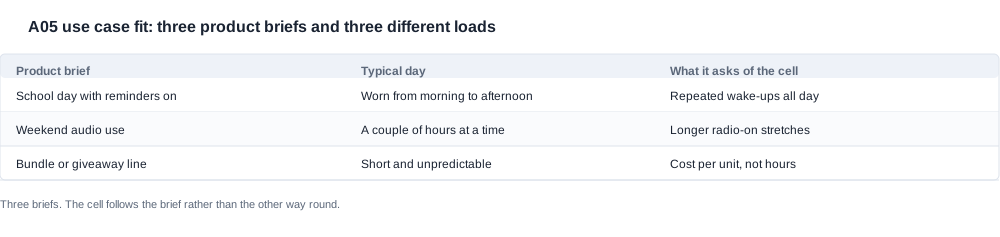
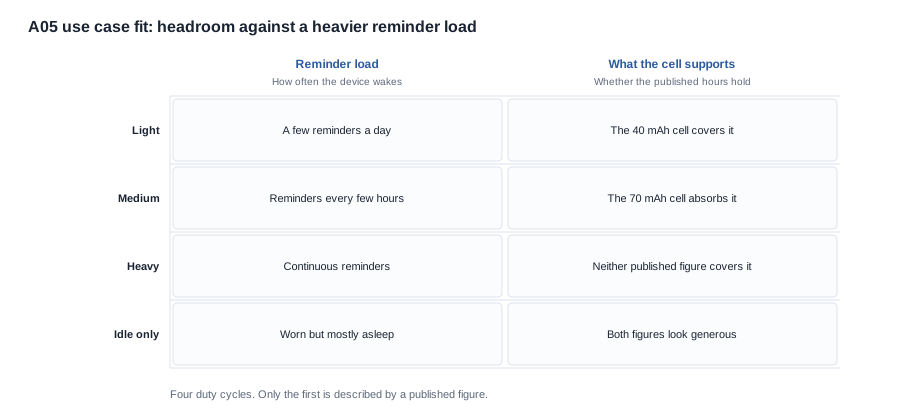
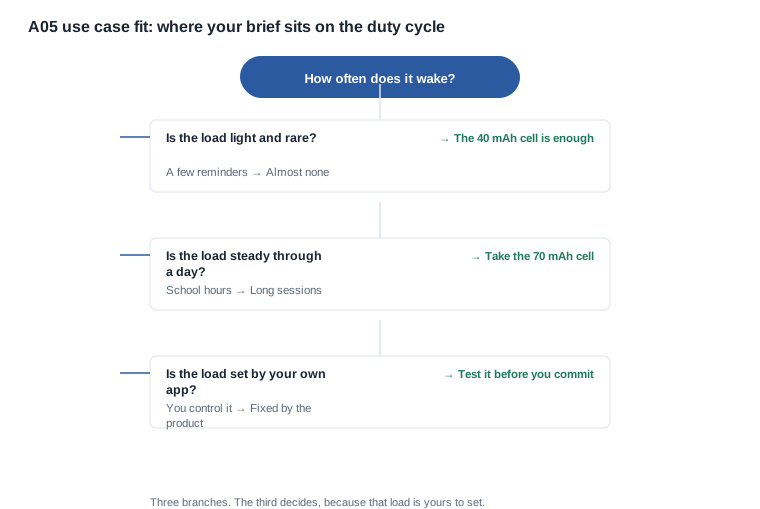
A child who uses the product continuously through a long day with reminders switched on. This is the brief that the A05's published specification was built for, and it is also the brief where the duty cycle is heaviest. Every reminder is a burst of current, and the frequency of those bursts is precisely the variable the twenty-hour figure does not describe. A seventy milliamp cell gives roughly seventy-five per cent more headroom for that pattern, which on a busy day can be the difference between a product that survives the session and one that does not.
A product used intermittently. Morning on, afternoon off, a couple of hours at the weekend. The forty milliamp cell is entirely adequate for that pattern, and it is the smaller bill of materials, which matters in a bundle or a giveaway line where the unit cost is the deciding number. This is the one situation in which the smaller cell is the better commercial answer, and it is worth saying so plainly rather than treating the larger cell as universally better.
A product whose reminder frequency is set by your own application. This is the interesting one, because it turns the workload from a hardware property into a decision you make in the software. A product designed to remind more often needs more headroom, and the forty milliamp cell has less of it. Before you commit, establish what the reminder frequency does to the runtime, because you are the one who sets the variable that the rating does not describe.
How to choose between the two cells without guessing
The practical method is to reduce the decision to one number you control and one number you have to obtain. The number you control is the reminder interval, because your application sets it and you can change it. The number you have to obtain is the measured hours at that interval, because no published row contains it.
Work from the interval. Take the interval your product brief implies — a school session, a homework evening, a weekend block — and write down how many reminders that implies. Then ask the supplier for the measured hours at that interval, and ask for the figure on the same footing as the rating: is it a mean, a typical case or a best case. Finally, apply the cell ratio as a sanity check rather than as a quote. Seventy against forty is a factor of one and three quarters, and if the supplier's measured figures at a heavier interval do not separate by roughly that factor, one of the two sets of numbers is being measured under a different condition, and that is worth finding out before you order rather than after.
Two pitfalls are worth naming, because both are common in this category and both cost a programme. The first is comparing a figure at your interval against a rating at theirs, and concluding that the larger cell is better or worse than it is. The second is treating the reminder interval as a hardware property when it is a software decision, which leads a buyer to order for a workload they never intended to ship.
The case question sits underneath all three
None of the three briefs is settled by the cell, because the cell only decides how long the device lasts between charges, and what happens between charges is a function of the charging setup. Neither the A05 nor the A07 publishes a charging-case capacity, and the catalogue does not publish a charging-case row for either model in the children's tier. That is an open item with commercial weight: a case determines the carton, the freight class and the weekly routine of the end customer, and it is one of the items most worth having in writing before the packaging is designed.

The radio difference that shows up on paper rather than in the hand
The A07 publishes Bluetooth V5.4. The A05 publishes no Bluetooth row at all — not a version, not a protocol class, nothing that can be copied into a specification sheet.
The consequence is entirely on the paperwork side, which is why it is easy to overlook and also why it has commercial weight. A brand using the A07 can write a compatibility statement, a device connection instruction and a support script directly from published rows. A brand using the A05 cannot, because there is no published radio version to write. Every one of those three documents has to be sourced from the supplier instead of transcribed from a catalogue, which makes them lead-time items on a launch schedule rather than a day's work.
There is a second-order effect worth checking before you rely on a specification sheet. Where a radio identifier appears in a technical file or a conformity document, it is normally tied to the model designation, and a document that names the A05 does not automatically cover a different designation. Since the A05 and the A06 publish identical rows and our documentation does not state what separates them, that question is live for both models. The A05 and A06 specification comparison sets out the detail.
This is also the point at which the A05 and the A07 comparison becomes genuinely straightforward. Those two models are clearly different on the published rows — a different cell, a different radio position, a different feature set — which makes them a far easier pair to build a two-model range around than the A05 and the A06 are.

How to measure the margin yourself
The measurement is not difficult and it is the only way to close the gap the catalogue leaves. Ask the supplier what reminder interval the twenty-hour rating was measured at. Ask for the measured hours at the interval your own application will use. Then run both on the sample for a full day and log the wake-ups. Compare the logged result against the published figure and keep both numbers — your measurement next to ours is the only honest way to argue about hours, and it is what lets you set your own interval in the purchase order as an acceptance criterion rather than as an assumption.
What the use case decision does not settle
Choosing between these two models on workload grounds is a sound decision, and it is also a partial one. Four things stay open whatever you conclude about the cells.
The detection behaviour of the A05. The thresholds, the sensing range, the reminder interval, the trigger logic and whether the child can dismiss a reminder are all unpublished. A brief that depends on how the detection feels in use cannot be closed from a data sheet.
The lens element's performance. No mechanism detail, no response time, no power draw and no cycle life is published for the lens-type electronic fogging element. The catalogue's own illustration contrasts a clear lens against a fogged one, which tells you the lens state is visible to the user and therefore something that will be photographed in a returns case.
Everything physical. Frame weight, temple length, lens dimensions, a detachable temple specification and an ingress rating are not published for either model, and the frame profile is what decides the age band and the return rate.
The commercial terms. The order minimum, the lead time, the unit price, the charging-case capacity and the certification scope are not published for either model. The catalogue carries a company-level export certification page whose content is images rather than text, contains no per-model certification row, and mentions no CE, FCC or RoHS marking anywhere in its text, so a certification position for either model has to be requested in writing. The checklist of questions to ask is short, and it is worth sending as one list rather than in stages: the radio version for the A05, the reminder interval behind the rated figure for both models, the measured hours at your own interval, the charging-case capacity, the frame weight and dimensions, the ingress rating, and the certification scope per market.
The total cost trade-off between the two cells
The larger cell is not free, and the trade-off a buyer should evaluate is not the cell but the total cost of the programme at the workload you intend to ship. A seventy milliamp cell raises the bill of materials, and depending on the case configuration it can raise the carton and the freight class with it. The forty milliamp cell is cheaper and lighter, and if your duty cycle is light it is also sufficient, which is a perfectly good reason to choose it. What is not a good reason is choosing it because a runtime figure made the two read as identical on a page.
The comparison that should reach your desk is therefore: the measured hours at your interval for each model, against the total landed cost per sellable unit for each model, against the operational cost of the charging routine each one implies. Those three numbers come from a sample stage and a quotation, not from the catalogue, and the moment you have all three the decision is short.
On this comparison, our position is that the thirty milliamp hours are margin and that we will not present them as additional hours on a listing. A product page that says the A07 lasts longer than the A05 is making a claim the published data does not support, because they publish the same twenty hours. What we will tell you is which model has the headroom, what the headroom is for, and what the reminder interval is actually standing in for — and we will not convert a sensing feature into a vision, health or prevention outcome for either model, because a posture and distance reminder is a behaviour prompt and we hold no clinical data for this category. The boundary is set out in our medical boundary guidance.
Send us the reminder interval your product would use, the target markets, the volume, the channel and the age range, and we will come back with the availability picture, what the published figures cover, and what still has to be measured on a sample.
Related reading
- How the twenty hours is reached — battery life for kids
- The model with the published radio version — A07 smart glasses best for
- What is not published for the other model — A06 limitations
Give us the reminder interval, the volume, the channel and the age range, and we will say which figures the published rows cover and which still need measuring.


