
A limitations article for a children's wearable is not a list of missing numbers, and treating it as one would be a mistake. The published rows for this model are a 40 mAh cell, a charge time of two hours or less, a rated runtime of about twenty hours, magnetic charging, and a lens-type electronic atomiser with correct and incorrect posture-and-distance states and clear and fogged lens states. On paper that is a complete, workable product. The limitations are all in the evidence rather than in the specification, and they divide into three groups that need completely different responses — one group closes with an email, one closes with a sample, and one closes only with a test programme whose schedule is measured in months.
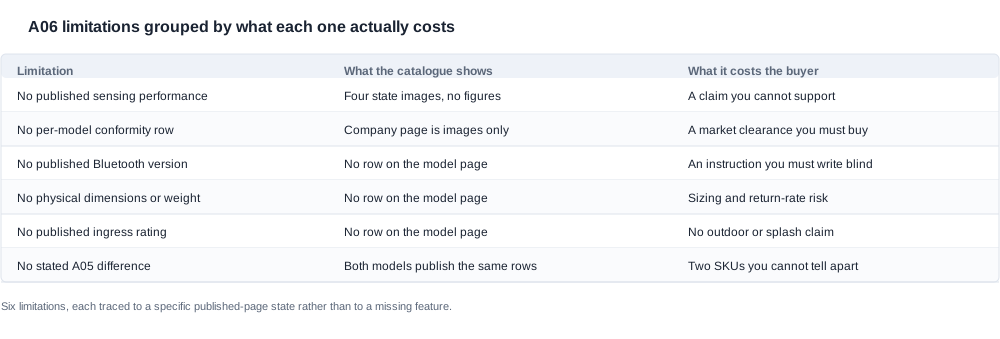
The table above traces six limitations back to a specific state on the model page rather than to a vague weakness. That distinction matters commercially, because a buyer who treats all six as one problem will either over-invest in the two that close with a request, or under-invest in the two that need a laboratory.
A06 smart glasses limitations, sorted by what they cost
Two limitations that are not limitations
"The battery is only 40 mAh." It is the smaller of the two children's cells, and it is paired with a twenty-hour rating. The A07 publishes a 70 mAh cell and the same twenty hours, and that is the proof: a cell seventy-five per cent larger producing an identical figure means the runtime is describing a light duty cycle with long idle periods, not a battery property. The twenty hours is the longest rated runtime published anywhere in our catalogue, and it is not limited by the cell. What it does not mean is twenty hours of continuous active operation, and that is a listing-wording problem rather than a product limitation.
"There is no charging case." No model in the children's range publishes a case, so this is a category position rather than a defect. For a product that goes on and off once a day, a dock on a bedroom shelf is the charging story, and a case in a school bag is a large object for a child to carry. The question to ask is whether a case is available at your quantity, not whether the absence is a weakness.
There is a third assumption worth naming because it is the most expensive one to hold: "the runtime figure means the product is good." It does not follow. The figure is published without its test condition, so it cannot be compared with a competing product's figure and it cannot support a durability claim. It is a number you can quote and a number you cannot yet rely on. The A06 battery life analysis covers this in more detail, and it is worth reading before anyone puts a comparative endurance claim into a listing.
The limitation that is genuinely a limitation: no per-model conformity row
What our catalogue holds on certification is one export page at company level, and the material on it is images rather than text; the catalogue text omits CE, FCC and RoHS, and nothing is published as a per-model certification row. That page also carries ten patent certificates — eight appearance-design patents and two utility-model patents — which are evidence of design ownership, not of market conformity, and which cannot substitute for an assessment in any destination market.
This is a commercial limitation, and it is the one that decides whether the product can be sold at all. Children's products carry additional requirements in most destination markets, and those requirements determine the test programme, which determines the cost and the schedule. A brand that resolves this before anything else has a project; a brand that resolves it last has a shipment it cannot clear. The child product compliance guidance sets out the framework, and our durability notes cover why the test programme is also the route to durability data.
It is worth being precise about the nature of this gap. It is an absence of a published row, not evidence of a failure. We are not telling you the A06 cannot be certified; we are telling you the catalogue does not carry the evidence, and that the evidence has to be produced before the product goes on sale in a market that requires it. A per-model file also has to name the model you are ordering, which is why the second limitation below has to be closed first.
The limitation that is real but closable: how the published states perform
The published feature set is described on the model page with four labelled state illustrations — correct posture and distance, poor posture and distance, lens clear, lens fogged — and not one of them has a performance figure attached to it. For the atomiser: no mechanism detail, no power draw, no activation trigger, no response time, no cycle life. For the posture and distance indication: no accuracy, no range, no reminder interval, no trigger logic, and no description of whether the wearer can dismiss a reminder.
For a product whose entire proposition is a behaviour indication, an unquantified indication is a real limitation on the listing — you can describe what it does, but you cannot describe how well it does it. It is closable with a sample and a child, and the A07 buyer checklist is the question list that works for this family.
The same applies to durability. No drop rating, no ingress rating, no hinge cycle figure, no material specification and no weight is published for this model. The frame has to survive a child, the indication has to survive a knock out of alignment, and the optical assembly has to survive a scratch — three separate failures that a single drop test would not catch. A model without a published ingress rating is a model that cannot carry a splash or outdoor claim, and that is a limitation of the copy rather than of the hardware.
The limitation that is a documentation gap: the model identity
The A06 and the A05 publish identical specifications in every row, and our catalogue states no difference between them. This is the third model in this range with an open identity question of some kind — the A05 against the A06, and the LC-105-1 against the LC-105-2 in the audio range.
It is a documentation gap rather than a product limitation, and it is closable with one question. But it has a cost if it is left open: a SKU you cannot describe, a catalogue that carries two products the customer cannot tell apart, and inventory you are paying to hold for no reason. It also propagates: a conformity file for one sensing model does not automatically cover the other, so a range that carries both carries two assessments unless the difference turns out to be a packaging variant.

The limitation that is a commercial gate
There is one limitation here that outranks all the others, and it is not a specification gap. It is the gap between what the catalogue publishes and what a distributor, a retailer or a marketplace will ask for before they will stock the product.
The published set is short and internally consistent. The buying organisation's set is long and specific: a per-model conformity file with numbers a compliance team can look up, a statement of which markets the file covers, a battery transport document for the fitted cell, a packaging and labelling specification for the destination market, a warranty position, and an aftersales process that names a contactable party. None of that is on the model page, and most of it is not on any page in our catalogue.
Three consequences follow, and they are the reason this gap is a gate rather than an inconvenience.
Schedule. The conformity file and the child-product assessment sit on the critical path. Every day they are outstanding is a day the launch moves, and the launch date is not something a buyer can negotiate with a factory.
Scope. The markets that can be entered without a new file are the markets you can launch in. In a category like this, that list is usually shorter than the one a buyer assumes, and the difference is decided by documentation rather than by hardware. A buyer who discovers the scope restriction after artwork is approved has artwork for markets it cannot ship into.
Cash. The assessment cost is a fixed cost per product family, and it is paid whether or not the model sells. The right sequence is therefore: settle the range structure first, because a range change after the assessment invalidates it, and then commission the file for the models that will actually ship.
The practical instruction that follows from this is short. Do not send the compliance question last. Send it in the first week, with the market list attached, and ask for the answer per model designation. The certification checks page sets out what a verifiable document looks like as opposed to a claim in an email, and the export considerations covers the paperwork a buyer will meet on the way in.

Closable gaps and the cost of closing them
The useful thing about a limitation is that most of them have a closure route, and the route determines the cost. The three routes below are worth keeping distinct because conflating them is how programmes overrun.
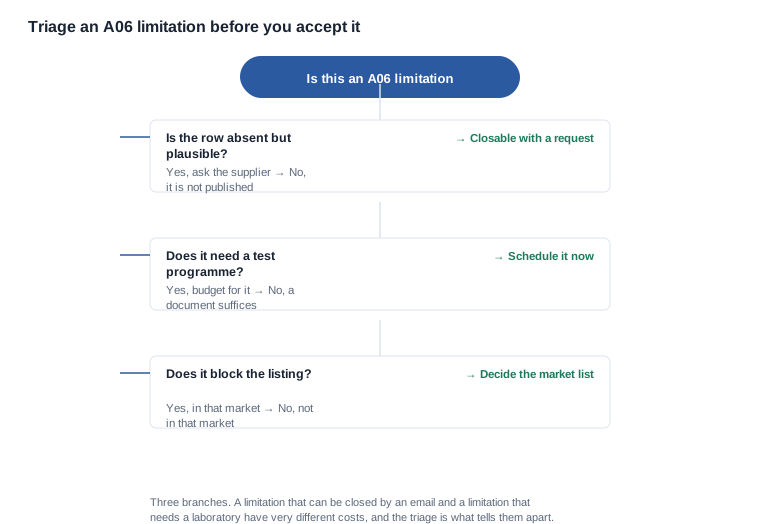
Request, measurement, and test programme are three different budgets. A request is an email and a waiting period. A measurement is a sample, a protocol and a week. A test programme is a schedule, an invoice and a dependency on the market list. When a limitation is accepted without knowing which of the three closes it, the estimate that goes into the plan is a guess.
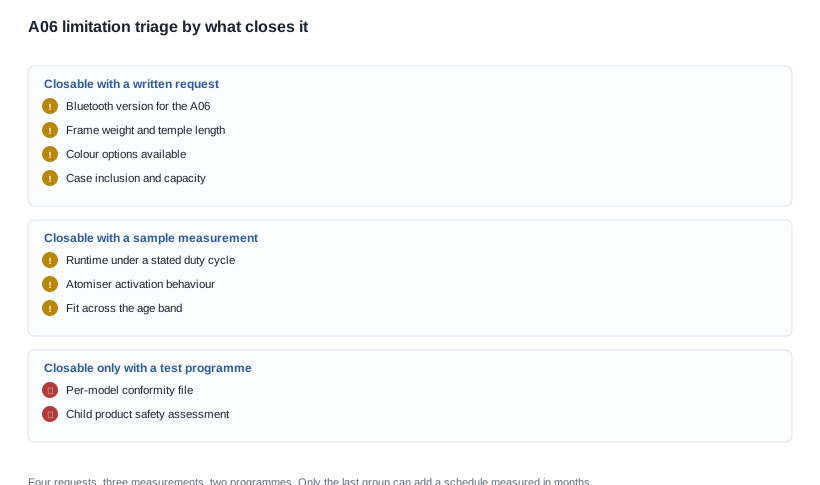
The checklist above separates the A06's open items into exactly those three groups. Four items close with a written request: the Bluetooth version, the frame weight and temple length, the available colour options, and case inclusion and capacity. Three close with a sample measurement: the runtime under a stated duty cycle, the atomiser's activation behaviour, and how the frame presents across the intended age band. Two close only with a test programme: the per-model conformity file and the child-product safety assessment, and these are the two that determine whether the product can be listed at all.
The one that closes fastest is the one with the widest commercial reach. The A05 versus A06 difference costs one written answer and unlocks the range structure, the packaging decision, the artwork and the certificate naming. If you close only one item in this whole article, close that one.
A worked example: one model, four markets
This is a hypothetical scenario rather than a client programme, and it is written to show the sequence rather than to report a result.
Assume a brand planning a single kids model for sale in four markets: two that require a per-model conformity file, one that requires a child-product assessment before listing, and one where neither applies but where the retailer still asks for documentation. The published rows for the model are complete enough to write a specification sheet from, and the buyer has a launch window of about ten weeks.
Step one is the range, not the file. The brand has two sensing model designations in consideration and the catalogue publishes the same rows for both. If it commissions a file for one and the range later changes to the other, the assessment has to be redone. So the brand asks the identity question first, gets a written answer that the two differ by a lens option rather than by any electrical or functional change, and confirms that the file has to name each designation separately regardless. That takes a week and it protects the assessment that costs far more.
Step two is the market list, not the order. The two markets that require a per-model file and the one that requires a child-product assessment determine the earliest possible listing date. The brand puts those three markets first in its launch plan and treats the fourth, where neither applies, as the market where the product can go live first while the assessments run. That is a decision the published catalogue cannot make for the buyer and the buyer can make for itself, and it is worth more than any negotiation on unit price.
Step three is the copy, written against the closed set. The listing describes the atomiser and the posture-and-distance states as published, quotes the cell, the charge ceiling and the rated runtime as published, and says nothing about detection accuracy, ingress, weight or durability because none of those are closed. A retailer who asks for a drop rating gets the honest answer that the figure is not published, and the brand can offer to have it measured on the sample units rather than inventing one.
Step four is the sample, used for the three things a sample can settle. The runtime is measured under a stated duty cycle. The atomiser's activation behaviour is observed under normal indoor light and recorded as an observation rather than a specification. The frame is measured for weight and temple length and the results go into the technical file for the retailer.
The result of that sequence is a launch in one market inside the ten weeks, a documented plan for the other three, and a copy that makes no claim the evidence does not support. The decisive decisions were all made before the sample order, and none of them was about the unit price.
What a closed gap is worth
A closed gap is worth more than the answer it produces, because it changes what the buyer can commit to. Take the runtime as the example. A published figure with no test condition can be quoted in a comparison sheet and cannot be written into an acceptance criterion, a warranty condition or a retailer agreement about expected performance. Once the condition is supplied — what was active, what was idle, the reminder frequency, the number of units, whether the figure is a mean or a best case — the same number becomes usable in all three places. The number did not change; its status did.
The same applies to the physical rows. Frame weight and temple length published as numbers let you size the product against an age band and predict a return rate. The same two items as "not published" leave the buyer with a sizing assumption and a returns exposure they cannot quantify. This is why a limitations discussion should end with a closure plan rather than with a list. The A06 specification reading sets out the same point row by row, and the A06 value analysis shows what the unclosed items cost in the total programme.

Turning a limitation into a closed item
The mechanics of closing a gap are unglamorous and they are the difference between a limitation that reaches the customer and one that does not.

Name the limitation as a specific missing row, not as a general weakness. "The Bluetooth version is not published for the A06" is a requestable item. "The documentation is thin" is a complaint. The first version can be answered in a sentence and tracked; the second cannot.
Decide whether the row is absent from our documentation or absent from the product. These are different problems with different fixes, and the catalogue gives no basis for assuming either. A row that is missing from the page may be available on request; a row that does not exist at all will not appear at all. Asking the question is cheap and the two answers lead to completely different plans.
Classify the closure route and attach it to a date and an owner. A request with no date is a wish. A measurement with no protocol produces a number you cannot compare with anything.
Then re-test the listing copy against what has actually been closed. This is the step that catches the failure mode where a specification sheet and a product page drift apart, and it is where a limitation either disappears from the customer's view or survives it.
The failure mode this process prevents
The characteristic failure in this category is not a bad product. It is a good product whose copy was written from the feature description rather than from the closed evidence, shipped into a market that then rejected it, a listing that was pulled, and a launch date that moved by a quarter. Every step in the flow above is cheap compared with that outcome, and every one of them is skipped by the same reasoning: the gap was assumed to be small.
The gap is never small when the product is for a child. A specification tolerance is a negotiation; a safety requirement is a legal fact. That asymmetry is the reason this article spends more space on the conformity row than on any of the electrical rows.
The boundary we hold on this model
The claims that cannot be made
We make no claim about myopia, vision development, vision protection or eye health for this model, and we hold no clinical data, no test protocol and no regulatory assessment for this category. A product that indicates posture and viewing distance is a behaviour-indication product. It is not a vision product, and a listing that says or implies otherwise is a regulatory problem rather than a marketing one. The boundary is set out in our medical boundary guidance, and the language to avoid is worth agreeing with your legal reviewer before the listing is written rather than after it is live.
We will not estimate a conformity position, a sensing accuracy, a durability rating, an ingress rating or a weight, and we will not describe a difference between the A05 and the A06 that our own documentation has not confirmed. That last point is the one that gets forgotten under commercial pressure, and it is the one that produces the worst outcome: a listing that states a difference a customer cannot find, and a support team with no answer.
What we will confirm is the published set — the cell, the charge ceiling, the rated runtime, the charging method, the atomiser and the four published state illustrations — and we will tell you plainly which open items we can close directly, which need a sample, and which need a laboratory.
Our position is that this is a capable product whose limitations are almost entirely about evidence rather than about the hardware, and that the one limitation which is genuinely about the business — the absent per-model conformity row — should be resolved before the model is chosen rather than after. We would rather name that gap than write around it, and we will not fill an evidence gap with a typical value from the industry, because in this category a typical value is a claim about a child's eyesight.
What we will do is confirm the published rows, tell you which of the open questions we can close for you directly, and say plainly which ones need a test programme or a legal view. If you give us the channel, the target markets, the volume and the age range, we will come back with the rows we can close and the ones that stay open. The family is on our kids smart glasses range page.
Related reading
- The buying situations this model fits — A06 best for
- Why durability and compliance are the same question here — kids durability
- Where the claims boundary sits — medical boundary
Send the volume, the age range, the channel and the target markets, and we will tell you which rows are closed and which are still open.


