

The published charging picture for the A06 is magnetic charging, a 40 mAh frame cell, a charge time of two hours or less and roughly twenty hours of rated use. Four things are absent that would normally accompany that set: the charging-case capacity, what ships in the box, what charge level is permitted for air freight, and whether spare parts are supported. For a children's product, one of those absences matters more than the other three, and it is not the one most buyers start with.
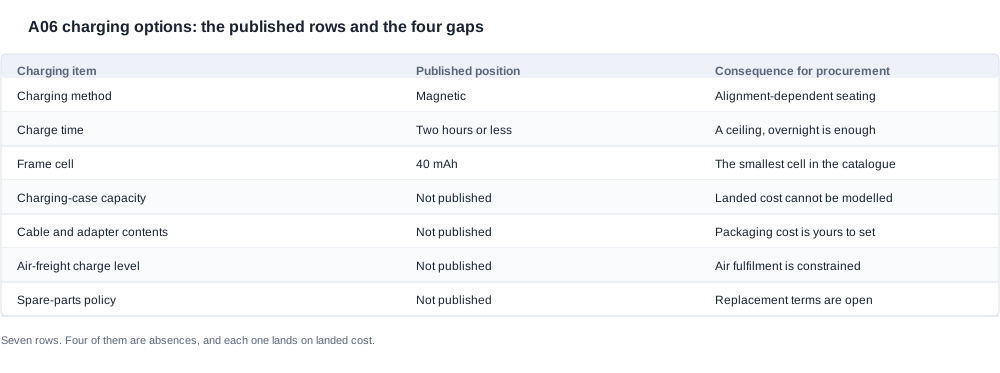
The reason that absence is the important one is that charging is not a feature of this product, it is the product's interface with its own routine. A magnetic seat on a frame worn by a child is a daily action performed by a parent, and the daily action is where the design decisions show. The A06 battery analysis covers the runtime side of the same picture, and this article covers what happens between the cell and the delivered unit.
A06 charging options: magnetic seating and a ceiling on the charge time
Magnetic charging. The frame seats on an interface rather than plugging in, which is convenient, and alignment-dependent, which is the part that has to be checked. A temple seated slightly off can appear to charge while progressing very slowly, and for a product bought for a child that is a usability issue and a returns issue at the same time rather than a minor support detail. It also means one line in the quick-start guide is worth more on this product than on an adult model, because the seating instruction is the difference between a routine and a support call.
40 mAh. The smallest cell in the catalogue, against the A07's 70 mAh. Both rate roughly twenty hours, which is a combination worth asking about directly rather than treating as an equivalence: what does the larger cell in the sibling model do that this one does not, and what does this one trade away to fit 40 mAh into a child's frame? The answer is not published for either model, and the trade is a real one — the smaller cell sits in a frame that also carries a lens-type electronic fogging element and two detection functions.
Two hours or less to charge. That is a ceiling, and the wording matters in a way that is easy to lose in a paraphrase. Overnight charging is sufficient, and a buyer who plans a same-hour top-up is planning something the published figure does not support.
Roughly twenty hours rated. Long for this category, and stated without a test condition. On a product with no camera row and a sensing duty cycle, the figure is more plausible than a comparable camera claim would be, but it is still a rating rather than a measurement, and no starting state, interval or charger is published. The battery specification guidance covers how to write the power rows so that they survive a compliance review.
What the seating method changes about the rest of the product
Magnetic charging is not a detail on the end of a specification sheet. It changes four other things, and each of them reaches the commercial terms.
It changes the pack. A magnetic interface needs a cradle or a case to sit on, and that object has volume, weight and a unit cost. It changes the carton, because a case is a packing decision and packing decisions propagate upward into the carton count, the pallet configuration and the volumetric weight. It changes the charging routine, because a frame that returns to a case in a bag behaves differently from one that has to be placed on a specific cradle every night. And it changes the support script, because the failure mode a parent will report is a flat pair or a mis-seated pair rather than a missing cable.
None of those four is a technical specification, and all four of them land on the same commercial line: the pack. Which is why the pack contents are the item a buyer should push hardest on, and why the first of the four open items below is the one that matters most.

What magnetic charging does to the pack, the carton and the freight
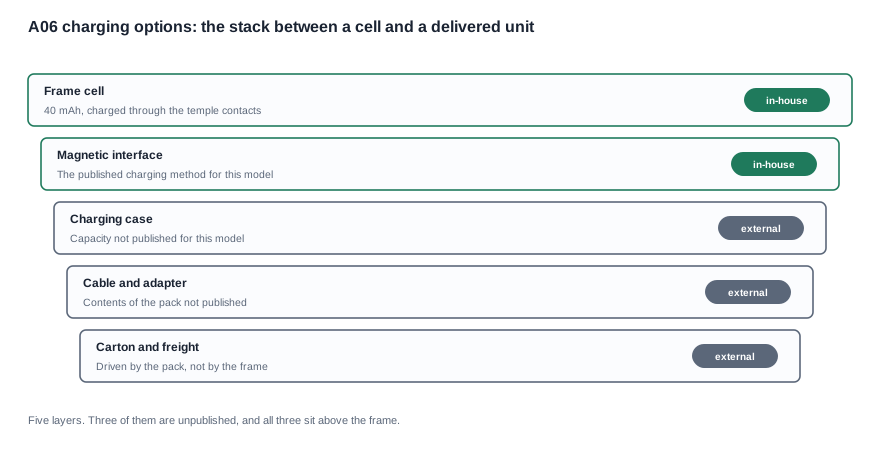
The stack in that chart runs from the cell upward, and the division matters because the two layers at the bottom are ours to describe and the three above them are the supplier's to produce. The cell is 40 mAh and is charged through the temple contacts. The interface is the published charging method for this model. Above that sit the charging case, the cable and adapter, and the carton, and every one of those three is unpublished for this model.
The consequence for a procurement team is that the published charging row describes the bottom of the stack and nothing above it. A buyer who reads "magnetic charging" and stops there has described one layer out of five, and the four remaining layers are where the landed cost, the freight class and the returns rate actually live.
The carton is set by the pack, not by the frame. This is the most common modelling error in this category and it is worth stating plainly. The frame's dimensions are not published for the A06 either, so a buyer who has no case has nothing to model a carton from, and a buyer who has a case has a carton that is largely determined by the case. The carton count per unit, the pallet configuration and the volumetric freight calculation all follow from the pack decision, which is why the pack decision has to come before the freight quote rather than after it.
The cable question is separate from the case question. A magnetic case needs a cable to charge the case itself, and whether one ships, along with an adapter and which plug type, is a packaging cost and a market-compliance choice that has to be made rather than inherited. A buyer entering several European markets inherits a plug-type question that a buyer entering one domestic market does not have.
The volume of the pack is a freight class decision, not a packing preference. Volumetric weight is calculated from the carton dimensions, which are set by the pack, which is set by the charging design. A case that doubles the carton volume does not merely add a case's worth of freight to the order; it moves the shipment into a different freight band, and at volume that difference is a line item rather than a rounding error.

The order in that flow is the order to work in, and it is not the order the questions usually arrive in. The charging method is fixed and published, so it is step one and it takes no time. Step two is the decision that everything else depends on: what charges the interface, because a case and a cable imply different packs, different cartons and different routines. Step three derives the shipping model from that decision. Step four constrains the route. Step five is the commercial term that has to be settled before the artwork is printed, because a replacement-parts policy changes what the packaging promises.
Working the steps in a different order is what produces a landed-cost model that has to be rebuilt. A carton quoted before the case is known is a carton quoted for the wrong product, and the freight figure that came with it is wrong too.
How to build the landed-cost model with four absent rows
The model itself is not difficult, and the four gaps do not make it impossible — they make it provisional, and a provisional model is a tool for comparing options rather than for approving an order.
Start from the unit count and the configuration, because the pack format is per-configuration and the order minimum is per-model. Then build the pack: the frame, the case if there is one, the cable if there is one, the printed materials, and the retail packaging that the channel expects. From the pack, derive the carton dimensions, the units per carton, the carton count per unit and the pallet configuration, and from those derive the volumetric weight and the freight band. Then add the cell's declared watt-hour rating to establish the transport route and whether the consignment can travel by air at all.
The last step is the one that makes the model decision-grade: run the model with the four absent rows left as a range rather than as a single figure. A case capacity between two values, a pack with and without a cable, a route with and without the air restriction. A model with a range tells you which of the absent rows actually moves the answer, and therefore which one is worth spending a supplier call on. A model with a single invented figure tells you nothing, and the invented figure is the one that ends up in the quotation.

The four unpublished items that block a landed-cost model
Each of these four is absent for this model, and each one lands on a number a buyer has to produce before the order can be evaluated.
One, the charging case. Our catalogue publishes no charging-case row for the A06. That means you cannot model shipping weight or landed cost from the published data, and it matters considerably more for a channel shipping to schools or institutions than for a direct-to-consumer order, because the institution is buying a quantity that has to be carried, stored, charged and recovered. A written statement that no case is supplied is just as useful as a capacity figure, because the answer changes the model in a different direction and the model still has to be built. The charging solutions guidance sets out how the case and the pack contents affect landed cost.
Two, the cable and adapter contents. Not published. What ships in the box is a packaging cost and a market-compliance decision that you make rather than inherit, and it is the item most often discovered after the artwork is approved, when the box has already been printed.
Three, the air freight charge level. Not published. A lithium cell raises the transport requirements that UN38.3 testing supports, and the permitted charge percentage constrains e-commerce fulfilment directly: a cell shipped above the permitted level cannot travel by air on that consignment, which is a routing decision rather than a compliance footnote. The battery transport guidance covers the chain, and the declared watt-hour rating of the cell is the number that determines it.
Four, the spare-parts policy. Not published. This one is specific to a children's product for two reasons: the frame has to suit a head that is growing, and returns may travel a long way before they reach you. A product with no detachable temple specification and no published replacement terms is a product whose returns are governed by whatever the default policy happens to be, and that is a cost line nobody has modelled.
How the four interact with each other
The four gaps are not independent, and a buyer who treats them as four separate requests will get four answers that do not reconcile.
The case and the cable are one decision. A magnetic interface needs something to charge it, and the three plausible answers are a case with a built-in cell, a case without a cell that acts purely as a cradle, or a direct cable into the frame. Each of those implies a different pack, a different carton, a different routine for the end customer and a different set of spare-parts questions, because a case with a cell is a product with a second battery in it and a second failure mode.
The charge level and the route are one decision. The permitted charge level for a lithium cell determines whether the consignment can travel by air, and that determines the lead time, the cost and the routing of the whole order. A buyer who has settled the freight method before establishing the permitted charge level has settled a routing preference rather than a plan.
The spare-parts policy and the case are one decision in a subtler way. A case is the object most likely to be lost or damaged, and a supplier that does not support spare cases will convert a small percentage of a large order into returns. In a children's product the percentage is not small, because the case travels with a child.
The practical instruction is to ask for the pack as a single configuration rather than as four separate answers. Ask what the pack contains, what it weighs, what it measures and what it is made of, and ask for the replacement position on each component of it. One question, one answer, and a model that reconciles.
What to ask the supplier, and when
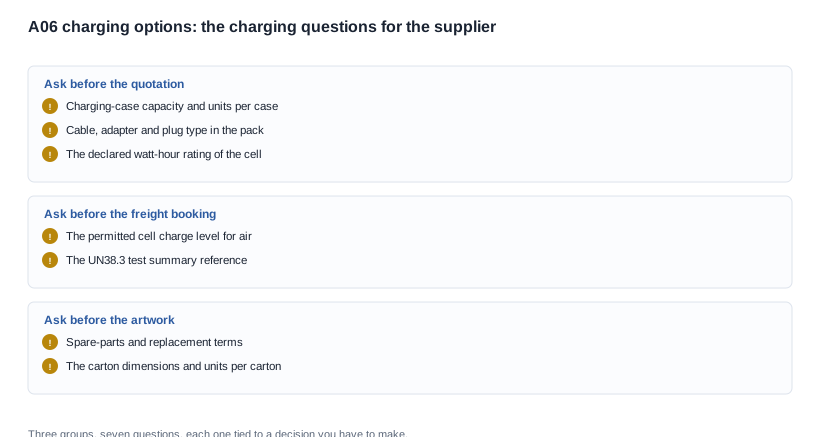
The seven questions in that checklist belong to three moments, and sending them at the wrong moment wastes them. Before the quotation, ask for the case capacity and the units per case, the cable, adapter and plug type in the pack, and the declared watt-hour rating of the cell — these three determine whether the quotation you are about to compare is comparable at all. Before the freight booking, ask for the permitted cell charge level for air and the UN38.3 test summary reference — these determine the route and therefore the lead time. Before the artwork, ask for the spare-parts and replacement terms and the carton dimensions with the units per carton — these determine what the packaging promises and what the shipment weighs.
The reason the ordering matters is that the first group can invalidate the second and third. A quotation that excludes a case is not comparable with one that includes it, and a freight booking made against a carton that was assumed rather than confirmed is a booking that will be re-made.
Putting "two hours or less" on a spec sheet without over-claiming
The charge time is the row most likely to be mangled between the catalogue and a channel listing, and the fix is a single phrase.
"Two hours or less" permits exactly two hours. "Under two hours" does not. The published figure is a ceiling, and the ceiling is what you may assert. Writing the stricter form on a spec sheet asserts something the documentation does not support, and in a category where the product is aimed at children, a spec sheet is a document a reviewer reads carefully.
Three things follow from treating it as a ceiling. An operational plan built on it has to assume the worst case, which means an overnight cycle rather than a same-hour top-up. A customer-facing claim has to carry the qualifier, so "charges in two hours or less" rather than "charges in two hours" — the first is the published figure, the second is a measurement that has not been made. And a warranty clause written on "two hours" would be a clause on a figure nobody has confirmed, so it should be written on "two hours or less from the stated starting state", with the starting state supplied in the same document.
The starting state is the part that most often goes missing, and it is the one that makes the ceiling usable. A ceiling with a stated start is a planning number. A ceiling without one is a claim that cannot be tested, and a buyer who cannot test it cannot put it in an acceptance criterion.
The two questions to ask about the charging method itself
Because the seating behaviour is not published, two questions go into the request. First, how does a correctly seated frame present itself — is there an indicator, a tone, a change in the behaviour of the device, or nothing at all, because nothing at all is a support script you will write later. Second, what is the tolerance on the seating, in words rather than in millimetres, since the answer a support line needs is "it clicks" or "it sits flush", not a dimensional figure.
Neither question is about the charge time. Both are about what happens on the ninety-nine per cent of nights when the child is doing it themselves, and they are the questions that decide whether the charging routine works without an adult in the loop.
The boundary between a charging feature and a care claim
The A06 publishes a lens-type electronic fogging element as an anti-vapouring measure, alongside posture and viewing-distance detection. Both are physical design and sensing features. Neither is a therapeutic effect, and neither may be presented as myopia control or vision protection — we hold no clinical data, no test protocol and no regulatory assessment for this category, and a listing that implies otherwise is a regulatory exposure rather than a marketing decision.
The boundary is worth stating explicitly in a charging article because of a specific temptation. A lens that fogs and clears is a mechanism a buyer will describe in the words "it fogs when the child gets hot and clears again", and the phrase "anti-vapouring" is already close to the edge of the line. The safe formulation is mechanical: a lens-type electronic fogging element that changes the lens state. The claim that is never available is what that change achieves for the child's eyesight.
The same applies to the detection functions, and the practical test is simple. If the sentence would still make sense with "eye health" deleted and replaced by "the behaviour of the device", it is describing a mechanism. If it does not, it is making a claim. The kids eye care technology page and our medical boundary guidance set out where the line sits, and the child product compliance page covers the category obligations that do not depend on any health claim at all.
The charging story here is simple and good, and the documentation gap is what should determine whether you proceed. We will tell you which of the four open items we can confirm today, and we will not convert a sensing feature into a health claim on a product used by children.
Tell us the market, the quantity and the required configuration, and we will say which rows we can answer and which we cannot — and if the configuration you are planning needs a case, a cable or a certification scope that is not in the published material, we will tell you that before the artwork rather than after it.
Related reading
- How the charging design reaches landed cost — charging solutions
- Battery transport before you book freight — battery transport
- The runtime side of the same rows — A06 battery life
Pass the target market, the quantity and the required configuration to us, and we will come back with what is available and what is not.


