
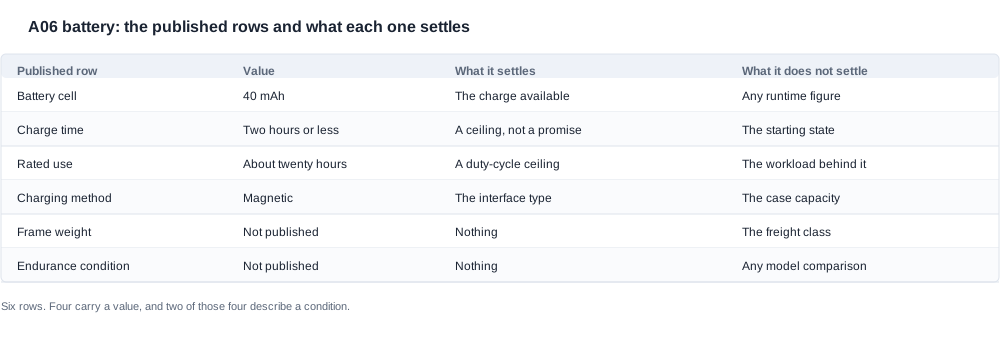
The A06 smart glasses publish a 40 mAh cell, a charge time of two hours or less and an endurance figure of about twenty hours. That last number is the highest published rated-use figure in our catalogue, and it sits on the smallest cell in it. The two facts are not a contradiction, and understanding why is the whole point of this article — because a buyer who takes twenty hours at face value will build the wrong expectation about when the product needs charging, and that expectation becomes a returns problem rather than a documentation problem.
The reading that matters for a procurement decision is this: twenty hours describes a duty cycle, not a shift. It describes how long the product lasts while it sleeps most of the day and wakes periodically to sample a sensor and sound a reminder. It does not describe continuous operation, it does not come with a test condition, and it does not transfer to a heavier workload. This article works through what the number licenses you to claim, why the charging routine rather than the cell sets the weekly pattern, the five numbers the endurance row does not contain, and where twenty hours breaks once the product is in a field.
A06 battery life: reading twenty hours on a forty milliamp cell
Two published facts define the A06's power situation, and it helps to hold them separately rather than letting one explain the other away.
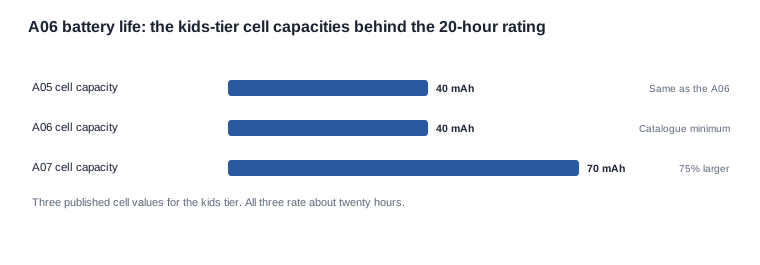
The first is the cell: 40 mAh, the smallest battery published for any model in our catalogue. The second is the rated use: about twenty hours, the highest published figure in it. A smaller cell producing the longest runtime is the kind of combination that invites a buyer to doubt one of the two numbers, and it is worth showing why neither is wrong.
The comparison that resolves it is the A07. The A07 publishes a 70 mAh cell — seventy-five per cent larger than the A06's — together with the same roughly twenty-hour rated use, on a frame that carries an open-ear speaker and no sensing hardware at all. If the runtime were a property of the battery, the larger cell would produce a longer day. It does not. So the runtime is describing something other than the cell.
What it is describing is a duty cycle. A product that spends most of its time asleep, waking periodically to sample a sensor and sound a reminder, draws a very different current profile from one that is processing continuously. The A06's 40 mAh cell is being managed by exactly that profile, and it is why the cell can be small and the published figure can still be high.
Two conclusions follow, and both are useful to a buyer.
The endurance figure is dominated by standby and detection duty, not by processing. Anything that changes the duty cycle changes the real runtime, and the cell capacity only sets the scale of the margin you have. This is the same reasoning that makes the A07 the better choice for a heavier workload, and the A05 and A07 workload analysis works through the ratio.
The figure is not a continuous-use figure. A twenty-hour rating on a 40 mAh cell is not twenty hours of active operation. It is twenty hours of the product doing what it is designed to do — detecting and reminding — while mostly asleep. A buyer who reads it as continuous use is building a customer expectation the product cannot meet, and the expectation reaches the listing, the support line and the returns queue.
Neither number is published with a condition, and that is a category-wide gap rather than a peculiarity of this model. What was running during the measurement, at what interval, from what starting state, at what temperature — none of it is stated, and every one of those inputs moves the result.
What a rated figure lets you claim, and what it does not
The distinction between a rating, a measurement and a promise is the practical difference between a defensible listing and an indefensible one, and it is worth setting out before anything goes on a product page.
A rating is a figure published by the manufacturer under conditions the manufacturer does not specify. It is legitimate to publish and legitimate to quote, provided it is presented as a rating. Our catalogue publishes about twenty hours of rated use for the A06, and you can carry that number to a channel as a rated figure.
A measurement is a number somebody observed under a stated condition. It is stronger than a rating, because it can be repeated and compared. It is also the only kind of number that belongs in a purchase order as an acceptance criterion. If you measure the A06 at the reminder interval your own application uses, on units from the order, then that measurement is yours and you can write it into the contract.
A promise is a number presented without a qualifier. "Twenty hours of battery life" on a product page is a promise, and it will be read as twenty hours of continuous use by every adult who sees it. The number is defensible as a rating and indefensible as a promise, and the difference between the two is a single sentence of qualifying language.
The charge ceiling, and a distinction worth being careful about
The charge time for the A06 is published as two hours or less. That is a ceiling and it should be written as one. Two hours or less permits exactly two hours; "under two hours" does not, because it asserts a stricter bound than the documentation supports. The distinction is small, it is invisible to most readers, and it is exactly the kind of over-claim that a compliance reviewer or a careful channel will find. Our battery specification guidance sets out the wording conventions for the whole power row.
A ceiling also constrains what you can plan around it. Two hours or less means an overnight charge is sufficient and a same-hour top-up is not something you should promise. It does not mean the product is charged in two hours, because no starting state is published.
The comparison warning that applies to every figure in this row
These numbers are not directly comparable with the figures on other models in our catalogue, and the reason is the measurement rather than the product. Our audio models publish between six and eight hours on cells of 55 mAh, 70 mAh, 90 mAh and 100 mAh configurations, because an open-ear speaker drawing audio draws a different current profile from a frame that mostly sleeps. Neither number is wrong. Putting twenty hours next to six hours in a spreadsheet compares a sleep test with a playback test, and a buyer who reads that comparison as a like-for-like ranking will make the wrong selection.

The weekly routine is set by the case, not by the cell
This is the part of the A06's power story that a specification sheet cannot tell you, and it is where the commercial questions actually live.
The A06 charges magnetically. The frame seats on an interface rather than plugging in, which is convenient for a child and convenient for a parent, and it has two consequences that are worth pricing in. The first is alignment: a temple seated slightly off can appear to charge while progressing very slowly, and on a product used by a child that is a support issue and a returns issue rather than a minor inconvenience. The second is what the interface connects to, and our catalogue publishes no charging-case row for the A06 at all.
That absence is more consequential than it looks. A 40 mAh frame that returns to a case in a school bag is a fundamentally different product from a 40 mAh frame that has to be placed on a specific dock every night, and the difference shows up in four places at once. The carton changes, because a case is volume. The freight class changes, because volume drives the freight calculation. The customer routine changes, because the charging action is different. And the return rate changes, because the failure mode a parent reports is different.
If a case is supplied, the case is what actually determines the customer's weekly routine, not the cell. A buyer who has decided the product on the twenty-hour figure and has not established whether a case exists has decided the wrong half of the question. The open items around the charging setup are set out in the A06 charging options analysis.
There is a related point about the unit itself that is easy to miss: the charge state a customer can see. Whether the A06 shows a visible charge state is not published, and it decides whether a flat pair is returned as a fault or charged overnight. That is a returns-control question before it is a feature question, and it is one of the items a sample review has to settle.
The five numbers the endurance row does not give you
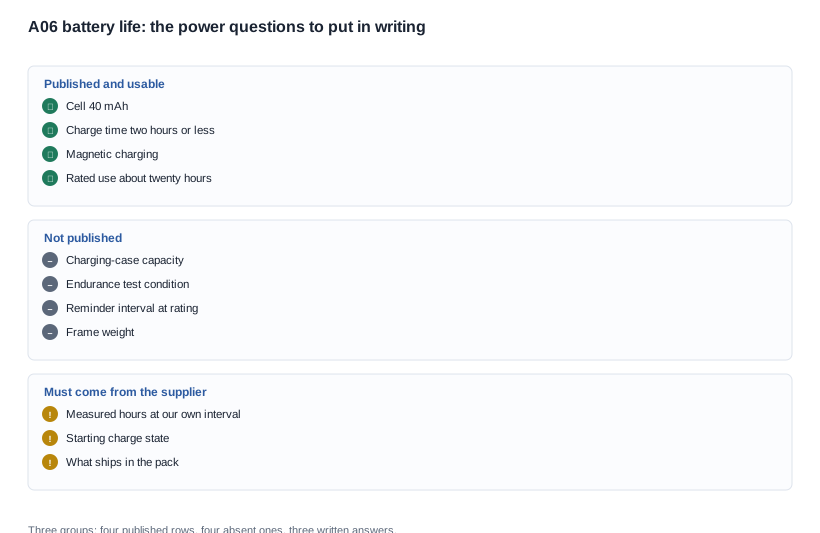
The endurance row is one line on a specification sheet and it depends on at least five other lines that are not there. A buyer who needs the endurance figure to mean something has to obtain all five.
One, the starting state. A charge time of two hours or less describes a charge from somewhere, and the somewhere is not stated. A full charge, a half charge and a flat cell are three different intervals, and the difference between them is the difference between a specification you can plan a shift around and one you cannot.
Two, the reminder interval at the rating. This is the variable that decides whether the twenty-hour figure describes the workload your product will actually run. Our catalogue records the app and firmware customisation capability for this tier as awaiting verification, which means the notification behaviour is a variable to be established rather than a property to read, and establishing it is what makes the interval question answerable.
Three, the charging-case capacity. Not published for this model, and it is the number that converts a cell figure into a routine figure. The A06 specifications and the A05 and A06 comparison both leave it open.
Four, the frame weight. Not published for this model. Across our whole catalogue, one weight is published, and it is the 158 g of the MT6 glasses unit, which is an adult camera model. The A06's weight is not derivable from it, and it sets the freight class, the shipping cost per unit and the fit of the product on a child's face.
Five, the age band and the smallest detachable part. Neither is published for this model, and the age band decides how long the product is expected to be used before it is outgrown, which is a direct input into how many charge cycles a customer will get from a single purchase.
The questions to put in the request, in one list
The five items above convert into a short request, and the request is more useful than a general enquiry because each item names a specific output. Ask for the measured hours at the reminder interval your application will use, and ask whether that figure is a mean, a typical case or a best case. Ask for the starting charge state and the charger used for the published two-hour ceiling. Ask for the charging-case capacity and the number of units per case, or a written statement that no case is supplied. Ask for the frame weight and the temple length with the tolerance. Ask for the recommended age band and the smallest detachable part with its dimensions. Ask for the endurance test condition in writing.
Every one of those is answerable, and every one of them is currently absent from our catalogue for this model.
How to evaluate the endurance claim before you order
The criteria to apply, in order, are these, and applying them takes about the length of one supplier call.
- Is the figure quoted as a rating or as a guarantee? If the supplier's own document uses qualifying language — rated, typical, under stated conditions — you can quote it. If it does not, ask for the condition and, failing that, quote it yourself with the qualifier attached.
- Does the figure carry a condition you could repeat? A repeatable condition names the starting state, the interval and the load. A description does not, and a description will not survive a quality claim.
- Is there a measured figure at your workload? If not, this is the number to obtain, and it is the only one that will decide which model you should buy.
- Is the workload a variable you control? If the reminder interval is set in your own application, you can change it, which makes the question negotiable. If it is fixed in the firmware, the workload is a property of the product and the rating is the only figure you will get.
- Will the supplier accept your measured figure as an acceptance criterion? If they will, the question is closed. If they will not, you have learned something important about how the programme will run.
Those five are the criteria a procurement team can apply to a spec sheet, and they are the difference between selecting a model on evidence and selecting it on a number that was copied between two products. The signs that a claim has been copied rather than established are worth naming too: a charge time quoted as a duration rather than as a ceiling, a runtime quoted without a qualifier, a runtime quoted for a workload nobody measured, a frame weight offered as a range with no source, and a certification status asserted at family level when the documentation holds no per-model row. Any one of those is a reason to go back to the supplier before you order rather than after.
Where the twenty hours breaks in the field
Five failure modes account for most of the discrepancy between a rated twenty hours and a customer's experience, and each of them has a prevention that is available before the product ships.
The flat pair comes back as a fault. The symptom is a return described as "it stopped working". The root cause is that the customer cannot tell a flat battery from a broken unit, because no charge indicator behaviour is published for this model. The prevention is to establish the indicator behaviour on a sample and to write the support script accordingly, because a support script that assumes a fault generates a return, while one that assumes a flat cell generates a charge.
The seating is misaligned. The symptom is that the product charges very slowly despite being left on the interface overnight. The root cause is the magnetic interface being alignment-dependent. The prevention is a sample check of the seating behaviour and an instruction that shows the correct seat position, in the pack rather than on a web page.
The reminder frequency was raised after the rating. The symptom is a product that no longer survives the day, with the rating quoted in the listing as proof that it should. The root cause is that the rating was measured at an interval nobody recorded. The prevention is to write your own interval and the measured hours at that interval into the purchase order, so the claim and the configuration are tied together.
The case never shipped. The symptom is a routine where the product is charged on a specific dock every night, with a returns rate that reflects it. The root cause is that the case was treated as a packaging detail rather than as a product component. The prevention is to settle the case and the pack contents before the artwork is approved.
The figure was carried across models. The symptom is a support line asked about a battery life it cannot explain, because the listing quoted twenty hours and the customer expected the behaviour of the audio models. The root cause is a comparison between two measurements of different workloads. The prevention is to keep the rating next to its qualifier on every surface where it appears.

Measuring it yourself, properly
The protocol is short. Charge a unit to the state the supplier states and record the time taken. Run it in the worn condition a child will experience, not on a bench, with the phone nearby. Log every wake-up and the interval between them across a full day. Repeat on a second unit, because one unit proves very little. Write the condition next to the number and put both into the purchase order as an acceptance criterion.
That last step is what converts a measurement into something contractual, and it is the step most buyers skip. A measurement that stays in a spreadsheet is a fact; a measurement that sits in the purchase order is an acceptance standard, and a lot that fails it is a lot you can refuse.
The twenty-hour figure is a genuine strength of this platform and also the figure most likely to be misread. We will publish it as a manufacturer rating, we will not convert it into a continuous-use claim, and we will not present it as comparable with the endurance figures on the audio models, which are measured under entirely different load conditions. We will not describe the detection functions as producing any vision, health or prevention outcome, and we will not quote a weight, a case capacity or a certification number that the documentation does not contain.
Send us the buyer, the age band and the expected use pattern, and we will tell you which published figures apply as they stand and which have to be confirmed on a sample before they go on a listing.
Related reading
- The data published for this model — A06 specifications and features
- What the charging setup still needs — A06 charging options
- The operating routine — how to use A06 smart glasses
Send us the buyer, the age band and the expected use pattern, and we will say which published figures apply and which have to be confirmed on a sample.


