

The honest answer to a form factor comparison between these two models is that we cannot complete it. Neither publishes a frame weight, a temple length, a lens dimension, a colour option or an ingress rating. There is no documented shape difference to compare, and any article telling you one frame is slimmer, lighter or more child-friendly than the other is describing a product photograph, not a specification.
What the two models do differ on is published, and one of those differences is large enough to matter. The A06 publishes a 40 mAh cell and six feature rows covering a lens-type electronic element, an atomiser, correct and incorrect posture-and-distance states, and clear and fogged lens states. The A07 publishes a 70 mAh cell, a Bluetooth version of V5.4, and no feature rows at all. Both publish a charge time of two hours or less, a rated runtime of about twenty hours, and magnetic charging.
This article is about structure: what the catalogue does publish about physical design across our range, what it omits for this pair, and what the one published number tells you about the inside of the two products — and what it very deliberately does not.
A06 and A07 form factor: the published structure and the published silence
What the catalogue publishes about structure
Physical design is not a subject our catalogue avoids. It publishes it — for a specific set of models, in a specific vocabulary, and on the same page as the electrical rows. That is worth establishing first, because it changes what the silence in this pair means.
The vocabulary is small and consistent. Across the camera group, the V06 publishes an ergonomic design line, a removable inner frame and an IP54 waterproofing line, alongside a four-colour row. The S7 publishes an ergonomic design line, a 13-megapixel line, a removable inner frame and an IP54 line. The V03 Pro publishes a flexible temple line, a photochromic lens line and a Type-C charging port line, with a three-colour row. The MT6 publishes a portability line, an ultralight line, the 158-gram figure and a folding charging case line. The G07 publishes an ultra-slim and removable temple line. The YK12 publishes a slim temple line. These are ordinary, physical, product-specific statements about how a thing is built.
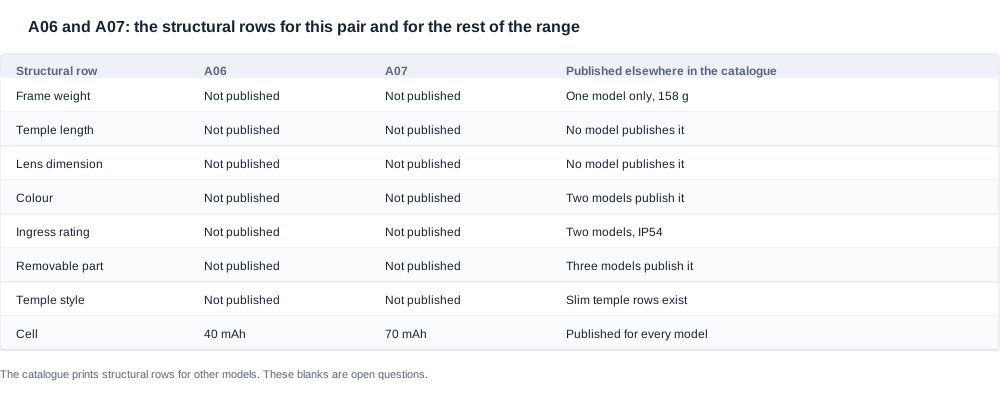
The distribution is what makes them useful. An ingress rating appears on exactly two models. A colour row appears on exactly two. A temple or inner-frame structure row appears on exactly four. The entire kids family — the A05, the A06 and the A07 — carries none of them. The A07 is the only model in the family that publishes any row beyond the five standard ones, and that row is a radio version, not a structural one.
What is published for these two models
For the A06: six feature rows, four electrical rows, and nothing about the physical object. The six feature rows describe a sensing arrangement — a lens-type electronic element, an atomiser, a correct posture-and-distance state, an incorrect posture-and-distance state, a clear lens state and a fogged lens state. None of them is a dimension, a material, a weight or a mechanism specification.
For the A07: five standard rows and a radio version, and nothing about the physical object either. The catalogue's product name designates the A07 as a kids smart audio glasses model, which tells you the product idea, and it publishes no further feature rows behind that name — no driver description, no acoustic descriptor, no microphone count, no control row.
Both models publish a cell, a charge time, a runtime and a charging method. The A06 publishes 40 mAh. The A07 publishes 70 mAh. That is the entire measurable difference between them.
And both models publish the same seven absences. No frame weight. No temple length. No lens dimension. No colour. No ingress rating. No recommended age band. No cell count.
The six models that do carry structural rows
The table above makes the pattern checkable rather than asserted, and it is the most useful single thing in this comparison. A buyer who wants to know whether the missing rows for the A06 and the A07 are a product limitation or a documentation position does not have to guess: the same catalogue prints structural rows for other models, in the same product family, using the same vocabulary.

The request sequence matters because the rows arrive in a usable order. A removable or flexible temple answer determines whether a replacement part is a stock line. A weight answer determines whether the sizing is a guess or a specification. An ingress answer determines whether the listing can make an outdoor claim at all. Each of those unblocks a different downstream decision, and the sequence above is ordered by how much work each answer unblocks.
A06 form factor: what a 30 mAh cell difference does and does not reveal
The cell gap, measured
The gap is thirty milliamp hours — the A07 publishes seventy, the A06 publishes forty. That is a ratio of one and three quarters, on a published basis, and it is the largest measurable difference between the two models.
It is the largest difference and it is not a form factor. This is the point most comparisons of these two models get wrong. A cell capacity tells you about the power system inside the product, and the power system is one of several things competing for a fixed internal volume. It is not a measurement of that volume, and it is not a measurement of any dimension.
So the temptation to read it as a size difference should be resisted. A buyer who concludes that the A07 is physically larger because it carries a larger cell, or that the A06 is physically smaller because it carries a smaller one, is reading an inference into a row. The two conclusions are not even consistent with each other: a smaller cell inside the same envelope is equally possible, and so is a smaller cell inside a smaller envelope.
Two explanations that fit equally well
Two accounts fit the published rows equally, and the catalogue does not distinguish between them.
The first account is the temple volume budget. The A06 carries a sensing arrangement and its electronics alongside a 40 mAh cell; the A07 carries a larger cell and no published feature rows. On this reading, the A06's cell is smaller because the sensing electronics occupy space that the A07 spends on capacity. This is a coherent design story, and it would predict that the A06 is the physically tighter of the two.
The second account is the duty cycle. The two cells were simply sized for two different intended workloads — a sensing product that spends most of its time asleep and an audio product that spends more of its time drawing current. On this reading, the cell difference reflects the design target rather than the available volume, and it would predict nothing at all about the external dimensions.
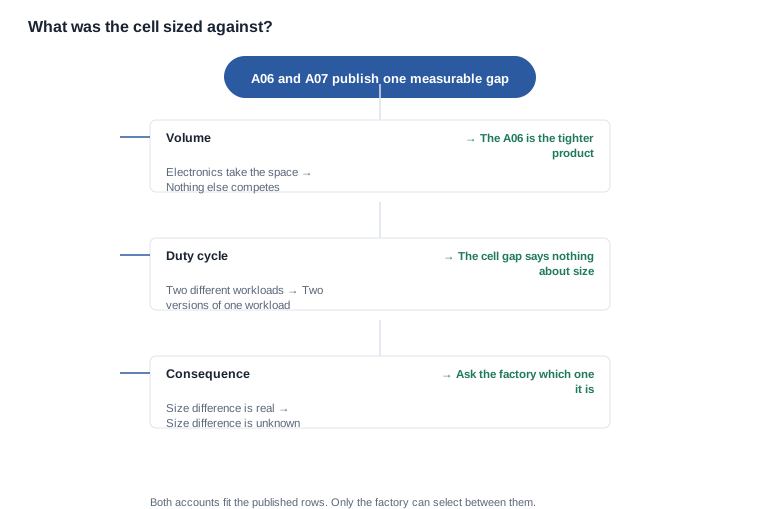
Nothing in the published documentation selects between them, and the distinction matters commercially: the first account would put the A06 at a size disadvantage, and the second would not. A buyer who plans a shelf, a display case or a size-based segmentation is planning on a premise that has not been established. The question to put to the factory is a single one — what the cell capacity was chosen against, and what else occupies the same space in each model.
The average draw, and why it is a clue rather than a specification
A derived figure is available and it is worth carrying, provided it is labelled as derived rather than published. A 40 mAh cell published against an approximately twenty-hour rating implies an average draw of roughly 2 mA across the rated period. A 70 mAh cell against the same rating implies roughly 3.5 mA. Both are calculations; the catalogue states neither.
Read together, the two numbers are a design clue and not a specification. The A07's published headline sits on a heavier average draw than the A06's, which is consistent with an audio duty cycle being more continuously active than a sensing duty cycle. That is an inference from two derived numbers and a pair of product ideas, and it is exactly as far as it can be taken.
It cannot be turned into a runtime promise in either direction. Neither model publishes its test condition: what was active, what the reminder frequency was, over how many units, and whether the figure is a mean or a best case. A clue tells you where to ask; it does not tell a buyer how long a unit will run in a deployment. The A06 battery life analysis and the A07 battery life analysis set out the same arithmetic from each side, and the A06 and A07 use case comparison covers what the difference means for deployment.
A06 and A07: sizing, adjustment and the returns line
The rows a growing head needs
The consumer of these products is a child, and the child changes size. That makes three rows commercially decisive for this family, and none of them is published for either model.
Frame weight is the first. It is not a comfort claim in the way a brochure would use the word — it is the weight that a parent picks up, and the number that goes into a sizing guide. The catalogue publishes exactly one weight anywhere in its twenty-eight models, and it is 158 grams for the MT6 eyewear body, including its battery and camera and excluding its folding charging case. That figure belongs to a different product in a different group, and it cannot be borrowed as a proxy for a kids frame.
Temple length and lens dimension are the second and third, and they are the rows that actually determine whether a unit returns. A frame sized for a six-year-old is a returns liability in a twelve-year-old, and the remedy for that in a product family is a size range, not a discount. Neither model publishes a dimension, so a buyer planning a kids range is planning returns by assumption.
And a recommended age band is published for neither. The catalogue names the A05, the A06 and the A07 as children's models, and that is the whole of the age position. Any more specific statement — an age range, a head circumference, a lens width in millimetres — has to come from the factory in writing.
Where the catalogue's weights come from, and why they cannot be borrowed
It is worth being explicit about the one weight in the catalogue, because it is quoted elsewhere in ways that overstate it. The 158 grams belongs to the MT6, an AI camera glasses model with a 1200 mAh folding charging case. It is the eyewear body's weight. The case weight is not published, and the catalogue nowhere states a bare frame weight for any model in the range.
The same caution applies to the structural rows published elsewhere. A removable inner frame on the V06 and the S7 and a removable temple on the G07 are real, published, product-specific statements about serviceability and about how the product is put together. They are not evidence about the A06 or the A07, and a buyer who reads a family-wide "these frames come apart for adjustment" position out of three camera models and a slim-temple audio model has generalised across the catalogue. The question for this pair is whether the concept carries over, and the catalogue does not say that it does.
The two exceptions worth noting are the ones that are model-specific rather than family-wide. A photochromic lens configuration on the V03 Pro and an IP54 rating on the V06 and the S7 are statements about those products. Neither can be borrowed, and in the A06's case the photochromic point is worth a second look, because a lens that changes with the light and a lens that fogs are two different optical propositions, and the A06's published rows describe the fogging states rather than a photochromic behaviour.
The returns line is the real form factor cost
For a children's product sold through retail, the cost of an unsized frame does not appear on the invoice. It appears in the returns rate, in the review content, and in the second sale to a customer who has already had a bad experience with the same brand. And it falls on the range plan in a way that is specific to a two-model family: a buyer cannot offer a size progression across two models when neither publishes a dimension, so the range has no answer to give a customer whose child has outgrown the frame.
That makes the structural rows the commercially highest-value open items in this comparison, above the ones that sound more urgent. A cell question changes an engineering note; a size question changes the returns rate of the whole category, and it changes it silently until the first season's data comes in.
A06 form factor: the structural questions to ask
What to ask, and what each answer decides
Six questions close the structural gap for this pair, and each of them unlocks a different commercial decision.
- The frame weight for each model, stated for the eyewear body alone and for the full shipped configuration, so that the two numbers cannot be confused later.
- The temple length, the lens dimension and the head circumference range each model is designed for, in millimetres.
- The recommended age band and the head size it corresponds to, so that the listing can state a fit rather than an age.
- Whether the temple or the inner frame is adjustable or removable on each model, and whether a replacement part is available.
- The cell capacity each model was sized against, and what else occupies the same internal volume — the question that decides between the two accounts in the section above.
- The ingress position for each model, and the conditions the rating would be claimed under.
- The colour and lens options available, with the count and the names.
The first three are the ones to ask first, because they change the range plan. Weight, dimension and age band together decide whether the family can be sold on a size progression, and a family that cannot be sold on a size progression is a family with a returns problem in it. The fourth decides whether a spare-parts business exists. The fifth decides the internal design question. The last two are listing items and can close later.
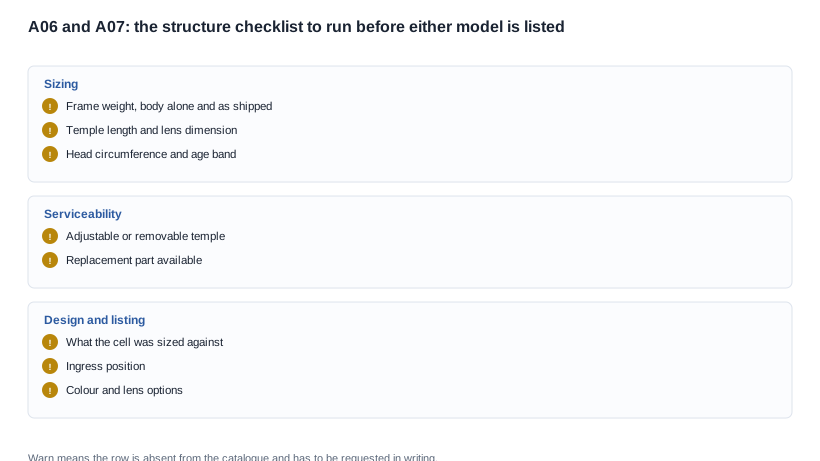
The checklist above is ordered by consequence rather than by ease. Sizing rows first, because they carry the returns rate. Then the serviceability rows, because they decide whether there is a spare-parts line. Then the listing rows, because they are the cheapest to close and the easiest to forget.
One more question belongs on the list, and it is a procurement question rather than a product one. Ask whether the A06 and the A07 share a frame tooling base, and if they do, whether that is documented or merely coincidental. Two models that look alike in a product photograph may be the same tooling, and two models that look different may not be. A buyer who knows the answer can write a single sizing and fitting guide; a buyer who does not has to write two and keep them consistent, which is a recurring cost with no visible line in the quotation.
A tooling question is worth a separate line in the range plan for a second reason. If the two models do share a frame base, then the sizing, the temple length, the lens dimension and the age band are almost certainly shared as well, and a single answer closes the entire sizing block for the family at once. If they do not, then the sizing block has to be collected twice, and the family needs two fitting guides, two size charts and two sets of listing language — which is a cost that appears in the content work and in the support load rather than in the factory invoice.
What we can confirm, and what we will not estimate
We can confirm the published rows for both models, the one measurable difference between them, and the derived average draw implied by those rows. We can confirm which structural rows our catalogue prints for other models and in what vocabulary, and we can therefore tell you that the missing rows for this pair are open questions rather than negative statements. And we can tell you exactly which six questions will close the structural gap, in the order that closes it fastest.
What we will not do is estimate a dimension, a weight or an age band. We will not borrow the 158 grams from a camera model in a different group, and we will not read a cell capacity as a proxy for a frame size. We will not present a derived average draw as a published runtime, and we will not describe the sensing functions as producing any vision, health or prevention outcome — we hold no clinical data for this category, and the boundary is set out in our medical boundary guidance. We will not quote a certification status that our documentation does not support, and the certification and compliance documentation framework covers the work that does.
What we can do is close the six questions in one exchange. Send us the markets, the channel, the age range and the listing wording you intend to use, and we will tell you which of the structural rows we can confirm today, which ones we can put to the factory in a single written request, and which of the two models you can list today on published evidence. The A06 and A07 use case comparison covers the functional side of the same pair, and the kids smart glasses buying guide covers the category decision behind it.
Related reading
- The category these models belong to — kids smart glasses
- Reading a runtime claim properly — smart glasses battery life
- How certification is actually verified — certification checks
Send the market, the channel and the wording, and we will tell you which model you can list. A06 smart glasses vs A07 form factor cannot be settled on the published rows alone, and the six questions above are the whole of what stands between an assumption and a specification.


