
The A06 and the A07 sit on the same children's line and answer two different procurement questions, so the decision between them is a category decision before it is a specification decision. The A06 is published as a children's protective glasses model whose catalogue page carries six feature rows: lens-type electronics, a fogging unit, correct and incorrect posture-and-distance prompts, lens clarity and lens fogging. The A07 is published as a children's audio glasses model whose page carries no feature rows beyond the standard battery, charge time, rated endurance, charging method and Bluetooth set. Read as a spec sheet, three rows look identical and the two models appear interchangeable. Read as a category split, only one of the pair publishes rows that speak to behaviour, and only the other publishes a Bluetooth version row. What follows walks the branches a sourcing team actually runs, names the published row that settles each branch, and lists what the catalogue leaves open on both models.
A06 Versus A07: the category split lands before the spec sheet
A buyer assembling a children's line is not choosing between two configurations of one product. The two models are published under different product names, and the names are the first filter a catalogue gives you: one is a protective glasses entry, one is an audio glasses entry. Everything downstream of that — what has to be verified, what a compliance file has to contain, what the marketing claim may and may not say — follows from it.
That matters commercially because the two briefs arrive with different paperwork attached. A protective-glasses brief usually arrives with a safety or ergonomics argument attached and a request for documentation about posture and distance prompts, fogging consumables and the lens system. An audio-glasses brief arrives with a content and interoperability argument attached and a request for a radio version, a cell capacity and an endurance condition. Neither request set is complete on either model's page, and neither page pretends to be. The sourcing task is therefore to decide which brief you are actually working to, then to know exactly which rows on the other model's page are silent.
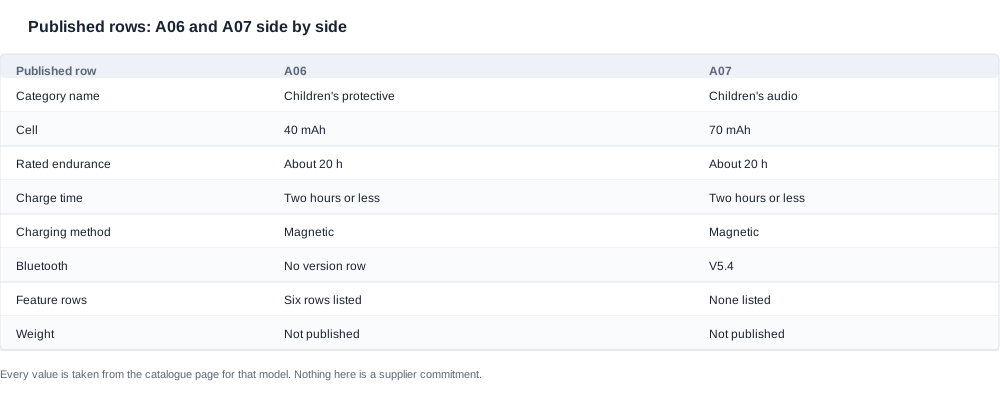
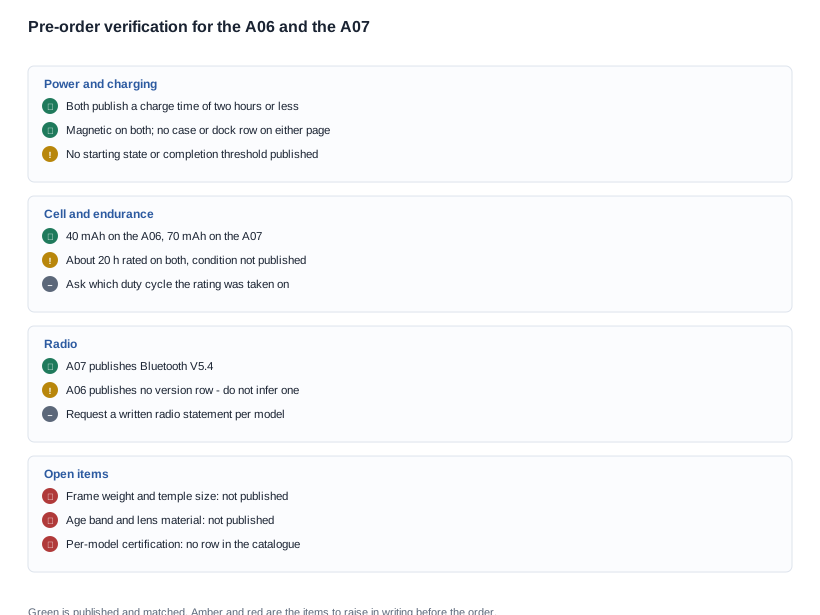
The second reason the category split comes first is that the two pages do not have the same shape. The A06 page lists a 40 mAh cell, an endurance rating of about twenty hours, a charge time of two hours or less, magnetic charging, and six descriptive feature rows — and no Bluetooth version row at all. The A07 page lists a 70 mAh cell, the same endurance rating of about twenty hours, the same charge time ceiling of two hours or less, magnetic charging, a Bluetooth V5.4 row, and no descriptive feature rows. For a buyer building a quotation request, that difference in page shape is the single most actionable fact in this comparison, because it tells you which questions can be answered from published documentation and which have to be raised with the supplier in writing.
The third reason is that a shortlist built on the three matching rows is a shortlist built on nothing. Identical rated endurance, an identical charge time ceiling and an identical charging method are real, and they are also the rows least likely to decide anything, because they are shared by almost every model in the catalogue. Of the twenty-eight published models, seventeen list magnetic charging, seven list Type-C, and four publish no charging method row; twenty-six of the twenty-eight publish a charge time of two hours or less, with only the D17 and the ZH12 publishing roughly one hour. Charging method and charge time are therefore structural groupings, not differentiators within the children's pair. They are useful for grouping the catalogue; they are not a reason to pick one of these two models over the other.

Which published row settles the A06 or A07 question
Four rows do the actual decision work on this pair, and three of them come from the category name rather than from the numbers.
The feature-row count. The A06 publishes six descriptive rows; the A07 publishes none. This is the row that carries the most weight in a use-case comparison, because a use case is a thing the product does, and descriptive rows are the only published evidence of what each product does. If the brief asks for a device that prompts on posture or distance, or that handles lens fogging, the published rows point at one model in this pair and away from the other. If the brief asks for audio, the A07's category name is the only published evidence of that capability — its page carries no speaker row, no driver row and no volume row. The right reading of a missing feature row on the A07 is the catalogue does not publish it, not the product does not have it, and the difference between those two readings is exactly what your supplier confirmation has to close.
The Bluetooth version row. The A07 publishes Bluetooth V5.4. The A06 publishes no Bluetooth version row. This is the row most often mishandled in a comparison table, because the gap reads like an oversight to be filled in. It is not a gap to be filled in by inference. Do not carry a version across from the A07 to the A06, do not assume parity, and do not let a quotation or a product sheet you were sent elsewhere stand in for the catalogue row. The defensible statement to put in your own comparison file is that the catalogue publishes a Bluetooth V5.4 row for the A07 and no Bluetooth version row for the A06, and that the A06's radio position is a written question for the supplier. The A06 certification status analysis and the A07 certification status analysis cover the parallel documentation question model by model.
The cell capacity row. Forty milliamp-hours against seventy is the only numeric row on which the two models differ. Both pages publish an endurance rating of about twenty hours, so the cell row is where the inference has to be done carefully: two published ratings that match, sitting on two published cells that do not, mean the two ratings were reached under different duty assumptions — or that one of them was. Neither conclusion is published, so neither is a fact you can quote. What the pair does support is a question: what test condition produces the twenty-hour rating on each model, and whether that condition is the same on both pages. This is the question a technical buyer should ask before either number is used in a tender document. The A06 charging options analysis and the A07 charging options analysis set out how the shared charge rows should and should not be used in a comparison.
The weight row, which is absent on both. The catalogue publishes no frame weight for the A06 and no frame weight for the A07. Across the whole twenty-eight-model catalogue the only published weight is the MT6's 158 g, and that figure is for the MT6 alone — an adult camera model with a folding case, not a children's frame. If a fit requirement, a sizing schedule or a shipping calculation depends on the weight of either of these two models, that number has to come from a supplier measurement. Do not carry the MT6 figure into a children's comparison, and do not substitute a vendor estimate for a supplier figure without labelling it as an estimate. The kids sizing guidance and the age suitability analysis cover what a fit brief should specify when the catalogue is silent.
The two branches a sourcing brief actually runs through
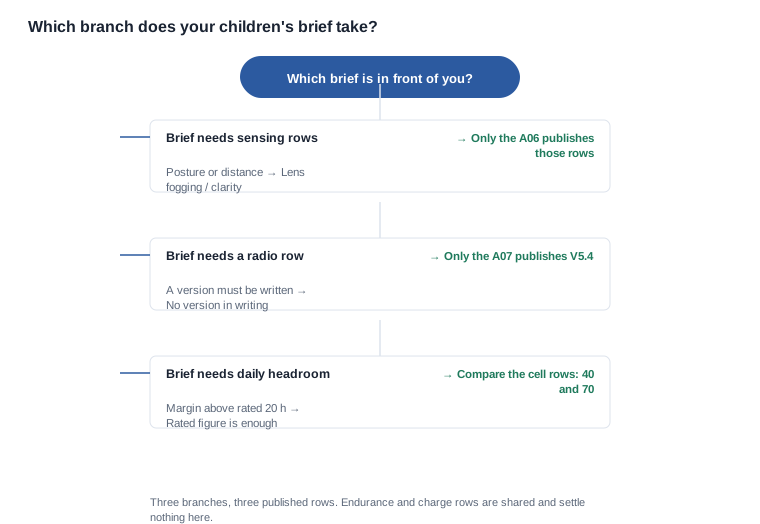
A children's brief arrives with one of two jobs attached, and the branches below are named by that job rather than by the model. Neither branch is a product recommendation: each one states which published row narrows the field, and what that row leaves undecided.
Branch one: a brief that needs sensing rows rather than an audio path
A protective-frame brief is usually driven by something a buyer can name in one sentence — a school partner asking for posture or distance prompting, a channel campaign built around a fogging or lens-clarity story, a brand whose own positioning already leans on behaviour rather than content. When that is the brief, the A06 is the only model in this pair whose published page speaks to it, and the buyer's work shifts from selection to verification.
Verification is the hard part, because six descriptive rows is a vocabulary, not a specification. What does the fogging unit do, and is it a consumable, and what is its replacement interval? What triggers a correct posture-and-distance prompt versus an incorrect one? Is there a threshold, and is that threshold adjustable? What does the prompt consist of — a tone, a spoken cue, a vibration, a message that has to be read somewhere? Does the lens clarity row describe a state indicator or a corrective action? None of these are published, and each of them is a question that has to reach the supplier as a written request attached to the purchase order rather than a verbal assurance. The posture monitoring analysis describes the published rows; the A06 buyer checklist works through the order these questions should be asked in.
One boundary has to be stated plainly and early, because it is the fastest way to lose a compliance review. The six rows describe what the catalogue lists. They are a published equipment description, not a medical effect statement. Nothing in them should be presented, in your own collateral or in a seller's, as producing a vision outcome, a health outcome or a prevention outcome, and no buyer should accept a supplier's marketing material that makes that leap on their behalf. The same applies to how you describe the categories themselves: the A06 is published as a protective glasses model and the A07 as an audio glasses model, and those are catalogue product names to be quoted as such, not clinical descriptors to be paraphrased. If your destination market requires children's product testing, that is a documentation question — the kids certification analysis and the children's safety requirements analysis set out what to request and from whom.
The second half of this branch is the data question, and it should be opened before a prototype arrives rather than after. A device that publishes prompting rows raises the question of where the prompting logic runs, what data if any leaves the device, what an accompanying application is required for, and what a supervising adult can see. None of that is published for the A06. A buyer who needs the answer to be nothing is collected cannot establish it from the catalogue, and a buyer who needs it to be something specific is collected cannot establish that either. Both need it in writing. The privacy considerations analysis is the right place to build that question list.
Branch two: a brief that needs a radio row and endurance headroom
An audio-glasses brief is driven by a different problem: content, interoperability and the routine of a full day. When that is the brief, the A07 is the only model in this pair with a published Bluetooth version row, and again the buyer's work is verification rather than selection.
Interoperability is the first checkpoint, and it is cheap to check early. Ask for the radio list per model, in writing, and check it against the devices your channel actually sells — the handsets, the tablets, the classroom or warehouse equipment the buyer expects the glasses to pair with. Version compatibility is a support-cost question as much as a technical one: a mismatch between what the catalogue implies and what your buyers own turns into returns, and returns on a children's product with a charging dock in every unit are expensive to reverse. Because the A06 publishes no version row at all, any requirement that flows to it has to be answered by the supplier directly rather than read across from a sibling model on the same line.
Headroom is the second checkpoint, and the two published numbers are not directly comparable. The A07 carries seventy milliamp-hours and a rated endurance of about twenty hours; the A06 carries forty milliamp-hours and the same rated rating. A buyer planning a full working day should treat the twenty hours as a rated figure published by the supplier, not as an observed endurance, and should not turn it into a claim that one charge lasts a day. The catalogue publishes no test condition, no starting state and no definition of what the device was doing during the rating, so the only responsible use of the number inside your own documents is to repeat it as a rating and ask for its basis. The A06 battery analysis and the A07 battery analysis take the two architectures apart on that basis.
There is a channel-specific version of this branch that is worth naming separately, because it is where most children's volume actually lands. A distributor is not reselling a model; they are reselling a restocking cycle. That makes the charge time ceiling, the charging method and the availability of a case or dock line items rather than features — and on all three, both of these models publish magnetic charging and a charge time of two hours or less, with no charging case row on either page. Since a charge time of two hours or less is a ceiling rather than a fixed figure, and no starting state or completion threshold is published for either model, it cannot be used to calculate dock turnover for a store shelf. Ask the supplier for the charge profile and the completion criterion before you put a replenishment schedule behind it. The bulk ordering analysis covers how that kind of question should be structured in a purchase order.
What neither model's page settles, and the order to close it in
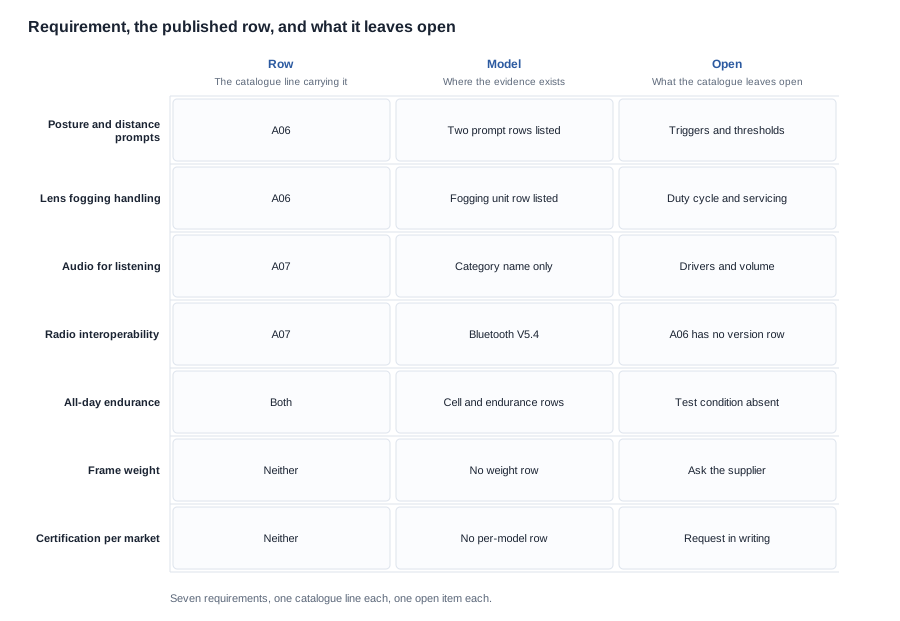
Verification is the part of this comparison that is worth the most time, because both pages are honest about their scope and neither page is complete. The following is the working order I would use with a supplier, in the sequence that fails fastest if an answer is missing.
Start with the category and contents question: what is in the box, what rows describe the device as supplied rather than as an option, and which of the published feature rows are standard on the shipment you are buying. For the A07 this is especially important, because a page with no descriptive rows leaves the buyer inferring the configuration from the product name.
Next the power chain, in this order: the test condition behind the rated endurance figure; the starting state and completion criterion behind the charge time ceiling; and the charging method as physically implemented, including whether magnetic charging requires a dock that is supplied or sold separately. The quality checks analysis covers what to sample and how to record it.
Then the radio position: a written statement of the Bluetooth version per model, with the A06 specifically named, because that model has no published version row to fall back on.
Then the mechanical and fit rows, none of which are published for either model: frame weight, temple dimensions, the lens material, the recommended age band, and the adjustment range. Collect these as measurements with the measurement method stated, not as estimates from a product photograph.
Then the documentation position for your destination market: what test reports exist per model, what they cover, what they do not cover, and who issues them. Across the catalogue there is a company-level export certification page, and its content is images rather than text; the catalogue text contains no reference to CE, FCC or RoHS, and there is no per-model certification row anywhere. That means certification for any individual model is a document you request, not a claim you inherit from a catalogue page. Buyers routinely ask for CE, FCC, RoHS, UN 38.3 and transport documentation on this kind of product, and the honest answer to each of those questions, until paperwork is in hand, is that our catalogue does not publish it for this model. The export considerations analysis covers the logistics documentation that sits alongside it.
Finally, the consistency check on the returned answers against the published rows. If a supplier's answer contradicts a published row, the published row wins and the contradiction goes into the file as a supplier inconsistency. That record is worth more than the answer, because it tells your quality control team what to check on the first production delivery.

Where either model breaks a due diligence file
Three failure modes show up repeatedly when this pair is shortlisted, and each of them is a paperwork problem rather than a product problem.
The first is treating a rated figure as an observed one. About twenty hours is published on both pages as a rating. Written into a tender response as an endurance claim, it becomes an assertion the supplier never made and cannot be held to. The same applies in miniature to the charge time: two hours or less is a ceiling, and a ceiling that is met exactly at two hours is still compliant with it.
The second is filling the Bluetooth gap by inference. This is the most common error in children's product comparisons, because the two models sit adjacent in the catalogue and the assumption forms easily. It is also the error most likely to survive an internal review, because the resulting document looks complete. Every place where the A06's radio position appears in your files should be traceable to a written supplier statement with a date on it.
The third is letting a category name harden into a claim. Protective and audio are catalogue product names. If either is paraphrased into a benefit statement anywhere in the chain — in a distributor deck, a product listing, a tender answer — the paraphrase will have travelled further from the published rows than the original wording, and children's product categories attract exactly the scrutiny where that gap gets noticed. Quote the names, keep the feature rows attributed to the catalogue, and keep the medical language out of the file entirely.
Commercially, the leverage sits in the open items rather than in the published rows. Both models are well specified on charge method and charge time, and those are not where a negotiation should be spent. The negotiation is over the unanswered rows: the endurance test condition, the per-model radio statement, the fit measurements, the contents list, and the per-model documentation for your market. Put them in the purchase order as items to be supplied, attach the delivery milestone to each, and treat a supplier who cannot answer them in writing as a supplier whose due diligence file will not survive your client's review — regardless of what the catalogue page shows. What we will not do is manufacture answers to close those gaps: no weight, no age band, no certification reference, no endurance condition and no clinical language is published for either model, and we will not supply one from inference. The A06 specification list, the A07 specification list and the A06 versus A05 comparison are the honest baselines to work from.
What the branch test returns, and what stays unanswered
If your brief names posture or distance prompting, or lens fogging, or lens clarity, the A06 is the only model in this pair whose published rows speak to it, and the work from there is verification rather than selection. If your brief names audio, interoperability or an all-day channel routine, the A07 is the only model in this pair with a published Bluetooth version row and the larger cell, and the same applies. If the brief cannot be reduced to one of those, the honest conclusion is that the two models are not competing for the same slot, and the A06 versus A07 use-case question has been asked before the requirement was written down.
Either way, the three shared rows — rated endurance, the charge time ceiling and magnetic charging — will not decide it, and neither model's page supplies the weight, the age band or the certification evidence that a complete due diligence file needs. Send the buyer, the brief, the destination market and the annual volume, and the branch collapses quickly; the A06 and the A07 stop being a spec comparison and become the category question they have been from the start.
Related reading
- The physical difference — A06 and A07 form factor comparison
- The institutional brief — school requirements checklist
- The line-level decision — which kids model to pick


