

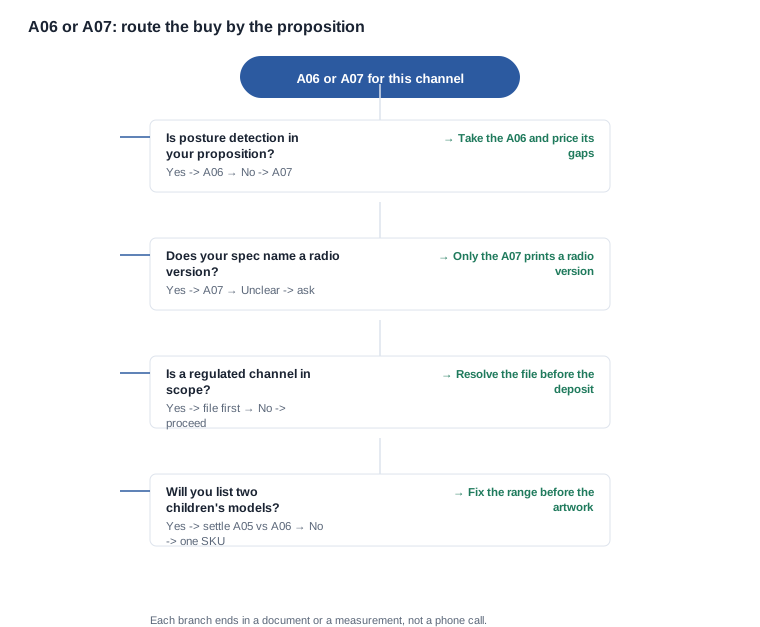
If posture and viewing-distance detection is load-bearing in the proposition your channel sells, the A06 is the only one of the two that carries the published rows to support it. If it is not, the A07 is the better-documented product in a different way: a 70 mAh cell against 40 mAh, and a published Bluetooth V5.4 where the A06 prints no radio version at all. That is the short version of the comparison, and it is genuinely the whole of it. What sits underneath the short version is a set of questions that neither model answers, and the buyer who treats this as a two-way specification decision will sign an order before discovering them.
The comparison below is written for a procurement manager assembling a children's line, not for a shopper. It separates the rows the catalogue prints from the rows it does not, names the owner of each open item, and says plainly which questions have to be answered before a deposit moves.
A06 versus A07: the two published rows that decide the comparison
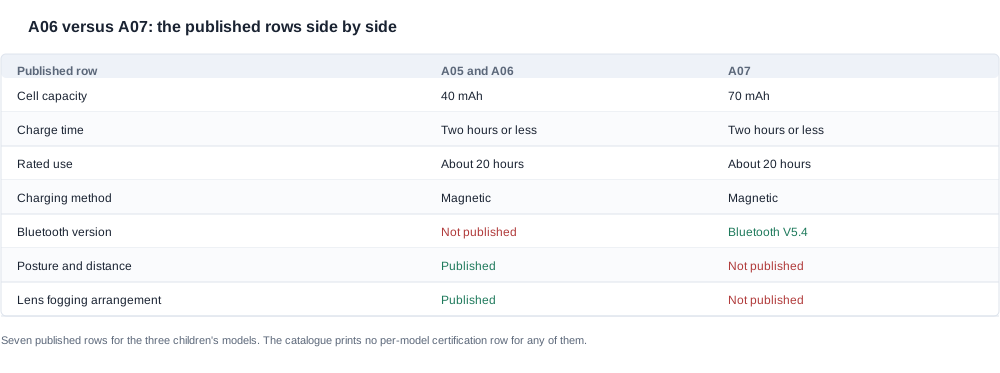
Read the table above as two columns of certainty and one column of noise. The rows that separate the A06 from the A07 are only two.
Cell capacity. The A06 publishes 40 mAh and the A07 publishes 70 mAh. That is a difference of seventy-five per cent, and it is the only hardware figure in the entire children's range where the two models differ. It is also the figure nobody puts on the front of a box, because the rated runtime is printed the same for both models.
Bluetooth version. The A07 publishes Bluetooth V5.4. The A06 prints no radio version row at all. This is a larger difference than it appears in a procurement file, because a specification that names a protocol version can be checked against a delivered unit, while a specification that names nothing can only be checked by asking.
Everything else in the comparison is identical or absent. Both models publish a charge time of two hours or less, a rated use of about twenty hours and magnetic charging. Both publish no frame weight, no dimensions, no recommended age band, no ingress marking, no charging-case row, no charge-indicator row and no per-model certification row. Neither model publishes a camera, a detection threshold, a reminder interval or an acoustic specification.
The twenty-hour figure is where the comparison turns interesting. Two cell sizes, seventy-five per cent apart, carrying the same published runtime, means the runtime is describing a duty cycle rather than a continuous load — and the duty cycle is different in the two models, because the A06 carries a lens-type electronic fogging arrangement and posture and distance indication while the A07 carries a radio and an audio path. A twenty-hour figure on a 40 mAh cell that also wakes to sense and indicate cannot be the same twenty hours as a figure on a 70 mAh cell running audio intermittently. Neither figure states its condition, so neither can be used to differentiate the two products in a listing without inventing a comparison the catalogue does not make.
What this means commercially. A buyer who wants to separate the A06 from the A07 on the battery row has to write the runtime condition into the purchase order and then measure both on samples. A buyer who wants to separate them on the radio row can do it today, from the catalogue, in writing. The second route is cheaper and it is the one that survives a review.
A06 sensing obligations and what the A07 audio row obliges you to claim
The A06's published rows are an obligation, not a feature list. The catalogue prints a lens-type electronic fogging arrangement, and it prints a correct-posture-and-distance versus incorrect-posture-and-distance indication. If your channel lists those functions, three things become your responsibility rather than the supplier's.
The threshold is not published. No distance in centimetres, no angle in degrees, no delay in seconds, no false-positive rate and no reminder interval appear anywhere for this model. A detection function without a threshold is a behaviour, not a specification: it cannot be compared between suppliers, it cannot be tested on a sample against a written acceptance criterion, and it cannot be defended when a parent reports that the product objected to a posture that was fine. Ask for the threshold with a unit, the delay, the behaviour on a repeated trigger, and the default reminder interval. If the supplier cannot give those, the function is one you will not be able to write an acceptance criterion against, and that is a finding you need before the order, not after.
The supplier evaluation for this model is a functional one, not a factory one. A factory audit checks whether the process that produced the sample can produce the next one; it does not check whether the detection function behaves. What checks the function is a protocol you write before the first reading, and the protocol has to name the trigger distance, the delay, the number of repeated triggers, the room, the light and the pass condition. Run it on several units from the same batch and on units from a second batch, because a detection function that drifts between batches is a supply-chain defect rather than a sample defect, and the difference matters commercially: a batch defect is a rejection question and a sample defect is a supplier question. Ask for the defect taxonomy the factory works to — what counts as a detection failure, what counts as a cosmetic failure, what is scrapped — because your returns terms and your warranty claim both depend on that vocabulary, and it is almost never the vocabulary your customer service team is already using.
The claim boundary is a regulatory line, not a copy preference. A product that indicates a posture or a viewing distance and reminds a child is not a clinical intervention, and we make no vision, myopia, eyesight or eye-health claim for the A06 or for any other model in our catalogue. We hold no clinical data, no test protocol and no regulatory assessment for this category. If your channel's proposition is an eyesight concern rather than a behaviour reminder, this is the wrong category, and the cost of discovering that after the packaging is printed is the whole first print run.
The certification position for the A06 is not established in our documentation. The catalogue carries a company-level export certification page whose content is images rather than text — ten patent certificates, eight appearance-design patents and two utility-model patents. The catalogue text contains no reference to CE, FCC or RoHS, and there is no per-model certification row for the A06, the A05 or the A07. That is not a statement that the product fails; it is a statement that our documentation cannot tell you it passes, and you cannot write that on a page.
By contrast, the A07's published rows oblige you to much less. A cell, a charge time, a rated runtime, a charging method and a radio version are all infrastructure claims: they describe what the hardware is and what it connects to, and they do not imply anything about a child's eyesight. A buyer who wants a camera-free, sensing-free, simply-documented model for a retail channel has a shorter route with the A07, and the A07 specifications breakdown sets out the full row set for it.
The A05 and A06 identity question sitting under this comparison
Here is the part that makes this comparison more expensive than it appears. The A05 and the A06 print identical rows in the catalogue: the same 40 mAh cell, the same charge time, the same rated use, the same magnetic charging, the same lens-type electronic fogging arrangement and the same posture and distance indication. The catalogue does not state what separates them.
That is not a documentation oversight you can work around, because it propagates into three separate decisions.
First, the range architecture. If the A05 and the A06 are one product sold under two designations, then your children's line is two models, not three, and the per-model cost of a conformity file halves. If they are two products with an undocumented difference, then you are committing to a SKU whose differentiator you cannot write on a listing, because you do not know what it is. Neither answer is in the catalogue.
Second, the file. A conformity document needs a model designation to name. Two designations that print identical rows will produce two documents, two testing bodies' schedules and two sets of labelling, unless the difference is established first. A certification file is priced per model and per market, so this is the most expensive open question in the comparison, and it is more expensive than the A06-versus-A07 question you came here to answer.
Third, the channel story. If your listing shows two models that appear identical and differ only in name, you have created a customer service problem rather than a range. A parent or a buyer who compares the two pages will ask what the difference is, and "the catalogue does not say" is not an answer you can put on a product page.
Get this answered in writing before you commit to the range. It is one line in an email to the supplier, and it is worth more than any comparison chart, because it determines how many files, how many listings and how much artwork spend you are about to make.

A06 or A07: sequencing the request so the answer arrives in time
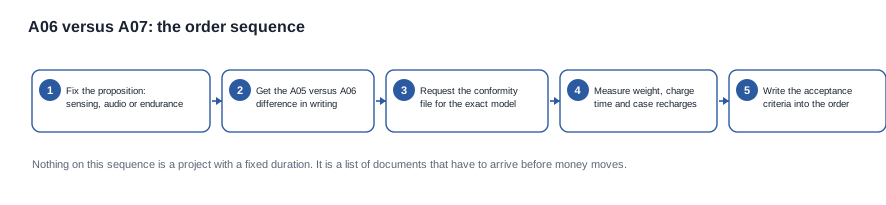
The comparison above is decided by documents, and documents arrive in a sequence. Here is the order that keeps a deposit from landing before the facts do.
Step one — fix the proposition in writing. State whether posture and viewing-distance indication is required, and if it is, state the threshold you will accept. Do this before the supplier is engaged, because it determines whether the A06 is even a candidate and it determines the claim wording your legal reviewer will have to check.
Step two — establish the A05 versus A06 difference. One question, one written answer. If the answer does not come, narrow the range to two models and document the narrowing decision, because a documented two-model range is commercially safer than an undocumented three-model range.
Step three — request the conformity file for the exact model designation you intend to ship, per destination market. Children's products attract requirements that adult electronics do not — EN 71 in the European Union, ASTM F963 and the Consumer Product Safety Improvement Act in the United States — and the radio side sits under the Radio Equipment Directive (EU) 2014/53/EU, which is a different workstream from the restricted-substance side. Establish which frameworks apply with a testing body in your own market rather than with the factory, because the route is a question about your market and the factory is not qualified to answer it in your market. The certification checklist covers how to ask for the numbers, the issuing body and the validity dates.
Step four — measure the hardware you cannot read. Frame weight and dimensions across several units rather than one, because a children's product on a growing head is where the size range and the weight drive returns. Charge time from a stated start state rather than from whatever the dock presented. Runtime under the usage pattern you actually intend to sell. Whether the temple carries a touch surface and how it is configured — the catalogue publishes no touch row for any model, so this is a question and never a specification.
Step five — write the acceptance criteria into the purchase order. The published rows for the configuration ordered. The detection threshold, the delay and the reminder interval, if the A06 is the model. The charge indicator behaviour, the accepted charging input, the ingress position, and the warranty period with a stated response. A criterion that lives in an email is not binding; a criterion in the order is an acceptance standard you can hold a delivery against.
Order the samples as a sample order, not as a favour. A sample order carries a cost, a lead time and a defined configuration, and it is the only purchase in the programme where the configuration is under your control rather than under the factory's. Name the colour, the logo, the packaging state and the firmware branch you intend to ship, and get the sample order to carry those names. A sample that arrives with the wrong logo or the wrong firmware branch tells you nothing about the production unit, and a factory that will not name the branch on a sample order is telling you how the branch will be handled at volume. The sample evaluation note covers the difference between a sample that demonstrates a feature and a sample that demonstrates a configuration.
A06 or A07: the gaps that have to be closed before a deposit
Before any money moves, nine items are open on this comparison, and the owner of each one differs. That distinction is what makes the request manageable.
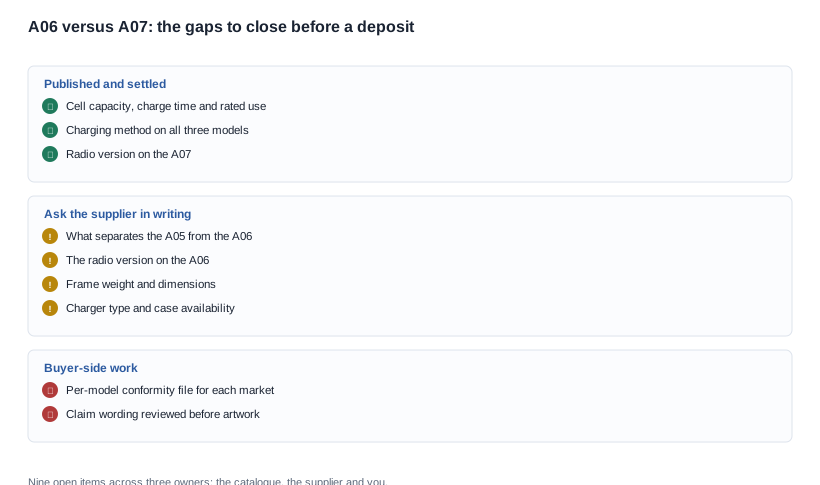
Four of them sit with the supplier and cost nothing to ask for: the A05 versus A06 difference, the radio version on the A06 if the catalogue has simply omitted a row, the frame weight and dimensions, and whether a charging case exists for the configuration at your volume. Three of them are yours to settle: the conformity file per model per market, the claim wording, and the acceptance criteria. Two of them are a market question rather than a product question: which frameworks apply to a children's product in your destination market, and whether your packaging wording changes the classification.
Two commercial points are worth putting in the negotiation rather than leaving to a catalogue. The first is the accessory and spare-parts scope: a magnetic charger is a small object that gets lost, and whether a replacement can be ordered separately, at what price and at what minimum order quantity, is a term worth settling before launch rather than after the first call from a parent. The second is the artwork round count. Every additional round is a week, and the charge indicator, the charging instruction and the claim wording all belong on the same artwork, so they should be collected in one pass rather than three.
Unit price and volume tiers are negotiable, and the number of models you commit to is the largest single lever, because each combination carries its own minimum order quantity and its own file. Certification cost and certification lead time are not commercial variables — the cost is fixed per model per market and the elapsed time is set by the testing body. Tooling and certification are frequently bundled into a single quotation line, and it is worth asking which one you are being quoted, because the difference decides whether a range reduction actually saves money.
The third number to model is landed cost, not unit price. Unit price is the smallest figure in the file. Landed cost is unit price plus freight and incoterms plus the per-market labelling and documentation cost plus amortised tooling plus the certification cost per model per market plus the support cost of a device in a child's hands. For a two-model range, splitting the documentation cost across a smaller volume raises the per-unit share; for a three-model range in which one pair is indistinguishable, the third model carries a full file cost and returns nothing to the listing. That arithmetic is the commercial form of the A05-versus-A06 question, and it belongs on the same page as the range plan rather than in a separate spreadsheet that nobody reconciles.
Where the A06 versus A07 decision lands with us
On this pair, our position is narrow and we will state it plainly. We publish the rows we hold, and where the catalogue prints nothing we mark it as absent rather than filling the row with a typical value. We will not describe the A06's posture and distance indication as though it changed a child's eyesight, because we hold no clinical data and no regulatory assessment for that claim, and we will not support a listing that does. We will not describe the A07 as carrying the A06's fogging arrangement or its sensing rows, because those rows are not published for that model. And we will not tell you the A06 is certified, because our documentation contains no per-model certification row and no reference to CE, FCC or RoHS anywhere in the catalogue text — the export certification page is an image page carrying ten patent certificates, and a patent certificate is not a conformity declaration.
What we will do is tell you which of the nine open items above we can close from the material we hold today, which have to come back to you as unknown, and which are yours to close with a testing body in your own market. Send us the two models, the destination markets, the age range and the channel, and we will answer item by item rather than in general terms.
The kids smart glasses range page holds the three published models, and the A07 buyer review checklist covers the sample-stage work in detail.
Related reading
- The published rows for the audio model — A07 smart glasses specifications and features
- How the two models sit inside the whole range — A07 smart glasses how it compares
- The compliance route in full — A07 smart glasses certification status
Tell us the market, the age range, the volume and whether posture detection is part of your proposition, and we will tell you which model fits and which rows remain unpublished.


