
This model is published as a children's audio frame with a 70 mAh cell, a charge time of two hours or less, about 20 hours of rated use, magnetic charging and a Bluetooth V5.4 radio. It does not list posture or distance detection, and it does not list the lens-type electronic fogging arrangement that appears on the two neighbouring models. Those two absences answer most of the questions buyers ask.
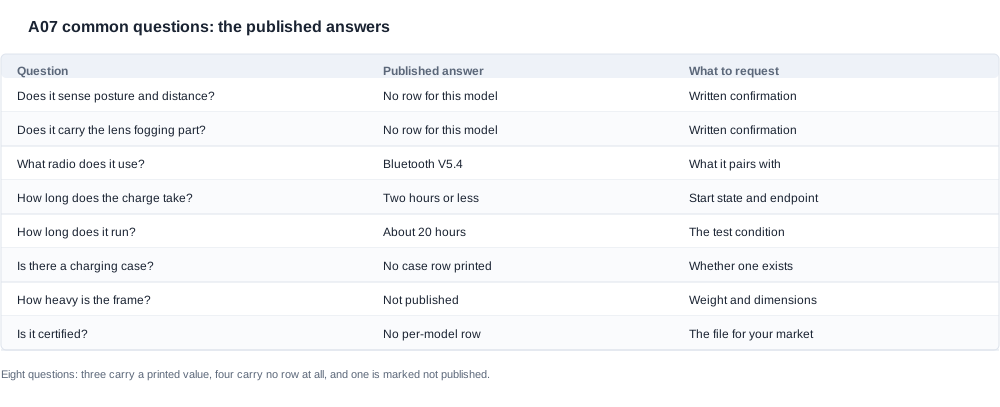
The eight questions below are the ones a procurement team actually asks about this model. Each one is answered with what our catalogue prints, and each answer carries the part that a catalogue row cannot settle on its own. The last section is the part that turns a question into something you can put in a purchase order.
A07 common questions: the eight that decide the specification
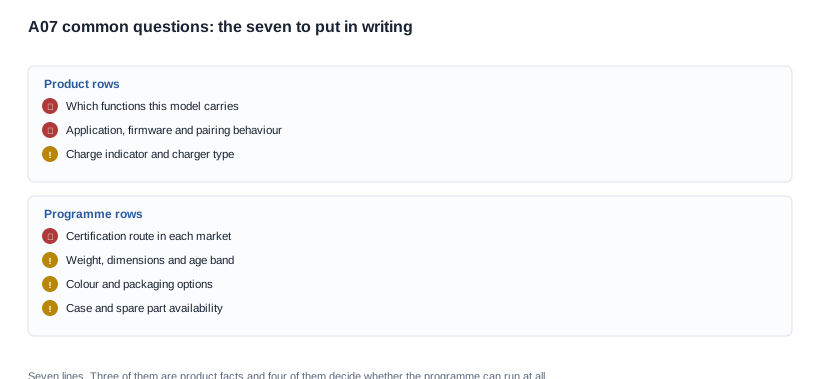
Three of the eight carry a printed value, four carry no row at all, and one is marked not published. That distribution is the thing to understand about this model before you start asking: it is not under-documented across the board, it is documented in a narrow band and silent everywhere else, and the silence is structured rather than accidental.
The narrow band is the electrical and radio specification. A cell size, a charge ceiling, a rated runtime, a charging method and a radio version. Those five rows are enough to write a basic specification, to write a compatibility line and to describe the product honestly on a retail page.
The silence is in three other places. There is no function row, so the catalogue says nothing about what the device detects or arranges. There is no physical row, so the catalogue says nothing about the weight, the dimensions, the size range or the recommended age band. And there is no conformity row, so the catalogue says nothing about certification for this model or for any other in the range.
How to choose between the models once you have the answers. The eight questions are not eight obstacles; they are the fastest way to narrow the range to one or two candidates. If your answers show you need a detection function, two models in this family publish one and this model does not, so the choice is between the A05 and the A06 — which are themselves indistinguishable in the catalogue, so you have also inherited the question of what separates them. If your answers show you do not need a detection function, this model becomes the natural candidate and the questions that remain are the physical ones and the paperwork ones. The criteria for stopping the search are simple: when the remaining questions are all about measurement rather than about function, you have enough to place a sample order, and when they are all about paperwork you have a compliance programme to start rather than a product to compare.
That structure decides how you should approach the model. You do not need a supplier to tell you what this product is; you need a supplier to tell you what it weighs, what it does when it is more than an audio frame, and what paperwork travels with it.
A07 questions on sensing, the lens arrangement and the radio
Question one: does it detect posture and viewing distance? No. The catalogue prints no function row for this model, and two other models in the same family do print that function. This is not a question of degree or a configuration difference — the function is absent from this model's published specification. If a programme is being built around detection, choosing this model means the programme needs redesigning, and that conversation is much cheaper now than at the sample stage.
Question two: does it carry the lens-type electronic fogging arrangement? Also no. The catalogue prints a lens-type electronic fogging arrangement on the A05 and on the A06 and prints nothing of the kind on the A07. Whether that is an advantage or a disqualification depends on your market, because the regulatory position for a feature of that kind varies by destination and is not something we can answer generically. Either way, it is a question about a function this model does not publish.
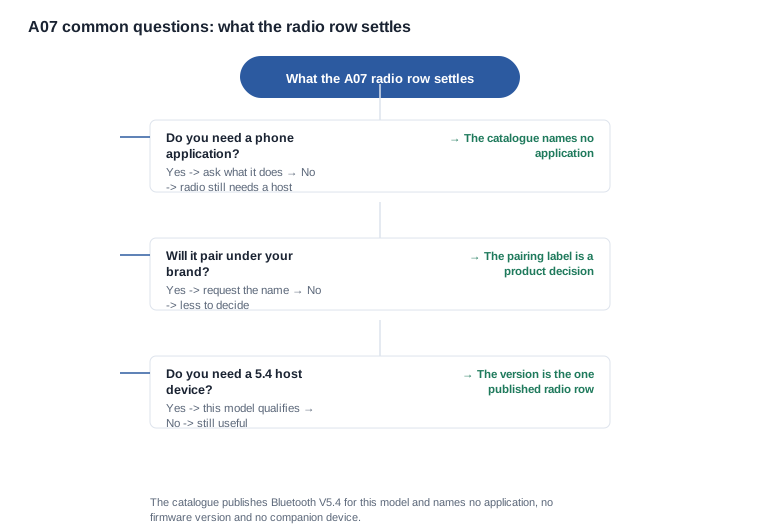
Question three: what radio does it use, and what does it connect to? Bluetooth V5.4 is published, which means this is a connected device, where the two neighbouring models at 40 mAh publish no radio version at all. That changes the runtime story — a radio consumes power whether or not it is carrying traffic — and it is part of why the larger cell on this model is doing something the smaller cells are not.
What the published version does not tell you is what the radio connects to. There is no published application, no published companion device and no published host requirement for this model. The app and firmware position for this tier is recorded as awaiting verification, which is the wording our documentation uses for a row that exists and has not been confirmed. That is a different position from a row that does not exist, and a buyer who treats the two alike will draw the wrong conclusion in either direction: either they will assume an application they cannot describe, or they will assume there is none and design a proposition around a device that turns out to have one.
If your programme depends on the product connecting to something, that needs an answer in writing. It is also worth asking whether the connection name appears in a host device list as your brand or as the factory's, because that is the string a parent reads when a unit will not connect, and it is the string that ends up in the support ticket rather than in the specification.
What to ask, and three red flags to watch for in the reply. Ask for the application name and who operates it, for the list of functions the application exposes, and for the firmware version that will ship on the first production run. Three answers are common and all three are warning signs. An answer that describes a phone application in the abstract, without a name, is describing a category rather than a product. An answer that says the device pairs with any compatible phone, without naming a requirement, has moved the burden of compatibility onto your support team without giving them a list. And an answer that says the application is the same as a previous model, has not established that the firmware is maintained for the life of this programme rather than for the life of the previous one. Any of the three is a prompt for a second question, not a reason to stop asking.
A07 questions on runtime, charging and the household routine
Question four: is the 20-hour figure real? It is published, and it is published for all three models in this category, with no stated test condition. Twenty hours from 70 mAh is a striking ratio and it should prompt the same question every runtime figure prompts: what was running during those twenty hours? A connected audio product running continuously for twenty hours on a 70 mAh cell is at the edge of what is plausible, and the fact that the two smaller models publish the same figure on 40 mAh cells tells you the number describes a light duty cycle rather than an active one. Measure it on a sample under your own pattern rather than quoting ours in a listing.
Question five: how long does the charge take? The catalogue publishes two hours or less. That is a ceiling, and the correct form of the claim in a listing is that the charge completes in two hours or less. It is not the same as a precise figure, and it is not the same as a claim that it takes less than two hours, because the two-hour case itself is inside the ceiling. The catalogue publishes no start state and no completion criterion, which is why the figure cannot be used to calculate how much of a day is lost to charging: without a beginning and an end, a bound tells you very little.
Question six: is there a charging case, and what does the household routine look like? The catalogue prints magnetic charging for this model and prints no charging-case row at all. It also prints no row describing what the physical charger is — a pad, a case or a cable-ended puck — no charge-indicator row, and no accepted input current and voltage. That absence is why the daily routine has to be designed rather than derived. A device that charges on a proprietary dock and a device that also accepts a direct USB input produce entirely different household routines, and only one of them can be planned from the documentation. The A07 charging options breakdown covers the accessory and packaging programme in full, and the A07 battery life analysis covers the energy rows.
How to evaluate a charge time that arrives without conditions. Before you order, ask for three things in writing: the start state the measurement began from, the point at which the charge was judged complete, and the ambient temperature. If the reply contains all three, you have something you can compare with another supplier's figure. If it contains only the two-hour ceiling, you have a bound and nothing else, and you can still use it — as a bound, in the form "two hours or less", which is what the catalogue supports. What you cannot do is convert it into a measured figure, and a supplier who offers a measured figure without stating the conditions has either not measured it or has measured it under conditions that do not match a household. Both of those are questions to ask before you order rather than after.
A07 questions on weight, ingress, certification and claims
Question seven: how heavy is it, and what age band is it for? Not published. The catalogue prints no frame weight, no dimensions and no recommended age band for this model, and it publishes none for the other two either. This is the gap that matters most in this category, and the reason it matters most is that the frame is on a growing head for a full school day. Weight and size range drive both the comfort of use and the return rate, and neither can be inferred from a cell capacity. Get the figures, then run a size-range check across real children rather than accepting a single dimension as a range.
Question eight: is it certified, and can we claim a vision benefit? On certification: our documentation holds no per-model certification row for this model. One page in our catalogue is titled as an export certification page, and everything on it is an image rather than typed text — ten certificates in total, eight of them appearance-design patents and two utility-model patents — and not one of CE, FCC or RoHS is named anywhere in the catalogue text. Children's products typically attract requirements that adult electronics do not, with EN 71 in the European Union and, in the United States, the ASTM F963 standard together with the Consumer Product Safety Commission's own rules, and whether those apply here depends on categorisation and marketing that we have not verified. The answer is that we cannot tell you it passes, and that claim cannot go on a page.
On the claim: no model in this category carries a published claim about vision protection or myopia prevention, and such a claim would need its own regulatory basis in each market you sell into. A household that buys on a health claim and does not receive a health outcome is the source of both the return and the review, so the safest listing is the one that never makes the claim. Nothing in our file for this category is clinical: no data, no protocol, no regulatory assessment, and we will not help write one.
And on ingress, a shorter answer. No ingress rating is published for any model in this range. The only two models in our whole catalogue that carry an ingress marking are the V06 and the S7. So there is no basis for a claim about water, sweat or rain for this model, and there is no rating to test against either.
The trade-off in a health claim is a legal one, not a marketing one. Writing "protects vision" is not a stylistic risk; it is a different product category with different requirements, and the trade-off is between a claim that a household may act on and a claim the product cannot support. The usual pitfalls are predictable: a category name that implies a benefit, a comparison with an unspecific alternative, and a translation of a neutral function into a protective claim. None of them requires bad intent to cause a problem, which is why the review belongs before the artwork rather than after the listing is live. If a market's positioning genuinely depends on a vision benefit, the correct answer is that this is not the category, and it is better to hear that before the packaging is printed than after.
Turning an A07 question into an order line
Seven of the lines in the checklist above are on the list: three of them are product facts and four of them decide whether the programme can run at all, and the method is the same for all of them. Write the question as one written line, check whether the catalogue already prints it, mark the result as published, open or absent, and convert every open row into an order line. Where a line cannot be closed on paper, test it on a sample.
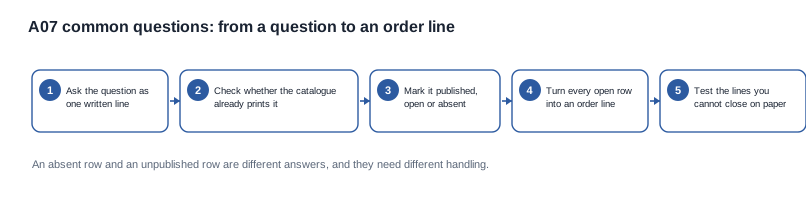
The distinction between open and absent is the one to get right. A row that is absent means the catalogue prints nothing on the subject, and the answer could be anything. A row that is open means the catalogue prints something but the condition attached to it is missing, so you have a figure but not its meaning. The twenty-hour rating is open. The absence of a function row is absent. Treating them the same produces two errors at once: publishing a rating as though it were a promise, and assuming a function that was never documented.
A question that has been asked once and not recorded is a question that gets asked again. Keep the answers as a register against your own specification, with the date and the source, because the source matters. An answer from the catalogue is durable. An answer from a supplier's sales conversation is durable only until somebody else asks it differently. And an answer from a measurement on a sample is durable only while somebody remembers which protocol produced it.
The register is where due diligence actually lives. A buyer who has eight questions answered and seven lines recorded has something that can be handed to a colleague, to an insurer, to a marketplace reviewer or to a distributor's technical team. A buyer who has eight answers in their head has a set of things to remember, and the set of things to remember is the first thing lost when a programme gets busy. Add to the register the total cost of closing the open lines — the testing, the samples, the rework and the artwork rounds — and the register becomes a document you can take to a range plan meeting rather than a set of notes you take to it.
A shortlist of the four questions to close before the artwork, if the order of the rest does not matter to you: the frame weight and the size range, because they decide the audience; the charge indicator behaviour, because it decides whether the routine is workable; the conformity route for each destination market, because it decides the launch date; and the function list for the exact model, because it decides what the packaging is allowed to describe. Close those four and the remaining questions are answerable in parallel without blocking anything.
What we will and will not say about this model
We can tell you what the A07 is published as: Bluetooth V5.4, a 70 mAh cell, a charge time of two hours or less, about 20 hours of rated use and magnetic charging. We can tell you that the catalogue prints no function row, no physical row and no per-model certification row for it, and we can tell you the app and firmware position for this tier is recorded as awaiting verification.
We will not describe this model as carrying the detection function or the lens arrangement of its siblings, because those rows are not published for it. We will not quote a weight, an age band, a size range, an ingress rating, a case capacity, a charge indicator or a certificate number that our documentation does not contain. We will not turn the twenty hours into a continuous-use claim or the two-hour ceiling into a measured figure, and we will not describe the company-level patent page as a conformity position for a model.
What we will do is tell you which of the eight questions above our documentation answers today, which come back to you as unknown, and which need a sample, a protocol or a testing body in your market. Send the programme, the buyer type, the volume and the required functions, and we will come back with what is documented and what is not. The range is on our kids smart glasses page, the comparison against the two-function alternative is in A07 versus A06, and the detection function is covered in posture monitoring.
Related reading
- Where this model sits against the two-function alternative — A07 versus A06
- How the detection function should be described — posture monitoring
- Kids smart glasses category overview — kids smart glasses
Send the programme, the buyer type and the required functions and we will come back with what is documented.


