

The charging question for the CY05 looks simple on a specification sheet and turns out to be anything but, because three of the rows a charging decision runs on are published and the fourth one — the one that decides the interface — is not. The catalogue publishes a 290 mAh frame cell, a rated use of about seven hours, a charge time of two hours or less and a 1400 mAh charging case. It does not publish how the frame charges. For a model whose case capacity is the largest published in the range, that single missing row sits underneath every other question in this article: what the customer plugs into, how long the carton takes, and whether the product can be sold to a channel that needs a Type-C frame.
So the approach below is not a ranking of charging options and not a recommendation. It is a set of branches, each one anchored to a published row, with the unresolved rows named as unresolved. A buyer who takes the branches in order ends up with a short list of measurements and a short list of written questions, which is what a charging decision actually needs before packaging artwork is signed off.
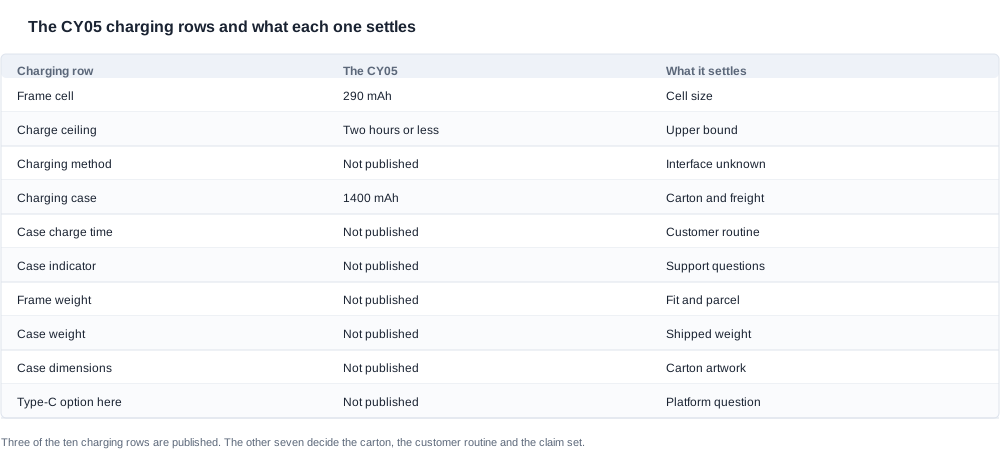
CY05 charging: what is published and what is not
Three published rows carry the whole of the CY05 charging story. The frame cell is 290 mAh. The rated use is about seven hours, and the charge time is two hours or less — a ceiling, not an average, which is a distinction that matters for every branch below. The charging case is 1400 mAh, which is the largest case capacity published anywhere in this catalogue and roughly five times the frame cell it recharges.
One row that a buyer would expect to find is missing, and its absence is structured rather than accidental. The charging method is not published for the CY05, and the same is true of exactly four camera models in the range: the MT6 and the CY05, and the CY03 and the L1 Pro. Every other camera model publishes either magnetic charging or a Type-C interface, so the CY05 is not in a class of its own — it is one of four models in a specific open position, and a buyer who has been told the interface is "magnetic" for this platform has been told something the catalogue does not say.
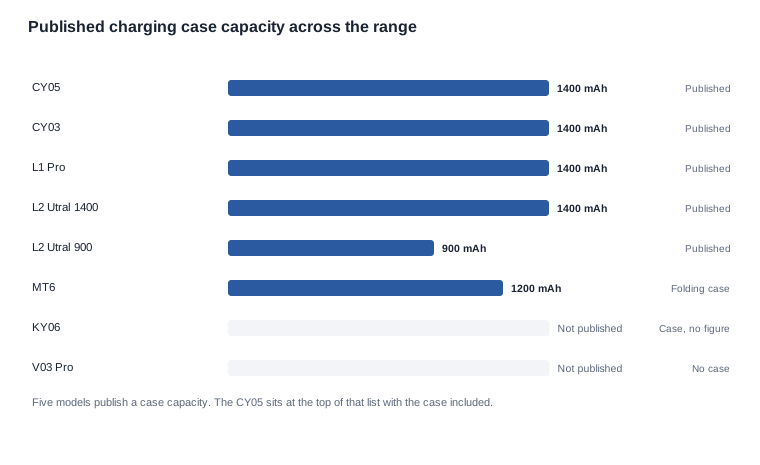
The case capacity has a second structural dimension worth noticing, because it changes how the case is discussed. Five models publish a case capacity: the L1 Pro and the CY05, and the CY03 — each at 1400 mAh, the L2 Utral at either 900 or 1400 mAh, and the MT6 at 1200 mAh in a folding case. Two further models — the KY06 and the MT5 — publish the existence of a case without publishing its capacity, and four models — the V03 and the V03 Pro, and the S7 and the V06 — publish no case row at all. That is three different case positions in one catalogue, and the CY05 sits in the first of them.
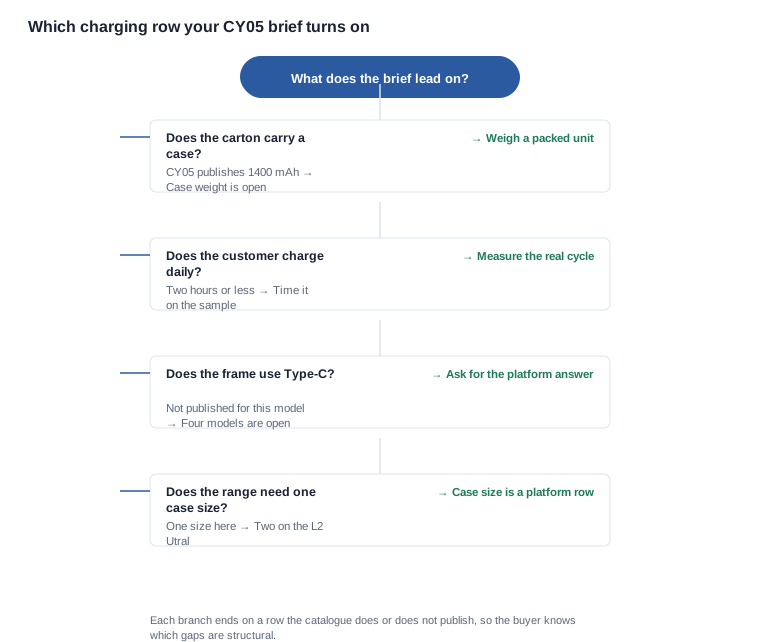
The branches in the decision tree follow from those rows rather than from a general impression of the category. If the brief leads on the carton, the published 1400 mAh case settles the size question and leaves the weight question open. If it leads on the daily routine, the two-hours-or-less ceiling has to be turned into a measured cycle on a sample before it means anything. If it leads on the interface, the row is simply not published and the answer has to be requested for the platform. If it leads on the range, the case size is a platform-level row rather than a per-model one, which means it has to be settled once for the whole range rather than model by model.

The four branches of a charging brief
Is the product sold to consumers as a single unit? If it is, the 1400 mAh case is a merchandising feature and should be photographed, described and priced in as part of the product rather than treated as an accessory. A customer who sees the case in the product image and finds a thin pad in the box reads that as a discrepancy, and a customer who sees the case in the box understands why the product lasts a day instead of charging nightly. The AI camera glasses packaging options piece covers how the carton has to carry that difference.
Is the parcel weight the binding constraint? If it is, the same case becomes a cost rather than a feature, and the arithmetic is unforgiving. A 1400 mAh case is roughly five times the frame cell, it ships in every unit, and it changes the packed weight, the volumetric weight, the freight class and the transport documentation at the same time. That makes it one of the largest single lines in the landed cost of a product that is otherwise a light electronic accessory, and it is invisible on a product page because it appears in the carton rather than in the specification. The AI camera glasses shipping weight analysis covers the parcel arithmetic.
Does the customer need to charge without the case? This is the branch where the unpublished charging method row bites hardest. The question is not academic: a customer who charges once a week, a customer who charges overnight, and a customer who charges between shifts are three different use cases, and only one of them is served by a case. The range publishes a Type-C route on other models — the L2 Utral is published with a Type-C frame and a case in either capacity, and the V03 Pro is published with a Type-C frame and no case — so a Type-C configuration exists as a pattern in this catalogue. What is not published is whether this platform offers one. That answer has to come in writing, for the platform and for this configuration, before the packaging is designed.
Is the product shared between several users? If it is, a case means a customer can hand the product over for a demonstration and have it ready again, while a pad means they have to find the pad. For a distributor running demonstration units, that difference is a logistics question rather than a feature question, and it changes the accessory list on every sample, every showroom unit and every trade-show unit in the plan.
How to evaluate the branches in order
The four branches are not equally forgiving, and the order in which they are walked matters more than it looks. The interface branch is the one to take first, because it is the only branch that can close a question rather than defer it: if the platform publishes a Type-C configuration for this model, several downstream questions resolve at once, because the interface, the case pairing and the charge-cycle measurement all become testable on a unit that exists. If the platform does not, the branch becomes a written request that has to be closed before the order, and every measurement that assumed an interface is on hold.
The carton branch comes second, because it decides the packaging lead time, and packaging is usually the longest item on the critical path once artwork is approved. The routine branch comes third, because a measured charge cycle needs the interface answered first. The sharing branch comes last, because it is a channel decision rather than a product decision and it rarely changes what is ordered. Evaluated in that order, a charging brief produces one written request and one measurement session rather than four parallel investigations, and it produces them in the sequence that unblocks the artwork.
What a 1400 mAh case changes downstream
The case is not a detail that sits beside the product. On this model it is the largest published capacity in the catalogue, and it propagates into four downstream areas that are usually costed separately and usually missed.
The first is the endurance story the product page can carry. A 1400 mAh case against a 290 mAh frame cell means a customer can plausibly get through a full day and top up once in the evening, which turns the published roughly seven hours from a spec-sheet number into a working routine. That is a legitimate claim to make from the published rows, provided the claim is phrased as endurance rather than as a charging convenience — the seven hours is a rated use, and nobody should present it as a measured runtime under a stated condition. The AI camera glasses battery comparison covers how the case column differs across the camera range.
The second is the parcel, and this is where the cost sits. A second lithium cell in every unit changes the shipping weight, the volumetric weight, the freight class and the transport documentation, and the air-freight permitted charge percentage can become a routing decision rather than a detail once a two-cell package is involved. A buyer who has not accounted for the case in the freight model has usually built the landed cost on the frame cell alone, which is the number that is published and therefore the number that gets used by default.
The third is the packaging itself. A 1400 mAh case needs a cavity, a lid and protection in the master carton, which makes it an artwork and tooling item rather than a print item. That has a lead time of its own, and it is the kind of item that is discovered late when the print artwork is already signed off.
The fourth is the failure mode the customer will experience. A case that ships with the frame has to survive transit, and the case is now a product with its own failure points: a charge indicator that may or may not be there, a connector, a hinge. Each of those is a potential return reason that did not exist when the product was a frame and a pad, and each of them is invisible in the published specification. The AI camera glasses charging case options analysis covers the accessory economics behind these decisions.
Where the Type-C question actually sits
Because the charging method row is open for four camera models, it is worth being precise about what the range does publish and what it does not, so that a buyer does not infer a platform answer from a neighbouring model.
What the range publishes is a spread: magnetic charging across the bulk of the models, Type-C across seven of them, and an open position on the CY05 and the L1 Pro, and the MT6 and the CY03. The four open models are not the cheap end and not the premium end. They are spread across the camera tier, and two of them publish the largest case capacity in the catalogue. The open row is therefore a documentation gap that runs through the middle of the range, not a signal that these models are configured differently.
The Type-C route that does exist in the range is worth studying for what it demonstrates rather than for what it implies. The L2 Utral publishes a Type-C frame with a case in either 900 or 1400 mAh, which shows that a Type-C frame and a published case are not mutually exclusive in this catalogue. The V03 Pro publishes a Type-C frame and no case at all, which shows the opposite pairing. Either arrangement is therefore possible at platform level, and neither is published for the CY05.
The practical consequence is a question rather than an answer, and it is a question that has to be asked for the platform rather than for the model: does this platform offer a Type-C frame configuration, and if it does, does it carry a case and what capacity is it published at. A buyer who assumes the answer from the L2 Utral risks designing a carton around an interface that this configuration may not use, and a buyer who assumes it from the CY03 risks the same error in the opposite direction, since the CY03 has exactly the same open row. Whichever way it resolves, the resolution belongs on the platform's written answer, not on a neighbouring model's specification.
The rows nobody has published
Everything about the charging interface itself is open for this model: the charging method, whether a Type-C variant exists on this platform, and how the frame and the case divide the charging job. Everything about the case beyond its capacity is open too — the case weight, the case dimensions, the case's own charging interface, the charge time for the case itself, and whether it carries a battery indicator.
These are not trivial gaps, and each one lands in a different place. The case weight and dimensions land in the packaging artwork and in the shipping weight calculation. The case's charging interface and its charge time land in the customer's weekly routine, because a case that refills in two hours and a case that refills overnight are different products for a user who charges once a day. The battery indicator lands in support, because a case with an indicator generates a different question pattern from a case without one, and the difference is visible in the first month of a programme.
Red flags and trade-offs in a charging brief
Three patterns in a charging quotation are worth naming before they turn into a carton rework. The first is an interface that is stated as a fact rather than as a published row. If a quotation says the frame charges magnetically, the buyer should ask which published row that came from, because for four camera models in this range no such row exists and the answer may have been carried over from a neighbouring model. The second is a case capacity quoted without a configuration. The L2 Utral publishes two capacities, and a brief that quotes one of them as "the case" has not described a configuration. The third is a charge time quoted as a typical value rather than as a ceiling; two hours or less is a limit, and a limit presented as an average understates the customer experience and overstates the charging convenience.
The trade-offs are real and they are not symmetrical. A heavier configuration buys endurance and costs freight; a lighter one costs the routine and saves the parcel. The published rows do not settle which trade-off a programme should take, because they do not price either side — and they are not the place where that decision belongs anyway. What the published rows do is bound the trade-off: they establish the size of the battery in the box, the ceiling on the charge cycle and the fact that the interface is open. A buyer who works from those three facts has enough to build a comparison sheet; a buyer who adds the sample measurements has enough to sign off artwork; and a buyer who adds the written platform answer has enough to place an order without carrying an assumption into the purchase order.
The chart above is the range context for the CY05's case, and it makes two points that are easy to miss. The first is that 1400 mAh is the top of the published list, so the CY03 and the L1 Pro, and the CY05 carry the largest published case in the range and the L2 Utral carries a smaller option of the same pair. The second is that the chart is not a ranking of anything that matters commercially — it is a map of what is documented. A model appearing at "no figure" is not a model without a case; it is a model whose case has not been documented, and the KY06 and the MT5 sit in exactly that position while the V03 Pro is published as having no case at all. Treating those three positions as one is how a range gets a carton designed for a case that the product does not ship with.
The frame weight is open as well, and the same care applies. The only published frame weight anywhere in this catalogue is the MT6's 158 g, which is the glasses body including its cell and its camera and excluding its folding case. That figure belongs to a different model with a 265 mAh cell, and it cannot be used as a proxy for the CY05's frame. A proxy that travels between models in a conversation is exactly the kind of number that ends up on a product page, so the weight has to come off the sample unit and be recorded with the configuration it was taken from.
Settling the charging brief before the packaging is designed
A charging brief is settled when every open row has a named owner and a named evidence source. The table below is the CY05 version, with the published side and the sample side of each row paired so that the review session has a definite agenda rather than an open brief.
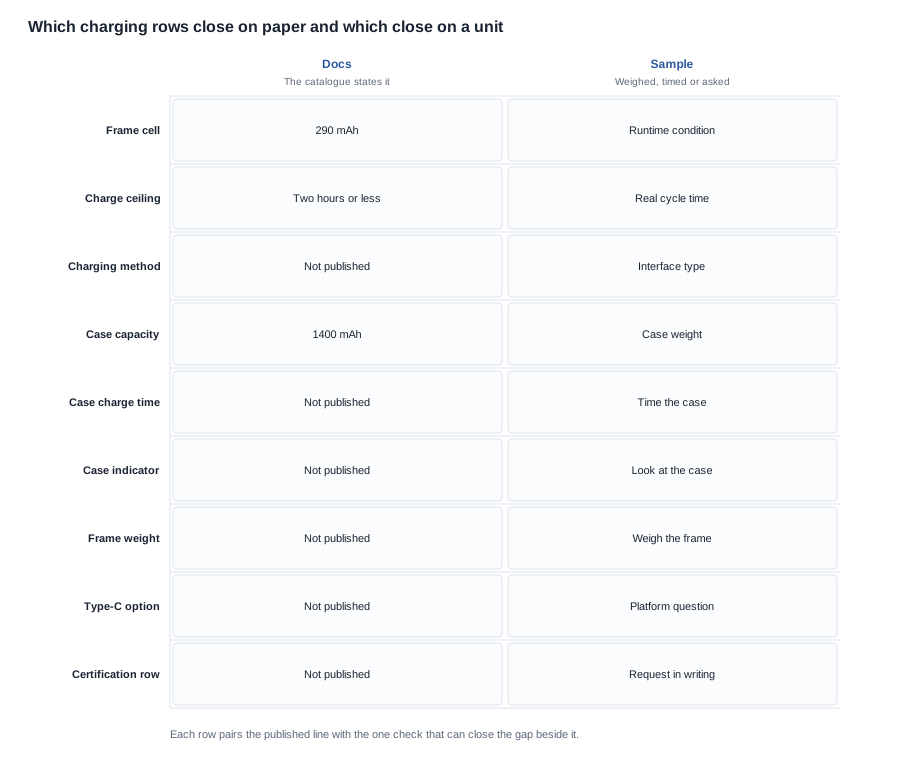
Five things have to be established before the packaging is designed, and each one has an owner:
- The charging interface for this configuration, in writing, naming the model and the configuration. Nobody can settle this on a sample, because a sample shows one interface rather than the platform's options.
- Whether a Type-C configuration exists on this platform, and if it does, whether it carries a case and what capacity that case is published at.
- The measured charge cycle, timed on the sample in the condition a customer will create, with the case in and out of the equation recorded separately.
- The packed unit weight and the case dimensions, taken off the sample while it is in hand, because nothing in the catalogue can produce them.
- The endurance condition behind the roughly seven hours, including what the camera was doing during the measurement, whether the Bluetooth link was active and whether the figure came from one unit or a batch.
The six-item CY05 charging request, and the criteria to apply before you commit
A charging request that goes to the supplier as a written list closes faster than one that goes as a description of a problem, and the due diligence value of the list is that every item on it has a named document behind it. The six questions below are the minimum that makes a CY05 charging brief reviewable: which published row states the charging method for this configuration, whether a Type-C configuration exists on this platform, whether it carries a case and what capacity is published at it, the measured charge cycle on a sample with the condition recorded, the packed unit weight and the case dimensions, and the cell test summaries for the frame cell and the case cell for the transport file. Ask all six in one request rather than in sequence, and attach the model designation and the configuration to the request so that the answer has to name what it applies to.
The trade-off in that list is deliberate: three of the six are unanswerable by the supplier in writing and have to be answered by a sample, which is why the sample review and the written request should run in parallel rather than in sequence. The remaining three are questions about documentation that the supplier holds, and they are the ones that decide whether the configuration can be sold in a given market. When the checklist is closed in that shape, the packaging decision is made on measured and documented inputs, and the product page is written from the same material.
On the CY05 charging configuration, our position is deliberately narrow. We publish the 290 mAh cell, the roughly seven hours rated use, the two-hours-or-less ceiling and the 1400 mAh case capacity, and we do not extend any of them into a claim the documentation cannot carry: not "two-hour charging" as a promise, not "magnetic charging" as an interface, and not a case weight or a case interface or a case charge time that nobody has published. The published CY05 specification list is the baseline for the model, and the CY05 versus CY03 price positioning analysis covers the range structure that both of these models share.
A charging decision that is made on the three published rows and closed on the seven open ones will not produce a better product claim than one made on a complete sheet. It will produce a carton that fits, a transport file that matches what ships, and a product page that says only what the documentation holds. That is the whole return on a review session.
Related reading
- What this model publishes — CY05 smart glasses specifications and features
- What the accessories cost — AI camera glasses charging case options
- The freight arithmetic — AI camera glasses shipping weight


