

AI camera glasses for ecommerce carry on four published rows and are blocked by five others, and the difference between the two sets is the difference between a listing that can be defended and one that cannot. A shipped consumer order depends on fulfilment rules you do not negotiate and on a returns rate you cannot forecast from a specification sheet, which is why the discipline in this channel is different from the discipline in a project channel. A project channel negotiates one customer's requirements. A consumer channel publishes one proposition to thousands of people at once and then answers for it.
Our catalogue publishes eleven camera models — the MT5 and the MT6, the L2 Utral and the V06, the L1 Pro and the V03, the KY06 and the V03 Pro, the CY05 and the S7, and the CY03 — and it publishes the rows that carry a listing and, just as importantly, the rows that stop one. The table below separates them.
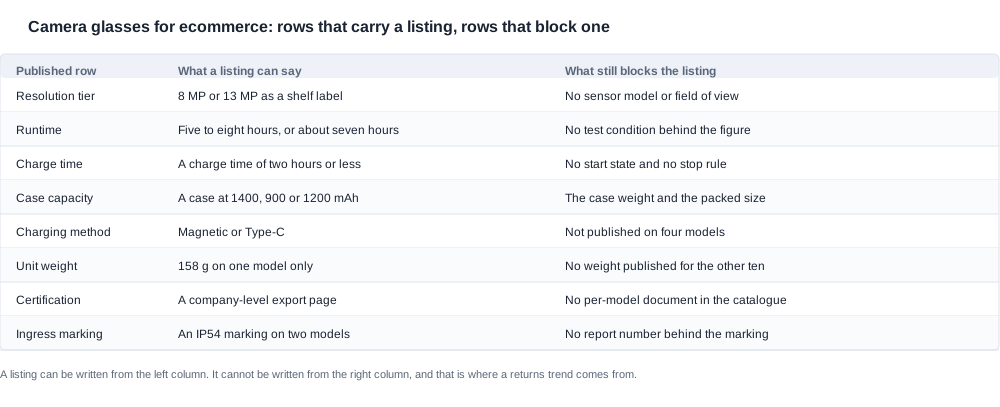
AI camera glasses for ecommerce: the rows that carry a listing
Four published rows do real work in a consumer channel, and it is worth being precise about what each one can carry, because a row that carries a shelf label cannot also carry a quality claim.
The resolution tier carries the shelf label. Eight of our eleven camera models publish 8 MP — the V03 Pro and the V03, the MT6 and the CY05, and the MT5 and the KY06, and the V06 and the CY03 — and three publish 13 MP, which are the L1 Pro and the S7, and the L2 Utral. A tier is a legitimate listing figure because it is a fact about the hardware that a buyer can check. What it cannot carry is an image quality claim, because no sensor model, no field of view, no video resolution and no frame rate is published for any camera model in the range. The AI camera glasses imaging reference sets out why the tier and the quality are different arguments.
The charging case carries the proposition. Five camera models publish a case capacity — the L1 Pro and the CY03, and the CY05 — each at 1400 mAh, the L2 Utral at 900 or 1400 mAh, and the MT6 in a 1200 mAh foldable case — and a case is what makes a "use it through the day" statement credible on a product page. It is also the largest single driver of the parcel, because a case is a second lithium item in every unit. The charging solutions reference covers the electrical side and the AI camera glasses charging case options piece covers the commercial one.
The runtime carries the endurance line. Published for every camera model in the range: 5 to 8 hours on the S7 and the V03 Pro, and the V06 and the V03; 6 to 8 hours on the KY06 and the MT5; about 7 hours on the L1 Pro and the L2 Utral, and the MT6 and the CY03, and the CY05. A consumer listing has to express this carefully, because the figure is a rating without a published test condition and appears as a band on some models and as a single value on others.
The charging method carries the in-box contents. Five camera models publish magnetic charging — the S7 and the KY06, and the MT5 and the V06, and the V03. Two publish Type-C — the V03 Pro and the L2 Utral, and both need no charging accessory in the box, which makes them the lightest parcels in the range. Four publish nothing at all — the L1 Pro and the CY05, and the MT6 and the CY03 — and those four are exactly the models that publish a case capacity, so their packaging cannot be finalised from the catalogue.
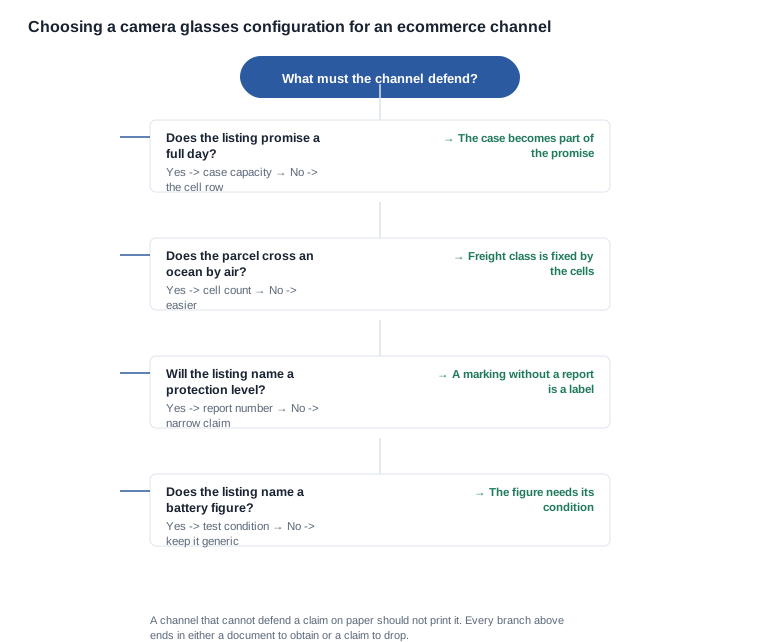
It is worth thinking about the structure of the page rather than only the claims, because the four rows land in different places. The resolution tier belongs in the title or the first line of the specification block, because it is the only published figure a shopper will compare. The charging method belongs in the bullet list of what is in the box, because it is what the shopper is deciding about. The runtime belongs in the endurance line, and it belongs there in its published form rather than in an inflated one. The case capacity belongs in the box-contents description, next to the picture of the accessory, because that is where the shopper's question actually is. A page that scatters these four across the description rather than placing each one where the question arises will convert less and defend no better.
The five constraints an ecommerce programme cannot negotiate away
The other side of the table is the set of rows that a consumer channel runs into and a project channel does not. These are not worse products; they are constraints that arrive with the channel.
The first is the freight rule. A shipped consumer order travels by whatever the channel's fulfilment terms require, and the parcel in this category contains one or two lithium items depending on the case configuration. The declared cell count and the capacity of each are what the carrier works from, and they are decided by a row on the product page rather than by anything the buyer negotiates at the point of sale. The battery transport reference covers what the second cell changes, and the shipping weight has to be measured rather than estimated because no camera model publishes a packed weight.
The second is the returns rate. A consumer channel cannot negotiate its returns rate, and a returns rate is made of reasons. A unit returned because the footage was not what the listing implied is a listing problem; a unit returned because a charging case failed is an accessory problem; a unit returned because the battery did not last the session is a specification problem. These three have different causes, different remedies and different costs, and a channel that logs them under one reason code will never see which of them is growing.
The third is the documentation requirement. A marketplace operator, a retailer's technical team and a customs authority will each ask for the file that covers the units they received, at whatever point they decide to ask. Our catalogue carries a company-level export certification page whose content is images rather than text — ten patent certificates, of which eight are appearance-design patents and two are utility-model patents — and the catalogue text contains no reference to CE, no reference to FCC and no reference to RoHS. There is no per-model certification row and no certificate number for any camera model, so the certification checklist is a request list rather than a source.
The fourth is the published weight. One figure exists in the entire range: 158 g for the MT6 glasses unit, including the battery and the camera and excluding the foldable case. For every other model the unit weight, the case weight and the packed weight have to be measured on a sample. A consumer listing that makes a portability claim has no published number behind it on ten of eleven models.
The fifth is the environmental claim. Two camera models carry an IP54 marking, the V06 and the S7, and no report number is attached to it in the source. Nine camera models carry no published marking at all. A channel that states a protection level for a model with a marking, and stays silent for the other nine, is making a claim that can be defended for two models and a non-claim for the rest — which is a defensible position, but only if it is written that way deliberately.

Building a listing proposition that survives a returns desk
The practical work is to build the proposition from the rows that can carry it and to remove the claims that the rows cannot. This is a removal task more than a writing task, and the removals are the part that takes judgement, because the claims that have to go are the ones that would have sold.
The method has four steps.
First, write every claim the page is going to make as a row before anything else. One line per claim, with the row that supports it beside it. A claim with no row is either dropped or converted into a question for the factory. In this category the claims that fail this test are predictable: image quality derived from a megapixel tier, endurance derived from a runtime rating, protection derived from a marking, and any weight, price or certification statement.
Second, decide which claims are supported by a document rather than by a published row. A published row is a fact about the product and can carry a shelf statement. A document is a fact about the product and the market and can carry a compliance statement. The difference matters when the channel is audited: the second kind survives an audit and the first kind survives a question.
Third, measure what cannot be published. The packed unit weight, the case weight and the packed dimensions have to come off a sample in the shipping configuration, including the case if one ships and the insert if one is used. Compare that with the volumetric weight of the master carton to see which governs the freight. A consumer channel that has not done this is pricing its freight on an estimate.
Fourth, write the failure into the page. Where a row is absent, the honest thing is to leave the claim out and let the specification speak, rather than to substitute a related figure. A page that says "13 MP" and nothing else about the camera is making a narrow claim that is true. A page that says "13 MP for crisp, detailed HD video" is making a second claim that no published row supports, and that second claim is what a returns desk will collect.

There is a commercial argument for the removal approach that is usually missed. The claims you remove are the ones that generate the returns. A returns reason code for "the video quality is not what the listing promised" is a cost that lands on the channel and is caused by a line that was written to move units. The margin gained on the page is smaller than the margin lost on the returns desk, and the second cost is invisible in the weekly numbers because it arrives as a mix shift rather than as a single line.
The same reasoning applies to the specification block rather than only to the marketing copy. A consumer channel publishes a specification table, and a shopper who compares it against a competitor's table will find that the competitor's table is longer. Longer is not the same as more defensible, and a buyer who cannot say where a figure came from is not in a better position than one who has fewer figures and knows the source of each. The rows that survive that test are the ones that also survive an audit, and in this category they are the electrical rows and the resolution tier — which is exactly the set our catalogue publishes for every camera model.
There is also a point about volume that a consumer channel gets right and a project channel gets wrong. A consumer channel is buying for a forecast rather than for a specification, so the commercial term that matters most is the one that survives a forecast error: the minimum order quantity, the packaging configuration and the freight basis all change when the forecast is wrong, and the returns handling cost changes when the forecast is wrong in the other direction. A channel that negotiates its quotation on unit price alone is negotiating the wrong variable for the risk it actually carries.

The five questions a consumer channel cannot answer from a catalogue
These are the questions that decide whether a consumer proposition in this category can be built at all, and they are worth settling before a range is planned rather than after a listing is live.
- What is the packed unit weight of the shipping configuration? It sets the freight, the storage and the delivery promise, and it is published for no model.
- What is the charge time measured from, and to what state? The catalogue publishes two hours or less for every camera model, which is a ceiling without a starting state or a stop rule. A channel making a turnaround promise needs the test protocol.
- What does the unit record, for how long, and where does the file go? Storage capacity, container format, overwrite behaviour and the transfer path are published for no model, and storage exhaustion is one of the most common causes of a returned camera product because it is indistinguishable from a fault.
- Which document covers the model for the market the channel sells into? Model-named documents have to be requested per model and per market, and they are what an audit asks for.
- What does the channel do with a unit whose specification it cannot verify? The honest answer is that it should not make the claim. That is a commercial decision as much as a compliance one, and it is much cheaper to make before a page goes live.
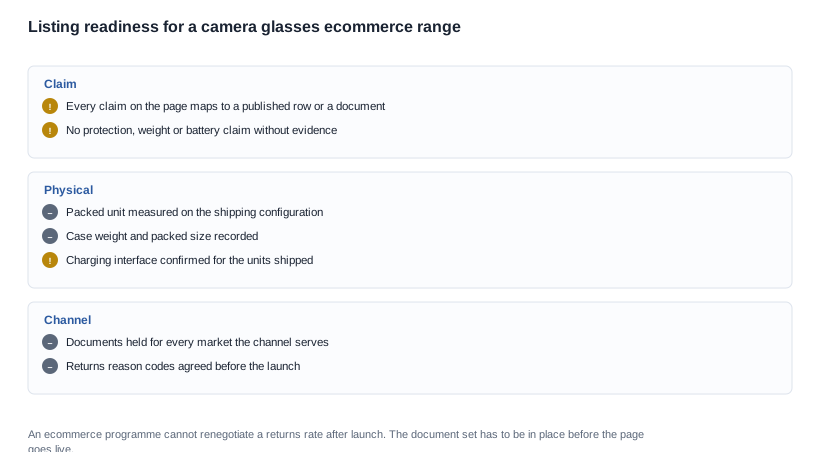
The channel-facing counterpart is a returns reason code set. Five codes — specification not as described, power or endurance, accessory failure, transfer or storage, and a defect — are enough to make the first hundred returns readable, and they cost nothing to set up before launch. The alternative is to open a consumer channel with a single returns code and spend a season discovering what was actually happening.
There is a second structural limit that sits behind all five of the constraints above, and it is the one that decides the range rather than the listing. A consumer channel that carries two models carries two specification sets, two return profiles and two freight profiles. The published rows make that visible: two camera models carry the ingress marking and nine do not; five publish a case capacity and six do not; four publish a charging interface and seven do not. A range built on one model is a simpler programme to document, to ship and to support, and the second model has to earn its place against that. The test is not which model sells better in the abstract, it is which second configuration the team can document well enough to defend, and the published rows are the best available guide to which configuration that will be.
The boundary between a listing claim and a document
We will tell you exactly which of our published rows can carry a listing claim, and we would rather a page say less and be defensible than say more and be challenged.
What we publish for the eleven camera models: the frame cell capacity, the rated runtime as a band or a single value, the charge time at two hours or less for every camera model, the resolution tier, the charging method for seven of the eleven, the case position in all four of its states, the IP54 marking on the V06 and the S7 with no report number behind it, and one unit weight in the range at 158 g for the MT6 glasses unit excluding its foldable case. Each of those can carry a shelf statement. Each of them can carry a compliance statement only if a document supports it, and for the certification rows no such document is published by us.
What we do not publish, and will not supply as a basis for a listing: any sensor model, field of view, video specification or frame rate; any unit weight for the other ten models; any packed weight, case weight or case dimension; any certificate number, report number or issuing body; any UN 38.3 summary; and any price, MOQ, lead time, production capacity or warranty period for any camera model. We publish no market size, no market share and no sales ranking for this or any other category.
The claims we will not write on a page, for our own products or anyone else's: that a megapixel tier is an image quality figure, that a runtime rating is a working day, that an IP54 marking is a tested rating, that a company-level export certification page covers a model, or that a charge time of two hours or less means under two hours. Each of those is a claim the published material does not support, and in a consumer channel an unsupported claim is a returns reason.
The escalation path is worth knowing before it is needed, because the cost of answering a challenge rises with every week it sits. A shopper's question about whether the published tier matches the footage is answered in a day. A marketplace listing review is answered in a week and usually requires a document. A customs authority's query is answered with a file and a timeline, and it stops a shipment while it is open. A retailer audit arrives later still and asks for the documents covering the units that were received, not a general assurance — which means the file has to have been retained against the units, not merely obtained. The practical consequence is that the document set is a record-keeping obligation rather than a one-off procurement task, and the retention arrangement should be agreed with the supplier at the same time as the document request.
What we can do is help build the proposition that the evidence supports. Send us the channel, the markets, the volume and the case configuration you intend to ship, and we will tell you which published rows can carry the listing, which claims have to be removed or qualified, what has to be measured on a sample, and which documents have to be requested from the factory before the page goes live. The range is at AI camera glasses, and the commercial structure of the range is in the price comparison and the buying guide.
Related reading
- The in-box decision — AI camera glasses charging case options
- The second cell in the parcel — battery transport
- The document set — certification checklist
Send us the channel, the markets and the case configuration, and we will tell you which published rows can carry the listing.


