

An AI camera glasses price comparison is usually requested as a table of figures and delivered as a ranking. That table cannot be produced honestly by a supplier who does not publish prices, and it is not the most useful object for a buyer in any case, because the number in the table is a total while the decisions behind it are structural. What this article does instead is set out the comparison that can be built from published specification rows: which groups of AI camera glasses are like-for-like, which differences between two quotations are structural rather than commercial, and which lines belong on a quotation before any two numbers are placed side by side. We do not publish prices, price tiers, unit prices or minimum order quantities, because our documentation does not contain them, and the section on where our published position stops explains why a comparison built this way is more defensible than one built on numbers we would have to estimate.
AI camera glasses price comparison: what the comparison is actually made of
The phrase "price comparison" is doing two jobs at once in this category, and separating them is the whole point of the article.
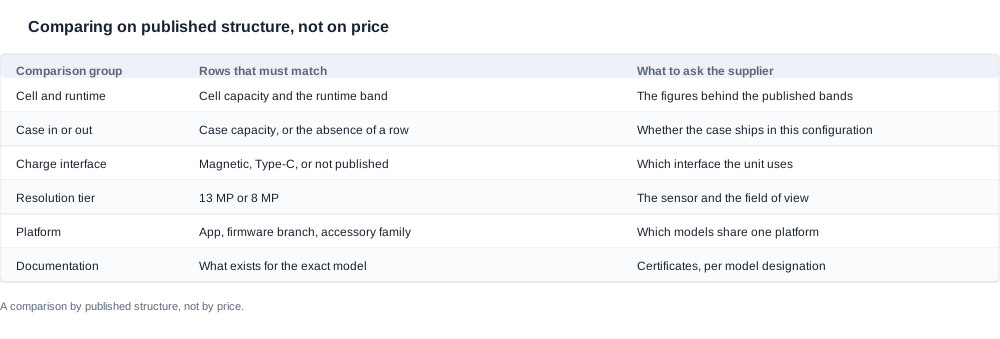
The first job is grouping: deciding which models are close enough that a buyer could order either of them for the same commercial purpose. That job is entirely answerable from published rows. The eleven camera models divide cleanly by resolution tier, by charge interface, by charging-case position, by cell capacity and by runtime band, and each of those divisions tells you something about what a unit does. A buyer who groups first and prices second avoids the most common mistake in the category, which is comparing a model with a charging case against a model without one and reading the difference as supplier margin.
The second job is ranking: saying which of them costs less. That job requires a unit price, a minimum order quantity, a configuration and a set of commercial terms, none of which our catalogue publishes. It also requires something else that no catalogue publishes, which is the other supplier's terms for the same configuration.
So this article answers the first job completely and answers the second job by substitution: instead of ranking models, it identifies the variables that make two quotations differ, so that a buyer can ask for each of them explicitly and then read the returned quotations against a common structure. The title's "price comparison" is meant in exactly that sense — a comparison built from cost drivers, not a table of prices.
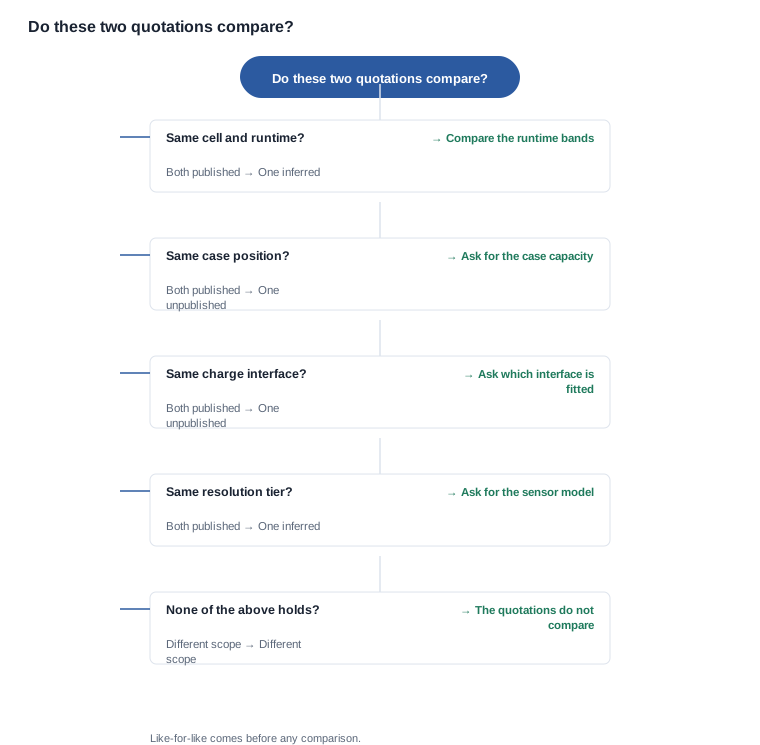
There is a practical reason to prefer this framing. A quoted unit price is a number that changes with quantity, configuration, packaging, artwork, tooling and payment terms, and a buyer comparing two numbers produced under different assumptions is comparing two different objects. A structural grouping, by contrast, is stable: if two models publish the same cell capacity, the same runtime band, the same interface position and the same case position, then a difference between their quotations is a difference in the commercial terms, and a buyer can go straight to the term that explains it. The AI camera glasses charging case options piece covers one of these variables in detail, and the OEM ready platforms pricing tiers piece covers how a multi-SKU commercial structure is built around a shared platform.

The cost drivers a buyer can trace to a specification row
Five drivers of the final landed cost can be traced, in whole or in part, to a row our catalogue publishes. They are listed here in the order a buyer should settle them, because the first two change the configuration and the last three change the lines around it.
The charging case. A case is a second lithium cell in the unit. Five camera models publish a charging-case capacity: the CY03 and the L1 Pro, and the CY05 — each at 1400 mAh, the L2 Utral at 900 mAh or 1400 mAh, and the MT6 at 1200 mAh in a folding case. Six publish no charging-case row at all. That distinction is the single largest structural divider in the range, because a case changes the packed weight, the freight class, the battery transport documentation, the warehouse volume per unit and the customer's charging routine. It also changes the accessory supply chain the buyer has to stand up, and the AI camera glasses shipping weight piece covers why the packed weight cannot be derived from the catalogue.
The charge interface. Two camera models publish a Type-C port, the V03 Pro and the L2 Utral. Five publish magnetic charging. Four publish no interface at all, and those four are precisely the models that publish a case capacity. An interface difference is a small thing to a buyer and a large thing to a channel: one cable across the range is a different accessory policy, a different insert and a different support script from two interfaces, and it is a line on the quotation that separates suppliers who have thought about it from suppliers who have not.
The resolution tier. Three camera models publish a 13 MP row and eight publish an 8 MP row. The commercial significance of a resolution difference is genuinely limited — the AI camera glasses competitor landscape piece covers why a resolution figure is easier to sell than to defend — and its commercial significance is not in the sensor at all. It is in the requirement the listing makes, and therefore in how hard the tier is to substitute.
The platform. A range built on one platform shares the companion app, the firmware branch, the accessory family, the conformity file and the artwork, so each additional model in the range costs a fraction of the first. A range assembled from several platforms pays that setup several times. Nothing in our catalogue publishes a platform grouping, so this driver is a question for a supplier rather than a row — but it is the driver that decides whether a range is affordable, and the OEM ready platforms which models are ready piece covers how a platform view changes the shortlist.
The documentation set. There is no per-model certification row in our catalogue. The company-level export certification page carries images rather than text, and the catalogue text contains no reference to CE, FCC or RoHS. So the documentation position is identical for every model in the range, and it is the one variable a buyer is most likely to be quoted a verbal assurance about. The O-series compliance analysis piece covers what the evidence has to look like.
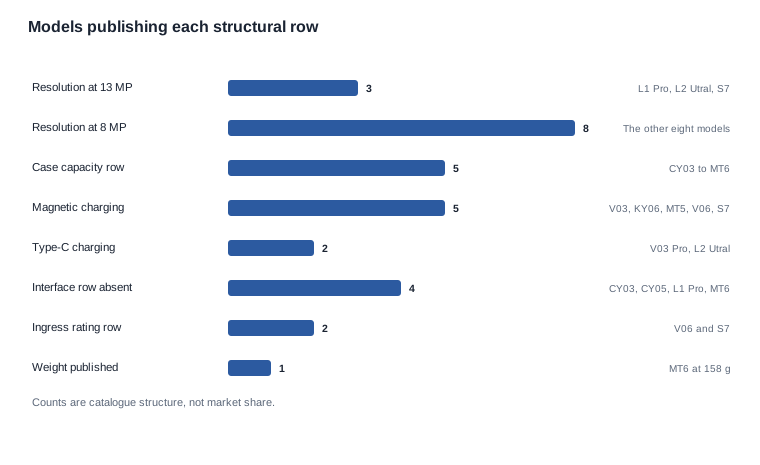
A sixth driver sits outside all of these and deserves separate treatment: the parcel. No frame weight is published for any camera model except the MT6 at 158 g, excluding its folding case; no case weight is published anywhere; and the carton, the insert and the master carton are unpublished too. The freight rate is calculated on the greater of actual and volumetric mass, so this is the driver most likely to produce an invoice that differs from the plan, and it cannot be closed from a catalogue at all.
Questions to ask before two quotations can be compared
A quotation is comparable when the lines beneath it are comparable. The checklist below is the set of lines to ask for, in the order that makes them easiest to obtain, because each one is easier to answer once the configuration is fixed.
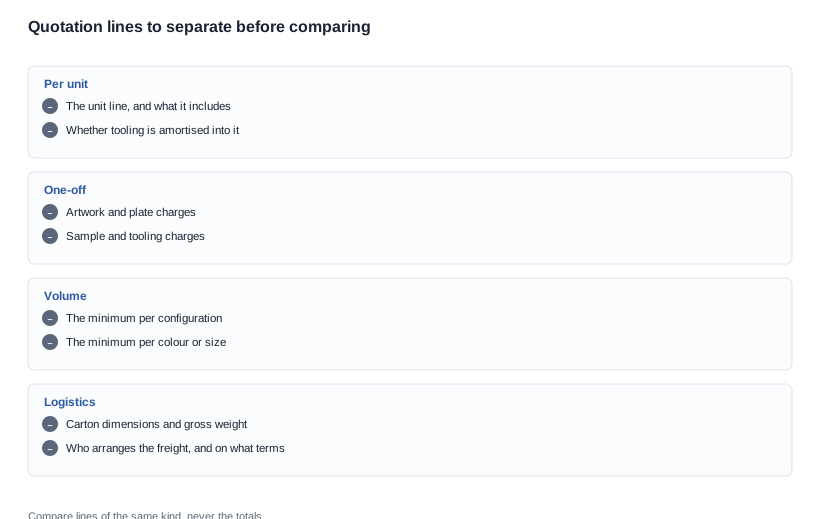
The configuration line. Ask which model designation, which case position, which interface position, which colour and which artwork version the quoted number covers. If the supplier answers with a model family, the number does not cover a purchasable object and the comparison cannot start.
The quantity structure. Ask for the minimum per configuration and the minimum per colour or size, separately, and ask whether they are the same number. In a range where one model carries a case and another does not, a single minimum across the range is either inconvenient or hidden, and both are worth knowing before the first order rather than after it.
The one-off lines. Ask what is charged once: artwork and plate preparation, sample and tooling charges, certification-related work, and anything else that sits outside the unit. Ask specifically whether tooling is amortised into the unit figure or charged separately, because a quoted unit that quietly includes a one-off is misleading at a second order where that one-off does not recur.
The logistics lines. Ask for the packed unit weight and dimensions, the carton quantity and the carton dimensions, and the freight terms, including who arranges the shipment, on what incoterm, and who carries the risk at each point. The AI camera glasses bulk ordering piece covers where a freight measurement belongs in a production sequence.
The terms. Ask for the payment terms, the deposit structure, the delivery schedule against each configuration, the warranty position, and the defect and returns policy. None of these is published in our catalogue, and each one is a line a buyer can negotiate, which is exactly why they belong on the list before any comparison is attempted.
The validity. Ask how long the quoted figures hold, and what changes them. A quotation without a validity period is an opening position, and a comparison built on opening positions is not a comparison at all.
Six questions, then, and the answer to each is a line the buyer can compare. Where a supplier declines to answer one — and some will, because each of these narrows the work they have to do — that refusal is itself a data point about the quotation, and it belongs in the comparison.

Reading a returned quotation against the published rows
A quotation arrives as a list of lines, and the work of comparing is really the work of attributing each line to a cause. The published rows give you a fixed reference to attribute against, which is worth more than it sounds: a buyer with no reference points ends up reasoning about which explanation is more plausible, and with two suppliers that reasoning is where the mistake happens.
The procedure is short and it is repeatable.
First, map every line to a model designation. A quotation that names a product family rather than a designation cannot be mapped, and that fact alone should stop the comparison until it is resolved. Where the designation is one of ours, write the published rows beside it on the same line: cell capacity, runtime band, charge time, interface position, case position, resolution tier. You now have a table with two columns of meaning rather than one column of figures.
Second, check the quotation against the rows it should contain. A quoted configuration that includes a charging case should correspond to one of the five camera models that publish a case capacity, and a quoted configuration with a Type-C cable should correspond to one of the two that publish a Type-C port. Where a quotation includes an accessory that the published rows do not support for that model, ask which accessory it is and whether it is a supplier addition. That question catches substitutions, which are invisible in a summary table and expensive later.
Third, attribute the difference. For each pair of lines that differ, name the variable responsible: case position, interface, resolution tier, platform, quantity, one-off work, packaging version, freight terms or payment terms. Write it in a column beside the figures. Once every difference has a name, the negotiation has an agenda and the rows that remain unnamed are the rows that need a supplier question rather than a buyer decision.
Fourth, mark what you do not know. Where a supplier has given a figure without a basis — a packed weight that was not measured, a freight estimate with no carton dimensions, a lead time with no configuration behind it — write "not stated" rather than accepting the figure provisionally. A comparison built on provisional figures is a comparison with invisible assumptions in it, and the assumptions are exactly where the disputes come from.
The discipline that makes this work is simple: never carry a figure forward without a cause attached to it. The AI camera glasses market trends piece covers the related habit of refusing a number that arrives without a scope, and the cy03 against cy05 price positioning piece shows what happens inside one tier of the range when two models are treated as interchangeable and are not.

A comparison walkthrough for a multi-SKU range
The following is a hypothetical comparison, written to show the decision sequence rather than to report a result from a client project.
Assume a brand that already sells a small range of camera glasses has been quoted by two suppliers for an extension of that range, and has been handed two summary tables with a figure on each model. The brand's first task is to decide whether the tables can be compared at all.
The brand does not attempt that comparison. It writes down the four structural variables that matter to its channel — case position, charge interface, resolution tier and platform — and asks both suppliers to restate their range against those four. One supplier's range turns out to be a single platform with a consistent interface position; the other supplier's range spans three platforms, and the model the brand had quoted first is the one with the unpublished interface. The brand now knows that the two tables are not two views of the same offer.
The second step is to identify what the tables were silently including. The brand asks for the one-off lines and discovers that one supplier has folded artwork preparation into the unit figure for the first model and not for the others. It asks for the minimum per configuration and per colour and discovers that one supplier's minimum applies across the range while the other's applies per configuration. It asks for the packed weight and carton dimensions and discovers that neither supplier has measured them on a packed sample, which means the freight line in both tables is an estimate rather than a figure.
The third step is to rebuild the comparison as a request for a like-for-like quotation. Instead of asking which supplier is cheaper, the brand asks both to quote one configuration, at one quantity, with one packaging version, on stated payment terms, with a stated validity period, and with the freight terms named. That request is much easier for a factory to answer correctly than a request for a discount, and it produces two documents that can be read against each other line by line.
The fourth step is to take the unresolved lines back to both suppliers as a single list: the packed weight and carton dimensions measured on a sample, the charge interface for the models where it is not published, the case weight for the models where the capacity is published, and the certificate numbers covering the exact designations being ordered. The answers arrive at different levels of detail, and the difference in detail is itself the most informative output of the exercise.
The outcome is a comparison that the brand can act on: not a ranking, but a structure in which each difference has a named cause, and in which the four unresolved lines are known rather than assumed. The AI camera glasses entry level options piece covers how the lower end of a range is usually approached, and the OEM ready platforms scaling up piece covers what adding a model to a platform actually costs in setup terms.
Where our published position stops and the quotation begins
On AI camera glasses price comparison, our position is that a comparison in this category is a cost-driver exercise, and that the published specification rows are what make it one. We publish the electrical rows for twenty-eight models, eleven of them camera-equipped, and for those eleven we publish the resolution tier, the cell capacity, the rated runtime band, the charge time, the charge interface where it exists and the charging-case capacity where it exists. Those rows are enough to group the range, to identify the variables that separate two quotations, and to write the questions that close the gaps.
We do not publish a unit price, a price tier, a minimum order quantity, a lead time, a production capacity or a warranty period, and we do not publish a landed cost. That is not a gap in the catalogue; it is the boundary of it. An estimate that becomes a quotation is worse than an open question, and a comparison built on numbers we would have to invent would be a comparison that fails the first time a buyer checks it against a real one.
The second half of our position concerns what a buyer should require from any supplier, ourselves included. The unit line and what it covers, the one-off lines and whether tooling is amortised, the minimum per configuration and per colour, the packed weight and carton dimensions measured on a sample, the payment terms, the delivery schedule, the warranty position, the defect and returns policy, and the validity period of the quotation — those are the lines that turn a comparison from an opinion into a document. The AI camera glasses battery comparison piece covers the endurance rows in full, and the AI camera glasses buying guide piece covers how to narrow the range before the comparison starts.
Send us the models you are comparing, the configurations and the destination markets, and we will tell you which published rows apply to each configuration and which rows you will have to obtain in writing before the two quotations can be read against each other.
Related reading
- Deciding the range — AI camera glasses buying guide
- The accessory that decides the cost — AI camera glasses charging case options
- The parcel arithmetic — AI camera glasses shipping weight
- The endurance rows — AI camera glasses battery comparison
- The production sequence — AI camera glasses bulk ordering
- Which models are ready — OEM ready platforms which models are ready
- The commercial structure — OEM ready platforms pricing tiers
- Adding models later — OEM ready platforms scaling up


