

The mistake in a bulk order for this category is almost never the unit price. It is pricing the frame and forgetting the case, because the case is the heaviest item in the box, a second lithium cell with its own transport documentation, and a different freight class. A second error follows closely: pricing from a frame weight when the freight class is set by a packed unit. AI camera glasses bulk ordering is therefore a sequencing problem before it is a negotiation problem, and the sequence below puts the landed cost ahead of the purchase order rather than after it. It is written for a procurement lead who has to defend the number to a finance team, not only to a supplier.

AI camera glasses bulk ordering: the sequence and where it usually breaks
Seven stages, and each one has an output that the next stage consumes. A stage with no output is a stage that has been skipped, and in this category the skipped stages are always the same ones, because they are the ones that cost nothing to skip on the day and a great deal later.
Stage one, fix the configuration. The model, the colourway, the case configuration, the packaging contents and the destination market. Every one of those is a variable that changes the cost, and in this range the case choice is the largest. The CY03 and the CY05, and the L1 Pro each publish a 1400 mAh case. The L2 Utral publishes either 900 mAh or 1400 mAh, which is the only case choice published anywhere in the range. The MT6 publishes a 1200 mAh folding case. The KY06 and the MT5 publish a case without a stated capacity. The V06 and the V03, and the S7 and the V03 Pro publish no charging-case row at all. That distinction matters: a missing row is a question to put to the supplier, and until it comes back answered the case position is not a design fact you can plan a carton around.
Stage two, obtain a production-revision sample and weigh the packed unit. Not a marketing unit and not a showroom unit — the unit that is the production revision, with the packaging that will actually ship. A frame weight is not a shipped weight, and a shipped weight is not a freight class, because the freight class is set by the packed unit: frame, case, retail carton, master carton, void fill and the outer case count.
Stage three, price the landed cost from the measured weight. This is where the sequence either holds or collapses. A landed cost built on an assumed weight is not a landed cost; it is a guess with a currency symbol on it, and it is the guess most likely to be wrong, because the case is the item nobody weighs before ordering.
Stage four, freeze the artwork, the model number and the marking together. These three are one decision. A model number that changes after the artwork is approved invalidates the artwork, the marking, the conformity file and the label approvals, and each of those has a turnaround that a launch date then has to absorb.
Stage five, get the commercial terms in writing against a fixed configuration. A quotation that is not tied to a named model, a named case option, a named packaging and a named quantity is not a quotation. It is an opening position, and it will be renegotiated at the worst possible moment in the programme.
Stage six, agree a pre-shipment inspection against the written specification. Agreed before the production slot, not after the batch is finished. An inspection plan written after the goods exist is an inspection plan that inspects what is there.
Stage seven, assemble the conformity, traceability and battery transport papers. This is the longest-lead item in the file and the one most often started last, because it depends on decisions taken in stages one to four and on test reports that take time to produce.
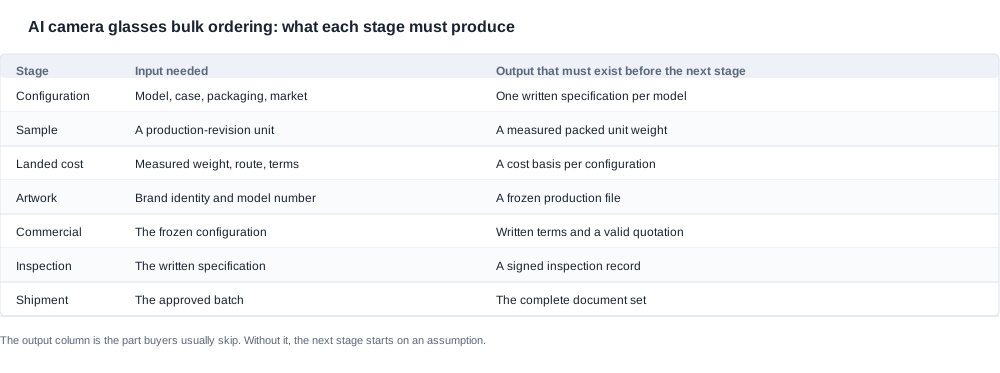
Where the sequence usually breaks, in practice. Three failure points account for most of the programmes that go wrong, and they are worth naming because each is avoidable at a known stage. The first is stage two: the sample is approved as a product, not weighed as a parcel, and the freight number is invented later. The second is stage four: the model number moves after the artwork is with the printer, and the whole file restarts. The third is stage seven: the battery documentation is assembled after the production slot is booked, and the transport paperwork then becomes the item that delays the shipment. None of the three is a supplier problem. All three are sequencing problems, and all three are decided by the buyer.
The reason to fix the configuration before anything is priced. In this range the configuration is not a cosmetic choice. Two models publish a Type-C port — the V03 Pro and the L2 Utral. Five publish magnetic charging — the KY06 and the S7, and the V03 and the V06, and the MT5. Four publish no charging interface row at all — the CY05 and the MT6, and the CY03 and the L1 Pro, and all four of those do publish a case capacity. A Type-C product ships with a cable and no proprietary accessory; a magnetic product needs a case or a pad; a model with a case and an unpublished interface needs a question answered before the packaging can be designed. Fixing the configuration first is what makes every later number a real number.

The landed cost problem a case creates before a price is quoted
The cost drivers in a camera glasses programme are structural, and four of them are visible in the published rows even before a supplier is approached. A buyer who builds the landed cost from the unit price and the published cell capacity will still get it wrong, because the parcel weight is set by the accessory and the documentation burden is set by the number of cells.
Driver one, the second cell in the parcel. A shipped case is a lithium cell in a box, in a carton, in a master carton, in a vehicle, and in a warehouse. That single fact creates a second line of battery transport documentation, a second UN38.3 test summary if the case cell is a separate cell from the frame cell, and a different packaging and marking treatment. In a range that mixes configurations, the number of separate cell types in a parcel is a number that has to be tracked, because it is the number of documents.
Driver two, the interface. A Type-C configuration needs no charging accessory in the box, which removes an accessory line, a spare-parts line and a second packaging variant. A magnetic configuration needs a landing surface, and if that surface is the case then the case becomes a hardware item with its own supply line and its own failure rate. The charging case options analysis sets out the case positions model by model, and it is the right starting point for the accessory programme.
Driver three, the model split between magnetic and Type-C. A range that mixes both has two different parcel architectures by design, and the master carton has to be counted for each. This is a real cost, but it is also avoidable: a range built on a single interface has one packing instruction, one carton, one void-fill specification and one inbound receiving procedure. A procurement lead evaluating two models should treat a shared interface as a benefit, even when the catalogue makes it invisible, because the packaging is where the silent duplication happens.
Driver four, the weight that only one model publishes. The MT6 is the only model in the whole catalogue with a published weight — 158 grams for the glasses body, including the cell and the camera and excluding the folding charging case. The case weight is not published. That single figure is genuinely useful as an order of magnitude for the frame, and it is useless as a parcel input, because the parcel is decided by the frame plus the case plus the packaging, and the case is exactly the part that is not published. Buyers should be careful here: the temptation is to take 158 grams and multiply it, and the reason not to is that the 158 grams excludes precisely the item that dominates the parcel.
What to measure, and when. Four measurements, taken on a real packed production-revision unit, and taken before the purchase order rather than after: the packed unit weight including the case and retail carton; the master carton gross weight at the agreed quantity; the master carton external dimensions, which drive the container calculation; and the count of units per master carton, which is a packing decision rather than a measurement. These four numbers are the input to a freight quotation, and the shipping weight breakdown covers the arithmetic and the parcel components in detail.
The rule that keeps the landed cost from drifting. Every number in the landed cost has to trace to one of three places: a measured figure with the method recorded, a written supplier statement, or a published catalogue row. A fourth category — a plausible estimate — is where landed costs go wrong, and the usual symptom is a quotation that cannot be reproduced three weeks later by a different person on the same team. The battery transport compliance notes set out the document chain that the cell count determines, and the export documentation checklist covers the shipment set.

The specification file that has to exist before artwork is approved
The single most common defect in a private-label camera glasses programme is that no one wrote down what was approved. The sample was approved, the photograph was approved, the rendering was approved, and somewhere between those and the purchase order there was never a document that said, in words, what the product is. That is what the specification file is, and in this category it has to carry more than a product description.
The rows the specification file has to contain for a camera model. The model designation exactly as it will appear on the marking and in the conformity file. The camera resolution class. The frame cell capacity and the rated runtime, both as published values with no normalisation applied. The charging interface, where the catalogue publishes one, and an explicit open flag where it does not. The charging case configuration, including the case capacity where published, the case state where the catalogue publishes a case without a capacity, and the open question where there is no case row. The colourway. The packaging contents. And the firmware version, which is the row most often skipped and the one that turns a support ticket from a description into a diagnosis.
The rows the supplier has to add. The sensor, the field of view, the video resolution and the frame rate. The frame weight with the cell fitted. Whether the charging interface exists on models whose catalogue entry does not publish one. The case capacity for the models that publish a case without a number. The ingress position for models other than the V06 and the S7, which are the only two camera models in the catalogue with a published IP54 marking. The Bluetooth version, which the catalogue does not publish for any camera model. The per-model certification scope. And the measured packed unit weight, which is stage two's output and belongs in the file before the artwork is approved rather than after it.
Why the file has to be versioned and signed. A specification that exists in a chat thread is not a specification, because a chat thread has no state and no owner. The file needs a version, a date, a name against it, and a statement of which catalogue rows it draws on and which supplier statements it adds. That last part is the mechanism that keeps a procurement file honest: every row in the file is either published or supplied, and a buyer can see instantly which is which. The OEM ready brand guidelines covers the identity mapping step that catches an unproducible brand identity before it reaches the artwork, and the packaging design reference covers the insert and the carton.
The artwork dependency that catches people. The packaging has to state the model number, the electrical ratings, the charging instructions, the country of origin, the economic operator and the responsible person details, the conformity marking, the traceability marking and the battery warning. Each of those pulls from a different stage of the programme. If the artwork is approved before stages two, four and five have produced their outputs, then the artwork is a guess with ink on it, and the corrections after that point are reprints rather than edits. The rule is simple to state and hard to follow: nothing goes to print until the specification file is signed, and the specification file cannot be signed while the charging interface is an open question.

The commercial terms we will not publish and you should not accept unsigned
There is a set of numbers that every buyer in this category wants, and our documentation does not contain any of them. We publish no unit price, no price tier, no minimum order quantity, no lead time, no production capacity, no warranty term, no tooling charge, no customisation fee and no sample fee. We are not withholding them. They are not in the catalogue, and inventing them would be worse than useless, because an invented number that turns into a quotation becomes a commercial dispute with a fabricated history.
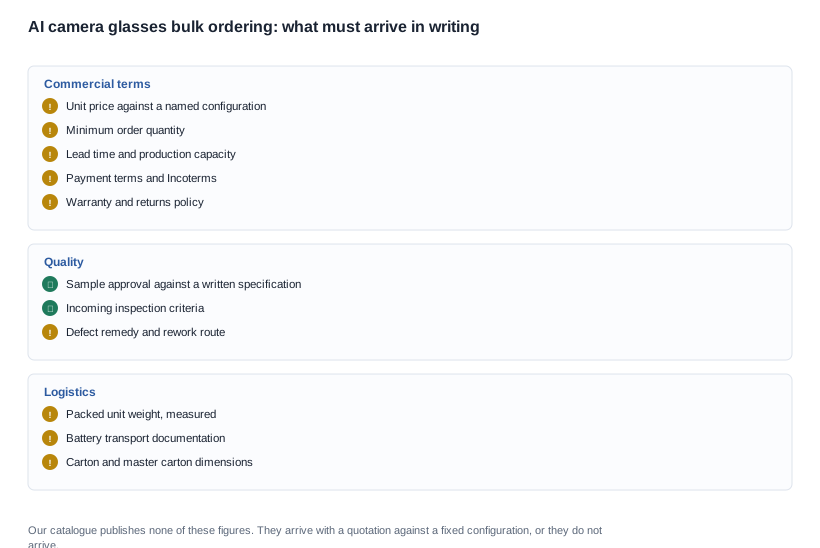
What has to arrive in writing instead, and in what form. The unit price, against a named configuration — model, case option, colourway, packaging and quantity all stated. The minimum order quantity for that configuration, per model and per case option, because in this range a model with a case and a model without one are not the same order. The lead time, and the production capacity behind it, so a second order is not a surprise. The payment terms and the Incoterms, since a deposit percentage and a delivery term change the cash position and the risk transfer independently. The warranty and returns policy, including who pays the freight on a defective unit and how a replacement is shipped. The defect remedy and the rework route, which is a different thing from the returns policy and is the one that actually settles a damaged batch.
Why a quotation without a configuration is not a quotation. The configuration is what makes a price meaningful in this category. The same model appears in the catalogue with a 900 mAh case and a 1400 mAh case — the L2 Utral does. The same model can be configured with or without a Type-C port. A different case option means a different accessory line, a different packing instruction and a different landed cost. A price quoted against "the L2 Utral" without the case option is a price for half the range, and the supplier will resolve the ambiguity in their own favour at the moment of the purchase order.
The minimum order quantity question that a case creates. If a range spans models with different case configurations, the order has to be planned so that the case production run and the frame production run land together. A frame that arrives without its case is a shipment that cannot be completed, and the workaround — selling the frame alone as a different product — changes the product, the listing, the conformity file and the accessory promise all at once. This is the operational reason the minimum order quantity discussion matters in this category: the minimum order quantity is not only a commercial threshold, it is a production-lot constraint that has to reconcile across two or more components.
What a negotiation on this category can and cannot move. The configuration is fixed by stage one and cannot move after the artwork. The specification is fixed by the sample and cannot move without re-approval. The case option and the packaging are the negotiable commercial terms, along with quantity, mix, payment terms and the shipment terms. The certification scope is not a negotiation term at all — it is determined by the destination market and the product, and a supplier who offers to "include the certificate" without naming the body, the standard and the model schedule has offered a document you cannot use. The OEM ready logistics planning piece covers the route and the consolidation, which is where the Incoterm and the carton dimensions start to interact.
And the two numbers we will state plainly as not published, because buyers ask for them every time. The production capacity behind any lead time, and the defect rate history behind a warranty offer. Both are legitimate procurement questions and both are absent from our documentation. A supplier who provides them in writing has given you something worth a great deal, and a supplier who declines to has told you something worth a great deal too.
What the inspection and the document set have to prove
The last two stages are the ones that decide whether a first shipment is a smooth arrival or a quarter of troubleshooting. The inspection has one job — confirm that the goods match the specification file — and the document set has one job — prove that the goods are lawful in the destination market. Both are cheap to do properly at the right moment and expensive to reconstruct afterwards.
What the pre-shipment inspection should actually check. Start with the packed unit weight on a sample of cartons rather than on the first carton, because a weight taken from one unit is a measurement of that unit. Check the model number on the device, on the retail carton and on the master carton label, against the specification file, because a mismatch between the marking and the file is the most common cause of a conformity problem at the border. Check the case configuration against the specification — capacity option, presence or absence, the state that the catalogue published or the one the supplier confirmed in writing. Check the charging interface physically, because it is the row that four models in this range do not publish and the one most likely to be assumed rather than verified. Check the colour against the approved artwork. Check the firmware version, which should match the version recorded at sample approval. And check the accessories, because the in-box contents are the difference between a magnetically charging product and a Type-C product, and it is the cheapest thing in the box to get wrong.
The defect classification that should be agreed in advance. Separate the defects into three classes and write the remedy for each before the batch is finished, because the remedy has to be decided with a factory in the room rather than a week later by email. A cosmetic defect on a non-visible surface, a functional defect affecting the camera or the radio, and a configuration defect — the wrong case, the wrong interface, the wrong colourway — are three different commercial problems with three different costs. The AI camera glasses quality checks cover what is verifiable on receipt and which faults are worth catching at that stage, and the quality consistency analysis covers the incoming checks that protect a multi-SKU programme.
The document set, and what each piece has to name. The declaration of conformity, which names the product and the applicable requirements. The economic operator and responsible-person details for the destination market. The traceability marking, which identifies the batch and the unit. The battery transport paperwork, which depends on the number of cell types in the parcel and is the item most likely to delay a shipment if it was started late. The test reports behind the certification scope, with the issuing body and the model schedule visible. And the per-model certification scope itself, which our catalogue does not contain: the catalogue has a company-level export certification page whose content is images rather than text — ten patent certificates, eight appearance-design patents and two utility-model patents — and the catalogue text contains no reference to CE, FCC or RoHS anywhere, and no per-model certification row for any model in the range. A patent certificate is not a conformity position. The per-model scope is a document to request from a testing body in the destination market, and the certification checklist covers how to ask for it in a form that can be checked.
What we will tell you about a first order in this category, in one paragraph. We will tell you which published rows each model supports, which rows are open and have to come from the supplier, which parts of the landed cost are decided by the case rather than the frame, and which documents your destination market will need. We will not quote a unit price, a minimum order quantity, a lead time, a production capacity, a warranty term or a certification status, because our documentation does not contain them. We will not commit to a delivery date we cannot evidence, and we will not offer a customisation as a promise — the customisation items are listed in the customization options article as questions to put to a supplier and as lines that belong in a quotation, because a brand marking, a minimum order quantity and a customisation fee are commercial terms with a written answer, not with a published one.
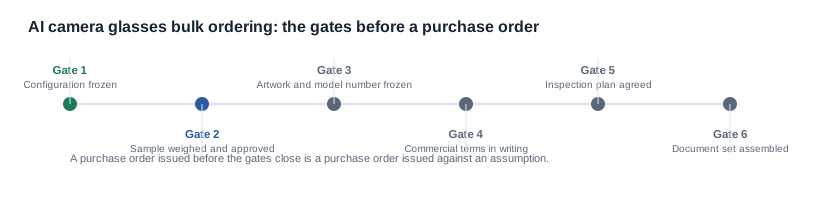
The next step. Send us the models, the case configurations, the destination markets and the expected volume, and we will tell you what has to be established before a landed cost can be built, which of the seven stages is the one your programme is currently skipping, and what the specification file needs to contain before any artwork is approved. A purchase order issued before the gates close is a purchase order issued against an assumption, and the invoice for that assumption always arrives later than the shipment.
Related reading
- Where the range decision sits — AI camera glasses buying guide
- The parcel arithmetic — AI camera glasses shipping weight
- The route and the paperwork — OEM ready platforms logistics planning
- The stock consequences of a multi-SKU programme — OEM ready platforms inventory planning
Send us the models, the configurations, the destination and the expected volume, and we will tell you what has to be established before a landed cost can be built.


