

Entry level in this category is not a price tier, and this article will not treat it as one. We publish no prices for any model, so there is no published basis for calling a group entry level, mid-range or premium — a claim of that kind would be our invention rather than a fact a buyer could check. What the catalogue does publish is enough to sort the eight Bluetooth audio glasses models into four structural groups of two, and those groups are what a buyer can actually filter on. This article sets out the four groups, the rows that define them, and the questions each group leaves open.
Bluetooth audio glasses entry level options: four groups defined by published rows
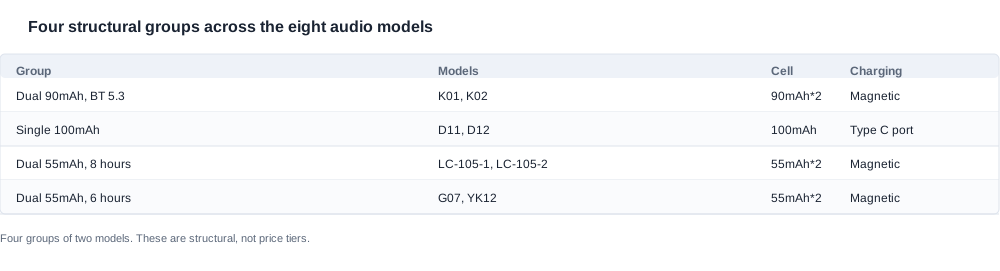
The eight audio models fall into four groups, and each group contains exactly two models. The grouping follows from the published cell configuration, the charging method, the Bluetooth version and the rated endurance — the rows that exist — rather than from any judgement about how basic a product is.
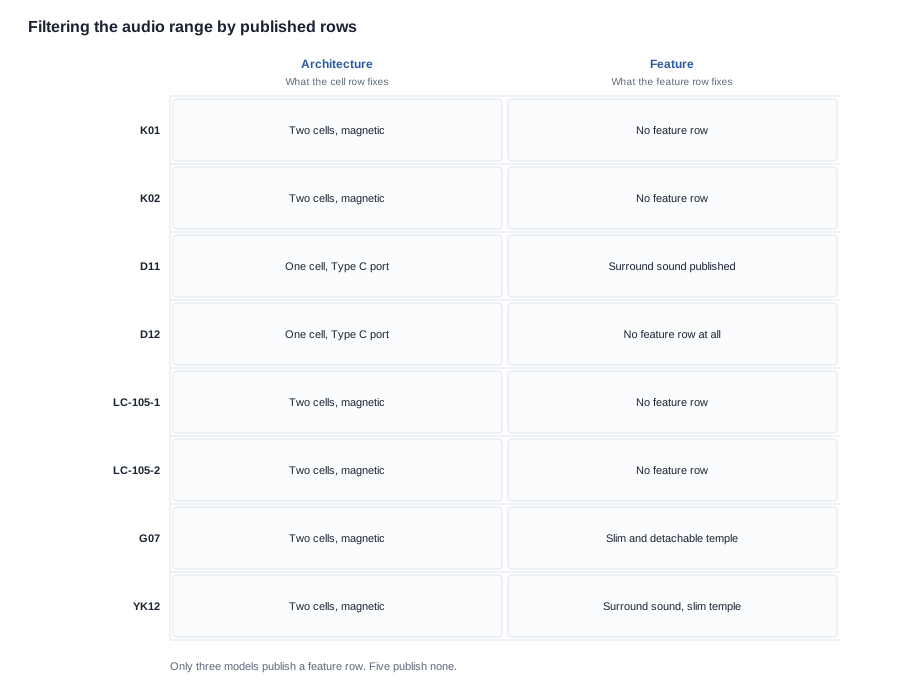
Group one: the dual 90 mAh models on Bluetooth 5.3. The K01 and the K02. Both publish 90mAh*2, magnetic charging, Bluetooth 5.3, a charge time of two hours or less and a rated endurance of about eight hours. Neither publishes a feature row. This is the only pair in the range on Bluetooth 5.3, which makes the pair easy to identify and also easy to exclude if the radio generation is a constraint.
Group two: the single 100 mAh models over Type C. The D11 and the D12. Both publish a single 100mAh cell, a Type C port, Bluetooth 5.4, a charge time of two hours or less and a rated endurance of about seven hours. The two are separated from each other by their feature rows: the D11 publishes a surround-sound row and a long-endurance row, while the D12 publishes no feature row at all. This is the only pair in the range that charges over Type C.
Group three: the dual 55 mAh models rated at about eight hours. The LC-105-1 and the LC-105-2. Both publish 55mAh*2, magnetic charging, Bluetooth 5.4, a charge time of two hours or less and a rated endurance of about eight hours. Neither publishes a feature row. The two are structurally identical on every published row in this range, which is worth stating plainly rather than looking for a difference the catalogue does not record.
Group four: the dual 55 mAh models rated at about six hours. The G07 and the YK12. Both publish 55mAh*2, magnetic charging, Bluetooth 5.4, a charge time of two hours or less and a rated endurance of about six hours. Both publish a feature row: the G07 publishes a slim temple with a detachable temple, and the YK12 publishes a surround-sound row with a slim temple.
Why the grouping is structural and not a price ranking
The distinction matters because the word "entry level" invites a price reading, and a price reading cannot be supported from anything we publish. We publish no unit price, no minimum order quantity, no lead time and no production capacity for any model in this range, and we do not rank our own products against each other on cost.
What the four groups represent is four different combinations of the rows that do exist. Group one is the only dual-cell pair on Bluetooth 5.3. Group two is the only single-cell pair and the only Type C pair. Group three and group four share a cell configuration and are separated by their published endurance figures — eight hours against six — and by the fact that group four is the only group where both models publish a feature row.
A buyer can use that structure to narrow a shortlist today. What a buyer cannot do is read a cost preference into it, and it would be a mistake to assume that a group called "entry level" is cheaper than one that is not, because the names carry no cost information whatsoever.
What the grouping leaves open
Each group narrows the range to two models, and two models still leaves a decision. Four items are unresolved at the group level, and none of them can be settled from the catalogue.
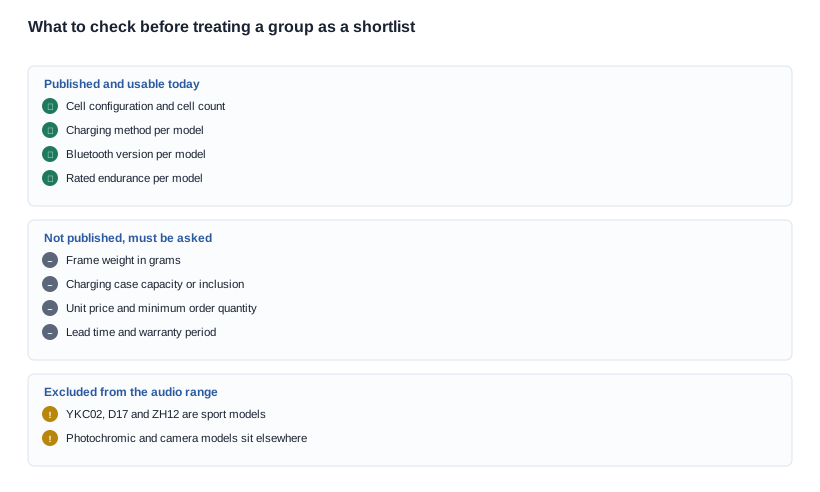
Frame weight. No audio model in this range publishes a frame weight, so the group cannot be filtered by mass. This is the largest single gap, because mass is what a buyer most often wants to sort on, and the comfort and fit article covers the measurement programme that fills it.
Carton contents and the charging case. No audio model publishes a charging-case row, so a group cannot be filtered on whether a case ships. Since group one, group three and group four all charge magnetically, the accessory question applies to six of the eight models.
Endurance protocol. Every model publishes an endurance figure, and no model publishes the test protocol behind it. The figures inside group three and inside group four differ — about eight hours against about six hours — while the cell configuration is identical, which is itself evidence that the figures were not taken under one shared procedure.
Commercial terms. Price, minimum order quantity, lead time, capacity and warranty are unpublished for all eight models.

Which group a requirement routes to
The groups are most useful when a requirement points at one of them directly. Because the routing is driven by published rows rather than by judgement, each route below terminates in a model or a pair rather than in a preference.
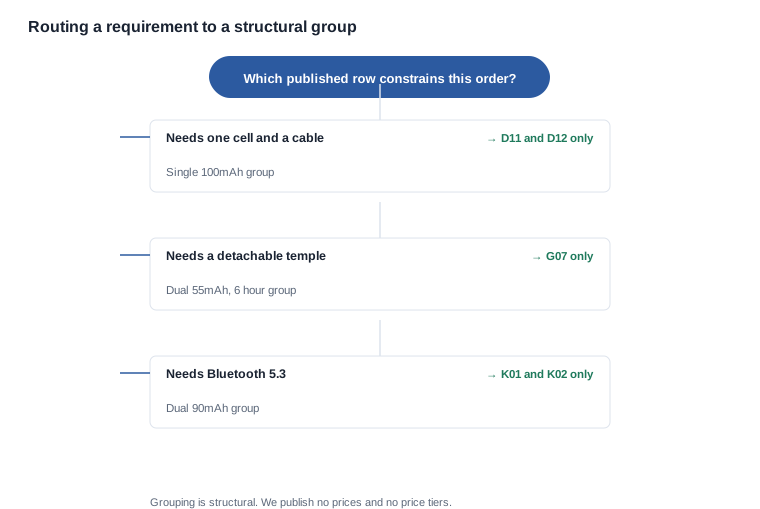
If the order needs a Type C port, the route terminates immediately at group two, and within that group at the D11 or the D12. There is no third option: the catalogue publishes a Type C port for those two models only.
If the order needs a detachable temple, the route terminates at the G07 alone, because that row is published on one model in the range. A requirement for a detachable temple and a requirement for the YK12's particular slim-temple row cannot both be met from a single model in this range.
If the order needs Bluetooth 5.3, the route terminates at group one, the K01 and the K02. It is worth asking a supplier whether 5.3 is a requirement or a preference, because it is the one row on which this pair differs from every other audio model.
If the order has no structural constraint at all, the useful filter is the published feature row rather than the cell row, because five of the eight models publish no feature row whatsoever and can therefore be eliminated from any requirement that depends on one.
Questions to ask once a group has narrowed the range
Narrowing to a group is the easy half. The list below is what has to be resolved inside it before a shortlist can be defended, and it is written so that it can be sent as an enquiry.
- For the two models in the chosen group, what is the unit weight as it ships, and does the figure include the cell?
- What is in the carton at the ordered quantity — a pad, a dock, a case or a cable — and does that differ between a pilot run and a production run?
- If a case ships, what is its capacity, its weight, its own interface and its own charge time? None of the four is published for any audio model.
- What is the starting state of charge and the end-of-test criterion behind the published endurance figure, and was it measured under one protocol across both models in the group?
- For the D11 and the D12 specifically, what does the surround-sound row describe physically, and is there any structural difference between the two beyond the presence of that row?
- For the G07, what does the detachable temple weigh, and is it included in any published unit weight?
- What is the minimum order quantity against a frozen configuration, what is the lead time stated as milestones, and what is the quoted unit price at our volume?
- Which certification documents exist for the exact configuration, and does each one name the model or the configuration on it?
Two groupings that a buyer should not make
Two errors account for most of the confusion when buyers first sort this range.
The first is counting models from outside the audio range into it. The YKC02 sits in the catalogue near the audio models and carries a surround-sound row, which makes it easy to include by accident — but it is a sport model, and its 70mAh*2 cell matches no audio model. The D17 and the ZH12 are the other two sport models, and both publish a charge time of about one hour, which no audio model does. Including any of the three produces a group structure that does not describe the audio range, and the error tends to survive into a comparison sheet.
The second is reading the groups as a quality sequence. Group three and group four share a cell configuration and differ only in their published endurance figure and their feature rows, and there is nothing in the catalogue that establishes one as better than the other. The honest statement is that they differ on two published rows and are otherwise not separable from this source.
Where our published boundary sits on this grouping
We publish the electrical rows and the feature rows for all eight audio models, in the form the factory builds them. We do not publish prices, price tiers, minimum order quantities, lead times, production capacities, warranty periods or frame weights, and we do not present the four groups as a ranking. A grouping drawn from published rows is something we can stand behind; a claim that one group is more affordable than another would be a number we cannot source.
Where a requirement maps onto a published row, a buyer can narrow to one or two models today, and the four groups above are the whole of what the catalogue supports. Where it does not map onto a published row, the question belongs in the enquiry, and the charging options article covers the accessory question that applies to six of the eight, while the bulk ordering article covers how the commercial terms are settled once a model has been chosen.

Working a group through a real shortlist
Applying the grouping to three specific models shows how much it actually resolves. Take the K01, the LC-105-1 and the D12 — one model from each of three different groups.
The grouping immediately separates all three: the K01 is the only Bluetooth 5.3 model of the three, the LC-105-1 shares its cell configuration with the LC-105-2 and the G07 and the YK12 while the D12 shares a single cell only with the D11. So the three cannot be compared on the published rows, because they publish different rows.
That is itself the useful output. A buyer who brings these three models to a supplier is not comparing them — they are three separate configurations, each with its own charging method, its own accessory question and its own quote. The grouping tells the buyer that the comparison has to be run three times rather than once, which is a materially different amount of work and a materially different quotation process.
The second thing the grouping does is identify where the open items concentrate. All three models are magnetic or Type C, all three publish no frame weight, and none publishes a case row. The open items are therefore common to the whole shortlist, which means one enquiry can cover all three rather than three separate ones — and, equally, that a single unanswered question leaves the entire shortlist unresolved.
Why one unanswered question can hold up the whole shortlist
The concentration of open items is not a coincidence; it follows from how the catalogue is built. The published rows describe the electrical construction of each model, and the construction is common across a group while the commercial and accessory decisions are made once per order. Six of the eight models charge magnetically, so the accessory question is one question for six models rather than six questions. No model publishes a weight, so the weight question is one question for eight models.
This has a direct consequence for how a buyer should structure the enquiry. Sending model-by-model enquiries to a shortlist of three produces three sets of answers that may disagree with each other on precisely the points that are shared. Sending one enquiry that names the shortlist and asks the common questions once produces a single coherent set of answers, with model-specific questions attached separately where they genuinely differ.
The practical structure is therefore two lists rather than one long list: a shared list of questions that apply to every model on the shortlist, and a per-model list of questions that apply only because of what that model publishes. The eight questions above are the shared list. The per-model list is short — the D11 and the D12 need the surround-sound question, the G07 needs the detachable-temple question, and the K01 and the K02 need the Bluetooth 5.3 question — which is what makes the whole enquiry manageable.
What changes between a sample and a production order
One further caution applies to every group, and it is the difference between a narrowing that holds and a narrowing that has to be redone.
The grouping above is drawn from rows that describe the product, and those rows should not move between a sample and a production order. The cell configuration, the charging method, the Bluetooth version and the rated endurance are properties of the model, and a supplier quoting a different electrical row at production quantity than at sample quantity has made a substitution rather than a variation.
The items that do move are the commercial and accessory ones. Whether a case or pad is included commonly depends on quantity. The minimum order quantity for a variant differs from the minimum for the standard model. The lead time belongs to the variant and the production window rather than to the model. None of those affects which group a model belongs to, and all of them affect what the order costs and when it arrives.
So the discipline is to freeze the group at shortlist stage using the electrical rows, and then freeze the configuration separately using the commercial ones. A buyer who freezes only one of the two has a shortlist that may not survive contact with a purchase order.

The shortlist page, assembled from the groups
Once the grouping is applied, the resulting shortlist page has a specific and useful shape, because every row on it is either a published fact or an explicitly open question.
The published section carries five fields for every model: the cell configuration with its cell count, the charging method, the charge-time ceiling, the rated endurance and the Bluetooth version. For a model that publishes a feature row, the row itself is added as a sixth field. That section can be completed today for all eight models without contacting anyone.
The open section carries the questions that have no published row: unit weight, carton contents, case capacity if a case ships, endurance protocol, acoustic detail behind a surround-sound row, detachable-temple mass, and the full set of commercial terms. Every entry in that section is a question rather than a gap, and every one of them belongs in the enquiry described above.
Keeping the two sections visibly separate on a single page is what makes the shortlist defensible. A reader can see immediately which claims are sourced and which are pending, and no one has to guess which is which. The common questions article sets out the same published-versus-unpublished split applied to individual questions.
What to settle, in order
- Decide the structural constraint first: cell architecture, charging method, Bluetooth version or feature row. Each one terminates at a specific model or pair.
- Eliminate the models that publish no feature row if the requirement depends on one, since five of the eight cannot satisfy such a requirement on published evidence.
- Obtain the unit weight for the remaining models by measurement or by supplier document, since no audio model publishes one.
- Settle the carton contents and the accessory question, which applies to the six magnetic models.
- Get the endurance protocol attached to the published figure for whichever models remain.
- Put price, minimum order quantity, lead time and warranty into the enquiry as commercial terms, to be quoted rather than assumed.
What to do when a group cannot be narrowed further
Two models with identical published rows are the normal end state of this process rather than a failure of it. Groups one and three both reach that point, and the honest response to it is to treat the two models as one configuration decision with two supplier answers, not as two products competing on quality.
The questions that resolve the pair are the ones with no published row. Two models with the same cell configuration can still differ in unit weight, in carton contents, in case inclusion and in every commercial term, and those differences are usually larger than anything the catalogue does record. A buyer who accepts that the published rows cannot separate a pair has saved the time that would otherwise be spent looking for a difference that is not there, and can put that time into the questions that will actually decide the order.
The second thing worth doing with a pair is to ask whether the two are genuinely distinct orderable configurations or variants of one platform. That question is worth asking precisely because the catalogue does not answer it, and because a supplier who treats them as variants may offer a volume structure that a supplier who treats them as separate models would not.
A note on why this article does not compare the groups
It is tempting to close an article like this by saying which group suits which kind of buyer, and the temptation is worth resisting, because the sentence would have to be built from facts the catalogue does not publish.
Which group is right for a buyer depends on the unit price, the minimum order quantity, the lead time, the packed unit weight and the sell-through in their channel. We publish none of the five, so any such sentence would be a guess wearing the clothing of a conclusion. What the catalogue supports is the grouping, the narrowing, and the question list — and a buyer who has those three has enough to run a procurement process properly, even though they do not yet have enough to place an order.
Related reading
- The range-level decision — Bluetooth audio glasses buying guide
- The accessory question for the magnetic models — Bluetooth audio glasses charging options
- The measurement gap — Bluetooth audio glasses comfort and fit
- The commercial terms — Bluetooth audio glasses bulk ordering
Send us the requirement you are working from and the models you have in mind, and we will tell you which published rows narrow it and which questions have to go into the enquiry.


