

Bone conduction glasses with an amplification gain of 35 dB are the most aggressively specified product in this catalogue and also the one with the highest regulatory risk. The published specification is 35 dB of amplification gain, a 200 mAh battery, a charge time of two hours or less, about seven hours of endurance and Type-C charging — and the source carries no model number, no certification position and no test conditions. If your business case depends on the words "hearing support", the regulatory question is not a footnote to the sourcing decision. It is the sourcing decision.
Bone conduction glasses for hearing support: the figure sets the route, not the spec
What a buyer is actually deciding
A buyer who arrives at this product with a hearing-support use case is usually carrying a business case, not a technical one. The case says something like: a customer population that struggles to hear in a specific environment, a channel that can reach them, and a price point that a procurement budget can absorb. The technical product that sits behind that case is a pair of glasses with a transducer against the skull and an amplification gain of 35 dB.
The decision in front of the buyer is not which specification to order. It is whether the product can be sold into that channel at all, in that market, with that wording — and that decision is made by a legal opinion in the destination market, not by a factory quotation and not by a product page.
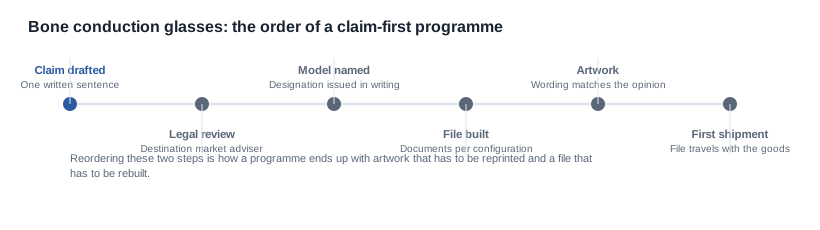
That ordering is worth stating plainly because it is routinely reversed. A buyer who negotiates the price first, samples the product second and discovers the claim problem in the artwork stage has already spent the budget, the time and the tooling on a programme that cannot be completed. The reverse order costs one email and one adviser's fee.
The published product, in full
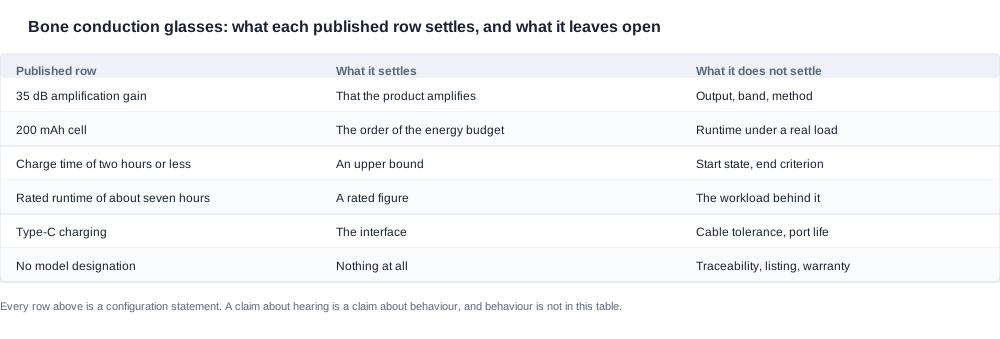
This is the entire published record for this product, and it is short enough to read in one sitting.
The amplification gain is 35 dB. The cell is 200 mAh. The charge time is two hours or less — a ceiling rather than a typical figure, with no starting state and no termination criterion. The rated runtime is about seven hours. The charging method is Type-C. There is no model designation. There is no Bluetooth version row. There is no frame weight, no temple length, no lens dimension, no transducer position, no frequency response, no output level, no leakage figure, no certification number and no clinical data.
The bone conduction certification and medical device boundary notes set out the regulatory frame from a different angle, and the bone conduction common questions cover the documentation gaps in detail.
Why 35 dB is a trigger rather than a specification
A gain figure quoted without a band, a reference level and a test method is the whole problem. A gain in decibels is meaningless without stating what the input was and at what frequency, because gain measured at a low frequency in a free-field chamber is a different number from gain measured at the ear, and the standards used for hearing-assist products measure it in a way that a product catalogue never does.
Thirty-five decibels is a large number in wearable terms. It is large enough that the product sits close to the territory where hearing-device regulation applies in most markets, and close enough that the claim printed on a box determines which regulatory route applies. This is a legal question, not a marketing one, and it needs an answer from a qualified adviser in the destination market before the artwork is finished.
Notice what is not being claimed here. Nothing in this article determines how the product is classified, and nothing in it is legal advice. What is being said is narrower and more useful: a 35 dB figure creates a question your counsel will ask, so plan for the question rather than discovering it.
The claim ladder, and where a buyer should stop
Three levels, and the line between them
The claim a product makes is the same thing as the route it takes. For this product there are three levels a buyer can work at, and the line between them is worth drawing before the copy is written.
Level one: a wearable audio device with a published amplification specification. The product plays and amplifies audio, and the listing says so. It states the 35 dB figure, states the cell, the charge time, the runtime and the interface, makes no statement about hearing, and compares itself against other audio products rather than against hearing devices. This level is the one we can supply product literature for, and it is a coherent business case for a channel that sells amplified audio.
Level two: hearing support as a use context. The listing describes the product as suitable for a situation where a person struggles to hear — a meeting, a crowd, a television at low volume. The wording is about the environment rather than about the person's ears, and the product is positioned as one tool among several for that environment. This level is workable in many channels, and it is where most of the commercially interesting demand for this product actually sits.
Level three: any statement that the product treats, corrects, prevents or improves hearing. Any comparison with a hearing aid. Any wording that positions the product as an intervention rather than a device. This level is out of bounds without a regulatory route that the buyer has established with counsel in the destination market, and the catalogue position is that we will not supply product literature that makes those claims.
Why the ladder has to be set before the artwork
The claim is not a description added to a finished product; on a retail listing it is the primary content, and it is what a regulator, a marketplace reviewer and a competitor will read first. Artwork that has been designed around level three cannot be pulled back to level one without reprints, new photographs and a fresh review.
The cheapest control is a written claim sentence, agreed before the artwork brief goes out, reviewed by counsel in the destination market, and then used as the constraint on every piece of copy. It is one sentence, and it is the highest-value sentence in the programme.
The test that a buyer can apply to any draft copy
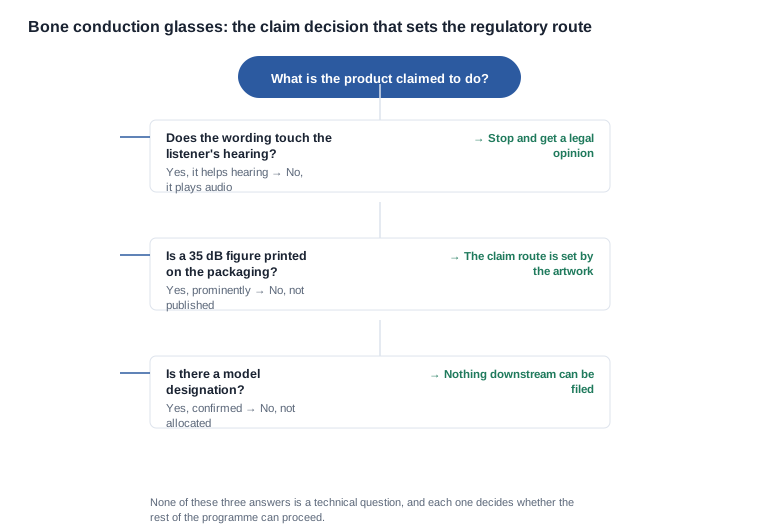
Take any line of copy that is proposed for this product and ask three questions about it.
Does it describe a behaviour of the product, or a state of the person using it? A product description is safe to write. A description of somebody's hearing is a claim about a medical condition, and it needs a route.
Does it imply a comparison with a hearing device? Even a comparison that flatters the product — louder, cheaper, more convenient — is a comparison, and it invites the classification question directly.
Does it print a bare decibel figure? A gain figure with no conditions is a number the brand cannot defend, because there is no published method behind it. If the conditions cannot be obtained, the figure should not be printed, and the listing should describe the product in terms the documentation supports.
Where the claim lives once it is written
A written claim sentence is a control, and a control only works if it reaches the places that write the copy. For this product that is a short list, and it should be named explicitly: the product listing, the packaging artwork, the retailer's category description, the marketplace title and bullet points, the support script, the training material for a distributor, and the comparison material used in a channel pitch.
Each of those is written by a different person, usually in a different week, and each of them will drift away from the agreed sentence if the sentence is not attached to them. The practical control is to put the agreed wording into the artwork brief and into the listing template rather than into an email, so that a copywriter inherits it rather than reconstructs it.
There is a second reason to name the places. A claim is also made by juxtaposition. A product page that shows a decibel figure next to a stock image of a person in a group conversation, with no text claiming anything about hearing, is still making an argument. The review of the listing is therefore a review of the images as well as of the words, and the two are usually reviewed by different people.

The six questions to ask, in the order that matters
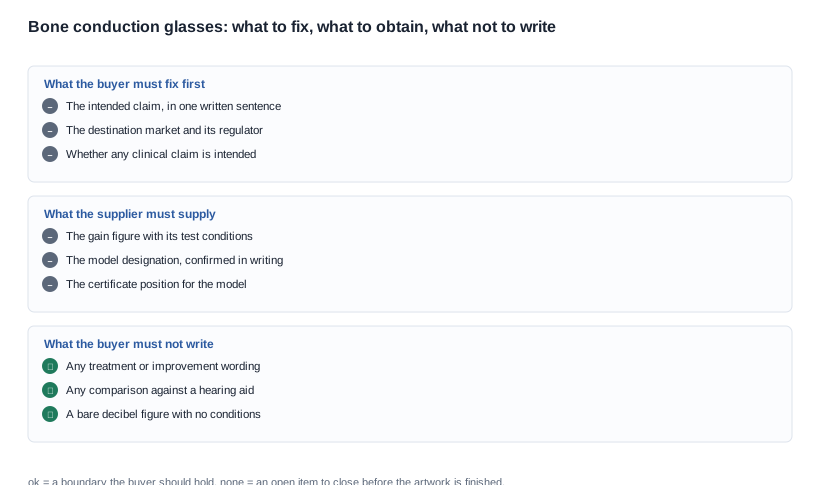
1. What is the intended claim, in writing? Is this product sold as a wearable audio device with an amplification specification, or as a device that assists with hearing? The answer determines the regulatory route, and it has to be a deliberate decision rather than an accident of how the copy is written.
2. What is the gain figure with its test conditions? Reference level, input signal, frequency band, and whether it is measured on the product or on a coupler. A supplier who cannot state these has a number without an engineering basis, and a buyer who accepts the number anyway is signing a claim they cannot support.
3. What is the frequency response? A gain figure without a band says almost nothing about intelligibility, and intelligibility is what a person buying this product is actually after. Without a response curve or a band description, you cannot say whether the product helps in a noisy environment or only in a quiet one.
4. Is the gain adjustable, and over what range? A fixed-gain product fits fewer people than an adjustable one, because hearing varies across a population. An adjustable product is also a better answer to a customer who finds the fixed setting uncomfortable.
5. How much of the output leaks away in an open-ear arrangement? Leakage determines whether the person receives the amplified sound or the surrounding noise. Leakage figures are not published for this product, and the open-ear form factor is exactly where leakage is the problem. The bone conduction durability analysis covers what the construction of this product demands.
6. What is the model designation? There is none published. Without a stable SKU you cannot get a document that names your product, you cannot file a warranty claim against a specific configuration, and you cannot tell whether a second quote is for the same thing. Get the SKU before anything else — and note that it has to be issued, not merely promised.
What to ask the adviser, rather than the factory
The adviser needs the published rows, the intended claim sentence, the destination market and the channel, in that order. What comes back is usually a classification view, a set of required documents and a list of wording that is out of bounds.
The factory needs a different list: the gain figure with its conditions, the frequency response, the adjustment range, the leakage behaviour, the frame dimensions and the model designation. Those two lists do not overlap, and a buyer who sends one to both parties will get an answer to the wrong question.
The one request to send the factory first
If only one request goes to the factory before the sample order, it should be the model designation, and it should be asked in a way that requires an answer rather than a promise: ask for the designation string, the artwork or document file that will carry it, and the date on which it will be fixed.
Everything else in this article can be worked around. A gain figure without conditions can be replaced with a narrower listing. A missing frequency response can be handled with cautious copy. A missing leakage figure can be handled with a sizing note. None of those workarounds is available for a product with no designation, because the designation is the key that the artwork, the documentation file, the customs declaration, the warranty record and the product listing all use. A programme that begins without it will acquire one late, and it will acquire one that does not match the artwork already approved.
The commercial reality underneath the compliance question
The comparison problem
A shopper comparing this product against a hearing aid is comparing across a regulatory divide that the product itself may not be permitted to enter. If your positioning invites that comparison, there is a problem that no amount of specification will fix — because the comparison is a classification argument dressed up as a shopping decision.
The commercial version of the same problem is at the channel level. A channel that already sells into the hearing-assist category will know the regulatory expectations, and a channel that does not will discover them. The first is a shorter path to a listing; the second is a path that ends with artwork being withdrawn.
The geometry problem, and why it becomes a returns problem
Bone conduction requires the transducer to sit in the right place against the skull, and an eyeglass frame holds it in the position the frame happens to put it. The seating is therefore a function of the frame rather than of the person alone, and the frame dimensions and the weight are not published for this product.
That is a returns problem waiting to happen, and it is worth sizing before the order rather than after the first quarter of returns. A buyer who cannot state the frame geometry cannot state the population the product suits, cannot write an accurate sizing note, and cannot separate a genuine fit-and-seating problem from a genuine hardware problem in the returns data. Both of those failures look identical in a spreadsheet.
Sizing the return risk before the order
The returns exposure in this category can be estimated without a single measurement, and a buyer who does not estimate it is choosing an unknown.
The estimate is built from three numbers and one assumption. The first number is the proportion of the channel for which an open-ear amplified product is a substitute for a hearing device rather than an addition to it; that population is smaller than the population that could use the product, and the difference is the population most likely to be disappointed. The second is the proportion of the channel that will try the product in a noisy environment, where intelligibility matters and where an unstated band leaves the most room for a mismatch. The third is the rate at which the channel's own expectation was set by a different product category.
The assumption is the return rate that follows, and it belongs in the commercial model rather than in the technical file — because the return rate is a function of the claim, the sizing note and the support script, and all three are decisions the buyer makes before the order.
The point of sizing it early is that the number changes the programme. A high estimated return rate on a low-margin channel product is a reason to narrow the claim, tighten the sizing note, or reconsider the product; and all three are cheaper to do before the first order than after the first quarter of returns.
The documentation problem
No model number, no certification position, no test conditions and no acoustic detail. That is a long list of open items for a product whose whole proposition is an acoustic specification, and it is the reason this category is harder to buy well than the price comparison suggests.
The evidence pack a buyer should assemble, in this order: the agreed claim sentence; the adviser's classification view; the model designation in writing; the gain figure with its test conditions; the frequency response and any adjustment range; the certification position for the model in each destination market, or a written statement that none exists; the frame dimensions and weight; and the leakage behaviour. Seven items, and every one of them is a document rather than a promise.
The commercial terms worth negotiating
The negotiable items are the sample cost and the sample terms, the unit price and volume tiers, the accessory set and its own minimum quantities, the packaging specification, the payment nodes against a first-article approval, the warranty period with a stated response, and the wording of any documentation the supplier is expected to provide.
The items that do not move are the certification cost and the certification time, which follow the process and the testing body, and the cost of a legal opinion in the destination market, which is the buyer's own cost and is the cheapest line in the whole programme.
What we can supply, and the boundary we will not cross
This product can be sold responsibly as a wearable audio device with a published amplification specification, and it should not be sold with any claim that it treats, prevents, corrects or improves hearing. We will not describe it as a hearing aid, we will not use "hearing-impaired" or "hard-of-hearing" in a way that positions the product as a treatment, and we will not present the 35 dB figure without the conditions that give it meaning, because the conditions are not published and a bare number is a claim without a basis.
We will also be direct that this is not a product we can supply into a regulated hearing-device market without a legal opinion on the intended claim, and that our documentation for it is the thinnest in the range. If your business depends on a hearing-support positioning in a market with hearing-device regulation, the right first step is that legal opinion, not a purchase order.
What we can do is give you the published rows, tell you precisely which of the six questions above we can close, and point at the documentary steps in between. The bone conduction buying guide covers the commercial side of the same category.
Six items to establish before anything else
- The intended claim, reviewed by a qualified adviser in the destination market.
- The model designation, confirmed in writing.
- The gain figure with its reference level, input signal and frequency band.
- The frequency response and any adjustment range.
- Frame dimensions, weight and the seating requirement for the transducer.
- The certification position for the model in each market, and the economic operator arrangements.
Related reading
- The regulatory boundary in detail — bone conduction glasses certification and medical device boundary
- The category overview — bone conduction glasses buying guide
- The physical side of the product — bone conduction glasses durability
Tell us the market this product is destined for and the claim you intend to make, and we will set out what is documented for this product, and which questions need a laboratory and a legal adviser to answer.


