
Our catalogue publishes a charge time of two hours or less for 26 of the models we list, and about one hour for two more. It publishes nothing at all about what happens in hour three, in hour eight, or in the morning when someone picks the glasses up off the charger.
That gap is the whole answer to the question, and it is worth being precise about why. "Can I charge overnight" is not one technical question. It is three, and each has its own evidence: does the device stop drawing current once the battery is full, what does the heat do while it sits there, and what does a long period at a high state of charge do to the cell. A charge time answers none of them. It answers a fourth question — how long until full — which is the one everybody already assumes has been answered.
This is a question a buyer has to answer twice: once for the customer who will leave the glasses on the charger every night, and once for their own warehouse, where a distributor may leave a hundred units on charge on a pallet. The commercial risk is different in each case. The customer case produces support tickets and returns; the warehouse case produces a safety question you may have to answer to a carrier, an insurer or a marketplace.
can i charge overnight: what the question is actually about
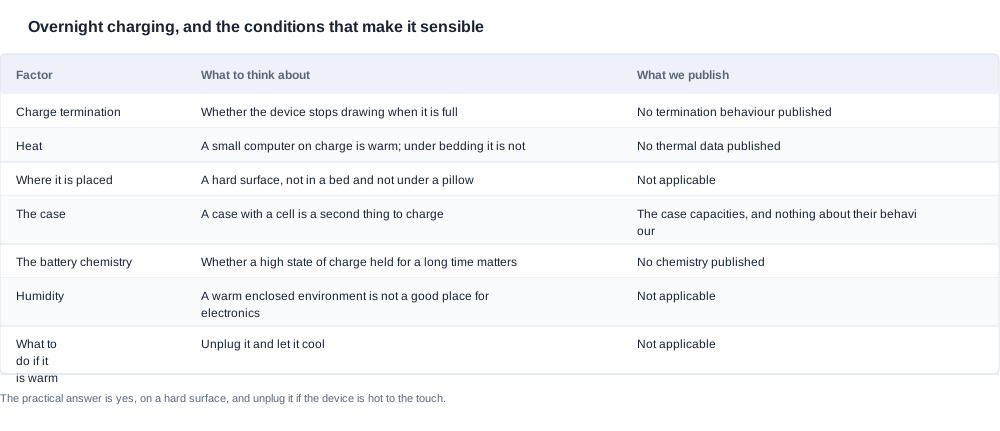
Most people asking this are not worried about their glasses. They are worried about a specific scene: the glasses are on the nightstand, the charger is plugged in, and they will still be there in the morning. If they are warm, is something wrong? If they are charging, are they consuming the cell? If the battery is full, does the charger keep pushing?
Those three worries map onto three separate answers.
Does the device keep drawing power once it is full? A correctly designed device stops. The charge circuit moves from a constant-current stage into a tapering stage as the cell voltage approaches its limit, and then it disconnects the current path and, in many designs, periodically re-checks and tops up. A device that did not disconnect would be a genuine fault. Whether ours does it, and how the re-check behaves, is not published for any model in our catalogue.
Does it get hot? Charging is lossy, and the losses leave the device. How much depends on the charger, the cell, the enclosure and the ambient temperature. Under a duvet, heat has nowhere to go and the operating temperature rises without anything being wrong with the product itself. Our catalogue publishes no thermal data, no operating temperature range and no thermal test report for any model, so the honest answer to "how warm is too warm" is that it has to be established on a sample rather than read off a page.
Does time at full charge damage the cell? This is a chemistry question, and the general answer is well established: a lithium cell held at a high state of charge ages faster than one cycled through a partial range, and the effect is stronger when the cell is also warm. That is a statement about cells in general, not about a particular model, and our catalogue publishes no cell chemistry, no cycle life, no calendar life and no charging temperature window for any model. We will not convert a general principle into a product figure, and we would rather a buyer had the general principle and a supplier's specific data than a specific-sounding number from us.
What the published charge time does and does not settle
The rows we publish are real and they are useful, but they have to be read with their exact wording.
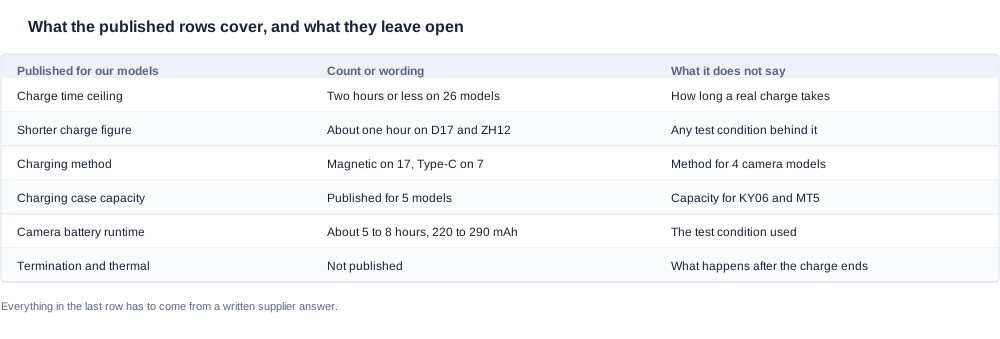
"Two hours or less" is a ceiling. Twenty-six models in our catalogue carry a charge time expressed as two hours or less. A ceiling answers the buyer's question "how long must I allow" and it does not answer "how long does it actually take". If a buyer writes "charges in 2 hours" on a product page, they have converted our ceiling into a typical and have done so without evidence. "Fully charged within two hours" is defensible; "charges in two hours" is a promise we did not make. The two models that publish a shorter figure — the D17 and the ZH12, both of them in the sport range, at about one hour — are the only two where anything closer to a typical exists, and even there the wording is approximate.
No test condition is published with it. There is no starting state of charge, no ambient temperature, no charger rating, no battery age and no number of cycles behind the figure. Every charge time in the catalogue is therefore a number without a method, which is exactly the kind of number a good buyer will not put on a product page without asking for the method.
The charging method is published for most models, and not for four. Magnetic charging is published for 17 models, Type-C for 7, and the charging method is not published for the L1 Pro and the CY05, and the MT6 and the CY03 — all four of them camera models. That last group matters more than it looks: the charging method is the interface your copy, your packaging artwork and your support script all depend on, and for those four models we cannot even tell you whether the customer plugs in a cable or places the glasses on a pad.
The runtime figures sit alongside, without test conditions. Across the camera models the rated runtime is about five to eight hours, the batteries sit in the 220 to 290 mAh range, and no test condition is stated for the runtime any more than for the charge time. That combination is enough to explain why a buyer should think about overnight charging in terms of charging rather than runtime: a camera model that runs five to eight hours from a 220 mAh cell is a product whose owner will very often put it on the charger at the end of a working day.
What is absent from the catalogue entirely. Charge termination behaviour. Thermal behaviour during charge. Cell chemistry. Cycle life and calendar life. Standby current. Float current, meaning the current the device draws when the battery is full and the charger is still attached. Operating and charging temperature ranges. All of it is not published for every model in the range. This is not a small list, and it is the reason we cannot answer this question from our own documentation, and the reason we recommend a supplier who will answer it in writing.
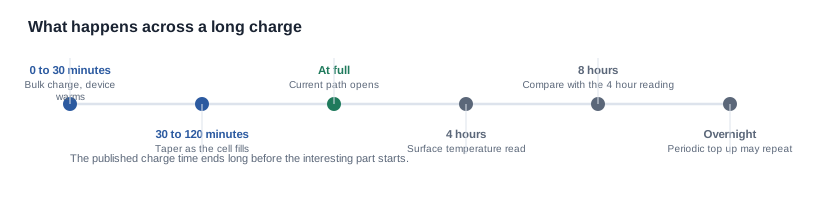
What happens to a device across a long charge
The behaviour of a device on charge for eight hours is a sequence, and the interesting part is what happens after the point where the charge time ends.
The taper. As the cell voltage approaches its limit, the charge circuit reduces the current. This is the stage where the device is warm and where the heat is generated. A device that reaches full in two hours spends most of that time tapering, and the last part of the charge is the slowest.
The disconnect. At full charge, the current path opens. The device is then drawing only what it needs to run itself — which for a pair of glasses that is close to nothing, since the radio is asleep and the sensors are idle. Whether the charger continues to present a voltage across the contacts is a detail that matters for a magnetic pad, and it is not published for our models.
The top-up. Many designs re-check the cell periodically and restore a small amount of charge if it has fallen. This is why a device left for a week on a charger can still be full. The cost is that the cell spends time at a high state of charge, which is the condition the chemistry dislikes. Whether our devices do this, and how often, is not published.
The heat, and the second enclosure. A device charging inside a closed charging case is a small computer inside a plastic box, next to a second cell, with the case's own charge electronics. Our catalogue publishes case capacity for five models — the L1 Pro and the CY03, and the CY05 — each at 1400 mAh, the L2 Utral at 900 or 1400 mAh, and the MT6 at 1200 mAh in a foldable case. It publishes a case for the KY06 and the MT5 without a capacity, and it publishes no case row for the S7 and the V03, and the V06, while the V03 Pro is explicitly a no-case product. So for five models, "overnight charging" means two cells and two charge paths running inside one enclosure, which is a materially different heat situation from a bare frame on a table.
The environment. A hard surface, ventilation and a dry device are the conditions that make an overnight charge sensible. Bedding, a closed bag and a warm room are the conditions that turn it into a risk. The instruction that matters commercially is the short one: do not charge a wet device. That is a safety instruction, and it applies whether or not the model carries an ingress marking. Only two models in our catalogue publish one at all — the V06 and the S7, both at IP54 — and the rest carry no IP marking whatsoever, which is a different statement from carrying a lower rating.
The one nuance worth adding for a distributor: storing a unit at a full charge is a different decision from leaving it on the charger. If the plan is to hold stock for a season, a full charge held in a warm warehouse is the state the chemistry likes least. That is a general principle again, and it is one of the reasons the charging behaviour appears in the questions we suggest a buyer asks.
The same principle applies to the return side of the business, and it is easy to overlook because it does not arrive as a complaint. A unit that has been left on a charger for a fortnight will have spent that fortnight in the state the chemistry likes least, and a customer who buys it months later may experience a shorter runtime than the figure on the listing. Nobody will describe this as an overnight-charging fault, because from the customer's point of view they charged it overnight once. Which is exactly why a distributor's storage practice belongs in the same conversation as the charge time, and why "do not store the units at full charge in the warehouse" is a better piece of aftersales advice than any number on a spec sheet.
A buyer who is building a due diligence file on this should also ask the question that sits underneath all of it: what is the cell's rated life, expressed both as cycles and as calendar time? Neither figure is published for any of our models, and without them the trade-off between charging convenience and cell longevity cannot be quantified for your own customers. It can still be managed, by policy rather than by engineering: by not storing stock at full charge, by not leaving units on chargers for weeks, and by telling the customer in the copy what the product expects.
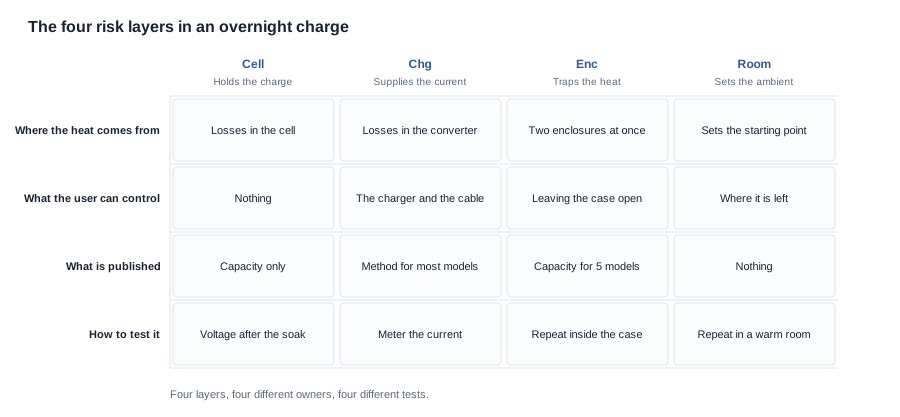
The charging method changes the overnight answer
Seventeen of our models charge magnetically and seven charge over Type-C, with the method unpublished for four camera models. The difference matters for an overnight charge in ways that are easy to overlook.
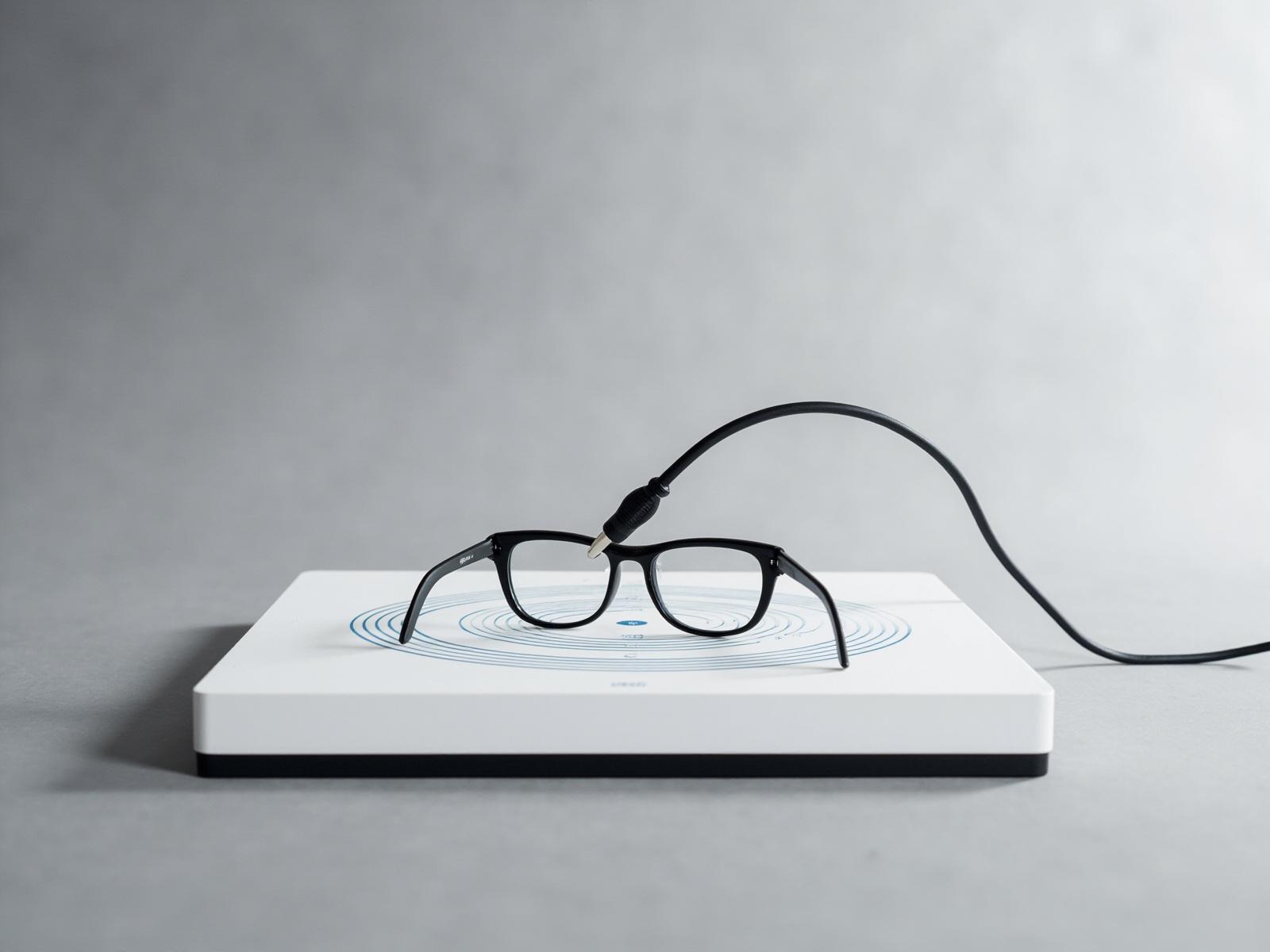
A magnetic pad is always live. It sits on the nightstand, it is plugged in, and it is presenting a voltage whenever the glasses are on it. Nothing about that is unsafe in a well-made product, but it does mean the charging interface is exposed to dust, to a spilled drink and to a curious child. It also means the device has to be physically placed on the pad to charge, which is easy to do at 23:00 and easy to forget at 07:00, so a "left charging all night" unit is quite often a unit that has been on the pad for a week.
A cable is a mechanical object. Leaving a Type-C cable connected overnight means the cable, the connector and the port are all carrying a mechanical duty, and the commonest failure is the cable being snagged and pulled out, or a consumer-damaged cable being left in a socket. Cable quality is not something a product page can govern, and it is one of the reasons the charging red flags we publish elsewhere are worth reading before you write your own instructions.
The four unpublished models. For the MT6 and the CY03, and the L1 Pro and the CY05, the catalogue does not tell you the charging method at all. Those four are also camera models, three of them with published charging cases. For a buyer building a line that includes them, that is a documentation gap to close before the artwork is printed, not after.
The distribution case. A distributor holding several hundred units has a different problem from a customer with one pair. Devices will sit on charge in a warehouse, on a shelf, in a carton in a container. Battery transport rules apply to the movement of those units regardless of who plugs them in, and the packing, labelling and documentation requirements for lithium cells travel with the goods rather than with the charging arrangement. That is a separate compliance question from the one this article is about, and it is worth settling early rather than at the first shipment.
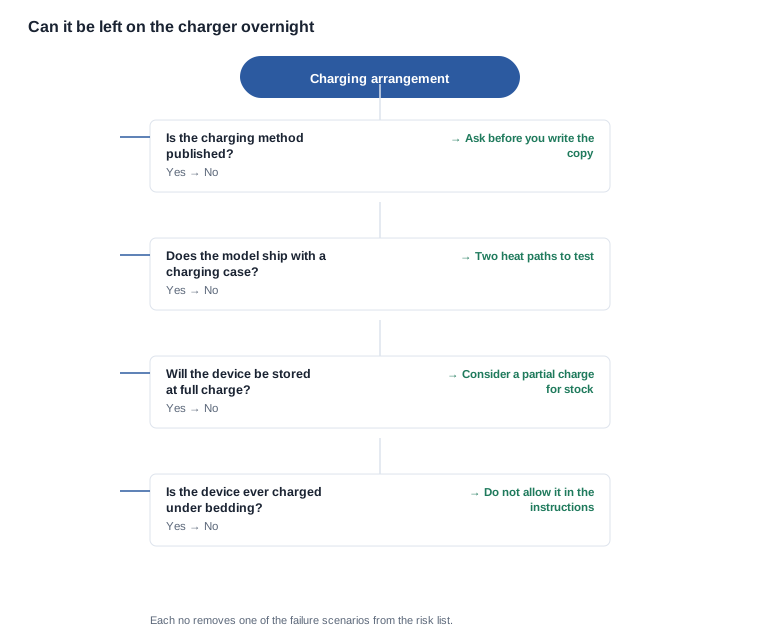
The test that settles it, and the copy that follows
The overnight question is one of the easiest to settle on a sample, and it is one of the few where a buyer can do the test themselves without a laboratory.
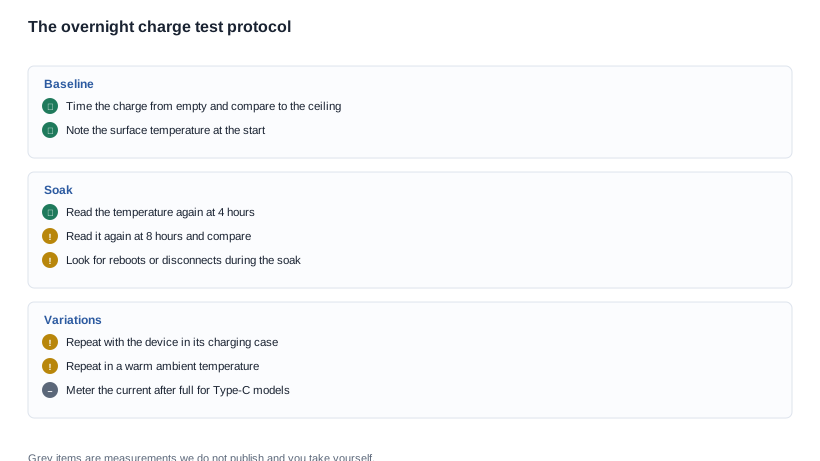
- Charge to full and note the time. Compare the observed time against the published ceiling. If the sample takes longer than the published figure allows, that is a question for the supplier before it is a question for the customer.
- Leave it on the charger for eight hours. Take a surface temperature reading at the start, at four hours and at eight hours, with an infrared thermometer or a thermocouple, in the same place each time. Compare the reading at eight hours with the reading at four. A device whose surface temperature is still climbing at eight hours is telling you something, and so is one that is comfortable to hold.
- Measure what the charger is drawing. For a Type-C model, a USB power meter between the charger and the cable gives you the current after the battery is full. For a magnetic model, the same information has to come from the supplier, because there is no measurement point in the cable.
- Repeat with the device in its charging case. For the five models with a published case capacity, this is the configuration that actually ships and the one that runs two charge paths inside one enclosure.
- Repeat in a warm ambient temperature. A room at 30 degrees is a reasonable proxy for a car dashboard or a warehouse in summer, and it is where an overnight charge stops being a formality.
- Watch for behavioural faults. A device that reboots, disconnects or resets its volume during a long charge has told you something about its power path that no specification sheet would have.
The copy that follows from the test should be short, and it should be in three places: the product page, the printed quick-start card, and the support script. Three sentences cover the majority of the tickets before they are written. It is fine to charge the device overnight, on a hard surface, not under bedding. Do not charge a device that is wet. If the device is hot to the touch in the morning, unplug it and let it cool before using it.
For a distributor, there is a fourth place the instruction has to appear: the warehouse picking and packing procedure. A stock system that charges every unit as it is received will keep a pallet on charge indefinitely, which is a thermal environment nobody designed for and a battery state nobody wants to hold. If your operation charges on receipt, the procedure needs a rule about how long a unit stays connected and when it comes off, and that rule belongs in the warehouse document rather than in the product copy.
The wet-device instruction is a safety instruction rather than a charging one, and the ingress side of it is covered under ip rating problems and fixes. The charging architectures themselves are described under charging solutions, and the battery and runtime context is under battery life and power.
The questions to put to a supplier about can i charge overnight
- What is the charge termination behaviour, and does the device draw any current once the battery is full?
- Does it periodically top up, and how often?
- What are the operating and charging temperature ranges?
- What is the cell chemistry, and what are the rated cycle life and calendar life?
- What does the surface temperature do after the charge time has elapsed, and does it settle?
- Is the charging method published for every model, including the four where it is currently not published for us?
- What does the charging case do to the thermal situation when it is closed?
- What are the supplier's own pre-order charging tests?
The eighth question is worth pursuing on its own, because a factory that already runs these tests will tell you what it found. We have published our own guidance on the claims to interrogate in charging manufacturer claims, the warning signs to look for in charging red flags, and the pre-order test sequence in how to test charging before ordering. A buyer who reads those three before writing their own instructions will write a better product page than a buyer who starts from the phrase "fast charging".
The shortlist criteria that matter here are evidence-shaped. Does the supplier publish a charge time with a method attached, or without? Do they distinguish a ceiling from a typical? Can they answer the termination question without going to engineering? Do they publish the charging method for every model in the range? Do they know what happens in their own charging case? A supplier who answers these with figures and documents clears the due diligence bar for an overnight-charging claim, and a supplier who answers them with adjectives does not.
Our own position is straightforward. We publish the charge time, the charging method, the charging case and its capacity where it is published, and the battery and runtime figures — and we publish no termination behaviour, no thermal data, no cell chemistry and no cycle life for any model, because our documentation contains none of them. We will not tell a customer that a device is safe to leave on the charger all night on the strength of a charge time, and we will not invent a derating factor to make a listing sound more precise than it is.
What we will do is take a model, check a supplier's answers on termination and thermal behaviour against the published rows we do hold, and tell you which of the questions our documentation can already answer and which of them need to be written down. Give us a model designation and a charging method and we will tell you exactly where the published answer stops.
Related reading
- The claims to interrogate — charging manufacturer claims
- The pre-order tests — how to test charging before ordering
- The wet-device question — ip rating problems and fixes
Ask us for a specific model and we will tell you what our documentation says about overnight charging, and what it does not.


