
Short answer for a buyer: yes, and the reason is structural rather than incidental — but the four things you have to establish before you sell it that way are the same four nobody publishes. This page is written for the brand or channel putting a first-person video product into a short-form content business, and it separates what the use case actually needs from what the specification actually says.
Can I use it for TikTok: the buying task behind the question
The question arrives from three directions, and they need different things answered.
A brand owner is deciding whether to build a short-form content SKU and needs to know which of the use case's requirements are published rows in a supplier catalogue and which are gaps that will have to be closed before the product can be listed at all.
A channel buyer is comparing a camera platform against a conventional action camera and needs to know where the glasses are genuinely better, because the answer determines the price point they can defend and the use case they can actually market.
A procurement manager is placing the order and needs the list of rows that have to be closed before the goods ship, because each of those rows becomes either a quotation line, a test plan line or a piece of copy that has to be withdrawn from the listing.
The reason a first-person camera platform fits short-form content at all is that the content is first-person and the hands are busy. Walking through a location, cooking, unboxing, demonstrating a repair, doing a haul or a setup — the camera is where the eyes are and the hands are free, which is exactly the constraint that makes a phone awkward and a tripod inconvenient. That is a structural fit, not a marketing one, and it is the reason camera platforms exist as a category.
It is also the reason a phone on a stick is not always the alternative. A phone on a stick gives a fixed frame; the glasses give the wearer's actual line of sight, which is what a short-form audience is watching for. The camera is a second pair of eyes rather than a device that has to be pointed, aimed, picked up and put down, and in a walk-and-talk format the difference is not subtle.
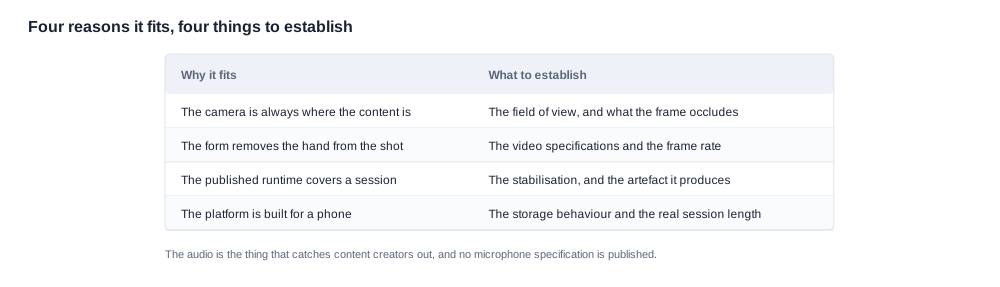
But here is the thing a buyer has to unlearn early. TikTok is a distribution channel, not a specification. Nothing about the platform tells you what the product has to do; the platform simply tells you where the output will be watched. The requirements come from the content itself, and they are always the same four: the image has to hold up in a vertical crop, the voice has to carry if the creator narrates, the battery has to survive a shoot day, and the storage has to survive a shoot day. Every one of those four is either partially published, entirely unpublished, or published without the condition that makes it meaningful.
That is the real shape of the answer. The product category is right, the structural fit is real, and the decision you are making is not whether smart glasses can be used for short-form content — they can — but whether you are willing to buy a specification with four open rows and close them yourself on a sample, or whether you need a supplier who will close them for you before you commit. Both are legitimate positions. Only one of them is safe if you take a pre-order.
There is one more party in the room that buyers sometimes forget to include, and that is the creator. In most of these channels the creator is not the buyer, but the creator is the person whose hands the product has to stay out of, whose voice has to sound acceptable, and whose day the battery has to survive. A specification that a procurement manager accepts and a creator rejects is a specification that generates returns, and the gap between the two is usually a comfort and endurance question rather than a technical one. If the channel has a creator who is willing to test, get that person on the sample test rather than the person who writes the copy, because the information they generate is the information that will settle the four rows.
The camera row, and can I prove it before the listing goes live
The camera is the reason the buyer is here, so it is where the published-versus-unpublished split bites first.
What the catalogue publishes is a resolution tier per model. Eight of the eleven camera models publish 8 MP, and three publish 13 MP — the S7 and the L2 Utral, and the L1 Pro. The V03 Pro is the only camera model that publishes photochromic lenses together with three colour options, and the V06 publishes four colours. Those are real, checkable rows and they tell a buyer something about the tier of product they are buying into.
What the catalogue does not publish, for any model in the range, is the sensor model, the field of view, the video resolution, the frame rate, the storage format, the stabilisation behaviour or the low-light performance. This is the gap that decides the use case, and it is worth being blunt about why. A still-image resolution figure tells you about the stills. It tells you almost nothing about the video, because video quality is a function of the sensor's readout, the field of view, the frame rate, the bitrate and the stabilisation, none of which are published. A product that publishes 13 MP stills and a product that publishes 8 MP stills may behave identically in video, and a buyer who selects on the megapixel number alone is selecting on the least predictive row available.
The practical way to settle this is not to ask a longer question of the supplier. It is to run a controlled comparison on a sample. Shoot the same script with the sample and with the device your customer currently uses, in the same light, in the same location, at the same subject distance. Put the two outputs side by side and look at the four things that decide whether a short-form clip works: how the frame handles a face at close distance, whether motion smears, how the auto-exposure behaves when the creator walks from shade into sun, and how the image behaves when the source is already clipped and bright.
Two published rows on our side pages set out what to test and why. The content creation camera performance page works through the sample test in the form we would recommend, and camera technology and real-world performance covers what changes once the product is deployed rather than demonstrated — the things that matter for a creator who uses the same device every day for months.
The commercial consequence of doing this properly is that you end up with copy you can defend. A buyer who has run the side-by-side shoot can write "the field of view is wide enough to hold a full kitchen in frame" because they saw it. A buyer who has not can only write what is published, and what is published stops at the megapixel number. Both are legitimate; only the first one survives contact with a creator who is unhappy with the result and wants to know why.
Which model you should be comparing is a separate question and it is worth answering explicitly, because the eleven camera models do not sit at one level. The AI camera glasses range is the published baseline for the whole family, and it is where the resolution tier, the colour list, the charging method and the battery figures for each model actually live. The content creation solution page sets out where the family is positioned for this use case.

The four rows nobody publishes, and can I close them on a sample
Here is the summary a buyer actually needs, and it fits on one page.
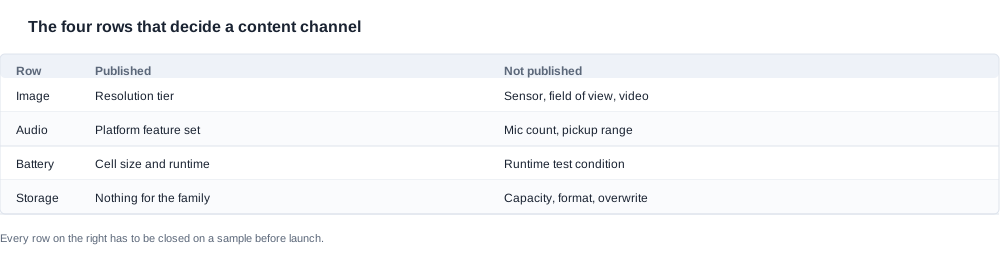
Image. Published: the resolution tier, and on some models the photochromic option and the colour count. Not published: sensor model, field of view, video resolution, frame rate, storage format. Close it on a sample with a fixed script in fixed light, and record the result so the listing can cite your own observation rather than a marketing adjective.
Audio. Published: the platform feature set, which includes hands-free calling and a voice assistant. Not published: microphone count, pickup distance, frequency response, and the behaviour when the frame's own audio is playing in a quiet room. The microphone quality discussion goes into the rows in more detail, including why a temple microphone at the end of a wire is a fundamentally different thing from a studio microphone. If your creator narrates on camera, this is the row that decides whether the channel works.
Battery. Published: cell capacity in the region of 220 to 290 mAh for the camera models, a rated runtime of roughly five to eight hours, and charging times. Not published: the test condition behind the runtime figure, and that condition is the whole question, because a runtime quoted with the camera idle is not a runtime. The battery planning discussion sets out the trade-offs between shooting time, charging time and what a shoot day looks like in practice. One further published fact matters operationally: charging is magnetic on seventeen models and Type-C on seven, while the method is not published for the MT6 and the L1 Pro, and the CY03 and the CY05 — so if you are building a creator kit with a spare cable or a power bank, that is a row to confirm before you finalise the accessory list.
Storage. Published: nothing for the camera family. Not published: capacity, file format, and what happens when it fills. This is the row that most often gets discovered on the second day of a shoot, and it is the one that produces a review that cannot be answered, because the creator's footage is gone.
There is a fifth row that only matters if you are building a kit rather than selling a device, and it is the charging case. The catalogue publishes a case for several of the camera models with a stated capacity — 1400 mAh for the CY03 and the L1 Pro, and the CY05, 900 or 1400 mAh for the L2 Utral depending on the version, and 1200 mAh for the foldable case on the MT6. For the KY06 and the MT5 a case exists but the capacity is not published. For the V03 and the V06, and the S7 there is no case row at all, and for the V03 Pro the catalogue states explicitly that there is no case. That last distinction matters more than it sounds, because a creator kit that promises a spare power source and ships a device that has no case is a fulfilment problem rather than a product problem, and the difference between a bundle that works and one that generates a message from the warehouse is decided by the model you pick.
The verification sequence that closes all four in one pass is short, and it is the part of due diligence that is worth spending the sample fee on.

The one structural point behind that sequence is that a sample does not only give you answers, it gives you a golden reference. Once you have a unit that has been tested against your own script, your light and your creator, that unit becomes the acceptance standard for the production delivery. Comparing incoming units against it is a far stronger incoming inspection than checking that a box contains the right model number, and it is the difference between a brand with a repeatable product and a brand with a variable one.
Six ways this channel gets sold wrong, and can I catch them early
These are the recurring patterns, and they are worth knowing because each of them is invisible until it is expensive.
The resolution was sold as image quality. The listing carries "13 MP" and implies a camera that makes good video. The creator's output does not match the expectation, the comments say so, and the return follows. Root cause: a parameter was presented as an output. Prevention: shoot the same script on the sample and on the alternative, and describe what you saw in words that a customer can check.
The field of view was assumed. A creator buys for a walk-through format, the framing is too tight for a room, and no published specification explains the mismatch. Root cause: the FOV row is closed for nobody. Prevention: ask for it, and measure it on the sample with a known object at a known distance.
The battery was quoted as a shooting day. The stated runtime is quoted as if it covers a full day of capture and the creator runs flat mid-shoot. Root cause: a rated figure with no condition, and a camera as the dominant power draw. Prevention: run a full shoot day on the sample and log the actual behaviour, then publish the figure with its condition attached.
The storage behaviour was discovered on day two. A returns driver and an unanswerable review. Root cause: nobody asked, because the row is not on the spec sheet. Prevention: fill the storage on a sample and record exactly what happens.
The audio was promised as studio quality. The creator's own commentary sounds thin in the final edit and the workaround — a separate recorder — makes the glasses pointless. Root cause: geometry. Prevention: record the creator's voice in a real room at a normal speaking distance and describe it honestly.
The weight was ignored for a long shoot. The frame comes off in hour three and the product is blamed for being uncomfortable when in fact nobody weighed it. Root cause: no measurement. Prevention: weigh the sample and run a full day with it. Only one model in our camera family publishes a weight — the MT6 at 158 g for the glasses alone, excluding its foldable case — so for everything else this is a measurement the buyer makes rather than a row they read.
What the channel is worth, and can I price it without over-claiming
A content channel is a channel where the return rate is decided by the product doing what the listing says. A creator who is disappointed once does not come back, and a channel that depends on repeat creators cannot absorb a high return rate built on an unclear claim. That is the commercial reason the narrow, honest claim is the cheaper one to run, not a moral argument.
The negotiation worth having is over the terms that genuinely vary between programmes, and for this channel five of them are worth more attention than the rest:
- Return terms for content-channel buyers. A creator is a consumer in practice even when the buyer is a distributor, and a return window that reflects that reality costs less than the returns it prevents.
- The warranty period with a stated response time. Not a period alone — a period plus what happens when a unit fails inside it, including whether the replacement ships with the warranty paperwork pre-completed.
- Payment nodes against inspection. Inspecting against the golden sample before the balance falls due is a commercial term and not an operational favour, and it is the cheapest quality protection available to a first-time buyer.
- Accessory minimum order quantities. A spare cable, a pouch, a case or a mount can be part of a creator kit, and each has its own MOQ that interacts with the unit order.
- Pilot-order terms. A first order at pilot quantities, with the price basis and the repeat-order basis stated separately, is worth more than a headline discount because it tells you what the second order costs.
Two costs are not the negotiator's to move. What a certification costs and how long the test takes are set out by the programme and by whoever runs the test, and tooling is usually amortised across the first order while certification cost is per product family. Ask which one a quoted line represents, because the two are frequently bundled into a single figure that hides which is which — and knowing that before you sign is the difference between a predictable cash commitment and a surprise one.
The agreement itself should carry the published rows for the configuration ordered, plus the four closed items with the method and condition that produced them: the field of view and the video specification as measured, the microphone behaviour as recorded, the runtime condition with the camera active, the storage capacity and overwrite behaviour, and the measured weight. What should stay out is any image quality, video, sound or working-day claim that has not been checked on a sample.
One term that is often left informal and should not be is the sample itself. The sample fee, whether it is refundable against a first order, how long the unit is held and what happens if the evaluation says no, are all commercially reasonable items and none of them are published, so they have to be asked for explicitly. A written statement that the sample fee is credited against the first purchase at a stated volume removes the main reason a cautious buyer hesitates over a sample programme, and it costs the supplier very little, because a sample that is not evaluated is not a sale. It is also worth asking whether a second sample of a different model can be evaluated at the same time, since evaluating one model at a time is what turns a shortlist exercise into a slow one.
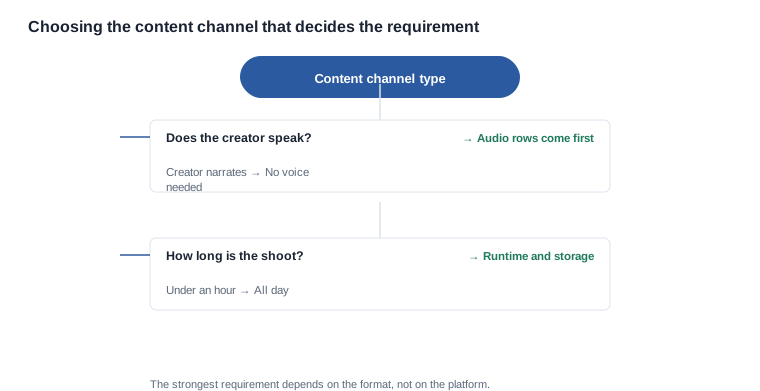
Which model you pick depends on which of the four rows matters most for your channel, and that is a genuine trade-off rather than a ranking. If the creator narrates, audio dominates and you should test the microphone rows first. If the content is walk-through and long, runtime and storage dominate and you should run the full shoot day before you commit. If the content is a haul or a setup, image and field of view dominate and the side-by-side shoot is the test. If the content is a full working day with audio and video together, you have a harder evaluation than any of the three, and you should tell the supplier that, because the answer changes which configuration is worth quoting.
On the underlying question, our position is simple and worth stating without hedging. The use case fits for a structural reason — the content is first-person and the hands are busy — and the four rows that decide it are the four nobody publishes. We will not present a resolution figure as an image quality claim, we will not quote a working day from a runtime that carries no condition, and we will not describe the microphone as characterised. What we will do is tell you which models publish which rows, and what we can close for you once a sample is in hand.
Send us the channel, the volume, the target market and a description of the content you expect to be made, and we will come back with what is available, what is not, and which of the two positions you are in — buying an open specification to close yourself, or buying a closed one.
Related reading
- The content creation positioning — Smart Glasses for content creation
- The camera rows and what to test — Content creation camera performance
- The range — AI camera glasses
- The camera in deployment — Camera technology and real world performance
- The voice row — Microphone quality and key specifications
- The shoot day — Battery planning for outdoor and sports use
Send us the channel, the volume and the content, and we will tell you which published figures apply.


