

Adding a prescription to a photochromic smart glasses product changes what the buyer is buying, and the change is larger than it first appears. A standard unit in this category is a catalogue item with a fixed specification; a prescription unit is a made-to-order item with a fitting process, a measurement record and a tolerance attached to it, and the two cost and behave differently in every part of the supply chain.
Three facts frame the whole question, and none of them is comfortable. Our catalogue publishes no prescription option for this entry. The entry itself carries no model designation. And the catalogue publishes no lens data of any kind for it — no substrate, no thickness, no base curve, no coating, no tint description, and no statement of how the lens is mounted. The published specification is five fields: the radio generation is Bluetooth version 5.4, the cell is 100 mAh, the charging method is magnetic, endurance is roughly seven hours, and a charge takes two hours or less.
None of that makes a prescription version impossible. It means that a buyer who wants one is buying a product that has to be described before it can be quoted, and the description is a joint document between the lens side and the prescription side. This article sets out what that document has to contain, who owns each part of it, what to ask, and how to write a purchase specification that keeps the two layers together once the first order is placed.
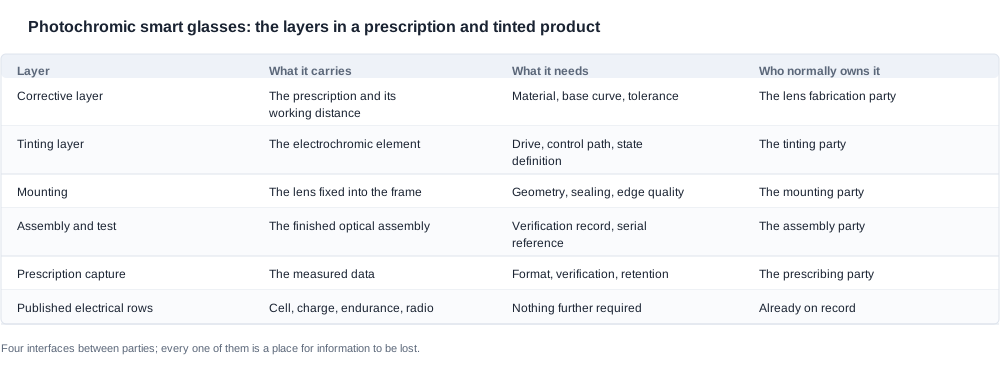
Photochromic smart glasses: the two lens layers in a prescription and tinted product
It helps to separate the product into two independent optical layers, because they fail for different reasons and are supplied by different parties.
The first layer is the corrective layer. It carries the prescription: the sphere, cylinder and axis, the addition if there is one, and the working distance the prescription was taken for. This layer is conventional. It is measured, it is generated from a blank, it is surfaced to a base curve, and it has a tolerance. The machinery and the practices behind it are well established, and a buyer in this category is not being asked to invent anything.
The second layer is the tinting layer, and in this category it is not conventional at all. The catalogue names this entry as electrochromic, which means the tinting is an electrically driven element rather than a passive material. That single fact is what makes the combination difficult. A driven lens has to be integrated with a corrective lens, and there are only a few ways to do that, and each of them has consequences for the parties involved.
The first approach is to drive a tint layer mounted in front of the corrective lens. The second is to drive an element that is bonded to or integrated with the corrective lens itself. The third is to place the corrective power in a separate element and treat the driven element as a separate optical component. Each approach puts a different party in charge of the optical result, and each of them changes who has to be measured, who has to be compensated when something is wrong, and which part of the product has to be reworked.
What a buyer should notice is that this choice is not purely optical. The approach determines where the drive electronics sit relative to the lens, and therefore whether the driven element can be replaced without replacing the corrective lens, or whether a mistake in a customer's prescription destroys a unit that contains a driven component as well. In a category where the driven component is the expensive and the scarce part, that is a commercial decision, not an engineering preference.
There is a third point about the combination that is easy to miss and expensive later. A prescription product does not have a single specification, it has a distribution of specifications. The catalogue's five published fields describe the product; the prescription layer adds a range, and a range has to be managed. A buyer who has only ever ordered a fixed-SKU product has no process for a tolerance, a remake, or a partial return, and all three arrive on the first order.
That last point deserves a little more, because it is the point at which prescription products usually fail commercially rather than technically. A fixed-SKU product is planned as a flow: units come off a line, they are counted, and the count is the whole of the planning problem. A prescription product is planned as a flow with a variable input, and a variable input changes the shape of the planning problem entirely. Capacity has to be reserved rather than consumed, because a unit at the edge of the prescription range may need a second pass through the optical process. Work in progress becomes a real category, and it has to be costed. The commercial question to put to a supplier is not how fast they can build a unit but how they will absorb the units that do not pass first time, because that is the part of the cost that is invisible in a unit price and visible in a margin.
The second thing the range changes is how the product is sold. A fixed-SKU product can be sold as it is; a prescription product has to be sold as a service, because somebody has to take the measurement, and the accuracy of the prescription limits the accuracy of the finished unit. The people taking those measurements are either the buyer's own staff, a partner, or the customer, and each of those three arrangements carries a different cost and a different failure rate. Choosing between them is a commercial decision that has to be made before the launch date, and it is a decision that is much cheaper to make before the product exists than to change afterwards.
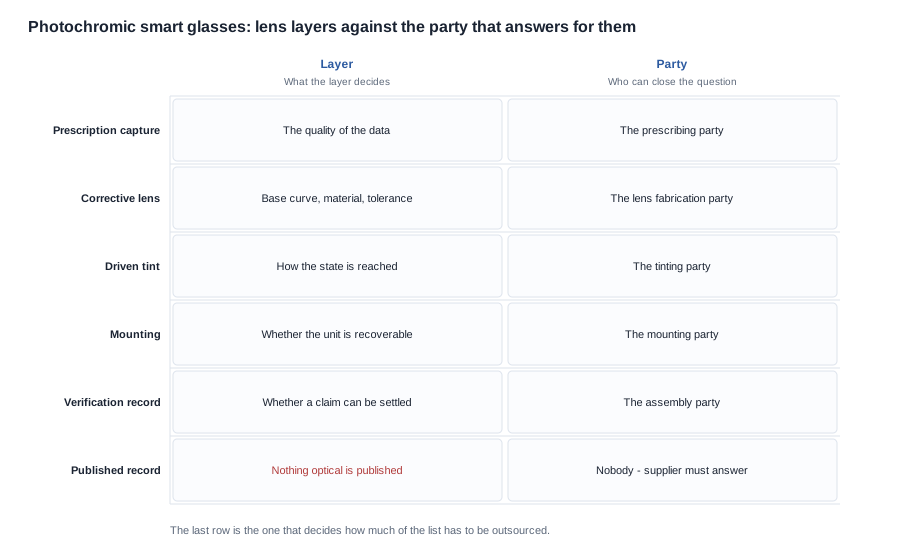

Who owns each layer, and what has to be handed over between them
The single most useful thing a buyer can do before asking any technical question is to write down who does what. In a prescription product there are usually five parties, and the boundaries between them are where defects are introduced.
The prescribing party takes the measurement and issues the prescription. It may be a store, a partner clinic, or a remote process with the customer uploading a current prescription. What has to be handed over is the prescription data, and the question is in what form and with what verification.
The lens fabrication party turns prescription data into a finished lens. It may be the product factory, a dedicated optical laboratory, or a local partner that fits lenses into frames. What has to be handed over is a written specification: the material, the base curve, the coating, the tolerances, and the permitted range of prescriptions the process can actually produce.
The tinting party supplies the driven element and, depending on the architecture chosen above, may also be responsible for integrating it with the corrective layer. What has to be handed over is the element's own specification, and the mechanism question from the way the drive works.
The mounting party fixes the lens into the product frame and seals it. This is where geometry is fixed and where a lens that is out of tolerance becomes a permanently unusable unit.
The assembly and test party puts the finished optical assembly into the product, flashes it, and performs whatever verification the process requires. What has to be handed over is a test record that ties the finished unit to the prescription it was built for.
The reason to name all five is the handover. A prescription product has at least four interfaces between parties, and every interface is a place where information is lost. A buyer who writes one combined specification and sends it to one party is assuming away four handovers that will in fact happen, and the assumption is where the defects and the disputes come from. The sizing and fit note for our sport range covers the geometry side of the frame question in more detail, and the shortlist note covers the wider sequence of how a shortlist gets built.
The commercial consequence of the five-party picture is that the price of a prescription product is a combination of at least five cost pools, and a quotation that gives one number for the finished unit without saying which party is inside it and which is outside it cannot be compared against another quotation of the same kind. That is the first rule of comparing anything in this category, and it applies with more force here than anywhere else, because a made-to-order optical product conceals more of its cost structure than a fixed one.
It also changes what a shortlist should contain. A shortlist of suppliers in a fixed-SKU category is a shortlist of companies; a shortlist in a prescription category is a shortlist of processes, and the two are selected on different criteria. A company with excellent manufacturing and no optical partner is not a candidate for a prescription version, however good its quotation is, and a company with an optical laboratory and no control over the driven element is not a candidate either. The criteria to apply are therefore: who guarantees the optical tolerance, who owns the record, and what the total cost of a remake is. Those three questions will separate a shortlist faster than any price comparison will.

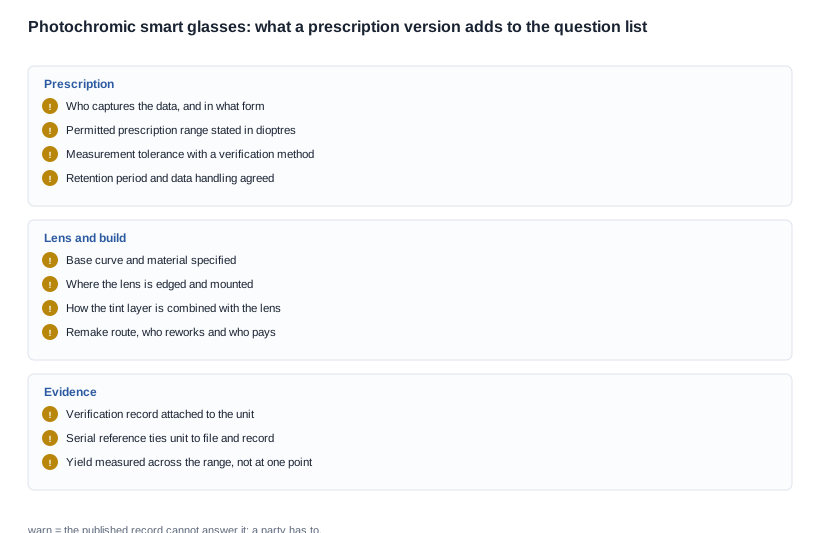
The questions a buyer adds when a prescription is involved
The published specification for this entry settles the electrical and radio side. A prescription adds a second questionnaire, and these are the questions that have to be answered before the specification can be written at all. They are listed in the order they should be asked, because the answers are not independent: a process that cannot hold a tolerance at the edge of its range cannot be made to hold one by a better incoming inspection routine, and a supplier who will not say where the edge is has not answered the question at all.
- Who takes the prescription, and in what form is it captured. A written prescription from a named professional, a measurement taken in store by the buyer, and a customer-uploaded document are three different quality levels, and they carry three different remake rates.
- What is the permitted range of prescriptions the process can produce. A supplier that will accept any prescription has not described its capability. The range has to be stated in dioptres, for sphere and cylinder separately, and with the tolerance at the edges of that range.
- What is the measurement tolerance on the finished lens. A tolerance without a unit and a verification method is not a specification, and a buyer who has not seen one cannot tell whether a remake rate of a few per cent is normal or poor.
- What is the base curve and the material of the corrective lens. Both are published by optical suppliers and both are absent from our catalogue for this entry, so they have to come from the party that builds it.
- Whether the lens is edged in the product factory or mounted from outside. A factory-edged lens and a locally mounted lens have different failure modes and different costs when something is wrong.
- How the driven element is combined with the corrective layer, and what that means for replacement: whether a change of prescription requires a new driven element as well.
- What happens on a remake. Is a new lens issued, is the unit reworked, is the whole unit replaced, and who pays the freight in each direction.
- Whether the prescription data is retained, and for how long. This is both a service-experience question and a data question, and the answer has to be settled before a consumer-facing product is launched.
- How the finished unit is verified and recorded. What is measured after assembly, what tolerance it has to meet, and what record is produced and retained.
- How the finished unit is identified. A serial or batch reference that ties the unit to its prescription, to its conformity documentation and to its test record is what makes a warranty claim tractable, and it is the same reference the conformity file note needs for the file to be coherent.
Two of those ten are worth flagging separately, because they are the ones buyers most often skip. The sixth is the one that determines the cost of an ordinary service event: if a customer's prescription changes after two years, and the driven element has to be replaced with it, then the company is shipping a driven component to make an optical correction, and the economics of the after-sales operation are completely different from those of a plain frame. The ninth is the one that determines whether a dispute is resolvable at all.
The lens data that the catalogue does not publish still matters here, for the same reason it matters everywhere else in this category. The tint note sets out what a tint description has to contain before a product can be re-ordered against it, and the timing note treats the timing of a driven lens, which is a question about the product in use rather than about the glass. A prescription product does not change either of those questions; it adds a tolerance to them.

Sampling, fitting and the tolerance that matters commercially
Sampling a prescription product is a different exercise from sampling a catalogue item, and the difference is not that it is more demanding. It is that the sample is not a sample of the product.
A standard sample tells a buyer what the production units will be. A prescription sample tells a buyer what one prescription produces, on one day, at one tolerance. The production units will cover a range of prescriptions, and the part of the range that matters commercially is the edge, not the middle. That is where the base curve is least able to accommodate the correction, where the tolerance is hardest to hold, and where the remake rate lives.
The practical protocol that follows from that is a spread rather than a single unit. A buyer should sample across the range it intends to sell, with a deliberate concentration at the limits of what the supplier claims to produce, and it should record what happened to every one of them. Two or three units at the extremes are worth more than twenty units in the middle, because they are the ones that decide whether the range is real.
Three measurements have to come out of that sampling, and they are different from the ones a catalogue product needs. The first is the accuracy of the delivered correction against the prescribed one, with the verification method recorded. The second is the yield, expressed as the proportion of units that need a remake, measured across the range rather than at a single point. The third is the time the whole process takes, because a prescription product that takes three weeks has a different operating model from one that takes three days, and the customer experience is not something to discover after launch.
The tolerance conversation belongs in the agreement rather than in the specification alone. A tolerance in a specification is a number the supplier aims at; a tolerance with a stated remedy is a cost the supplier owns. Those are different commercial positions, and the difference between them is worth a real argument during negotiation rather than a footnote.
Writing the purchase specification so the two layers stay together
The failure mode of a prescription product is not a bad lens. It is a product that satisfies two specifications and satisfies neither at the point of assembly. The purchase specification is where that is prevented, and it is worth a short set of rules.
- Separate the layers in the document itself. Give the corrective layer its own section and the tinting layer its own section, with their own tolerances and their own evidence, rather than describing a finished assembly. A document that mixes them cannot be used to work out which party owes what when something is wrong.
- Name the guaranteeing party for each line. Every element in the specification needs an owner, and the owner is the party that accepts the risk if the line is not met.
- Require the verification record to be attached to the unit. A measurement result that stays in a file at the factory is not a record of the unit; a record that travels with the unit is.
- Version the prescription specification, and link it to the product specification. When either changes, the other has to be re-checked, and that re-check is best made a contractual step rather than an assumption.
- Write the remake and the return route into the agreement. Which party reworks, which party pays the freight, how long the route takes, and what the customer is told in the meantime.
Our own position on this is straightforward and worth stating, because it is the part buyers ask about most often. We publish the five fields above and no lens data, and we do not publish a prescription option for this entry. We are not a dispensing service and we do not take measurements, and nothing in this article should be read as offering one. What we can do is tell you which questions a prescription version of this product adds to the list, which of them the published record can answer — which is to say, none of the optical ones — and which of them have to be closed with the parties who actually hold the optical data. That is the honest shape of the question, and it is a more useful place to start than a quotation.
If you are working out whether a prescription version of this product is viable for a particular market, send the prescription range you intend to cover and the party you expect to take the measurement, and we will mark, for each of those ten questions, who has to answer it and what evidence closes it before a first sample is worth ordering.


