

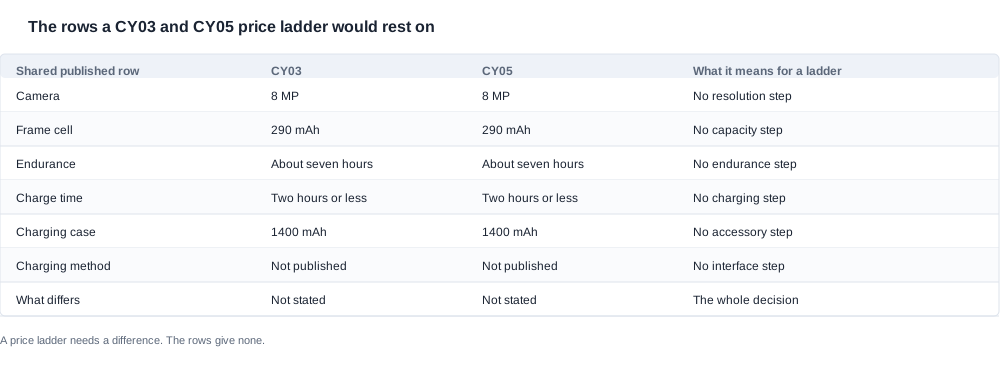
The CY03 and the CY05 publish the same camera, the same cell, the same charge time, the same endurance figure, the same case capacity and the same absent charging method row. On the published sheet they are one product with two names, and that is why a price position between them cannot be built from the specification. We publish no prices for any model in this range, so this article is not about which of the two sits at a particular figure. It is about what has to be documented before any price gap between them can be defended, what each possible answer costs across the range, and how to tell in advance whether two SKUs are a sensible structure at all.
Why a CY03 and CY05 price ladder cannot be built from the published sheet
Read the two catalogue pages side by side and every row lines up. The camera is 8 MP on both. The frame cell is 290 mAh on both. The charge time is two hours or less on both. The endurance rating is about seven hours on both. The charging case is 1400 mAh on both. Neither model publishes a charging method row, neither publishes a feature row, and neither publishes an ingress protection rating, a frame weight, a colour list or a certificate number.
Every row that a price ladder could rest on is therefore identical, and the two rows that would normally differentiate two products in this category are the two that are absent for both. A price gap normally expresses a difference — more capacity, a better component, a wider specification, a feature the customer can see. Here there is nothing published to express, which means that any gap placed between these two models is a merchandising decision rather than a specification consequence, and it has to be documented as one.
This is a different problem from comparing two products. It is a question about whether a range needs two products, and the answer has to come from the supplier rather than from the sheet.
Two things follow from the identity of the rows, and both are worth stating before the answers are discussed.
First, the identical rows are not evidence that the products are identical. They are evidence that the catalogue does not say they differ. A colourway, a temple, a lens treatment, a firmware revision, an enclosure change, a different minimum quantity or a different packing rule would all produce two identical published pages. So the sheet cannot tell you which of those is true, and any conclusion drawn from the identity of the rows alone is an inference about the publication rather than about the product.
Second, the identical rows cut both ways commercially. If a real difference exists and is unrecorded, the range has a merchandising axis it does not know it has, and a buyer who does not find it will build two SKUs that cannot be told apart. If no difference exists, the range is carrying two lines of inventory, two sets of artwork, two document sets and two freighting streams for one product. The commercial risk runs in both directions, and it is resolved by one written answer rather than by analysis.
One further point about the comparison method. It is tempting to compare the two models against other camera models on the published rows to establish that they are interchangeable — and they are, on those rows, which is the problem. Eight of the eleven camera models are published at 8 MP, so within that tier the resolution figure does no differentiating work at all. The models that do publish visible distinctions are the ones with feature rows: the V03 Pro with its flexible temple, photochromic lens, Type-C port and three published colours; the V06 with its ergonomic design, detachable inner frame, IP54 rating and four published colours; the S7 with its ergonomic design, 13 MP sensor, detachable inner frame and IP54 rating; and the MT6 with its portability, 158 g foldable-case configuration. If a range needs two camera SKUs that a customer can tell apart, the published evidence points away from this pair and towards a different pair.

The three answers to what separates them
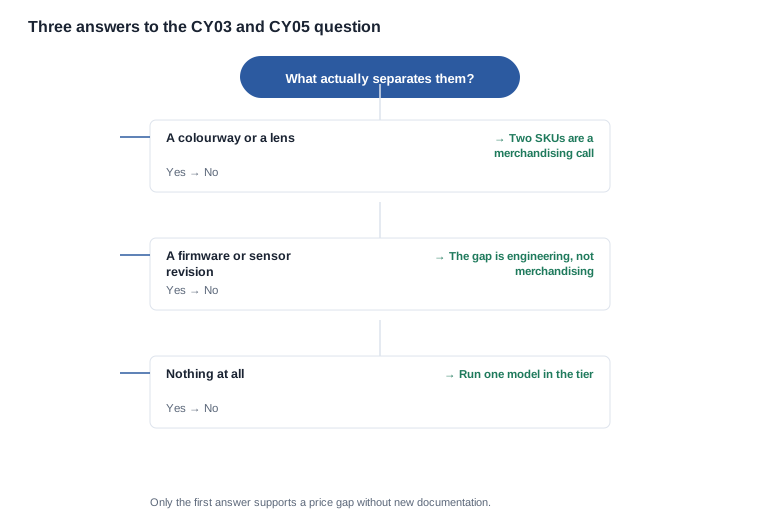
Answer one: a colourway, a lens or a packaging tier. Then two SKUs is a legitimate merchandising structure. The customer can tell them apart on a shelf or in a listing image, the case and the firmware are shared, and the gap between the two is a deliberate choice about which end of a colour line you want to stock. The work it creates is artwork and inventory; the work it avoids is a second platform, a second accessory programme and a second camera specification request. If the difference is a packaging tier, be clear with yourself about which tier carries which price — that is a merchandising decision you are making, and it should be written down as one.
Answer two: a firmware or sensor revision. Then it is an engineering difference, and the price gap has to cover the extra application work, the extra documentation scope and the extra stock. It also means the published specification for each model is incomplete in a way that will surface later, because two models that differ technically but not on the sheet will produce two different products under two identical specifications. The revision identifier and the firmware baseline are the strings that need to appear on the purchase order, the label and the test report, because without them there is no way to tell which product arrived.
Answer three: nothing at all. Then a two-SKU range is two thin lines. The customer cannot tell them apart, the second line exists because it was on a list, and the range underperforms because the sales history that would normally tell you which one to drop has been split between two products. The commercial response is the least satisfying and the cheapest: run one model in the tier, and put the budget into a configuration that differs on something published. The CY05 versus CY03 price positioning analysis covers the same question from the CY05 side, and the AI camera glasses which model to pick piece covers the wider range structure.
What to ask for, and in what form: one written answer naming both models, stating the difference in specific terms, dated. A verbal answer to this question does not survive a catalogue update or a staff change, and the question itself is the kind that gets deferred because it feels administrative right up until the second product page goes live.
What each answer costs across the range
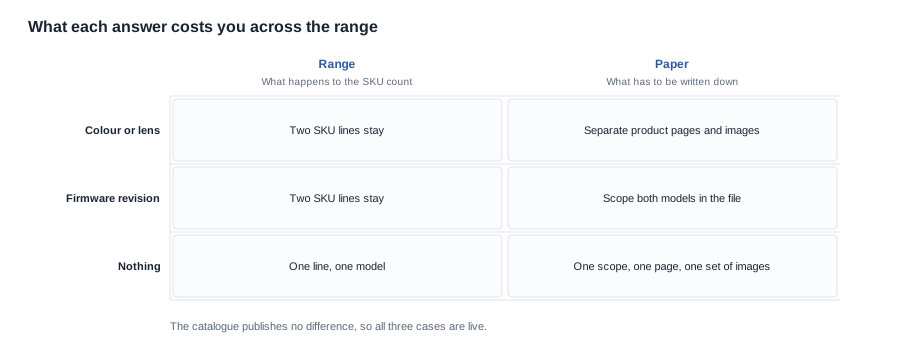
The three answers do not only differ in what they mean for these two models. They differ in what they do to the range, the documentation and the inventory — and the third answer is by a wide margin the cheapest of the three.
Under the colourway answer, the range keeps two SKU lines and needs separate product pages, separate listing images and separate packaging artwork, while sharing the accessory programme, the battery document and the camera specification request. The additional cost is design and stock, and it is predictable.
Under the revision answer, the range keeps two SKU lines and needs separate pages and images as well, plus a documentation scope that has to cover both configurations. The additional cost is a technical one: an extra firmware branch to maintain, an extra test report to hold, and a configuration string on every order that names which revision is shipping.
Under the nothing answer, the range contracts to one line. One product page, one set of images, one documentation scope, one inventory position, and one configuration string to manage. The saving is not only the stock — it is the removal of a whole category of question that a customer, a distributor or a platform compliance reviewer can ask and that the published sheet cannot answer.
There is a fourth possibility that is worth ruling out explicitly before anyone builds the range. The difference is commercial rather than physical — a different minimum order quantity, a different lead time, a different packing configuration, a different colour availability window. In that case the two models are the same product sold under different supply terms, and the price gap reflects a supply difference rather than a product difference. That is a legitimate structure, but it has to be visible in the quotation, because a customer who cannot see the supply difference will see only two identical products at two different figures and ask why.

Building two camera SKUs when the rows are identical
If the answer turns out to be a visible difference, the range structure still has to hold together commercially, and there are four conditions that have to be met before two SKUs make sense.
The customer has to be able to tell them apart without a specification sheet. That means the difference has to be visible in a photograph and in a one-line description. A colourway passes this. A firmware revision does not, and a colourway that only exists in the catalogue's internal naming does not either.
The compliance scope has to cover both, or each separately. The catalogue carries a company-level export certification page whose content is images rather than text, showing ten patent certificates — eight appearance-design patents and two utility-model patents — and the catalogue text contains no reference to CE, FCC or RoHS and no per-model certification row. So whether a document names the CY03 also covers the CY05 is a question to ask in writing, per model, with a scope and a date. A range that assumes coverage it has not confirmed carries the risk of an entire line of inventory that cannot be sold in a given market.
The documentation has to be closed once, not twice. The camera specification, the battery document covering the 1400 mAh case, the instruction artwork and the packaging specification should each be requested for the pair, not per model. If the answer turns out to be that the camera specification differs between them, then the two models are not one platform with two colourways and the range plan changes accordingly — which is exactly the kind of thing that is cheaper to learn before the pages are built.
The inventory has to be planned around the slower line. Two SKUs means two demand curves, two reorder points and two sets of forecast error. If the colourways are not evenly demanded, one of them will carry a disproportionate share of the stock while contributing a smaller share of the sales, and the range will look healthy on revenue and be unhealthy on cash.
There is one more option that is often overlooked and occasionally the best one: sell the pair as one configurable product rather than as two SKUs. If the difference is a colourway, a single product page with two colour options gives the customer the same choice, gives the distributor one line to reorder, and gives the warehouse one product code to pick. The commercial downside is that some channels need distinct listings to price and promote separately — and that is a channel constraint, not a product one, so it is worth checking before the range is designed rather than after.
What the negotiation looks like once the difference is known
The gap between these two models is a negotiation topic, and it is worth being clear about which parts of it are movable and which are not, because the parts that are not movable are the ones that have to be settled before the order rather than during it.
The documented difference is the only thing that can carry a gap. If the difference is a colourway, then the gap is a merchandising decision about how much a colourway is worth to your channel, and you should know that number before the conversation rather than discovering it during it. If the difference is a revision, the gap has to cover the incremental application work, the incremental documentation scope and the incremental stock — three items that are all real costs and none of which we can quote for you, because none of them are published for this model.
What is not movable is the published row set. The cell capacity, the charge time ceiling, the endurance rating, the case capacity and the resolution are identical on both models, and neither the supplier nor the channel can make them differ. A negotiation that tries to establish a gap by moving a published figure is a negotiation that will be reopened at the next audit or the next customer question, because the sheet says what it says. Similarly, a gap built on the absent charging method row is built on nothing: an absent row is an open item for both models, not a differentiator.
The commercial terms are the part that is genuinely open, and they are worth working through in the quotation rather than in the order. Minimum order quantity, lead time, payment nodes, packaging configuration, warranty terms and the defect remedy are all per-model in principle, and a request for a per-model quotation against a named configuration is the request that produces them. A blended rate across the pair produces something simpler to read and much harder to use.
The scope items are where a range quietly becomes expensive. If the certification documents name models rather than configurations, then adding this model to a range adds a scope to confirm, and confirming it after the range is assembled is materially more work than confirming it before. The same applies to the battery documentation covering the 1400 mAh case, to the instruction artwork, and to the charging instructions once the interface is established for the pair.
One practical discipline that closes most of this: ask for the per-model quotation and the model scope in the same exchange as the written answer on what differs. One message, three named items, and a single configuration string referenced in all three. The alternative — a sequence of emails each answering a different part — produces three partial answers that still have to be reconciled, and the reconciliation is the expensive part.

The questions to close before you set any price gap
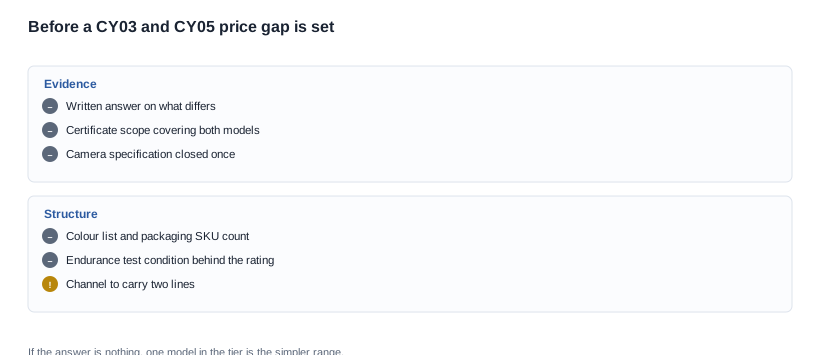
Evidence. What differs between the two models, in writing and specifically, dated. Whether the certification documents name both models or each separately. The camera specification, closed once for the pair or once per model. The colour list and the packaging SKU count. The endurance test condition behind the shared rating, so that whichever figure you publish is a figure you can evidence.
Structure. Which channel carries the two lines, and whether a single configurable product would serve it better. Whether the second line has a forecast that justifies the reorder point. Whether the case, the battery document and the instruction artwork are genuinely shared or genuinely duplicated. Whether the charging method row is still absent for both, because if the two models charge differently then the specification story changes.
Commercial terms. The quotation basis for each model separately, with its own minimum order quantity and lead time, rather than a blended rate across the pair. The configuration string on each order line. The defect and warranty terms. And the clause that says what happens when a delivery contains a different model than the order named, and who carries the freight — which on a pair with identical published rows is worth more than a warranty clause.
The order of these matters in one specific way. The written answer on what differs has to come before the quotation, because the quotation structure depends on it. Asking afterwards produces a blend you then have to unpick.
A buyer working through this checklist should hold one discipline throughout: every item gets an answer that names both models. "The two are the same" is not an answer, because it is the question restated. "They differ in the temple finish, the colour is the only other option, and the case and the cell are identical" is an answer, and it can be built on. The difference between the two forms is the difference between a range plan and a deferred decision.
The CY03 and CY05 pricing boundary and what we will not invent
A price ladder between two models with identical published specifications is a merchandising decision that has to be documented, and the honest alternative is to run one model in the tier and spend the budget on a configuration that differs on something published. We will not describe a difference the source does not state, and we will not present the shared endurance figure as a reason to prefer either model. We publish no price for the CY03, the CY05 or any other model in this range, and we will not publish a price band or a best-value designation, so we will not tell you which of the two sits at a particular figure or which is the cheaper buy.
What we will do is give you the comparison that can be evidenced. The published CY03 specification list and the published CY05 specification list are the honest baselines, the entry level options analysis piece covers the alternatives if you need two 8 MP lines, and the platform structure overview sets out how the shared rows fit the range.
Send us the channel, the two configurations you have in mind and the markets, and we will tell you whether these two models should be a range at all.
Related reading
- The published rows for the CY03 — CY03 smart glasses specifications and features
- The published rows for the CY05 — CY05 smart glasses specifications and features
- The platform structure — OEM ready platforms which models are ready
Send us the channel, the two price bands and the markets, and we will tell you whether these two models should be a range at all.


