

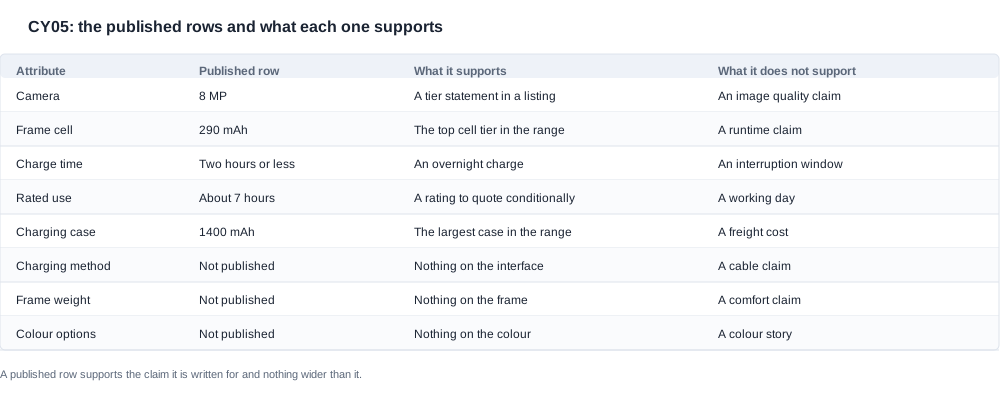
The CY05 publishes an 8-megapixel camera, a 290 mAh frame cell, a charge time of two hours or less, roughly 7 hours of rated use and a 1400 mAh charging case. Two of those rows — the cell and the case — are the strongest in the camera range. The rest of the model's published position is either behind another model or absent altogether.
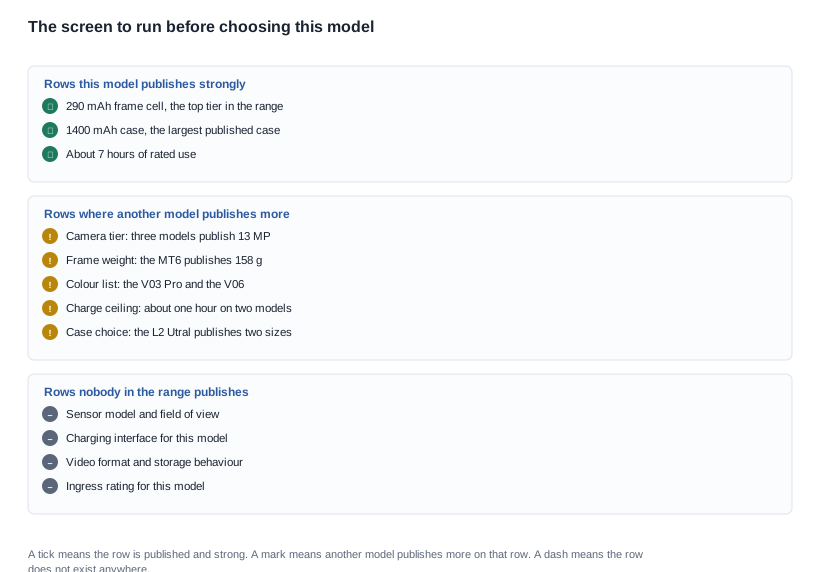
So the honest answer to a "which model is best for" question is not a model name. It is a screen. The CY05's published rows suit a brief built around what comes in the box and around the endurance story that box supports. Where the brief leads on the camera tier, on a published weight, on colour or on charge speed, another model in the range publishes more, and the comparison should be run against those models instead.
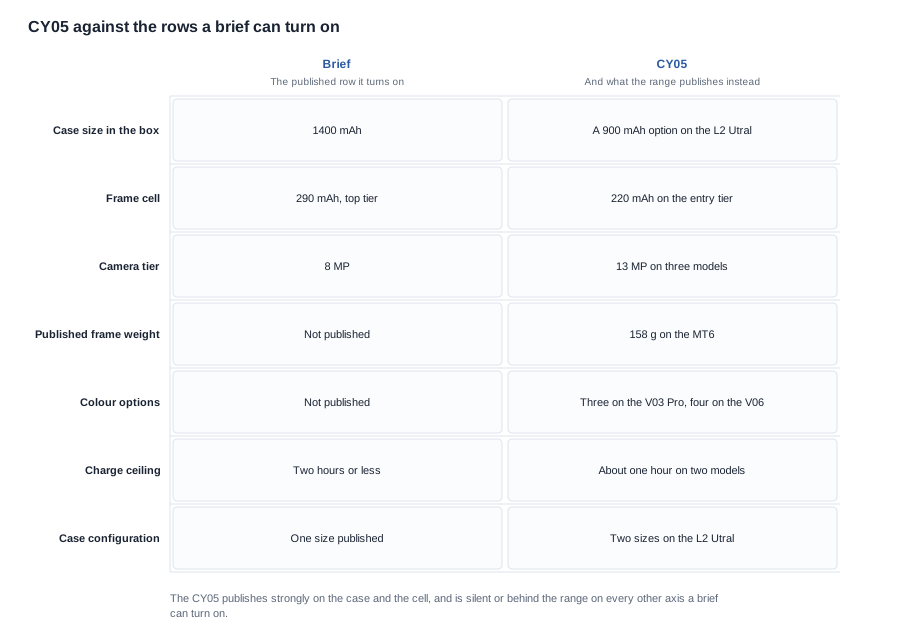
That framing is not a courtesy. A buyer who picks a model on the strength of the case row and then has to build a listing around a camera claim, a colour story or a weight figure will find that the listing has to be written without the rows that make it persuasive. The published rows have to support the proposition, and the CY05's strongest rows support one proposition.
We are not publishing a recommendation here, and we will not quote a price, an order quantity or a lead time to argue for one, because none of those three is published for this model or for any other. What follows is the screen, the reasoning behind it, and the questions to ask when the screen sends you to a different model.
Why the case is the argument
A 1400 mAh case is close to five times the frame cell, and it is the largest case capacity published anywhere in the camera range. The next largest is the MT6's 1200 mAh folding case, and the only other model that publishes two case sizes is the L2 Utral at 900 mAh or 1400 mAh.
Why it carries so much weight in an e-commerce proposition. It supports a "sample it, then wear it every day" story and removes most of the recharge anxiety that a customer forms in the first hour of ownership. That anxiety is what appears in customer reviews, because it is the row an ordinary buyer notices and can describe without a specification sheet.
Why it also helps the business case. Case capacity is published, so shipping weight, freight class and landed cost can be modelled today rather than after a sample. That is a rare position in this range: several camera models mention a charging case without quantifying it — the KY06 and the MT5 publish magnetic charging with a charging case and no capacity for it — and the V06 and the V03, and the S7 have no charging-case row published at all, while the V03 Pro has no charging-case row. If your planning process needs a delivered-cost estimate before the sample arrives, this model is ahead of most of the range. See charging solutions for the range-wide picture and the charging case options analysis for the accessory arithmetic.
What the case row does not settle. The case's own weight, external dimensions, charging interface, charge time and whether it carries a visible charge indicator are not published. Five numbers that decide the carton, the freight class and the customer's weekly routine, and all five have to be requested. The shipping weight analysis covers why that gap matters before the box is designed.
The 290 mAh cell is the other half of the argument. It is the top cell tier in the camera range, shared with the CY03 and the L1 Pro, and the L2 Utral, so it suits a brief built around heavy recording rather than intermittent use. It is not, however, a runtime advantage over the smaller cells in the range, and that distinction is worth keeping straight when the case is being used to justify the specification.

Where the CY05 is the wrong answer
Four rows of a camera product's published position are places where this model is behind the range. Each of them is a screen that sends the buyer somewhere else, and each of them is traceable to a published row rather than to a preference.
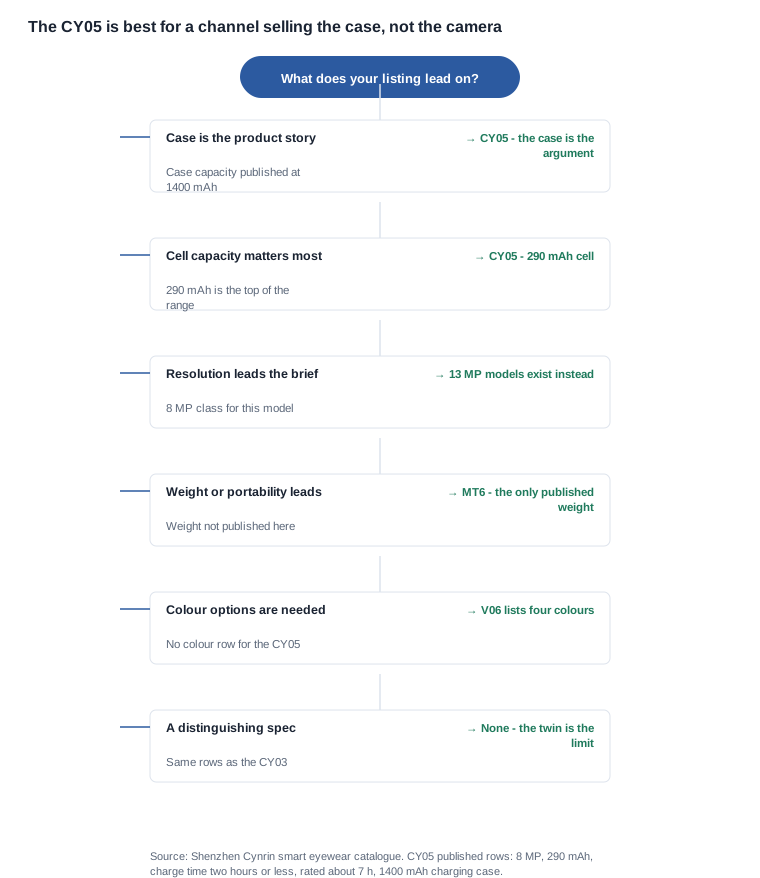
The camera tier. This is an 8 MP model. Three camera models publish 13 MP — the S7 and the L2 Utral, and the L1 Pro. If the proposition leads on a megapixel number in the listing title, the screen sends the buyer to that tier, and the CY05 is not in it. What the tier does not settle is image quality: no sensor model and no field of view is published for any of these models, so 8 MP is a tier label rather than a picture. See AI camera glasses imaging for why.
A published weight. No frame weight is published for the CY05. The MT6 is the only model in the catalogue that publishes one, at 158 grams for the glasses body with the cell and camera fitted, excluding its folding charging case — so it cannot be used as a proxy for this model, and it does mean a proposition built on portability has to be argued from something other than a published figure.
Colour. No colour options are published for the CY05. The V03 Pro publishes three — orange, cream and black — and the V06 publishes four, and they are the only two camera models in the range with a colour list at all. A channel that leads on colour has to start from a different model, and it also has to understand that a colour option is usually a finish change or a new mould texture, which makes it a tooling and artwork question with a lead time attached.
Charge speed. The published figure is a ceiling of two hours or less. The only models in the catalogue publishing about one hour are the D17 and the ZH12, which are sport models on different cells. So a brief that leads on a fast recharge does not find it here, and the right response to that brief is to go and look at the two models that publish it rather than to read a ceiling as a fast charge.
The screen, written as a list
The screen can be run in a single pass, row by row, against whatever brief the channel has:
- Does the brief lead on the box contents? If yes, the CY05 is a candidate on published rows, with a case capacity that can be costed today.
- Does the brief lead on the camera tier? If yes, the screen points to the 13 MP models and the CY05 leaves the shortlist.
- Does the brief lead on a published weight? If yes, the screen points to the MT6 and the weight claim has to come from a sample.
- Does the brief lead on colour? If yes, the screen points to the V03 Pro or the V06.
- Does the brief lead on charge speed? If yes, the screen points to the D17 or the ZH12.
- Does the brief lead on a case size ladder? If yes, the L2 Utral is the only model publishing two case capacities.
- Does the brief lead on image quality? If yes, no model in the range can be screened on published rows at all, and the answer is a sample comparison.
That seventh line is worth dwelling on, because it is where a lot of channel briefs actually sit. The published rows in this catalogue stop at pixels, and every model in the range shares that limitation. A buyer who wants to know which model photographs better cannot get it from a document and should plan a sample comparison rather than a shortlist exercise.
How the case changes the customer-facing proposition
A case is not a specification row that happens to have a retail consequence. It changes what the product is, in three places at once, and a channel that is selling the case is making three promises that have to hold.
The first is the photograph. If the product image shows the case and the box contains a thin pad, the customer concludes the listing was misleading. If the box contains the case, the customer understands why the product lasts longer than the battery figure suggests, and that understanding is what removes the recharge objection. The second is the packaging. A 1400 mAh case needs a cavity, a lid and protection in the master carton, which is an artwork and tooling item rather than a print item, and it changes the units per carton and therefore the pallet configuration and the warehouse space per unit. The third is the failure surface. A case that ships with the frame has a charge indicator, a connector and a hinge, and each of those is a possible failure that did not exist when the product was a frame and a pad.
That third point is where the case stops being a marketing asset and becomes a quality-control one. A case that does not indicate its state generates a support ticket that is really a charging fault, and the retailer absorbs the cost of the conversation. A case that ships and does not charge generates a return. Both of those are cheaper to prevent with a written specification and a first-article check than to absorb afterwards, and both belong in the quality-control plan rather than in the product brief.
There is also a habit worth avoiding, which is to present the case capacity as if it were an endurance promise. The 1400 mAh figure describes the box. What the customer experiences from that box depends on how the case is charged, how often it is topped up and how the frame is used in between — and the case's own charge time is not published. The case is a strong retail asset on its own published row, and it becomes a weak claim the moment it is presented as a number of hours.

What a case-led brief still needs from the supplier
A brief built around the case is not finished by the published capacity. Ten further items have to come from the supplier in writing, and each one belongs in the quotation rather than in a later discovery. Grouped by what they cost you when they are wrong, they are:
Carton and freight. The case weight and external dimensions; the packed unit weight; the carton dimensions and the units per carton; the freight class the configuration falls into; and the incoterm on which it ships. These five decide the delivered cost per unit, and none of them is published for this model.
Packaging and tooling. The artwork and tooling implication of a 1400 mAh case in the carton, whether the case is a separate line item in the quotation or part of the configuration, and what happens to the artwork and the lead time if the case capacity changes. A configuration change after artwork approval is one of the most expensive routine errors in this category, and it is prevented by naming the configuration as a controlled item on the purchase order.
Quality control. What the first-article inspection covers for the case, whether the case is included in the defect policy on the same terms as the frame, what the acceptance sampling rate is for the case as a separate component, and how a case that fails its indicator is handled in a return.
Commercial. Unit price at your planned quantity and the price breaks above it; minimum order quantity per configuration; lead time from deposit to shipment for this configuration rather than for the model in general; monthly production capacity; warranty terms; and payment terms.
Two of those groups deserve a specific warning. The defect policy on the case is the one most often assumed rather than agreed, and a case that is excluded from the warranty is a product whose most visible component is unprotected. The configuration as a controlled item is the one that prevents a quiet substitution: if the case capacity or the cell changes without the change passing through the artwork and the documentation, the shipped product no longer matches the file.
None of this is published for the CY05 or for any other model, and the reason is worth stating plainly to a supplier at the start of the conversation rather than at the end: the catalogue publishes what the product is, and it does not publish what it costs to put that product in a carton and ship it. Those are different questions, and the second one is yours.

The twin, which is the real limitation
The CY03 publishes rows identical to the CY05 — same camera tier, same cell, same charge ceiling, same runtime rating, same case capacity — and the catalogue does not state what separates them.
This is the CY05's genuine structural weakness, and it is more consequential than any of the four rows above. A buyer who compares two models on a shelf, in a listing table or in a range plan and finds nothing to distinguish them is looking at a range that is fragmenting itself. Two designations that publish identical specifications multiply the number of surfaces on which a model string has to stay consistent — the invoice, the carton, the listing and every document in the pack — without adding anything a customer can see.
What to do about it is a commercial question rather than a technical one. Find out what separates the two models in the supplier's own words, and treat the answer as a foundation rather than a detail:
- If it is a colourway or a packaging tier, two designations is a reasonable merchandising structure, and the difference is visible to the buyer.
- If it is an order quantity position or a lead time, two designations is a supply-chain decision, and it should be documented in the range plan.
- If the answer is that nothing differs, run one SKU. A second designation with no visible difference carries freight, artwork and compliance scope for nothing.
The CY05 versus CY03 positioning analysis covers what each of those answers costs in practice.
Documenting the difference so it survives the handover
Whichever answer comes back, it needs to exist in a form that a supplier, a warehouse and a compliance reviewer can all use, because the risk in this situation is not the ambiguity itself — it is the ambiguity surviving a change of hands. A range plan that says the two models differ, without saying how, is a conversation with one person; a range plan that says the difference is a colourway, with the artwork reference and the carton artwork version attached, is a control that anyone can act on.
Three practical rules follow. Record the difference as a row on the published specification sheet rather than as a note in a range document, so that it travels with the model into every downstream artefact. Make the distinguishing attribute a controlled item on the purchase order, so that a change to it reopens the artwork and the documentation rather than arriving silently. And put the model designation on the invoice, the carton, the listing and the documents as the same string, because two designations that publish identical rows are exactly the case in which a substitution hides.
None of this is published for the CY03 or the CY05. It is the part of the range plan that a buyer has to create, and it is the part that determines whether the range is a ladder or a duplication.
What is absent from this model entirely
No sensor model, no field of view, no video specification, no frame rate, no storage capacity, no file format, no overwrite behaviour, no frame weight, no ingress rating, no colour list, no stated charging interface, no certificate numbers, no issuing bodies, no validity dates and no covered-model schedule.
Two of those absences have commercial weight beyond the model itself. The missing charging interface means the packaging instructions, the product page and the support scripts cannot describe how the frame is put on charge, because the catalogue publishes a charging-method row for four camera models and not for this one. The missing certification row means there is nothing to attach to a compliance file: the catalogue carries a company-level export certification page whose content is images rather than text — ten patent certificates, eight appearance-design patents and two utility-model patents — and the catalogue text contains no reference to CE, FCC or RoHS marking and no per-model certification row anywhere. That request has to be made in writing, with its cost and its lead time, as part of the quotation rather than as an administrative afterthought.
What the CY05 screen is worth
The CY05 is a case-and-capacity product rather than a specification product, and its published rows should be used for what they are: the strongest cell and case position in the camera range, with a cell and a case that can be costed before the sample arrives. We will not describe 8 MP as image quality, we will not manufacture a distinguishing feature to justify carrying two near-identical designations, and we will not present a charge-time ceiling as a fast charge or a rating as a working day.
We will also not tell you which model to buy, because unit price, order quantity, lead time, production capacity and warranty are not published for this model or for any other, and a recommendation that rests on published specification rows alone would be a recommendation about a spec sheet rather than about an order. What the screen gives you is narrower and more durable: a list of the briefs this model fits on published rows, a list of the briefs it does not, and the models that do fit those.
Tell us what your listing leads on, and we will run the screen against the whole camera range and tell you which models publish the rows your brief needs — and which questions have to be closed with the supplier before any of them can be ordered.
Related reading
- The full camera range — AI camera glasses
- How case capacity changes your economics — charging solutions
- The range screen for every camera model — AI camera glasses which model to pick
We need the target market, the quantity and the required configuration, and we will come back with what is available and what is not.


