
Ask any compliance reviewer about the K02 smart glasses certification status and the answer usually arrives faster than the evidence does, because the published material offers something that resembles an answer without being one. The K02 certification status in published form is five specification rows and a single export certification page with images rather than text on it. What the catalogue does not print, anywhere, is a conformity record for the K02: no certificate number, no issuing body, no validity date, no list of covered models. So the compliance answer has to be assembled from documents requested from the supplier, not looked up in a catalogue.
Three items in the catalogue are routinely mistaken for certification evidence about this model: the export certification page itself, the ten patent certificates presented on it — eight appearance-design patents and two utility-model patents — and the model's own specification rows. None of the three is a conformity record for the K02. A patent is a right to exclude, not an assessment against a safety, radio or electromagnetic requirement, and a specification row describes what the product does rather than what an authority checked. Every file review that follows depends on keeping that separation clean, which is why it is worth establishing at the outset rather than discovering halfway through an enquiry.
This piece is written for the procurement manager and the compliance reviewer who will sign for market access on a model they have not yet put through a laboratory. It sets out what the catalogue prints for the K02, why no certificate number appears against it, which two frameworks genuinely apply to a Bluetooth product of this kind, what to request before the first order, and a checklist you can run against whatever comes back.
What the K02 catalogue page actually prints
Five rows constitute the entire published specification for this model: Bluetooth version V5.3, battery capacity 90mAh*2, a charge time of no more than two hours, a rated usage time of about eight hours, and magnetic charging. Read as a complete statement of documentation, that is the whole of it. There is no feature line on the K02 page, and that absence deserves more attention than it usually gets, because feature lines are where descriptive claims live — a descriptor a channel can print, a marketing team can quote, a reviewer can check. Five of the eight audio models publish no feature row at all, and that set is the K01 and the K02, the LC-105-1 and the LC-105-2, and the D12. The other three audio models do publish one: the D11 with surround sound and long battery life, the G07 with ultra-slim detachable temples, and the YK12 with surround sound and slim temple.
The published rows for the K01 are identical to those for the K02: Bluetooth V5.3, 90mAh*2, magnetic charging, about eight hours, and no feature line on either page. That similarity creates a specific trap for anyone moving quickly through a range. Identical specification rows do not imply shared documentation. Conformity evidence attaches to a model designation, so a document naming the K01 covers the K01, and it covers the K02 only if the K02 designation appears on it too. Assuming transfer from a sibling model is one of the most common reasons a compliance file stalls after the purchase order has already been signed.
The catalogue text names no CE mark, no FCC mark and no RoHS statement anywhere in it. Those three names come up constantly in buyer conversations, which makes them easy to mistake for something the catalogue holds. It does not hold them. A per-model certification row — a line mapping a model designation to a certificate number, an issuing body and a validity period — is absent from every page of the range, not merely from the K02.
Several commercial and physical rows are likewise not published for this model: weight, dimensions, sensors, storage, unit price, minimum order quantity, lead time, warranty and certificate numbers. The catalogue does publish one weight figure, and it belongs to a different model — the MT6 glasses body at 158 g, excluding its folding charging case — which is a useful illustration of how easily a number gets imported from the wrong row. For the K02, weight stays unpublished, and so does every other item on that list.
| Row published for the K02 | Value on the catalogue page | What that row actually is |
|---|---|---|
| Bluetooth version | V5.3 | A radio specification, not a conformity record |
| Battery capacity | 90mAh*2 | A component capacity, not a certification line |
| Charge time | No more than two hours | A product parameter, not a certification line |
| Rated usage time | About eight hours | A product parameter, not a certification line |
| Charging method | Magnetic | A product parameter, not a certification line |
| Certification row | Not published | No number, issuer, date or covered-model list exists |
None of the six lines above becomes a certification statement by restating it. A cell capacity becomes a transport question, not a conformity claim. A charge time becomes an operational question, not a conformity claim. A Bluetooth version becomes a radio question, and only that one. A buyer who treats these rows as evidence of compliance is not making a small mistake; they are reading the wrong column.

Why no certificate number appears against the K02
The absence is structural rather than an oversight in the document, and separating which of three reasons applies to which line of the request is what makes the request efficient rather than repetitive.
The first reason is that conformity evidence is a dated instrument issued by a named body against a stated requirement, and a catalogue row is none of those things. A catalogue publishes what a product is; a conformity file publishes what a third party checked. When a buyer asks what the K02's certificate number is, the question is being addressed to a source that structurally cannot answer it, and no amount of careful reading of the published pages will produce a number. This is also why a "please send your certificates for Europe" style request reliably returns the weakest possible answer: it asks the catalogue question at a person.
The second reason is the export certification page. It carries ten patent certificates, eight appearance-design patents and two utility-model patents, presented as images. The arithmetic matters when a buyer reconciles a supplier's document set against the catalogue: ten patent certificates are not ten design patents. More important is what these instruments do. An appearance-design patent protects the ornamental shape or surface ornamentation of a product, and a utility-model patent protects an invention in its configuration at a lower threshold of inventive step. Both are rights to exclude. Neither is issued by a body that performs conformity assessment, neither records a test against a requirement, and neither carries a validity period tied to a market. Presented to a customs authority or a market surveillance body as evidence of conformity, a patent certificate answers a question nobody asked, and the enquiry starts again from zero with less time than it had.
The third reason is the missing per-model row, and it is the one that decides the whole approach. Because no line maps a model designation to a certificate number, an issuing body and a validity period, there is no way to derive a K02 certificate from published material — not from a sibling model, not from the export page, and not from the existence of that page itself. The published route simply does not exist, and a request built on the assumption that it does will stall at the first reply.
It is equally important not to over-read the gap in the other direction. The catalogue does not publish a certificate number for the K02; that is a statement about publication, not about the product. A supplier may well hold a conformity file that the catalogue never contained, and a buyer who arrives at the conclusion that this model has no certification has replaced a documentation gap with a false finding, which is worse than the gap. The correct framing is narrow and practical: the evidence is not in the document you have, the supplier is the only party who can produce it, and the request below is the route to it. A dated refusal from the supplier is still an answer, and in most cases it is an answer you can file.

The two frameworks that do apply to the K02
Because the K02 publishes Bluetooth V5.3, it is a radio product, and radio equipment rules apply to it in full. For the European Union the instrument is the Radio Equipment Directive (EU) 2014/53/EU, which governs transmission characteristics and spectrum use. The second instrument is the Electromagnetic Compatibility Directive (EU) 2014/32/EU, which is a different question — whether the product's emissions and immunity interfere with other equipment. The two are assessed and referenced separately, so a supplier who cites one directive number when asked about the other has not answered the question, and a document described loosely as covering the European requirements leaves you unable to tell which assessment was actually performed.
Naming both frameworks by number and full title when you write the request is what turns a vague answer into a specific one. These are framework names, and they earn their place in a request precisely because they tell you what evidence to ask for. They are not certificates the catalogue holds against the K02, and no certificate number, issuing body or validity date is published for this model against either directive. A request that names a framework gets a document or a refusal; a request that says "certificates" gets a brochure.
The battery side of the file follows a different route again. The K02 carries two cells of 90mAh*2 and charges magnetically, and lithium cells shipped in any configuration raise transport questions that a radio conformity document does not answer — transport evidence for the cell, and any cell-safety documentation your destination and your logistics provider require. The catalogue publishes no transport documentation of any kind for this model, and the battery rows above remain product parameters rather than evidence of anything. Asking for transport evidence is a separate line in the request, and it belongs to a different owner inside the supplier organisation than the radio file does, which is worth knowing before you chase it.
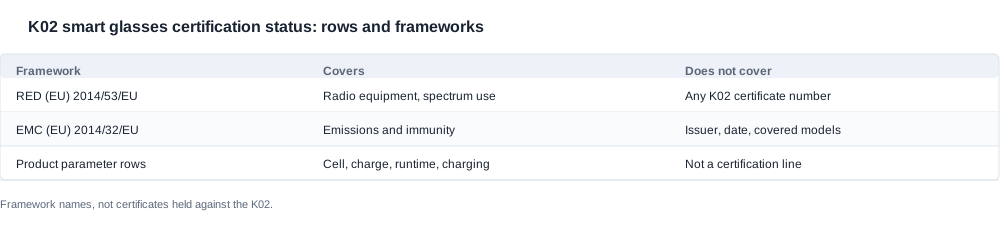
Two further points keep the request proportionate. First, a supplier that has run a proper radio and electromagnetic compatibility assessment will usually produce both documents from a single laboratory programme, because the same test setup covers much of both. Producing only one may indicate that the programme was never completed rather than that half the answer was withheld, so ask for both and treat one as a completeness check on the assessment. Second, a refusal can be useful. A dated, specific statement that a particular report does not exist tells a reviewer that the question was asked and answered, which is a materially better position than silence, and it tells you early which lines of the request to escalate to a supplier manager.
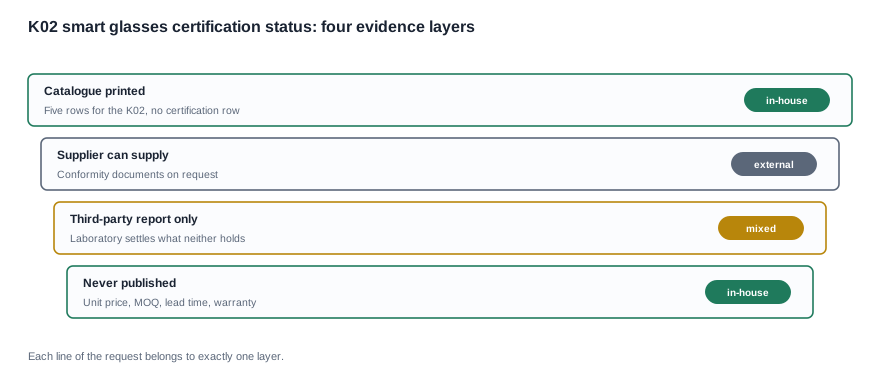
The layering above is the practical shape of the problem. The catalogue publishes a small set of rows and nothing else. The supplier can supply conformity documents on request. A third-party laboratory can settle what neither of those two holds. And a small set of commercial facts — unit price, minimum order quantity, lead time and warranty — will never appear in printed form and belong in the quotation instead. Sorting a request into those four layers before sending it stops you asking a supplier for something they cannot produce, and stops you asking for something they will only put in a quotation.

What a K02 buyer has to request before the first order
The request works when it is written as named documents with named conditions rather than as a general question about compliance. Ask the whole question at once and the reply tends to arrive as a brochure; ask for a specific document and the reply tends to arrive as the document, or as a dated refusal you can act on.
- Radio equipment conformity evidence for the K02. Name the instrument, the Radio Equipment Directive (EU) 2014/53/EU, and require the document to state the model designation, the test standards applied, the issue date, the validity period and the batch or serial range covered. A document without a validity period and a covered range is a snapshot of an earlier configuration, and a configuration change is exactly what a supplier is most likely to make without mentioning it.
- Electromagnetic compatibility evidence for the same model, kept as a separate document. The Electromagnetic Compatibility Directive (EU) 2014/32/EU, with its own report reference and its own covered range. Ask for it separately so that a single combined reference cannot hide an assessment that was never performed.
- A material and substance declaration for the destination market. The applicable regime differs by market and by material, so this is a per-destination request. State the destination country and the date by which the declaration has to be current.
- Cell and transport documentation for the two 90mAh*2 cells. Transport evidence for the lithium cells, the cell-safety documentation your logistics provider requires, and confirmation that the charging method on the unit is magnetic, so the documentation describes the hardware that actually ships.
- The manufacturer identification that will appear on the documents, and who holds that role in the destination market. If the product will be sold under your own brand, ask explicitly which entity a regulator contacts on your documentation. It is not always the supplier, and the answer decides who carries the obligation after the shipment clears.
- The exact model designation to be printed on the document and on the unit. Settle the designation in writing before the request goes out. A document carrying a slightly different designation may be one your reviewer will not accept, and the fact that the K01 and the K02 publish identical rows makes it easier for the wrong designation to be assumed on both sides.
- Laboratory detail wherever the supplier holds only a summary. Which laboratory, which report number, which unit under test. A named standard without a report behind it describes a route rather than an assessment, and the difference between the two shows up in the answer rather than in the confidence of it.
- A written statement of what is not held, plus a change-control undertaking. A supplier who states plainly which documents do not exist is giving you more usable information than one who answers optimistically. The change-control half tells you what you would be notified about if a component, a supplier or a process changed in a way that would affect the documentation.
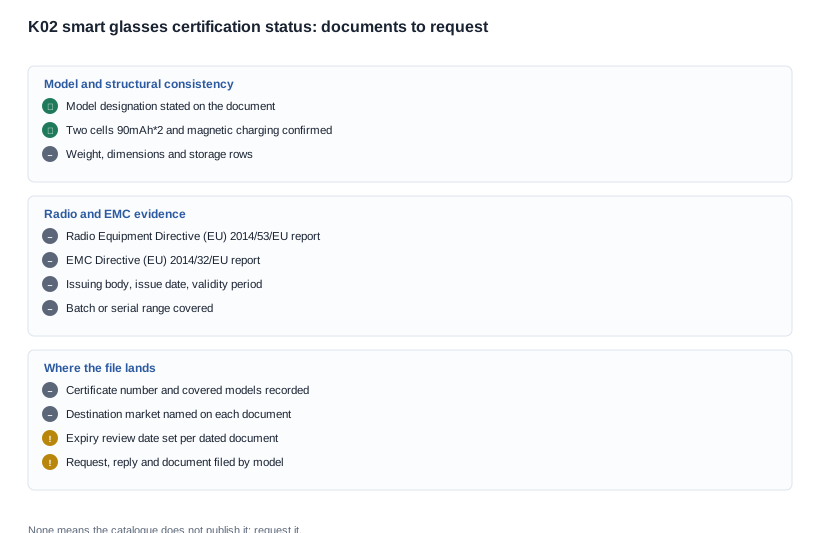
Sort the eight lines into three columns before sending them. Documents whose absence stops the order become conditions in the purchase order, which is a normal commercial structure because it transfers a documentation obligation rather than a price obligation. Documents whose absence creates work later go out as a request with a date attached. Documents you would like but can live without stay out of the conversation until the first column is resolved. Buyers who send one undifferentiated list get one undifferentiated answer; buyers who send a sorted list get a sequence they can act on, and they can also see early when a stall is a commercial signal in its own right rather than a scheduling problem.
Write each line the way the reviewer will actually ask it. Reviewers do not ask whether the supplier holds the radio report; they ask what evidence supports radio conformity for the K02 in the destination market. Written in the second person and against a named market, the request tells the supplier exactly which page of its own file is needed. Attach a deadline and a consequence, both stated commercially: before the purchase order is signed is actionable, and at your earliest convenience is not.
Several patterns in a reply are worth treating as red flags rather than as progress. A certificate that names no model designation, or that names a family instead of the K02, is the most common reason a compliance file stalls after signature. A validity date that has already passed, or one that expires before your planned shipment, is a scheduling problem to be resolved before the order is placed. A reply consisting only of standard names, with no laboratory, no report number and no unit, describes a route rather than a completed assessment. A supplier claiming that the export certification page covers the model is making a category error, and one that a buyer can correct quickly once the distinction is understood. A supplier who asks you to sign the purchase order before the documents arrive is not necessarily being unreasonable, but the answer has to be a condition in the order rather than an assumption.
Price, minimum order quantity, lead time, warranty and any documentation-related fee are not published for this model, and no attempt should be made to infer them. They belong in the quotation, written against the same configuration and the same model designation as the documents in the request, so that a later comparison is between like configurations rather than between a quotation and an assumption. Keep the record as you go: file each request, each reply and each document against the model designation rather than against the person who sent it, because the question recurs at the next order and the fastest answer is the one already on file.

The sequence above is deliberately ordered, and the order is the part most requests get wrong. Locking the model string first costs nothing and prevents the expensive failure mode, which is documentation that arrives for a designation nobody agreed on. Third-party testing comes third because it is the most expensive route and should only be used for the lines the supplier genuinely cannot close. Writing the certificate numbers, validity dates and covered ranges into the specification sheet and the purchase order comes next, because a document that lives only in an email thread is not a condition anybody can enforce. Packaging artwork comes last for the same reason: marking and labelling requirements are assessed separately, and artwork released against the wrong document set is expensive to correct once tooling exists.
The K02 certification status checklist
Run the answers against these criteria before you sign. The aim is not to collect more paper than the destination market requires, but to know which lines you can evidence and which you will have to disclose as an open item to a reviewer, an insurer or a customer.
- Model designation on every document. Confirmed in writing, identical across documents, and identical to the designation on the unit and the purchase order.
- Two cells of 90mAh*2 and magnetic charging confirmed on the unit as the documented configuration, so the technical file and the shipped hardware describe the same product.
- Radio evidence against the Radio Equipment Directive (EU) 2014/53/EU, with an issuing body, an issue date and a validity period that covers your shipment date.
- Electromagnetic compatibility evidence held separately, with its own report reference and its own covered range.
- Transport evidence for the cells, issued for the configuration you will actually ship, including the charging method.
- Material and substance documentation issued for the destination market, dated, and naming the entity that holds the manufacturer role there.
- Covered batch or serial range stated on the documents, and the traceability route from a unit on a shelf back to that range understood before the first shipment.
- Change-control undertaking obtained, so that a future component or process change is something you hear about from the supplier rather than discover at an enquiry.
- Written statement of gaps on file, dated, covering every line the supplier does not hold.
- Commercial lines in the quotation, with configuration, model designation, minimum order quantity, lead time and warranty written against the same unit the documents cover.
- Storage of the file against the model designation, with a named expiry review for each dated document.
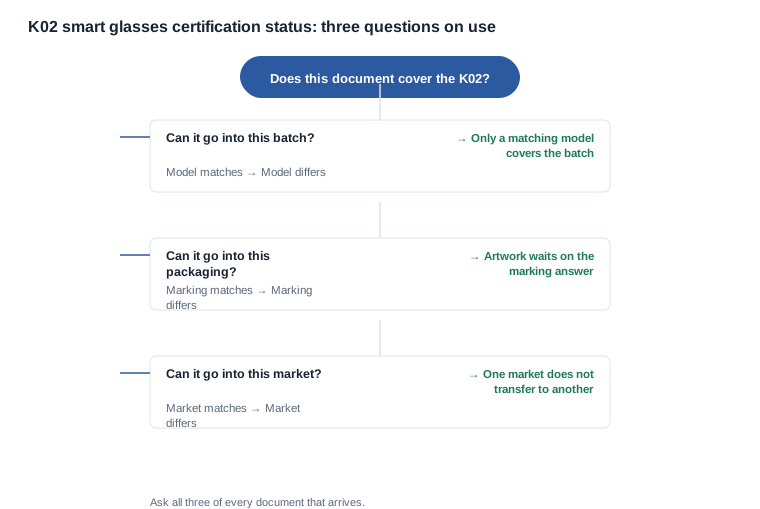
The three questions above are the ones to ask of every document that arrives, and they are quick to apply. Can it go into this batch? If the model designation on the document is not the model designation on the order, it cannot, and a covering letter does not cure the mismatch. Can it go into this packaging? Marking and labelling requirements are assessed separately from the product, so the answer to that question gates the artwork rather than the order. Can it go into this market? A document issued for one destination does not transfer to another, and the destination country named in your request must match the destination country printed on the document.
There is a trade-off here worth naming explicitly. A strict evidence position protects a buyer from a market-surveillance enquiry later, but it also delays an order and may shorten the supplier list. A loose position gets product into a channel sooner and leaves the exposure with whoever imported it. The practical middle is the sorted request: block the order on the documents the destination market genuinely requires, treat the rest as dated follow-ups, and keep a written record of what is outstanding so the risk is disclosed rather than hidden. That is a decision to make with the market and the timing in front of you, and this checklist exists to inform it rather than to replace it.
What the catalogue can tell you about the K02, and what it cannot, is now a short list. Bluetooth V5.3, 90mAh*2, a charge time of no more than two hours, about eight hours of rated usage and magnetic charging are the published rows; the catalogue publishes no certification row for this model, no certificate number, no issuing body, no validity date and no covered-model list. Those published rows are enough to specify a product. They are not enough to place one on a market, and the distance between those two statements is the whole subject of this piece. For a buyer who has to state the K02 smart glasses certification status in a file for someone else, that short list is the entire published position, and it is better to send it as-is than to dress it up.
Send us the destination market and the document list your K02 review requires, and we will mark every line as published, supplier-held, or not available to us. The model sits in the Bluetooth audio glasses range, and the published rows are set out in the K02 specification reading.
Related reading
- The five published rows and the other gaps on this model — K02 limitations
- The document set a first order should request — smart glasses certification checklist
- What the cells require before freight is booked — battery transport compliance
- Market-side documentation for the destination — FCC compliance documentation
Tell us the destination market and the document list your reviewer requires, and we will mark every line of the K02 smart glasses certification status as published, supplier-held, or not available to us.


