

A limitation list is only useful to a buyer if it separates the limitations you would inherit whatever you chose from the limitations you would inherit because of this specific model. The D11's limitations divide cleanly into two groups, and the larger group belongs to the category rather than to the product.
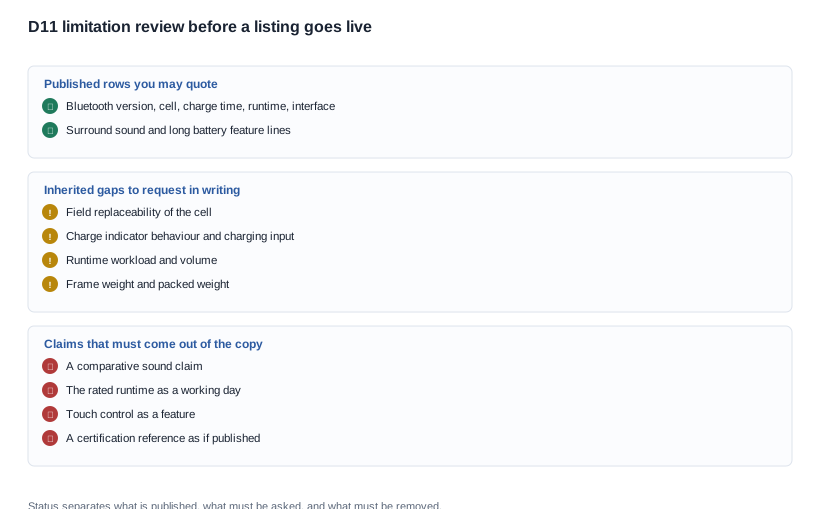
The D11 publishes Bluetooth V5.4, a single 100 mAh cell, Type-C charging, a charge time of two hours or less, an approximately seven-hour rated runtime, a surround-sound line and a long-battery-life line. That is the complete sheet. Everything else a buyer usually wants to see — acoustic measurements, frame weight, ingress rating, charge indicator behaviour, certification references, minimum order quantity, price, lead time — is not published.
Two of the D11's limitations are specific enough to be worth naming before an order is placed. One is the surround-sound feature row, which is a claim that has to be defended in the listing copy without a single supporting number, because our catalogue publishes the word and no measurement behind it. The other is the single-cell architecture, which changes the service profile and the spare-parts line without changing the headline charge time. The remaining gaps are the ordinary gaps of a specification-thin category, and they are inherited by every model in the range, so switching models does not remove them.
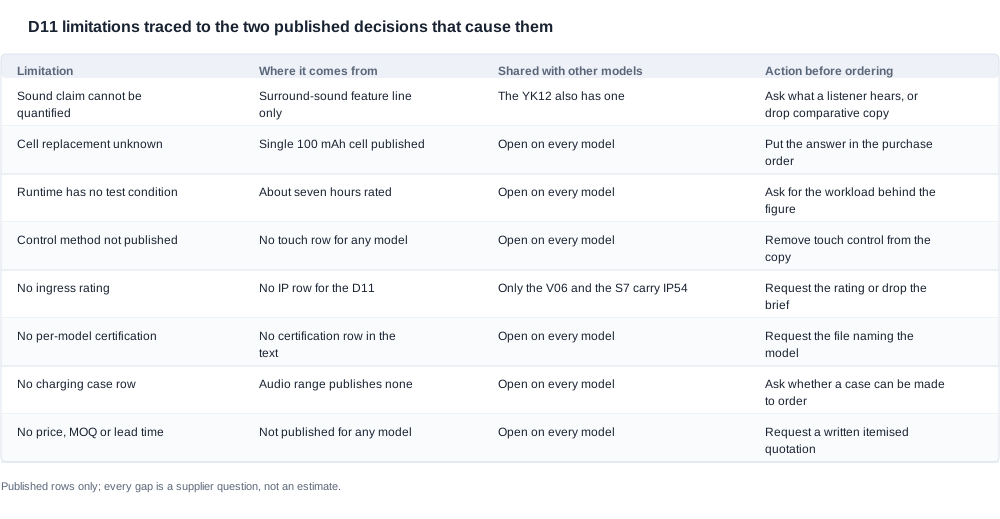
D11 limitations traced to two published decisions
The first decision: a feature row with no measurement behind it
Three of the eight audio models in our catalogue publish a feature row. The D11's page carries a surround-sound line and a long-battery-life line. The YK12's page carries a surround-sound line and a slim-temple line. The G07's page carries an ultra-thin detachable-temple line. The other five — the K01 and the K02, the LC-105-1 and the LC-105-2, and the D12 — publish no feature row at all.
That structure matters more than it first appears, because it determines what a listing can say. A model with no feature row gives a listing nothing to name beyond its electrical specification, so the listing has to be built on the radio version, the cell and the charging interface, which is a safe but thin proposition. A model with a feature row gives the listing a hook, and the hook has to be carried by whatever the supplier can evidence.
The D11 sits at the useful end of that trade-off: it publishes a surround-sound row, which is a specific, checkable claim in the sense that a reader can ask what it means, and it publishes nothing else that could be mistaken for a measurement. The D12, which shares the D11's electrical rows exactly, publishes no feature row. The two models exist as a pair, and our documentation does not publish whether anything beyond the feature line differs between them — that is a one-line question with a short answer, and it should be asked before a range is built on the pair.
The second decision: one cell where most of the range has two
The D11 carries a single 100 mAh cell. Six of the eight audio models carry two cells: the K01 and the K02 publish 90 mAh × 2, the LC-105-2 and the YK12, and the LC-105-1 and the G07 publish 55 mAh × 2, and the YKC02 — which is a sport model rather than an audio model — publishes 70 mAh × 2. The D11, the D12 and the D17 are the single-cell products in that group of three.
A single cell changes three commercial things and one commercial non-thing. The service profile changes: one cell to carry, one cell to test at incoming inspection, one cell to replace and one failure mode rather than a partial-failure question that our documentation does not answer for any model. The internal layout changes: a single cell in a temple frame is a different physical problem from two cells split across both temples, and it is one of the reasons the D11 is not interchangeable with the paired-cell platforms. The spare-parts line changes, because whether the cell is field-replaceable is not published for this model, and that single unknown decides whether your parts list carries a cell or a whole temple assembly.
The commercial non-thing is worth naming precisely because it is a difference buyers often expect. The published charge time of two hours or less applies to single-cell and paired-cell models alike, so the cell count does not produce a different headline figure and should not be used as a differentiator. The published charge time has no starting state and no end criterion attached to it, which is a gap discussed further below rather than a consequence of the cell count.
The gap that is neither of those
Between the model-specific limitations and the category-wide ones there is a third group: rows that a buyer will expect to find and that are absent for a reason the catalogue never states. Whether the frame can be opened for a battery change, whether the temple carries a touch surface, whether a companion application is required, what the charge indicator shows, what the accepted charging input is, whether the device is pairable with more than one host, how the microphone behaves in a noisy street — these are all absent, and no published statement explains whether they are absent because the feature does not exist or because it has not been written down.
That distinction matters commercially, because the two answers lead to different actions. A feature that does not exist can be scoped out of the proposition in one afternoon. A feature that exists but is undocumented has to be found, and finding it takes a request list, a supplier audit and often a sample order. A buyer who assumes the second category is the first category will scope out a capability the product actually has, and will be surprised by the quotation.
The sound-feature row and the claims it forbids
What the catalogue licenses you to write
A listing for the D11 may say that the model publishes a surround-sound row. It may say that the catalogue publishes Bluetooth V5.4, one 100 mAh cell, Type-C charging, a charge time of two hours or less and an approximately seven-hour rated runtime. It may attribute those figures to the catalogue rather than presenting them as test results, and it should, because the catalogue publishes no test condition behind the runtime figure.
Beyond that, the listing cannot go. There is no driver size, no frequency response, no leakage figure, no microphone count and no pickup distance published for this model or for any other in the audio range. The family-level technical description covers an open-ear acoustic structure, directional audio and intelligent noise reduction, and that description is a platform statement rather than a measurement of the unit in the box. Our open-ear audio guidance covers the trade-offs that the missing numbers would otherwise cover.
So the four claims a listing may not make are: that the D11 is louder than another model, that it leaks less, that it has larger drivers, and that it is better on calls. Each of those requires a number that does not exist, and each is the kind of claim a competitor, a reviewer or a retailer's own legal reviewer will ask to see the basis for.
The open-ear consequence the sound claim inherits
An open-ear product played loudly in a quiet space is audible to the people around it. That is a property of the acoustic structure rather than of this model, and it applies to every audio model in the range, including the ones with no feature row at all.
The reason it matters more for the D11 is that a sound claim invites the question. A customer who has been told the model has surround sound may play it louder to hear the difference, and the louder it is played the more audible it becomes to a bystander. A brand specifying into an open-plan office, a shared retail floor or a hospitality environment inherits that interaction whether or not the listing makes a comparative sound claim. It is not a defect and it is not specific to the D11; it is the cost of a claim that the buyer has decided to make.
The question that can actually be answered
There is a version of this row that can be closed without a laboratory, and it is the question a buyer should ask instead of a leakage figure. Ask what a listener hears differently when the surround-sound function is enabled compared with when it is not. That is a descriptive question about behaviour, most suppliers can answer it, and it converts an unqualified marketing word into a sentence a listing can use.
The answer still has to come from the supplier rather than from us, and it still has to be checked against the sample units rather than against the answer sheet. But it is closable, and closing it is what separates a defensible listing from a borrowed one.
The single-cell architecture and the service profile
What one cell changes in the workshop
A single-cell build is simpler to assemble and simpler to inspect, and both of those are advantages to a buyer who cares about the defect rate rather than only about the unit cost. One component to carry means one incoming test point for the cell instead of two, and one balancing step inside the enclosure instead of a pair of them.
The same simplicity becomes a disadvantage the moment a unit fails. A paired-cell frame that loses one cell is a partial-failure question, and a partial-failure question is an unresolved question: our documentation does not publish a policy for it on any model in the range. A single-cell frame that loses its cell is a whole-unit question, and a whole-unit question has an answer that a support procedure can be written around today. Whether the cell is field-replaceable is not published, so it is not yet known whether that answer is "swap the cell" or "swap the temple".
That unknown is worth closing early, because it sits upstream of two other commercial numbers: the spare-parts price list and the warranty handling route. A channel that stocks a spare cell carries a different inventory, a different obsolescence risk and a different returns handling process from a channel that stocks a replacement temple assembly, and the two are decided by one unanswered question.
What one cell does not change
The charge time. The catalogue publishes two hours or less for the single-cell D11 and for the paired-cell models, which means the headline figure carries no information about the cell count. A buyer who puts the D11 and the LC-105-2 side by side in a comparison sheet and concludes that the paired-cell platform charges faster would be reading a difference into a number that does not contain one.
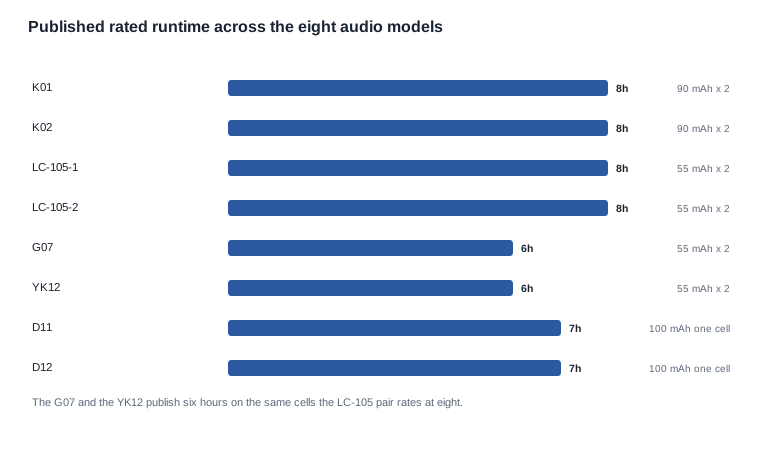
The runtime spread, either. The range shows a two-hour gap between models that carry the same cells: on 55 mAh × 2, the LC-105-1 and the LC-105-2 rate about eight hours of use, whereas the G07 and the YK12 rate about six on an identical 55 mAh × 2 arrangement. Whatever separates those two pairs is not the battery. The battery specification guidance sets out the questions to ask before any of the runtime rows goes into a comparison chart.
The weight, as far as the catalogue goes. No audio model publishes a frame weight. The only published weight anywhere in the twenty-eight model catalogue is the MT6's 158 g, and that is a camera model, and it is the weight of the glasses body including its cell and camera and excluding its folding 1200 mAh charging case. It cannot be used as a proxy for the D11, and it should not be repeated in a D11 listing as if it were a frame-weight figure for this model.
The failure-handling question to put in the order
Three answers close the service profile, and they belong in the purchase order rather than in a support handbook written after the first shipment: whether the cell is field-replaceable at the customer's own premises or only at the supplier's; what the documented procedure is when a unit fails; and whether a spare-parts line is offered at all, at what minimum order quantity. None of these is published for any model in the range, and all three are ordinary purchase-order lines for a product sold in volume.
Gaps that belong to the category, not this model
The gaps a different model would also have
Nine rows are absent for every model in the audio range, and switching to another model in the range does not close any of them. A buyer evaluating this category should treat them as the cost of entry.
- The runtime condition. Approximately seven hours is published for the D11 with no workload, volume level or pairing state. Every model in the range publishes a runtime without a condition.
- The control method. Our catalogue publishes no touch row for any model in the range — no capacitive touch line, no gesture line, no touch icon on any product page. The only control row anywhere in the catalogue is the AR model's indicator-light and button-control pair, and that is a button, not a touch surface. A listing built on touch control is a listing about a product we do not publish.
- The companion application. Whether one is required, who publishes it, which phone systems it supports and where the data is stored are all absent for every model.
- The charge indicator and the charging input. Absent for every model, and on a Type-C design the indicator is what prevents a misaligned cable from being read as a defective unit.
- Frame weight, temple length, lens dimensions and head-size range. Absent for every audio model. For a product specified into a retail programme this is a return-rate driver and it is a request, not a published row.
- Ingress protection. Absent for the D11. Only two models in the whole catalogue carry an ingress rating: the V06 and the S7, both camera models, both marked IP54. A brief involving rain, washing or a wet industrial environment has to be answered by a supplier, not by the range.
- Certificate references, issuing bodies, validity periods and covered model schedules. Absent. The catalogue carries a company-level export-certification page whose content is images rather than text, and the catalogue text contains no reference to CE, FCC or RoHS. There is no per-model certification row anywhere.
- A charging case. Absent for the D11, and absent for all eight audio models. Five camera models publish a case capacity, two more have a case without a published capacity, three publish no case row at all, and one has no charging-case row.
- Price, minimum order quantity, lead time, warranty term and production capacity. Absent for every model in the catalogue. These are quotation terms, and they are obtained by asking for a written, itemised quotation.
The gaps that a specific category decision creates
Three further gaps are worth separating out because they are consequences of how this particular category is sold rather than of the product sheet. The first is the absence of a documented regulatory route per configuration: a radio side of the file runs through the Radio Equipment Directive, whose framework reference is 2014/53/EU, and the obligation it creates binds to one named configuration, so a compliance file that does not name the exact model designation does not cover the units in the carton. The second is the absence of an acoustic measurement method, which is what converts the sound feature row from a description into an unverifiable claim. The third is the absence of a defined end criterion for the charge-time figure, which means the published ceiling cannot be turned into an interruption time for a customer topping up briefly.
The decision these gaps force
The practical conclusion is a shortlist rule rather than a rejection. If the channel's proposition needs an acoustic comparison, an ingress rating, a touch control or a mid-day case, the D11 cannot carry it on published evidence, and the honest answer is that those requirements need to be closed as supplier requests or dropped from the proposition. If the channel's proposition is built on the radio version, the single-cell service profile and the Type-C interface, the published sheet is enough to specify against, and the open rows are ordinary purchase-order diligence.


Building a claim set that survives review
One rule, applied to every line of copy
Every claim in a listing must trace to a published row, and every published row must be described as what it is. A feature row is described as a feature; a rated figure is described as a rated figure; a ceiling is described as a ceiling. This sounds obvious and is the single most common point of failure in this category, because a feature word reads like a claim and slips into copy unchanged.
Applying it to the D11 produces a short, defensible set. The listing can name the surround-sound row and attribute it to the catalogue. It can state Bluetooth V5.4, the 100 mAh single cell, Type-C charging, two hours or less, and approximately seven hours rated, attributed to the catalogue. It can describe the platform as open-ear. Everything else in the copy is either a request or an omission.
What to write instead of the claims you cannot make
The missing numbers do not have to become silence. A listing that says "surround sound, as published for this model" is thinner than one that says "surround sound" with a superlative attached, and it survives a review. A listing that quotes approximately seven hours as a rated figure with no stated condition survives. A listing that says the frame is charged over USB-C survives, because the interface is published.
Where a buyer needs a comparative claim, the answer is a request rather than a sentence: ask for the acoustic configuration and the measurement method behind the surround-sound row, and if no measurement exists, hold the comparative claim out of the copy. This is the same principle applied in the charging arrangement for this model, where the published interface and the open rows are separated in the same way.
The checklist for a reviewer
A reviewer checking a D11 listing against the published sheet should look for six things: a superlative attached to the sound feature; the runtime presented as a measured result or converted into a working-day claim; the charge time written as a promise rather than a ceiling; an acoustic number that appears in no published row; a control method named that the catalogue does not publish for any model; and a compliance reference presented as if the catalogue carried it. Each of those six is a one-line check, and each is a line that should be removed rather than defended.
What the catalogue publishes, and what it will not add
Our catalogue carries an electrical block and a feature block for each model it lists, and for this model the electrical block reads: Bluetooth V5.4, one 100 mAh cell, Type-C charging, a charge time of two hours or less and an approximately seven-hour rated runtime, while the feature block adds a surround-sound line and a long-battery-life line. Outside those two blocks we publish nothing — no price, no minimum order quantity, no delivery schedule, no warranty term, no production capacity figure, no frame weight, no charging input, no indicator behaviour, no cell cycle life, no ingress rating and no per-model certification row, and we will not substitute a typical value for any of them.
The surround-sound line carries no measurement behind it and will not be given one here; the roughly seven hours is a rating rather than a working day; and the acoustic, ingress, control and certification rows stay exactly as the catalogue leaves them, empty. The published rows behind this model are set out row by row, and the pair this model belongs with is worth reading before a range is built on the D11 and the D12 together.
Tell us the channel, the volume, the market you are selling into and the claims you plan to print, and we will answer with the published rows that carry them and the ones that cannot. The family is on our Bluetooth audio glasses range page. That is the whole of the D11 smart glasses limitations question: the published sheet tells you what the model is, the open list tells you what you will have to close in writing, and the two together tell you whether your proposition can be carried by this product.
Related reading
- This model's published figures — D11 specifications
- What an open-ear frame gives up — open-ear audio
- The pair this model belongs with — D12 against the D11
Tell us the channel, the volume and the target market, and we will come back with what is available.


