

This is the shortest comparison in the catalogue, and it is worth reading carefully because there is very little in it. Both models publish Bluetooth V5.4, a single 100 mAh cell, Type-C charging with a ceiling of two hours or less, and a rated runtime of about seven hours. The D11 adds a surround-sound row. The D12 publishes no acoustic descriptor at all. Nothing else is published as different.
So the question is not which model is better. It is whether your listing is going to carry a sound claim, and whether that claim is one you can defend.
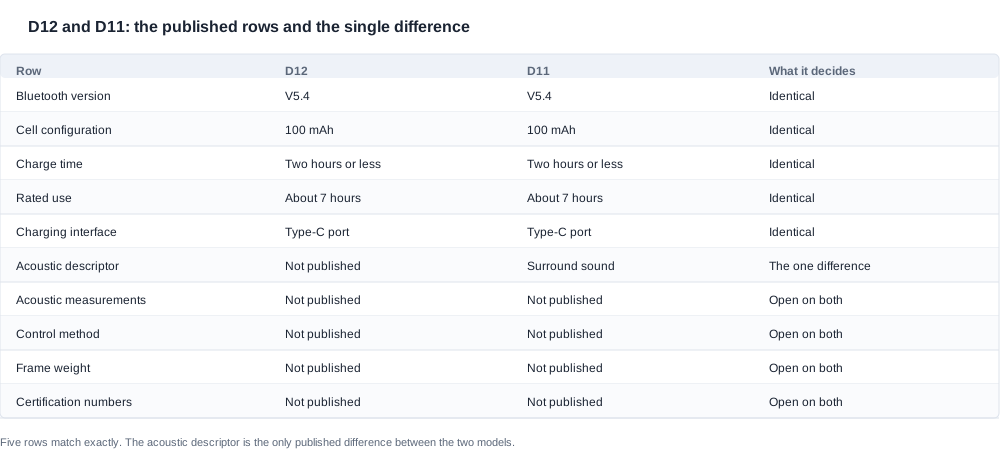
D12 and D11: the single row that separates them
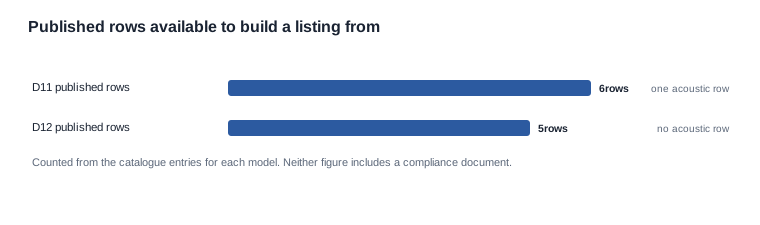
The chart above is the whole comparison in one picture, and it is worth pausing on the framing. The D11 has one more published row than the D12, and that row is an acoustic descriptor — a feature name, not a measurement. Six rows against five, and the extra one licenses a phrase in a listing rather than a capability claim.
That is a narrower separation than it sounds. Two products with six and five published rows are, on the evidence available, the same product with one line of marketing copy attached to one of them, and a buyer choosing between them should be clear that this is what the comparison contains.
What the separation does and does not license. It licenses the phrase "surround sound" on the D11's product page, because that is what the catalogue publishes for that model. It does not license a comparison of the two in acoustic terms, because the D12 publishes no acoustic descriptor that could be compared against it, and no acoustic measurement is published for either. And it does not license the conclusion that the D11 sounds better, because a feature name on a catalogue row is not a characterisation of the product.
The practical form of that distinction. A buyer can write "surround sound" and can write "the D11 carries a surround-sound feature row; the D12 carries no acoustic descriptor". A buyer cannot write "richer sound than the D12", "premium drivers", "less leakage" or any percentage. Those all require a measurement that no document in our material contains.
What a listing can say about each model
The two listings are not symmetric, and it is worth writing out precisely what each one may carry, because a buyer who treats them as symmetric will either overstate the D11 or overpromise for the D12.
For the D11, the listing may say that it publishes a surround-sound feature row, that it publishes Bluetooth V5.4, a 100 mAh cell, a charge ceiling of two hours or less, about seven hours of rated use and Type-C charging. Every one of those is a published row, and every one can be written on the page as it stands.
For the D12, the listing may say the same five rows and nothing more. It may not say that the D12 has no sound feature, because the absence of a descriptor is not a statement that the product lacks one — it is a statement that the catalogue does not record one. That distinction has to survive into the copy, because a listing that says "the D12 has no surround sound" is making a claim about the product that no document supports and that a sample unit could contradict in a minute.
For both listings, the copy may not say anything quantitative about sound, anything about call quality, anything about weight or sizing, anything about water resistance, anything about the battery lasting a working day, and anything about compliance status. That list is long, and it is the same for every audio model in the range, which is why a channel that operates in this category learns to write around the gaps rather than into them.
And what makes the two listings genuinely different to a shopper. The D11 has one extra phrase. The D12 has one fewer phrase and the same five rows behind it. The practical consequence is that the D12's page has to be built on what it does have — the interface, the radio generation, the cell, the overnight charge — while the D11's page has one more line available. A brand that builds both pages should plan for the D12's copy to carry more operational substance and less feature language, because that is what the evidence allows.
One thing worth adding to both pages, if the facts support it. That the product charges over a standard Type-C cable, that the radio is V5.4, and that a single 100 mAh cell sits behind a rated seven hours. None of those is a differentiator on its own, and all three are checkable by anyone who reads the specification table. A listing built on checkable facts is harder for a competitor to attack than one built on adjectives.

What the one row is worth, and what it cannot be asked to carry
The acoustic language in our catalogue describes the family, not the model. The camera-glasses and audio-glasses family is described in terms of an open-ear acoustic structure, directional audio and intelligent noise reduction. The D11 adds a surround-sound row on top of that platform; the D12 does not add anything.
So the question to put to a supplier is what the customer is supposed to hear differently, in words. That is a fair question and it has a fair answer, and the answer is what a listing should be built from: a description of the listening experience that a customer can recognise, rather than a number that nobody in the chain can verify. Our open-ear audio guidance covers the trade-offs that the missing measurements would otherwise have covered, and it is worth reading before a sound phrase goes on a page.
One caution about the family description itself. A buyer who reads the family-level language as a per-model feature list will produce a listing that promises capability the model entry does not support. For the D12 in particular that is the trap, because the model publishes no acoustic descriptor of its own — so anything a copywriter takes from the family description is a claim with nothing behind it.
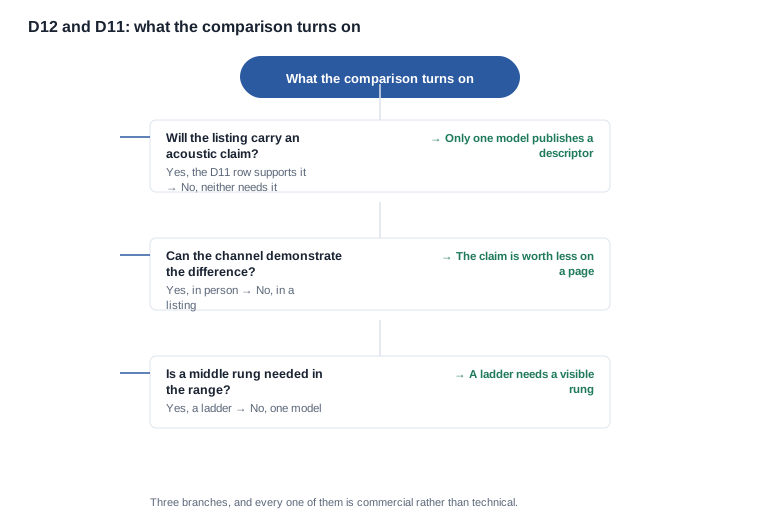
Three commercial questions that decide whether the row is worth a price step
Will the listing carry an acoustic claim at all? If it will not, the acoustic row does not enter the decision, and the two models are indistinguishable on the published evidence — in which case the choice is a commercial one, about order minimum, lead time and certification scope, and the D12 versus D11 price positioning page is where that comparison belongs. If it will, then the D11's row is the one that supports the phrase and the D12's absence is the one that constrains it.
Can the channel demonstrate the difference? In a physical shop a customer can try two frames side by side, and a sound claim is worth something there. On a listing page a phrase is worth much less, and a specification table is worth least of all. The D11's published advantage is strongest in the channel where a customer can hear it and weakest in the channel where they read about it.
Is a middle rung needed in the range? If a good-better-best ladder is wanted in the audio range, this pair is a natural way to build one: identical hardware, one published feature between them, and a price difference a customer can be given a reason for. That is a completely legitimate use of the pair, and it is more common in practice than it is admitted. The condition is that the rung has to be visible, because a rung the shopper cannot perceive collapses into a discount.
How the answer changes by channel
The same three questions produce very different answers depending on where the product is sold, and it is worth setting the four common channels out because the arithmetic of a sound claim differs in each.
A physical store. The customer can try both frames and hear the difference, so the acoustic row is worth something real, and a mid rung in the range works because a salesperson can point at it. This is the channel where the D11's extra row is at its most valuable and where the price step is easiest to defend.
A marketplace listing. A phrase is worth much less than a demonstration, and a specification table is worth least of all. The D11's row is present in the copy, but it is competing against a price comparison that a customer can complete in two clicks. On this channel the rung has to survive being reduced to a bullet point, and the honest answer is that a sound feature name does not always.
A B2B or corporate channel. The buyer is not the end customer, and the sound claim is worth almost nothing; what matters is the compatibility statement, the radio version, the interface, the charge turnaround and the certification file. On this channel the acoustic row is irrelevant and the two models are interchangeable on the published evidence, which makes the decision a terms decision.
A channel with its own application or platform. Here the firmware question moves to the front. If the product runs inside an existing ecosystem, the differences that matter are the ones your own integration depends on — and those are not published rows at all, they are a conversation with the factory about what the two designations actually are.
The point of setting the channels out. A buyer who reaches for the acoustic row without asking which channel they are in is using a feature argument to answer a channel question. In two of the four channels above, the acoustic row does no work at all.

The difference our documentation does not publish
Our documentation does not publish whether the D11 and the D12 differ in anything else. The published rows are identical apart from the acoustic descriptor, and we are not going to invent a second difference to make the pair look better differentiated.
But the absence of a published difference is not the same as the absence of a difference. If there is a further difference — a colour, a shell revision, a firmware change, a packaging tier — it is not in our documentation, and a buyer who lists both on the strength of the acoustic row alone may be carrying two stock-keeping units that are more similar than they need to be.
One question closes it, and it is worth asking before the range is designed. Ask, in writing, what else differs between the two designations. A reply that says nothing else differs is an answer that ends the two-model plan; a reply that names a difference is an answer that gives the range a second axis, which is worth more than the acoustic row.
And the compliance version of the same question. A document that names the D11 does not automatically cover the D12, even where the two publish identical electrical rows. Two designations with one acoustic row between them can still need two sets of evidence, and the certification scope belongs in the range plan from the start. The D12 certification status page sets out what has to be requested.
How to test both models on the same script
The acoustic difference is the only published difference, and it is the one difference that a sample can settle faster than a document. A single script, run on both models, produces the evidence a listing needs and the evidence a purchase order needs.
Use the same script on both units. One script is the whole point: a comparison run on two different scripts produces two anecdotes rather than a comparison. The script should be short enough to run twice on the same afternoon.
Set the conditions, then change one at a time. Start with a fixed playback volume, a fixed source, a fixed position and a fixed environment. Then change the one variable that matters for the claim — the environment, the distance to the source, the codec — and note what changes. A buyer who has a fixed baseline and one changed variable can describe the experience accurately; a buyer who changed everything at once can only describe an impression.
Capture the result and keep it. A recording made on the sample, with the conditions stated, is a reference file. It is what a channel partner can be shown, what a product page can be illustrated from where the channel permits it, and what a purchase order can point at. It is also the only thing that stops the acoustic row from turning into a number that nobody in the chain can reproduce.
Record what does not differ as well. The shared rows mean that cell, runtime, interface and radio behaviour should be the same across both units. If they are not, that is a finding, and it is a finding that matters more than the acoustic row because it would mean the published rows are not describing what is being shipped.
And note what the test cannot settle. A sample cannot tell you whether the acoustic difference is large or small in a customer's environment, it cannot tell you whether it survives the customer's own use, and it cannot tell you what a customer will believe about it. Those are channel questions, and they are the ones that decide whether the row is worth a price step.

The rows that are missing for both
- Whether any difference beyond the acoustic descriptor exists — not published.
- Acoustic figures — no leakage, driver size, frequency response, microphone count or pickup distance is published for either model, including the one that carries the acoustic row.
- The control method — not published for either. Our catalogue publishes no capacitive touch row for any model, including the K01, so touch behaviour has to come from the supplier.
- Runtime test conditions — not published for either, and no audio model in the range publishes one.
- The charge indicator behaviour and the charging input — not published for either.
- Frame weight, temple length and lens dimensions — not published for either.
- Ingress protection — not published for either.
- Certificate numbers, issuing bodies, validity periods and covered model schedules — not published for either.
- Whether a charging case is available — not published, and no audio model in the range publishes a case capacity.
- Order minimum, lead time and unit price — not published for either, and our internal documentation currently holds three conflicting order minimum figures that have not been arbitrated.
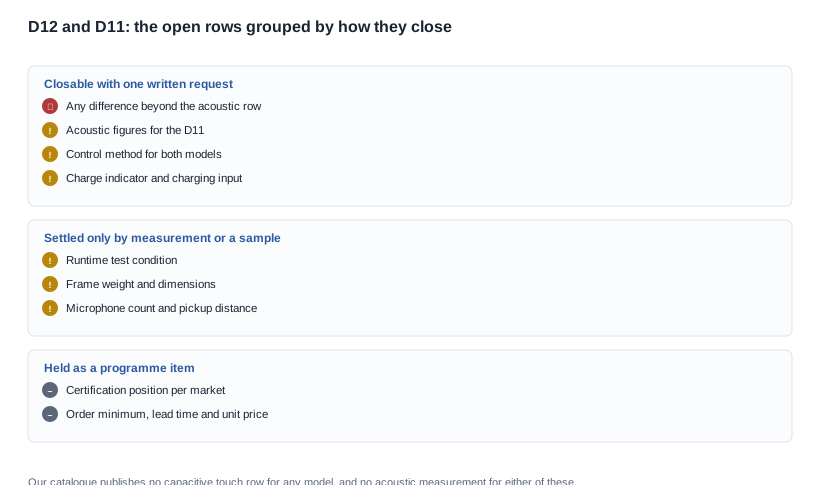
How to close the ten open rows
The ten open rows divide into three routes, and each route has its own method, its own cost and its own deadline. Splitting them is what keeps a selection from becoming a sequence of one-off emails.
Five close with a written request. The existence of a further difference, the acoustic figures for the D11, the control method on both, the charge indicator behaviour and the charging input. All five are records the factory holds, and all five are closed by one message that names the D12 and the D11 separately and asks for each answer against its own model designation.
Three close with a measurement or a sample. The runtime test condition, the frame weight and dimensions, and the microphone count and pickup distance. The first two come from three sample units in one session; the third comes from the same acoustic script. The reason to do these together is that the sample is already in the building, and the marginal cost of the second and third measurement on a unit that has arrived is close to nothing.
Two are programme items rather than questions. The certification position per market and the commercial terms — order minimum, lead time and unit price. Neither is answered by a supplier's record of the product; they are the supplier's commercial position and the testing body's calendar. Both have lead times that belong in the programme plan at the start rather than at the end, and both of them are the reason a two-model plan can take longer than a one-model plan even though the hardware is identical.
And the criteria for judging every answer. Each must be tied to a model designation, must state the configuration it applies to, and must say what it excludes. The red flags are an answer given for the family rather than for the model, a figure with no date, a best case offered where a mean was needed, and a certification answer naming a sibling model.
What a closed set looks like. Ten rows closed is a specification sheet that a quality team can accept and a purchase order can carry, and it is what turns this pair from two catalogue entries into a range decision.
Where our D12 and D11 position on this choice sits
The published evidence supports a capability statement rather than a preference. If your listing must carry a sound claim, the D11's row is the one that supports the phrase and the D12's published entry is not. If your listing must not carry one, the two models are indistinguishable on the published evidence and the decision belongs to the commercial terms.
We will not tell you the D11 is a better product, because on the published rows it is the same product with a claim attached. We will not add a number to that claim, and we will not tell you the two models are identical when our own documentation does not say they are. We will not quote a weight, a colour, a case capacity or a certificate number that the documentation does not contain.
Send us the channel, the volume and the target market and we will say which model we would put in a range and why, including where the answer is a conversation rather than a document. The family is on our Bluetooth audio glasses range page.
Related reading
- The published rows behind the sound model — D11 compared
- What to check on a model before ordering — D11 pre-ordering checks
- What an open-ear frame actually gives up — open-ear audio
Send us the channel, the volume and the target market, and we will say which model we would use.


