

The published power rows for these two models are the most instructive pair in our audio range, and not because either of them is remarkable on its own. The D11 publishes a single 100 mAh cell, a charge time of two hours or less, about seven hours of rated use and Type-C charging. The LC-105-2 publishes 55mAh2, a charge time of two hours or less, about eight hours of rated use and magnetic charging. Put those side by side and the intuitive reading collapses twice over. The obvious expectation that one large cell will beat two small ones survives neither direction, because the same 55mAh2 configuration publishes eight hours on the LC-105-2 and about six hours on the G07 and the YK12, so the cell configuration alone cannot be what produces the figure. And the shared charge-time ceiling turns out to mean almost nothing, because the two models reach it by completely different routes: a cable into a socket, and a placement on a dock. A buyer who reads these rows as a battery comparison is reading the two numbers that carry the least information in the pair. The useful comparison is the one about what the two rows do not say, because that is where the commercial exposure sits.
D11 and LC-105-2: reading the power rows against each other
The rows, as published
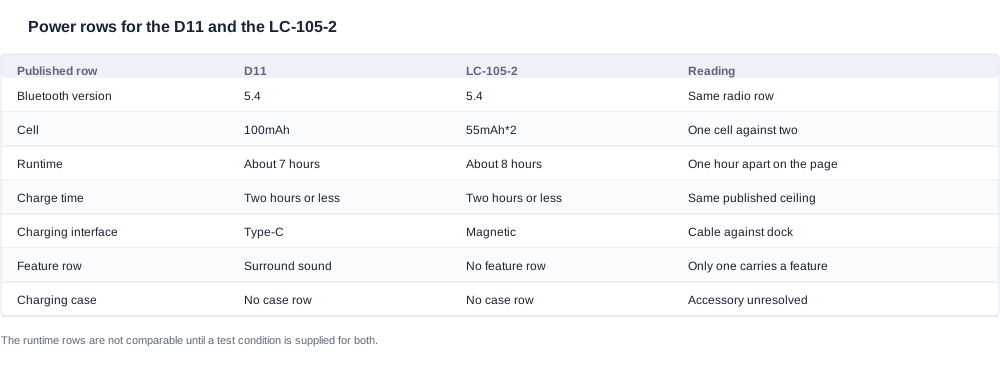
The D11 publishes Bluetooth V5.4, a 100 mAh cell, a rated runtime of about seven hours, Type-C charging, a charge time of two hours or less, and two feature lines: a surround-sound line and a long-battery-life line. The LC-105-2 publishes Bluetooth V5.4, 55mAh*2, a charge time of two hours or less, about eight hours of rated use, magnetic charging, and no feature lines at all.
Both figures for the charge time are ceilings rather than typical values, because the catalogue states a limit and not a measurement condition. That distinction matters here more than in most comparisons: two hours or less allows a two-hour charge, and the buyer who needs to know whether the charge takes ninety minutes or two hours has to ask.
The totals, and why they have to be labelled
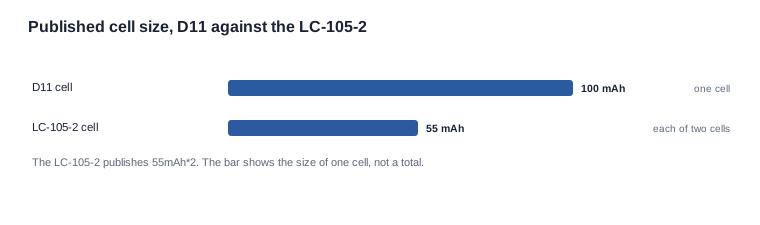
The D11 publishes 100 mAh. The LC-105-2 publishes 55mAh*2, which is two cells of 55 mAh each, so 110 mAh in total as a derived figure. A derived total is useful in analysis and has to be labelled wherever it appears, because a bare 110 mAh in a table reads as a published number and it is not one. We keep the published form in tables and charts, and we use the total in prose with the derivation stated.
Even with the derivation stated, the comparison is less interesting than it looks. A hundred milliamp hours against a hundred and ten is close enough that the total cannot explain a one-hour difference in published runtime, and it is close enough that a buyer should not treat the LC-105-2 as the product with substantially more energy. What the pairing does tell a buyer is that two 55 mAh cells are not simply a 100 mAh cell split in two for marketing reasons. The manufacturer chose a different architecture, with different consequences for assembly, ageing and charging.
The comparison that breaks the pattern
The pair that breaks the pattern is the G07 and the YK12. Both publish 55mAh2, magnetic charging, a charge time of two hours or less and about six hours of rated use. The LC-105-1 and the LC-105-2 publish the same 55mAh2 cells, the same magnetic charging and the same charge-time ceiling, and about eight hours. Identical cell configuration, identical charging method, two hours of difference in the published runtime.
That is the finding that matters for a buyer. The published runtime is not a function of cell size or cell count, so it cannot be used to rank these two models, and a specification sheet that presents about seven hours against about eight hours as a capacity advantage is presenting an artefact. The likely drivers are amplifier efficiency, firmware power management and the test conditions themselves, and the catalogue publishes none of them for any model. The battery comparison across the range works through the same point with the full set of published rows.
One large cell against two smaller cells
A single 100 mAh cell is a simpler pack. One element to assemble, one element to balance, one element to protect, and one element to age. For a buyer planning a product life, the single-cell architecture means there is one ageing characteristic to model rather than two that can drift apart, and it means the pack is physically simpler for a supplier to build consistently across a production run.
The charging side is equally simple, and it is simple in a way that matters commercially: a Type-C connector is a known interface, the customer supplies the cable, and the accessory content of the parcel can be minimal. A buyer with an existing Type-C cable supply does not have to build a new accessory line for this product.
Two 55 mAh cells publish a slightly larger total, 110 mAh as a derived figure, and a longer published runtime. The commercial argument for paired cells is usually about flexibility, about being able to fit a cell form factor into a temple that a single larger cell would not fit, and about the ability to charge one half while the other is in use, which depends entirely on the electronics and is not published for either model here.
The costs of a paired-cell architecture are real as well. There are two cells to match, two to protect and two to age, and over a product life the two halves of a pack can diverge. A paired cell also implies a magnetic dock rather than a cable, and the dock is not published in any list for either model, so the accessory content of the parcel becomes a quotation item and a stock line for the buyer.
Whichever architecture a buyer ends up with, the question that closes the row is the same: what is the cell specification, what is the cycle life, and what happens at end of life. The catalogue publishes no cycle life for any model, and the transport documentation that travels with a lithium battery is a real commercial item rather than a formality, because it attaches to the cell and the quantity. The battery transport compliance material covers what has to be in the file.

What a charge time of two hours or less actually permits
A ceiling is not a measurement
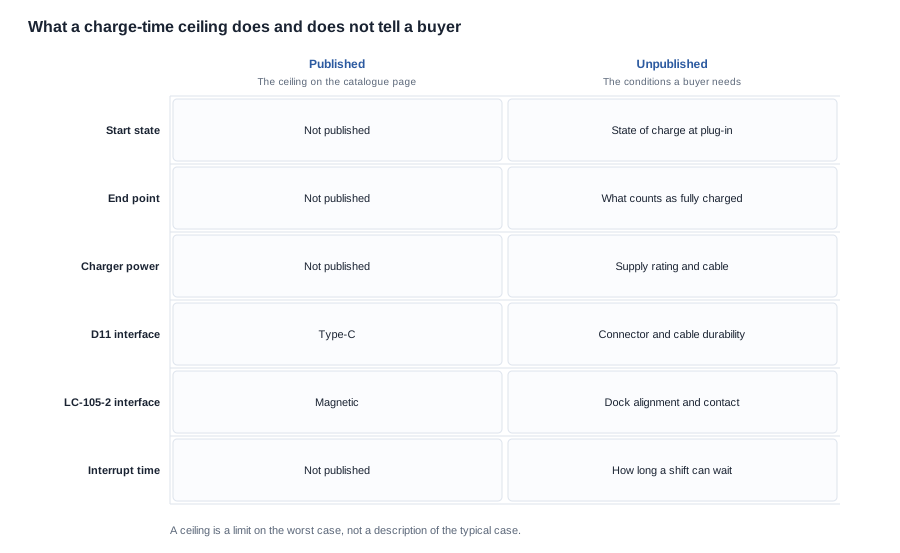
Two hours or less is a limit on the worst case, and the catalogue does not publish the conditions that produced it. Five things are missing from that row, and each one changes a buyer's plan.
- The start state. Was the cell empty, half full, or somewhere else? A charge from empty is longer than a charge from half, and the catalogue does not say which applies.
- The end point. What counts as charged? Full, or enough to be usable? A two-hour figure measured to a usable state is not the same as two hours measured to full.
- The charger. What supply was used, and what cable? A low-power supply produces a longer charge, and the catalogue does not publish a charger requirement.
- The temperature. A lithium cell charges more slowly when it is cold, and a working environment is not a laboratory.
- The interrupt behaviour. A buyer planning a shift needs to know whether a partially completed charge can be topped up, and how the cell behaves when the charge is stopped.
Why the shared ceiling is the least useful number in the pair
Both models publish the same ceiling, and a buyer is tempted to read that as a matched charging experience. It is the opposite of a match. The D11 is charged by connecting a cable to a port; the LC-105-2 is charged by seating the frames on a dock. The first fails visibly, the second fails quietly, and a quiet failure is the kind that becomes a support contact rather than a return. The first requires a socket or a power bank; the second requires a dock in a specific place.
So the two-hour ceiling, which looks like the one point of agreement in the comparison, is the point on which the two products differ most, and it is the point where a buyer is most likely to be surprised by a customer experience that the specification did not describe.
The charging interruption a buyer should ask about
A working-day question that the catalogue cannot answer for either model: how long can the product be used between charges if the charge is interrupted, and does a partial charge harm the cell over time. This is exactly the question a customer asks when the product is used hard, and the answer determines whether a single cell with a seven-hour figure is a workable proposition or a support problem. Asking it in writing is more productive than inferring it from a ceiling.
The charging routine each interface creates
The Type-C routine. The customer finds a port on a frame and plugs in a cable they probably own. The routine is portable, because the cable and the socket can be anywhere, and it is visible, because a charging product in a hand is obvious. Its weakness is that the customer has to be near a socket, and the weak point of the routine is the moment where the customer has to decide whether to charge at all.
The magnetic routine. The customer places the frames on a dock. The routine is stationary, because the dock is in one place, and it is quiet, because a frame on a dock can look like a frame on a shelf. Its weakness is that alignment has to be discovered, and once discovered, the customer has to return to the same place to charge. In a warehouse, a workshop or a retail floor, a dock is entirely reasonable. In a customer who moves between sites, it is a constraint, and a constraint that appears in the accessory cost rather than in the specification.

The questions that close the routine are short. Is a cable or a dock supplied with the product, and in which markets. What the charger or dock specification is, and whether the buyer may substitute its own. Whether the frames can be charged with a partially fitted or removed temple, where a detachable design exists. How a magnetic contact is protected in the box and in transit. And whether a charging case, if any is offered, is charged from the same interface, and how long that takes.
Both routines also need a quick-start page, and the pages are different. The Type-C page needs a diagram and a line about which way the connector goes. The magnetic page needs a diagram and a line about how the frames sit on the dock, because the failure mode is a frame that looks seated and is not charging. Neither page is expensive, and both are the sort of cost that is easy to forget until the first support tickets arrive.

Publishing an endurance claim without overreaching
What each figure supports
A published figure supports a rated statement, and a whole-day statement is a different claim. The D11's about seven hours supports a listing sentence that says the catalogue rates the product at about seven hours of use. It does not support a working-day claim unless the working day is seven hours, and it does not support a comparison against the LC-105-2 unless both figures come from the same test. The LC-105-2's about eight hours supports exactly the same kind of sentence, and it does not support an all-day claim either, because a working day frequently exceeds eight hours.
The rule a channel can apply without inventing anything: attribute the figure, name the model, and describe the condition. "Rated at about eight hours" is defensible. "All-day battery" is not defensible from this catalogue, on either model, at any quantity.
The claim review that prevents an overreach
Before a listing page goes live, every endurance sentence should be checked against four questions.
- Is the figure attributed to the catalogue, or presented as a measurement the brand made?
- Is a condition attached, or is a bare number standing in for a working day?
- Does the copy compare this model against another on runtime, which the published rows do not support?
- Does the copy mention a charging case, whose capacity is not published for either model?
A copy review that asks these four questions takes an afternoon and removes the single most common source of a claim that cannot be defended later.
The charge-time sentence deserves the same treatment, with one addition. Because the published figure is a ceiling, the copy should not imply a typical duration, and it should not be written as though the charge is certain to be finished at or before two hours from any starting state. A defensible phrasing is that the catalogue states a charge time of two hours or less.

What the battery rows leave to a sample
The measurement protocol for the pair
Because the runtime figures are not comparable, the sample is the only place the comparison can be settled, and the protocol has to be identical for both models.
- State the workload in writing. The volume level, the content played, the number of connected devices, and whether the product is used continuously or intermittently.
- Start from the same state. Fully charged, confirmed by the same method for every unit.
- Run to shutdown and log the elapsed time. Not to a warning, and not to a chosen cut-off.
- Repeat across every unit in the sample. A single unit cannot show the spread, and the spread is the acceptance band.
- Repeat the charge from the same start state and log it. This is where the two-hour ceiling either holds or does not.
- Record the result as a range, not a single number.
What the results tell the buyer
The measurement gives the buyer three things the catalogue does not. It gives a working-hour figure that can be quoted with a condition attached. It gives the spread, which is what determines whether a claim can be made at the lower end of the range or only at the average. And it gives a charge time that is a measurement rather than a ceiling, which is what makes the two-hour figure usable in a planning document.
It also gives the buyer something quieter and more valuable: evidence about whether the two models behave differently in a way the customer would notice. A seven-hour product and an eight-hour product may be indistinguishable in practice, or they may diverge sharply once the workload is realistic, and only the measurement tells you which.
What the sample leaves for the supplier to answer
A sample settles the power rows. It does not settle the cost of the product, the documentation that travels with it, the accessory content of the parcel beyond what is physically in the box, or the compliance position for the target market. The catalogue publishes no per-model certification row and no reference to CE, FCC or RoHS in its text, so any market access plan starts with a document request. The certification status for this model family explains what has to be requested and how to read the answer, and the charging options across the range covers the accessory side of the two routines described above.
What we publish, and what a buyer has to ask for instead
We publish the electrical rows and the feature rows for every model in the range, and for these two that means Bluetooth V5.4, a 100 mAh cell on the D11 against 55mAh*2 on the LC-105-2, a charge time of two hours or less on both, about seven hours against about eight, Type-C against magnetic, and a surround-sound line plus a long-battery-life line on the D11 against no feature line on the LC-105-2. We do not publish a price, a minimum quantity, a delivery schedule, a warranty term or a production capacity figure, so we cannot tell a buyer which of the two represents better value, and we will not rank them, because the ranking would rest on numbers we do not publish.
The rows that decide a purchase between these two are not the ones on the page. They are the workload behind each runtime figure, the condition behind each charge-time ceiling, the dock contents, the measured weight, and the file that names the exact model designation for the target market. So the practical question to ask a supplier is not whether one model has more capacity. It is what workload, what charging condition, what accessory content and what documentation come with each of them, in writing, in the same form from every supplier in the shortlist.
When a buyer asks how to choose between the two, the answer is a shortlist with criteria attached: the charging interface the channel has already standardised on, the accessory line the parcel plan can absorb, the endurance the customer's working period needs, and the documentation the market requires. We do not publish a recommendation, because the deciding inputs are commercial and unpublished, and a recommendation without them would not survive the first negotiation. We will map your requirement set onto the published rows, show which criteria the catalogue already settles, and list the questions that have to be answered in writing before the order. That is a decision you can defend to your own management, and it is the same standard we apply to every model in the range.


