
The published charging position on the D12 is short: a Type-C charging interface, a charge time of two hours or less, a 100 mAh single cell, and a rated use of about seven hours on a Bluetooth V5.4 radio. That is a mainstream configuration and it does what a mainstream configuration does. What is missing is everything a buyer needs to plan a charging routine around it, and the missing items are the same ones missing on every model in this catalogue.
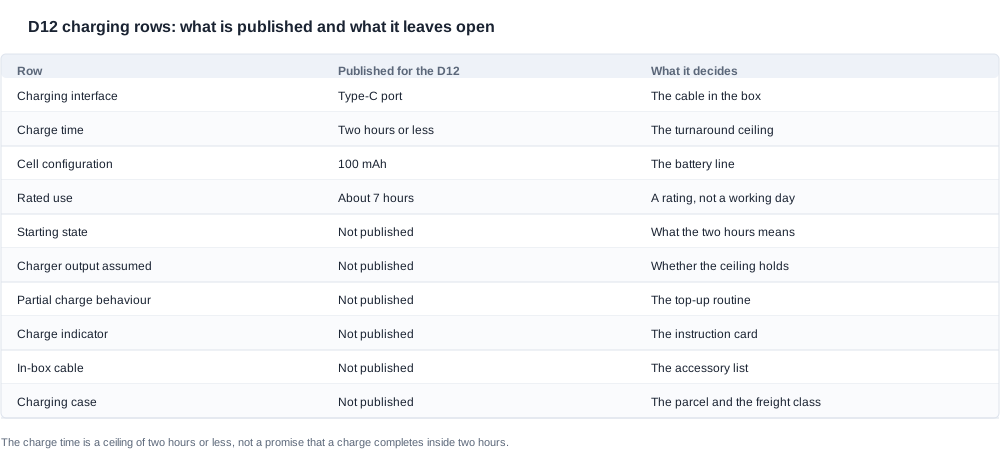
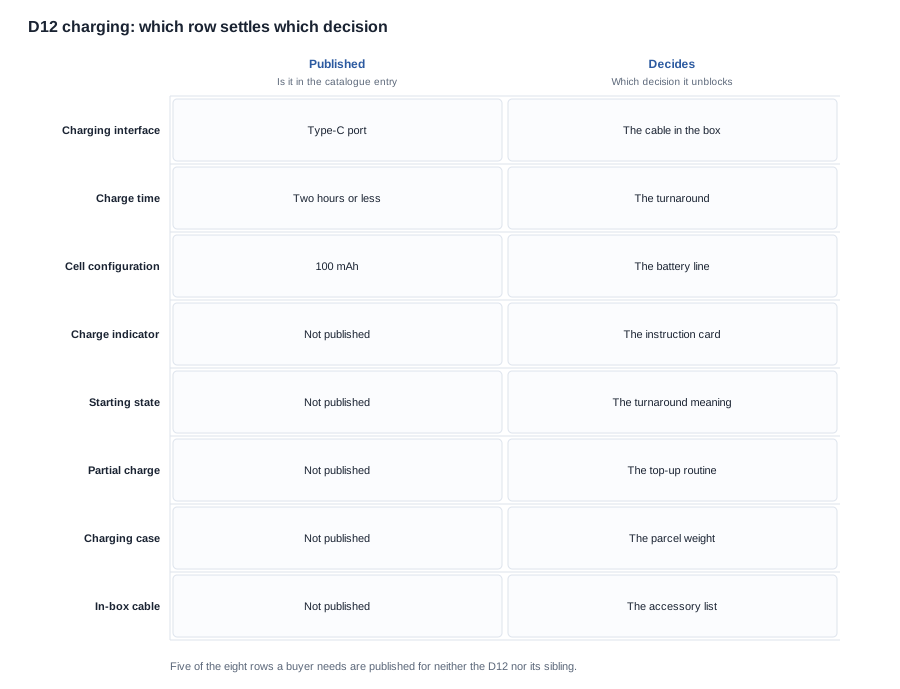
This page is for the buyer planning the accessory set, the parcel and the customer's daily routine around the D12. It separates the four published rows from the ten open ones, explains where the D12 sits between the magnetic and the Type-C models in the audio range, and sets out the questions to ask and the way to close them.
D12 charging options: the four published rows and what each one decides
Type-C charging. This is the row that matters most and the one buyers skim. A Type-C interface means the charging cable is not proprietary, which removes an entire category of field failure and makes a replacement cable something a customer can buy on any street. On a model whose cell is a modest 100 mAh, that portability is worth more than it would be on a larger frame, because the top-ups are going to happen away from a socket.
A charge time of two hours or less. This is a ceiling, and the distinction is not pedantic. A ceiling of two hours or less permits exactly two hours; it does not permit the stricter claim that a charge is completed inside two hours. The starting state is not published, so "from empty" and "from half-depleted" are different events, and the second one is the one that describes a customer topping up during a break.
A 100 mAh cell. One cell rather than the two-cell architecture published for several neighbouring models. The published figure is the cell value and the count, written as the catalogue writes it, and the arithmetic total of a two-cell configuration is a derived figure rather than a published one — which matters for how a comparison table should be built.
About seven hours of rated use. A rating with no test condition behind it. On an audio model the workload is a listening profile rather than a camera duty, but the question is the same one: what was connected and what was playing. The battery specification guidance covers the questions to ask before any endurance figure goes into a comparison chart.

Where the D12 sits between the magnetic and Type-C audio models
The eight audio models in this catalogue fall into three cell configurations, and the charging method lines up with them in a way that is easy to miss and useful to know.
The four models on a 55 mAh × 2 configuration charge magnetically, and so do the two models on a 90 mAh × 2 configuration. The two models on a 100 mAh cell — the D12 and its sibling — are the only audio models in the range that publish a Type-C interface.
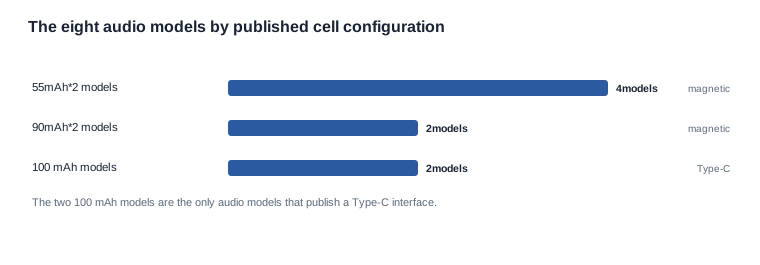
What that alignment tells a buyer. Within the audio range, the magnetic models all carry two cells and the Type-C models carry one. A magnetic interface needs a dock, a pad or a cradle, and a two-cell frame benefits from being able to charge both cells against a cradle without a second cable. A single-cell Type-C frame charges over one standard cable and needs nothing else in the box. So the choice a buyer is actually making is not between two charging styles; it is between an accessory-led charging routine and a cable-led one.
And it tells a buyer what the two 100 mAh models cost. The single-cell architecture means a smaller accessory footprint and a simpler instruction card, which reduces the accessory cost and the parcel weight. What it does not mean is a lighter frame — our catalogue publishes no frame weight for any audio model, so no weight comparison against the two-cell models is available from the published data.
The endurance figure follows the same grouping. The two-cell 55 mAh group publishes about six hours on two of its members and about eight hours on the other two, while the 100 mAh models publish about seven hours. These are different duty cycles and they are not interchangeable numbers, which is why the comparison method for battery life exists.
What the magnetic models in the range offer instead
A buyer who is weighing the D12 against a magnetically charging model is not choosing between two cables; they are choosing between two accessory strategies, and each has a real cost.
The magnetic argument. A dock or a cradle in the box is a deliberate charging ritual. The customer puts the frame on the cradle and it charges, which removes the need to find a socket and a cable in the right orientation. For a brand selling to a channel where the product is sold as an all-day item, that ritual is part of the proposition, because it is the thing the customer sees in the photograph and does at the desk. Two of the models in the 55 mAh group publish a detachable or slim temple, and one of them publishes a surround-sound row on a slim temple; the charging arrangement and the physical design are decided together in those configurations.
The Type-C argument. A standard cable removes a support category. There is no proprietary accessory to lose, no orientation to learn, and no replacement part to stock. For a channel selling into markets where the customer cannot easily obtain a proprietary dock, or where the product is bought for travel and used away from a desk, that is the more robust configuration — and it is the reason the D12's Type-C row is the first one a buyer should read rather than the last.
The cost the Type-C configuration passes on. A cable in the box is a consumable, not a durable. A cradle is a durable that stays on the desk. The customer-facing consequence is that the cable approach invites a support conversation about a lost lead, and the buyer has to decide whether that conversation is worth having at the volume they are planning.
The commercial consequence for the range. If a brand qualifies two models with different charging architectures, it qualifies two accessory families, two spare-parts policies and two sets of instruction cards — and it carries two sets of packaging artwork. If it qualifies two models on the same architecture, it carries one of each. That is a fixed-cost argument rather than a product argument, and it is often the one that decides the shortlist when the product arguments are otherwise level. The D12 versus G07 form factor comparison takes the pair of a 100 mAh Type-C model and a 55 mAh × 2 magnetic model through that comparison in detail.
The charging details a catalogue row does not answer
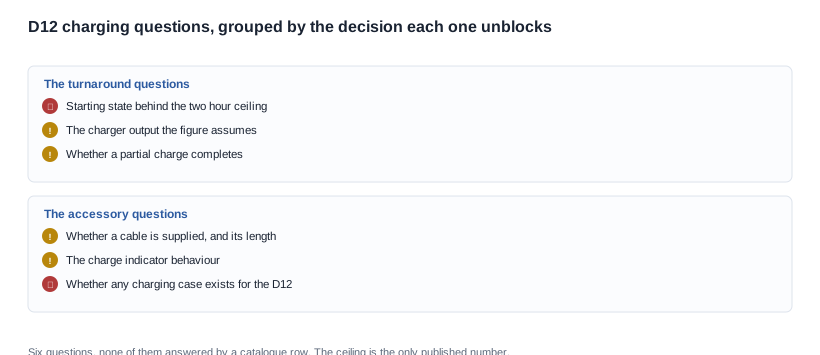
Ten items are missing from the D12's charging position, and they fall into three groups that a buyer should treat differently.
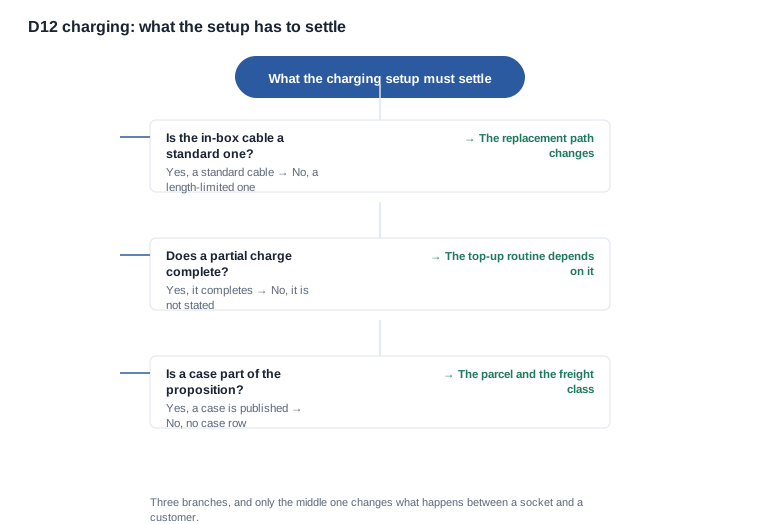
The turnaround group. What starting state the two-hour figure was measured from, what charger output the figure assumes, and whether a partial charge completes or has to run to completion first. The third is the commercially interesting one: if a partial charge completes, a customer can top up for ten minutes in a car and carry on; if it does not, the same customer has to find a socket for the full cycle or arrive with a dead product.
The accessory group. Whether a cable is supplied in the box and what length it is, whether the length is limited, and whether a charging case exists for this model at all. Our catalogue publishes no charging-case capacity for the D12, so the accessory set for a case-equipped package is an open item rather than a known one.
The indication group. How the frame shows its charge state, and what it does when the charge is interrupted. That is not a trivial detail on a product whose only published number is a ceiling: an indicator that a customer cannot read turns every "is it charged?" question into a support contact.
None of these is an unusual question and none is answered by a catalogue row. A supplier who answers them in one paragraph has done more for a buyer's planning than a supplier who sends a longer brochure.
The questions to put in one message, and how to judge the answers
Sending the open items as one request rather than as a sequence of follow-ups is what keeps a programme on schedule, and the request is short enough to be worth writing carefully.
- What starting state was the two-hour figure measured from, and what charger output was used? A figure without both of those cannot be compared with any other figure, including your own.
- Does a partial charge complete, and what does a ten-minute top-up deliver? Answer this in hours of use as well as in minutes of charge, because the customer only cares about the first number.
- What is supplied in the box — the cable, its length, its specification, and whether a case is available for this model?
- How does the frame show its charge state, and what happens if the charge is interrupted?
- Is there any charge-management or thermal behaviour documented for the 100 mAh cell?
- Does the answer apply to the configuration being ordered, and to which battery and which firmware?
How to judge the replies. A usable answer names the condition it was measured under. An unusable answer paraphrases the catalogue — "fast charging" tells a buyer nothing that "two hours or less from empty with a 5 V supply" does not. The second red flag is a reply that answers for the family rather than for the model designation; in this range the models share cell configurations and interfaces often enough that a family answer is plausible and frequently wrong. The third is a reply that gives a number with no unit of time attached to the workload, which is the usual way a rating turns into an accidental promise.
And one question worth asking that is not on the list. Ask what the supplier has measured on a sample unit that is not in the published documentation. Most factories measure more than they publish, and the gap between the two is usually where the useful operational detail sits — a partial-charge result, a measured indicator behaviour, an observed cable length tolerance. If the answer is that it has not been measured, you now know that it needs to be, and you know that before the first bulk order rather than after it.

What the absence of a charging case changes about the parcel
Because no charging-case capacity is published for the D12, the D12 is not automatically a two-lithium-cell shipment, and that is a commercial fact worth holding onto when it is compared with the camera models in the same catalogue — several of which do publish a case capacity of 1400 mAh or 1200 mAh.
What that saves. A second cell in every parcel means a second line in the battery transport documentation, a heavier carton, a different freight class and a different volumetric calculation. A single-cell, cable-charged product avoids all four. A buyer comparing a case-equipped model against the D12 on delivered cost is comparing two different logistics situations, and the second one is usually simpler than the first.
What it does not settle. Whether a case exists at all for the D12 is not published, so the accessory set is still an open question — it is simply that the published position does not point to a case, unlike the camera models where a case capacity is stated. Ask it as a question rather than assuming either way.
And what a case would change if one existed. The customer-facing proposition changes more than the parcel does. A case is what makes an all-day story possible on a product whose frame cell is modest, and it is the item a customer sees in a product photograph. A brand writing a product page for the D12 needs to know which of those two products it is describing, and that is a question for the factory rather than a decision the catalogue settles.

Planning a charging routine around a ceiling rather than a figure
The practical method for closing these questions is short, and it has the advantage of producing evidence that can be attached to a purchase order.
Ask for the charge time with its conditions, in writing. The starting state, the charger output assumed, the measured unit and whether the figure is a typical case or a worst case. A best-case figure is the one that gets quoted in a brochure and the mean is the one that generates the complaints, so ask which one you have been given.
Ask for the partial charge behaviour and what a short top-up delivers. "Thirty minutes from empty gives you enough for the first half of a shift" is a usable answer; "partial charging is supported" is not.
Ask what is supplied in the box. The cable, its length, its specification, and any case. This determines the accessory list, the customer instruction card and the spare-parts policy.
Then measure it on the sample unit. Run a full charge from empty and record the elapsed time and the charger used. Run a partial charge and record what a ten-minute top-up delivers. Note the indicator behaviour when the charge is interrupted. Record all of it with the conditions attached, because the same figure measured on a different charger is a different figure.
Finally, write the observed numbers into the specification with their conditions. A runtime and a charge time that carry their conditions survive being passed from the procurement desk to the quality desk to the customer-facing team. Numbers that travel without their conditions do not, and they are the numbers that end up in a returns argument.
And keep the ceiling as a ceiling. Plan against two hours, not against two hours and some change. A buyer who plans against a ceiling has slack in every direction; a buyer who plans against an average has none.
What the charging arrangement costs the customer, and what it costs the channel
The charging setup is also a support-cost decision, and it is the part most often left out of a business case because it sits between the product team and the after-sales team rather than inside either of them.
For the customer, a ceiling produces one specific complaint. "It did not last all day" is the complaint a rated figure without a condition eventually produces, and it arrives at the channel partner before it arrives at the brand. The defence against it is not a better product; it is a published condition attached to the figure, and a copy that says "about seven hours of rated use" rather than "seven hours of use". A buyer who publishes the rating as a rating converts a complaint about a broken promise into a question about a specification, and those two are handled very differently.
For the customer, a cable approach produces a different complaint. "The cable that came with it is too short" and "the cable stopped working" are both common in a channel that sells an accessory-led product alongside a cable-led one, and they are the reason the in-box cable specification matters. A buyer who learns the cable length after the artwork is printed has a packaging reprint; a buyer who asks for it in the same message as the charge-time conditions has a carton that says the right thing.
For the channel, the accessory decision changes the returns profile. A product that ships with a proprietary dock generates returns when the dock is lost, because the product is unusable without it. A product that ships with a standard cable generates returns when the customer buys a replacement of the wrong kind, which is a smaller problem because the replacement is obtainable. Neither is free, but the second is one the customer can solve themselves.
And for the buyer, the charge time sets the replenishment schedule. Two hours or less from empty means a frame charged overnight is ready for the next working day, and that is the assumption most channels make. It also means a frame used across a split shift has to find a socket in the middle of it, because a ceiling of two hours does not fit into a break. A buyer planning a shift-based programme needs to know whether the customer charges between shifts, and that is a question about the routine rather than about the specification.
Where our D12 position on charging sits
We publish the D12's charging rows as they appear in our documentation: a Type-C interface, a charge time of two hours or less, a 100 mAh cell and a rated use of about seven hours. We will not present the ceiling as a promise that a charge completes inside two hours, we will not publish a charge time from a starting state the manufacturer has not documented, and we will not present a partial-charge behaviour as standard when it has not been stated.
We also will not publish a frame weight for this model. Our catalogue publishes no weight for any audio model, and we will not substitute a cell-configuration inference for a measurement — a single 100 mAh cell suggests a lighter assembly than a two-cell frame, and "suggests" is as far as the documentation goes. And we will not describe the D12's audio characteristics, because it publishes no acoustic descriptor and no acoustic figures at all; the absence of a surround-sound row on this model is a fact about the catalogue, not a measurement of how it sounds.
The sample evaluation guidance covers how to run a sample stage properly before a bulk order, the certification coverage page covers the paperwork that travels with the goods, and the D12 specification reference is the row-level baseline for this model.
Related reading
- Getting a sample evaluated before a bulk order — sample evaluation
- Certification position for this platform — certification coverage
- Bluetooth audio glasses range overview — bluetooth audio glasses
Send the target market and quantity and we will come back with what is documented and what still needs confirming.


