

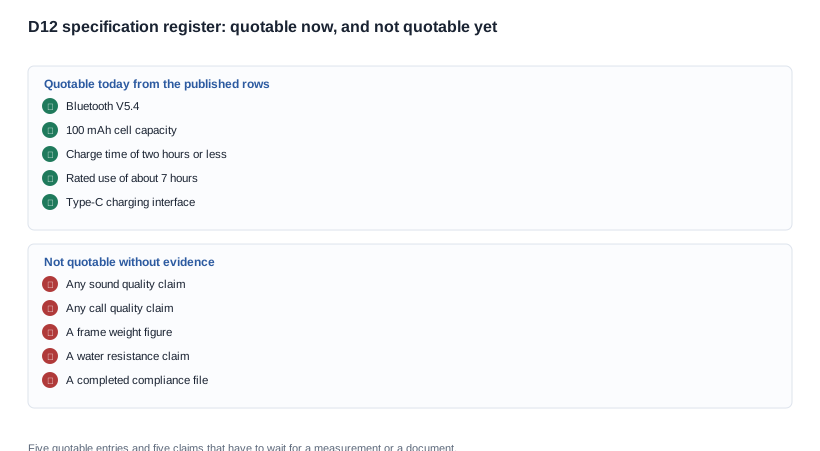
The D12 smart glasses specifications and features list runs to five published rows: Bluetooth V5.4, a 100 mAh cell, a charge time of two hours or less, about seven hours of rated use, and Type-C charging. Five further entries a buyer would reasonably expect are absent — acoustic detail, microphone pickup, frame weight, ingress protection and certification numbers. This page is that list, with an explanation of what each absence stops you claiming.
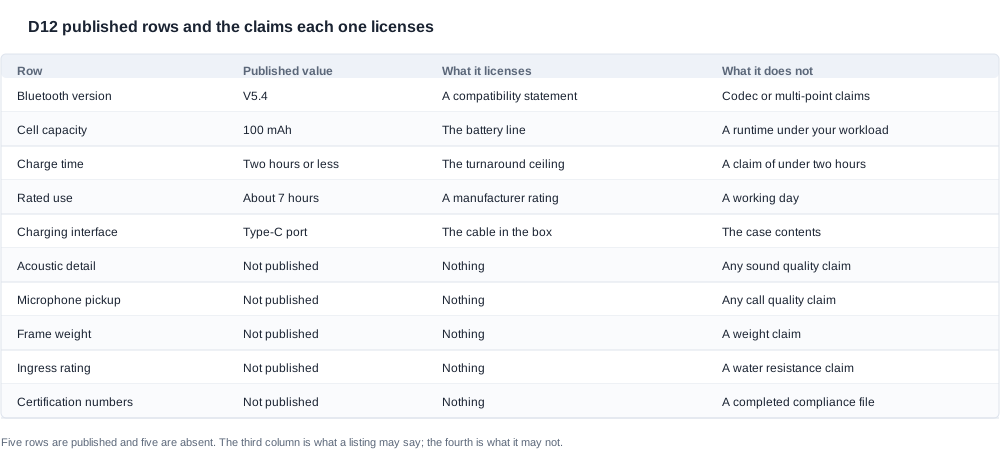
The framing that makes the list usable is the third column below. A published row does not describe the product; it licenses a specific claim and forbids several others. A specification sheet that records only the values is half a document, and the half that causes disputes.
D12 smart glasses specifications and features: the five rows that exist
Bluetooth V5.4 places the D12 at the current radio generation. It supports a compatibility statement and a pairing expectation, and it is the row from which a support script can be written rather than sourced. It does not establish codec support, connection stability or multi-point behaviour, and none of those is published for this model or for any other. The Bluetooth connectivity guidance sets out what a radio version does and does not settle.
A 100 mAh cell is a single-cell configuration, and it sits in the middle of what our catalogue publishes. It matches the D11 in the same audio group and the ZH12 in the sport group; it sits above the 55mAh2 configurations published by the LC-105 pair, the G07 and the YK12; and it sits below the 90mAh2 configurations published by the K01 and the K02, the 115 mAh cell of the D17 and the 200 mAh cell of the bone-conduction model. The comparison is only meaningful within the audio models, because a cell in a camera product does different work.
Note the form the catalogue uses. It publishes a cell value together with a count, so the two-cell models are written as 55mAh2 or 90mAh2 rather than as a total. The totals are derived values, and a table that mixes the published form with a bare total makes the derived number read as an official figure.
A charge time of two hours or less means an overnight charge is sufficient for a product in daily use. It is also the figure that separates the mainstream audio models from the sport-category models, where the D17 and the ZH12 publish roughly one hour. If turnaround matters to your channel, that is the row to compare on — and note that it is a ceiling, which permits exactly two hours and not a stricter bound.
About seven hours of rated use is the commercially important figure and the least specified. No test condition is published, so it is a manufacturer rating rather than a measurement of a working day. For an audio-only product the spread across conditions is narrower than it is for a camera model, but the duty cycle still moves the result: a device streaming at volume does not reach the figure that one used intermittently does. Our treatment of this is in the battery life guidance.
Type-C charging is stated explicitly, which removes an accessory question and a packaging question in one line.
How the cell configuration changes what you can compare
The published cell value is a number, and the number is not the whole of what the cell row tells you, because the catalogue publishes the cell value together with a count. Two things follow from that, and both of them change how a buyer should read a comparison.
The first is that a raw capacity comparison is not a runtime comparison. A 55mAh*2 configuration and a 100 mAh single cell are not two points on one scale; they are two different architectures with different charge management, different peak loads and different discharge behaviour. Putting them in a single ascending bar chart and calling the longest bar the best product would be a mistake of method, not of arithmetic.
The second is that the endurance column and the capacity column disagree, and the disagreement is informative. The 55mAh2 group publishes about eight hours on the LC-105 pair and about six hours on the G07 and the YK12, the 90mAh2 models publish about eight hours, and the 100 mAh models publish about seven. A capacity ranking would put the 55mAh*2 models at the bottom and the runtime column puts two of them at the top. The only honest reading is that the ratings were taken under different duty cycles and different protocols, and that is why the method for comparing battery life insists on the condition before the number.
What a buyer should write on the sheet instead. Record the published form in the capacity column, the published rating in the endurance column, and a third column that names the duty cycle each rating was measured under — once it is known. A sheet with three columns can be compared honestly; a sheet with two cannot, because the two columns are not on the same axis.
And the practical consequence for the D12 specifically. A single-cell configuration means the frame charges over one standard cable with nothing else in the box, so the accessory chain and the parcel are both simpler than on any of the magnetically charging models. That is a published consequence and it is worth more in a delivered-cost model than the endurance difference is. The D12 charging options page takes that decision in detail.
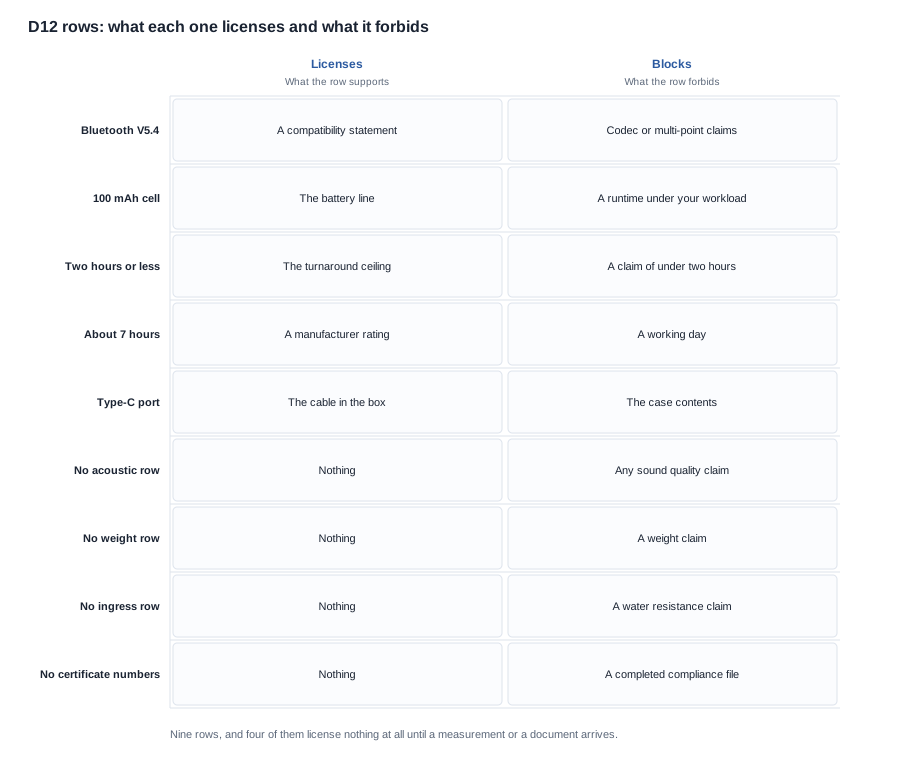
What each published D12 row licenses and what it forbids
This is the part of a specification sheet that pays for itself, and it is the part most sheets leave out.
The Bluetooth row licenses a compatibility statement and forbids codec claims, connection-quality claims and multi-point claims. A brand that writes "Bluetooth 5.4" on a product page is on solid ground. A brand that writes "stable multi-point connection" is not, because nothing in the documentation supports it.
The cell row licenses the battery line and forbids a runtime under a specific workload. "100 mAh" is quotable; "eight hours of playback" is not, even though the rated figure is about seven.
The charge row licenses the turnaround ceiling and forbids the stricter phrasing. "Two hours or less" is quotable; "fully charged in under two hours" is a different assertion and it is not what the catalogue says.
The runtime row licenses a rating and forbids a working-day claim. This is the row that gets stretched most often in copy, and the stretching is usually done by a well-meaning copywriter who reads "about 7 hours" and writes "all day".
The charging row licenses the cable and forbids the case contents. Type-C tells you what goes in the box; it does not tell you whether a case is available, what it holds or what the parcel weighs.
And the D12's row does not license a feature claim of any kind. The model publishes no acoustic descriptor and no camera module, so the feature side of the specification is empty, and any feature language in a listing has to come from somewhere other than this catalogue.
The five D12 absences and the claim each one blocks
No acoustic detail. Without a driver size, a frequency response or a leakage figure, no sound quality claim is available — and this model carries no named acoustic feature either, so there is not even a feature label to quote. The open-ear design context is in open-ear audio technology.
No microphone pickup distance. No call quality claim is available, and for open-ear designs the call is where customer criticism tends to land. The gaps are covered in noise control and microphone pickup.
No frame weight. No weight claim, and no way to pre-screen sizing before sampling. This is the single row most closely tied to returns in eyewear, and it is also the cheapest to close — three sample units and a scale.
No ingress rating. No durability claim. Some models in this catalogue carry an IP54 marking without a report number; this one carries no marking at all, so there is nothing to describe even as a marking.
No certification numbers. Our catalogue's text contains no reference to CE, FCC or RoHS anywhere, and there is no per-model certification row for the D12 or for any other model. Without a number, an issuing body, a validity date and a model coverage list, no retailer or marketplace compliance file can be completed. The certification checklist covers what to request, and the D12 certification status page sets out the position in full.
Closing the absences: which route each one takes
The five absences do not all close the same way, and a buyer who treats them as one list will spend the programme's effort in the wrong order.
Two of them close with a measurement on a sample unit. The frame weight and the frame dimensions come from the same three units in the same session, so one handling event closes both, and the cost is an afternoon rather than a correspondence. These are the two that block decisions rather than descriptions, which is why they should be first.
Two of them close with a written reply. The acoustic detail and the microphone pickup distance are measurements the factory has taken and has not published; a request with the right wording — driver size, frequency response band, leakage figure, microphone pickup distance — usually returns a number rather than a description. What comes back is often a bare figure without a condition, so the follow-up is to ask for the measurement method as well as the result.
One of them closes with a formal file. The certification position is a matter of documents and their scope, not of measurement, and it carries the longest timeline of anything on the sheet. It also cannot be compressed by a more urgent email, which is the reason to start it in the first week rather than the last.
And the order in which they close is not the order in which they were noticed. Nobody asks about the acoustic detail until a copywriter needs it, and nobody asks about the weight until the parcel is being costed — which is after the artwork, which is after the packaging specification, which is after the accessory list. Pulling the weight forward costs nothing and prevents a reprint.
One practical point on closing them together. Where a request covers several items, ask for the answers tied to the model designation. In this range that matters more than usual: the D12 and the D11 publish identical electrical rows, and several models in the 55mAh*2 group share a configuration with each other. A reply that answers for the family is not wrong so much as unusable, and it is easy to mistake for an answer.
Turning the D12 rows into a specification sheet a quality team can accept
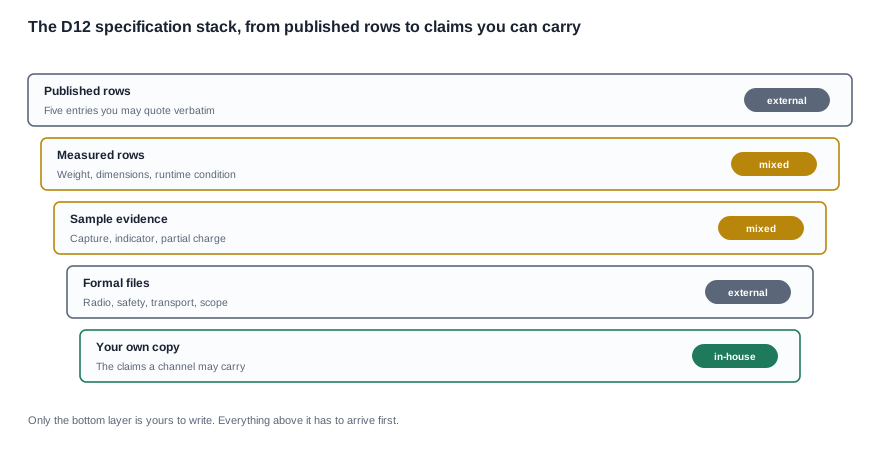
A specification sheet that records values is a document a supplier can quote against. A specification sheet that records values, conditions, evidence and exclusions is a document a quality team can accept, and it is the second one that prevents a dispute.
Every published row becomes a line with three parts. The value as the catalogue states it, the condition it was measured or specified under, and the verification method. The cell becomes "100 mAh, as published, verified against the supplier's bill of materials line". The charge time becomes "two hours or less, from the stated starting state, verified on the sample unit". The runtime becomes "about seven hours of rated use under the workload defined in the acceptance criteria".
Every absent row becomes a line with four parts. The row named, the claim it blocks, the evidence that would close it, and the owner with a date. "Frame weight — blocks any weight claim — measured on three units from the first shipment — procurement, before the purchase order." That line is a task, and a task on a specification sheet is a thing that gets closed.
Every forbidden claim is written down as forbidden. A short section that lists the claims this product may not carry: no sound quality claim, no call quality claim, no water resistance claim, no working-day claim, no compliance file until the documents arrive. It is the shortest section on the sheet and the one that prevents the most trouble, because it stops a claim being reintroduced by a copywriter or a channel partner who has never seen the specification.

Where the D12 sits between the mainstream and the sport audio models
Against the D11, the position is exact: the same cell, the same charge ceiling, the same rated runtime, the same radio version and the same interface, with the D11 publishing an acoustic descriptor and the D12 publishing none. That is the only published difference, and it is the axis on which the two can be separated.
Against the LC-105 series, the D12 publishes a single larger cell against a paired smaller configuration, and about seven hours against about eight — two figures produced under different duty cycles, which the D12 versus G07 form factor comparison examines in detail.
Against the sport-category audio models, the D12 publishes Type-C at two hours or less where the D17 and the ZH12 publish Type-C at roughly one hour, and it publishes a radio version and a cell configuration that a shopper is more likely to compare on a spec sheet than on a feature list.
So the D12 is a mainstream audio platform with a current radio and a standard interface. That is a coherent position for a volume product, and it is worth describing to your channel in those terms rather than as a premium one — a claim the published rows support, in a way that a premium framing would not.

How to evaluate the answers against the sheet
Once the replies and the measurements come back, the sheet has to be judged against criteria rather than absorbed. These are the criteria for the D12, and they are the same shape as the criteria for any model in this range.
- How to evaluate a weight answer: a figure in grams with the cell fitted and the case excluded, the number of units measured, and the spread across them.
- How to evaluate a dimensions answer: frame width, lens width and height, bridge and temple length, plus the temple's adjustment range if the temple adjusts.
- How to evaluate an acoustic answer: the driver size, the frequency response band and the leakage figure, each with the measurement method stated rather than the result alone.
- How to evaluate a microphone answer: the pickup distance and the noise conditions, since a pickup distance without a noise figure is not a usable number.
- How to evaluate a runtime answer: the workload, the volume, the codec and whether the radio was connected, with the figure given as a mean rather than a best case.
- How to evaluate a certification answer: the market, the document, the issue date and the model designations covered.
The red flags are the same across all six. An answer given for the family rather than for the model designation, a figure with no date, a best case offered where a mean was needed, and a certification answer naming a sibling model. A further sign worth naming is a result with no measurement method: a leakage figure without the frequency at which it was taken, or a pickup distance without the noise condition, is a number that cannot be repeated by a quality team, and it cannot be written into an acceptance criterion.
And the last step is the one that gets skipped. A row that has been answered still has to be carried into the sheet in the right form — value, condition, verification method — and into the purchase order as an acceptance criterion. An answered question that never reaches the agreement is an open question with better manners, and it comes back at the point where it costs the most to fix: the first shipment, the first quality claim, or the first listing that a customer has already bought against.
Where our D12 position on the published rows sits
The D12's published rows are sufficient for a functional product listing and insufficient for a performance one. We will publish the five rows and name the five absences, because a buyer who builds a listing on the first list and discovers the second at retail has a problem they could have avoided.
We will also not borrow a feature from a neighbouring model. The D11 publishes a surround-sound row and the D12 does not, and the reason a buyer should know that is precisely so the row is not carried across in a listing. We will not quote a weight, a frame dimension, an ingress rating, an acoustic figure or a certificate number that our documentation does not contain, and we will not present the company-level export certification page as a model-level certification claim.
Tell us the channel and the market and we will tell you what this model can carry in a listing, and what you would need from us before you can carry more.
Related reading
- The audio range this model belongs to — Bluetooth audio glasses
- What the audio models do not disclose — noise control and microphone pickup
- Why the runtime figure needs a condition — smart glasses battery life
Share the target market, the quantity and the required configuration, and we will come back with what is available and what is not.


