

The D12 publishes Bluetooth V5.4, a 100 mAh cell, a charge time of two hours or less, about seven hours of rated use and Type-C charging. It publishes no feature row at all. So the value case for this model is built on removing variables from your packaging and logistics rather than on adding anything a customer can see — and on three commercial terms that our catalogue does not publish.
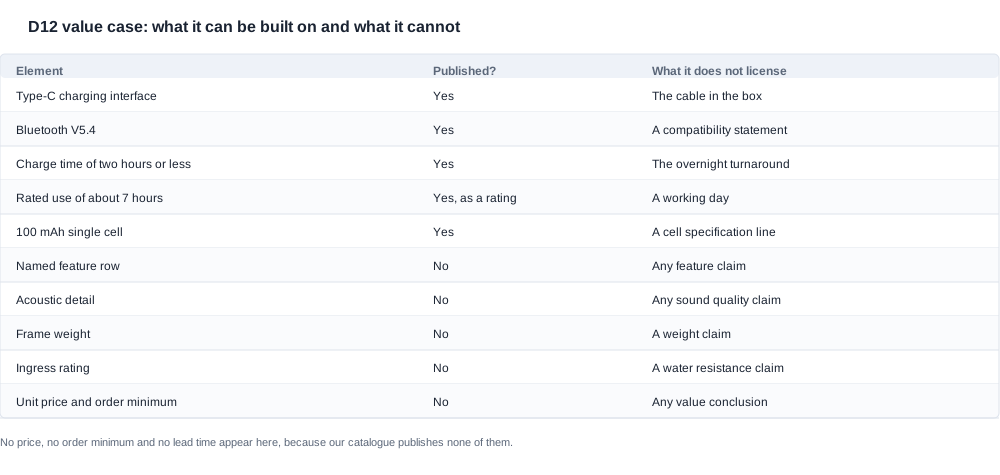
We publish no unit price, no order minimum and no lead time for this model or any other, so we cannot tell you whether it is good value. What we can do is tell you which rows the value argument can stand on, which claims it cannot carry, and which three inputs you have to obtain before the question can be answered at all.
D12 smart glasses value for money: the two published rows that carry the argument
Type-C is stated. That is more than most models in this range offer, and it removes three separate unknowns at once: the in-box cable, the accessory set and the carton specification. In a category where most rows are absences, removing a variable is worth more than adding a specification.
V5.4 is current. It supports a compatibility statement, which is a real and checkable claim even though it is not a performance one. The Bluetooth connectivity guidance sets out what a published radio version does and does not settle.
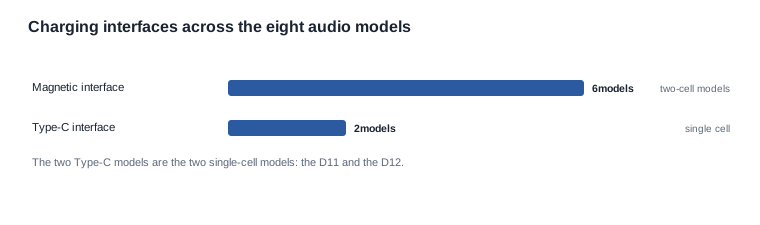
And the cell configuration is published too. A single 100 mAh cell, which across the audio range is the configuration that goes with a Type-C interface. The chart below shows the alignment: six of the eight audio models publish magnetic charging and all six are two-cell configurations, while the two models that publish Type-C are the two single-cell ones. That alignment is not decorative — it is why the D12's parcel and accessory chain are simpler than those of any magnetically charging model in the range.
Together these three rows are why the D12 suits a channel whose operations are already settled, and why it is the wrong model for a channel whose proposition is a named feature.
Why removing a variable is worth more than adding a specification
The instinct in this category is to chase the model with the most published rows. That instinct is usually wrong, because a published row only gives you something to write, while an absent row gives you something to design around.
A variable you have removed is worth more than a specification you have gained. When the charging interface is published, the accessory list, the carton specification and the customer instruction card can all be finalised, and the freight model can be built on a known configuration rather than on a guess. When the interface is absent, all four of those stay open, and each of them is a task with an owner rather than a line to be copied.
The same logic applies to the cell configuration. A published single-cell arrangement tells a buyer that one standard cable is the whole accessory story, and that the parcel does not carry a second lithium cell unless a case is added. That single row removes the need to model a case, price a case and document a case — and on the audio range, where six of the eight models are two-cell arrangements, it is the difference between a simple carton and an accessory-led one.
What a feature row actually buys is narrower than it looks. A named feature gives a listing a line of copy. It does not give a buyer a cheaper parcel, a simpler carton, a shorter accessory list or a lower documentation load. In a category where several models publish a feature name and none of them publishes an acoustic measurement, the feature name is the only row that is doing any work, and it is doing marketing work rather than an engineering one.
So the value ranking is not the specification ranking. A model with more published rows is not necessarily cheaper to run, and a model with fewer rows may be considerably cheaper to run if what it publishes removes a variable. The D12 is a case in point: five thin rows that remove an accessory, a cell and a carton question is worth more to a channel buyer than a model with eight rows that leaves the same four unknowns open.
And the test to apply before a shortlist is written. For each candidate, count the questions that close themselves against the questions that stay open. A model that closes one variable and opens nothing is a better operational proposition than a model that publishes two more marketing rows and still leaves the accessory set, the weight and the certification scope unresolved. That count is a structural fact from the catalogue, and it is available before a single quotation is requested.

Where the value case weakens, and which of those weakenings matter
No feature row at all. The D12 publishes no acoustic descriptor, no temple descriptor and no colour list. Compare the rest of the range: the D11 and the ZH12 publish an acoustic row, the G07 publishes a detachable temple, the YK12 publishes a surround-sound row on a slim temple. If your channel differentiates on a named feature, this model does not give you one, and no amount of listing work will manufacture it.
One point worth correcting, because it is quoted often in this category: our catalogue publishes no capacitive touch row for any model, including the K01. Touch behaviour on a temple has to come from the supplier. That is worth knowing before a feature list is built around it.
Mid-range rated runtime. About seven hours sits below the K01, the K02 and the LC-105 pair at about eight. And no test condition accompanies any of those figures, so none of them compares cleanly with another. The battery life guidance explains why, and it is the reason a value argument cannot be built on the runtime column.
And the absence of a published frame weight cuts both ways. It stops a weight-based claim, and it also means the freight class of every shipped unit is an assumption rather than a figure.
Which of those three weakenings actually matters depends on the brief. A channel selling on convenience and shipping speed is barely affected by any of them. A channel selling on sound quality is ruled out by the first, and a channel with an optical distribution model is blocked by the third until the weight is measured. That is why the value question cannot be answered in the abstract, and why the branches below are the useful form of it.
The delivered-cost lines a buyer can see without a price
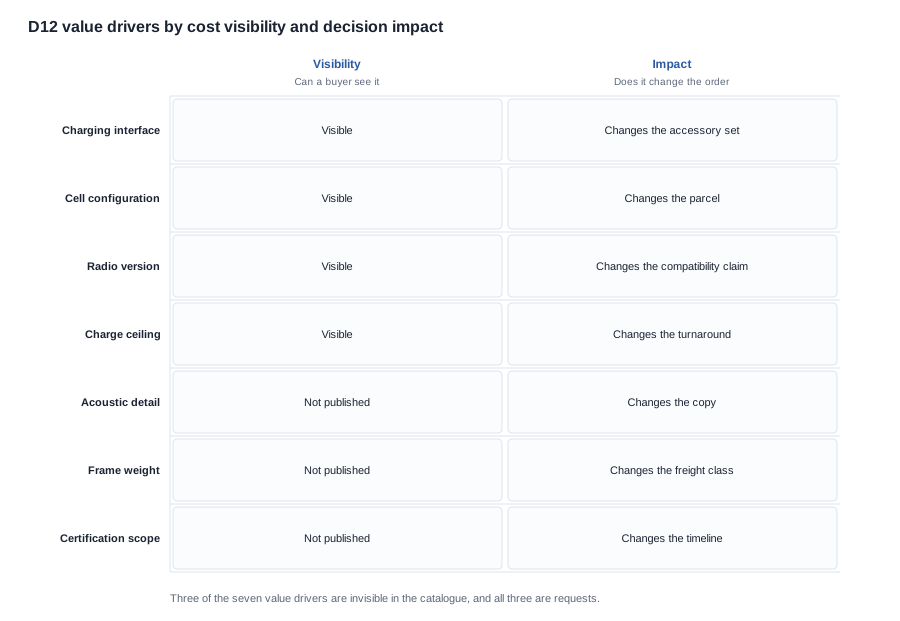
Even with no price published, the published rows are enough to build the skeleton of a delivered-cost model, and a skeleton is worth more than an estimate because it tells you which measurements to prioritise.
The lines the D12's rows let you write. The frame, on a 100 mAh single-cell configuration with no camera module published for this model. The accessory, on a Type-C interface with a standard cable. The carton, on a small box with no second lithium cell. The transport documentation, on a single-cell file. The charge turnaround, on a ceiling of two hours or less, which means an overnight charge is sufficient and the schedule does not need a mid-day socket.
The lines that stay as placeholders until the four inputs arrive. The frame weight, which determines the packed weight and therefore the freight class. The unit price and the order minimum, which together give the effective cost per unit. The lead time, which determines whether stock has to be held. And the certification scope, which sits outside the product and is the one line that cannot be compressed by ordering more units.
The arithmetic that makes the placeholder a priority. The freight class is a step function, not a curve. A packed weight that sits just below a threshold and a packed weight that sits just above it can fall into different freight classes, and the difference between those two classes is larger than most of the other cost lines in the model. That is why the weight measurement is worth doing before the carton is designed and not after, and it is the reason the shipping weight analysis exists.
And the step function applies to the battery paperwork too. A second lithium cell in every parcel changes the transport documentation and, depending on the shipping configuration, the way the consignment has to be declared. The D12's published single-cell configuration is the reason that line is simple — which is a saving that belongs in the model even though no price attaches to it yet.
What a skeleton gives you that a quote does not. A quotation gives you one configuration's numbers. A skeleton gives you the shape of the cost for every configuration you are considering, and it tells you which two numbers are worth the effort of measuring. That is the practical output of this section: the D12's delivered cost has six lines, four of them already known, one of them needing a scale, and one of them needing a factory.
The four claims a D12 listing cannot support
No acoustic detail, so no sound quality claim — and no named acoustic feature to quote in place of one. The open-ear audio guidance sets out what to ask for and what to measure.
No microphone pickup distance, so no call quality claim, and for open-ear designs the call is where customer criticism tends to land.
No frame weight, so no weight claim and no way to pre-screen sizing before sampling.
No ingress rating and no certification numbers, so no durability claim and no completed compliance file. Our catalogue's text contains no reference to CE, FCC or RoHS anywhere, and there is no per-model certification row for this model, so the file has to be requested rather than transcribed. The certification checklist covers the request, and the D12 certification status page sets out the position in full.
Those four absences are shared across most of the audio range, so they do not disqualify the D12 on their own — they define what a listing for it can say. What they do mean is that the D12's listing is narrower than a magnetically charging model's with a published feature, and the comparison a buyer makes is between two narrower listings rather than against a better product.

The three unpublished inputs a value case actually requires
This is where most of the work of a value assessment sits, and it is entirely outside the catalogue.
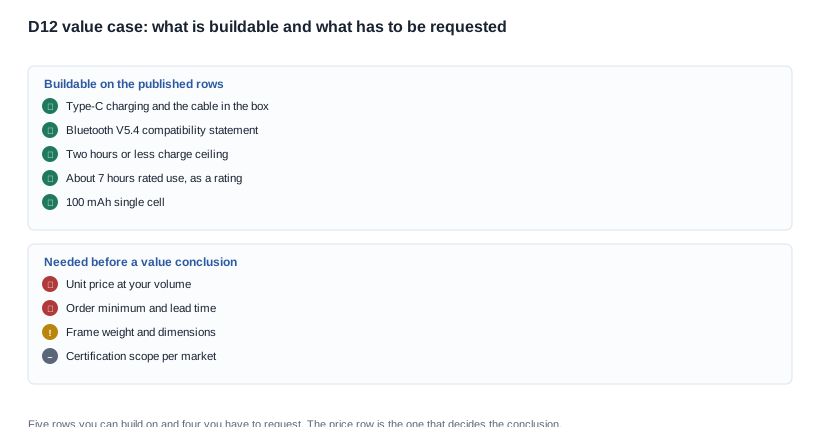
The unit price at your volume. Not published, and never a single number in any case — it is a price at each quantity break. A quotation without the break attached is not yet a price.
The order minimum. Not published, and this is usually the single largest driver of the effective unit price. Two products with identical published rows routinely sit at different prices for exactly this reason: one carries a lower order minimum, so it costs more per unit at the quantity you are actually buying. The wholesale context is where that arithmetic is usually worked through.
The lead time and the production capacity behind it. Not published. A shorter committed lead time is worth real money to a channel buyer because it is the difference between holding stock and replenishing against demand.
**And the certification scope, which is the fourth input even though it is not a price term.The catalogue carries a single company-level export certification page and it holds images rather than text, its text mentions no conformity marking of any kind, and there is no per-model row for any model. A two-model range can therefore require two sets of evidence where a one-model range requires one, and that is a cost line a buyer should have in the model before the order rather than after it. The OEM ready platforms page is where the surrounding commercial structure is set out.
How to obtain them. One request, four items, one message, addressed to the model designation and naming the quantity breaks you want. Ask for the answers as a table rather than as prose, because a table of four terms for one model is a document that a finance reviewer can read, and because a family-level answer is easy to spot in a table and easy to miss in a paragraph.
How to build the comparison once the four inputs arrive
The four inputs turn the assessment from a description into a comparison, and the comparison is worth structuring rather than improvising, because the structure is what makes it repeatable for the next model and the next range.
Put the inputs in the same order for every candidate. Price at each quantity break, order minimum, committed lead time, certification scope. Four rows, one column per candidate, every cell carrying a source and a date. A comparison that is built in the same shape every time can be extended to the next model without being rebuilt, which matters when the range is going to grow rather than stay at two lines.
Compute the effective unit price, not the quoted one. The effective figure is the price at the quantity you are actually buying, adjusted for the order minimum, the freight class and the certification scope. This is the only number that should appear in a business case, and it is the number most often skipped because each of its inputs sits in a different document.
Record the certification scope as a line, not as a footnote. It is a cost with a timeline attached, it does not scale with volume in the way the unit price does, and a two-model range can double it. Putting it in the comparison rather than below it is what keeps a range decision honest.
And mark the inputs you could not obtain. A blank cell in a comparison table reads as zero, which is how a certification scope or a lead time quietly disappears from a business case. Mark it "not provided" with the date you asked, so that the gap is visible to whoever reviews the model later.
The result is a defensible answer to a question the catalogue cannot answer. On the published rows alone, the D12 is the operational choice: a stated interface, a current radio, a single cell and no feature claim to defend. Whether it is the right commercial choice depends on the four inputs, and once those arrive the answer is arithmetic rather than opinion.

How we would position it
Sell the interface, the radio generation and the overnight charge. Do not sell sound quality, ergonomics or durability, because no figure exists for any of them, and do not sell the runtime as a working day.
Against the D11 the difference is the acoustic descriptor; against the D17 and the ZH12 it is the roughly one-hour charge instead of two hours or less, and the different category; against the K01 and the K02 it is a single cell and a standard cable rather than a two-cell magnetic arrangement. None of those comparisons requires a price, and all of them are traceable to a published row.
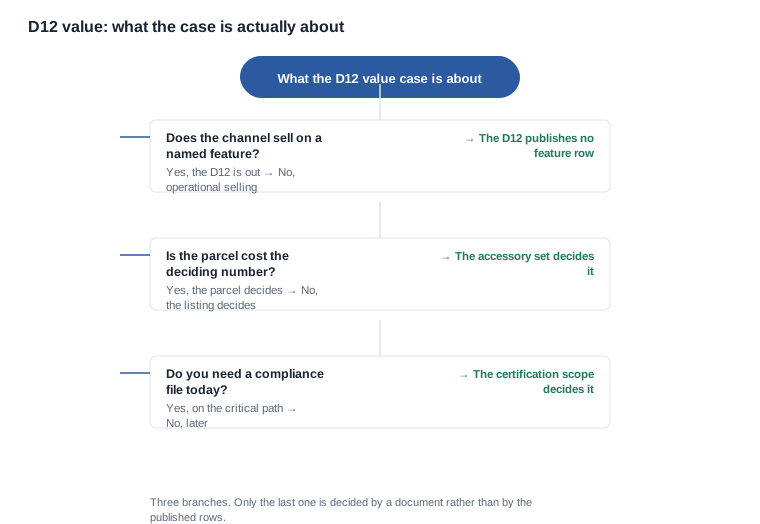
And the branch structure, for a buyer who wants a single answer. If the channel sells on a named feature, the D12 is out and the range guide is the place to look. If the parcel cost per delivered unit is the deciding number, the D12's single-cell cable arrangement is the stronger position, and the weight measurement closes the freight question. If a compliance file is needed today, then no model in this range can supply one from a catalogue and the timeline is a separate decision from the product one.
A shortlist test: is the D12 right for this brief
Four questions decide it, and they are worth answering in order, because each one eliminates.
Does the listing need a named feature? If yes, the D12 is eliminated at the first question, because it publishes no acoustic descriptor and no other feature row. There is no wording that gets round this one.
Does the customer need to be able to replace a charging cable? If yes, the D12's Type-C arrangement is the better answer than any magnetically charging model in the range, because the cable is replaceable anywhere and no dock has to be stocked or returned. If the proposition is a dock-led routine at the desk, the magnetically charging models serve it better and the D12 is eliminated on the second question.
Does the brief need a rated endurance figure of about eight hours? If yes, the D12 does not meet it on the published row, and the question becomes whether a measured figure closes the gap. If the brief is convenience rather than endurance, the rated seven hours is enough and the D12 stays in.
Does the range need two models, and can it say why? If the two are a volume model and a feature model, the D12 can only be the volume one, and the feature model has to come from elsewhere. If the two are the same product in two configurations, the decision is a terms decision rather than a specification one, and the four inputs decide it.
The signs that the D12 is the wrong model are worth naming as well, because they are easy to miss in a shortlist meeting. A listing plan whose copy needs an audio claim. A programme that depends on the customer charging at a desk rather than from a cable. A range plan that needs a feature ladder and only has two models in it. And a business case that carries a price but no order minimum, because the effective price has not actually been calculated yet.
Where our D12 position on value sits
This is a functional model suited to a channel selling on operational simplicity, and we would rather it be listed that way than positioned as a feature product it is not. No price is published, so we cannot tell you whether it is good value — only what it can carry and what it costs to carry it.
We will not present the D12 as having a feature, because it publishes no acoustic descriptor and no other feature row. We will not present the seven hours as a working day. We will not quote a weight, an ingress rating or a certificate number that our documentation does not contain, and we will not present the company-level export certification page as a model-level compliance file.
Tell us your channel, your interface standard and your volume and we will narrow this to one model and tell you which of the four inputs above still have to be closed.
Related reading
- Where this model sits in the audio range — Bluetooth audio glasses
- The specification for this model — D12 specifications
- Why runtime figures do not compare — smart glasses battery life
We need the target market, the quantity and the required configuration, and we will come back with what is available and what is not.


